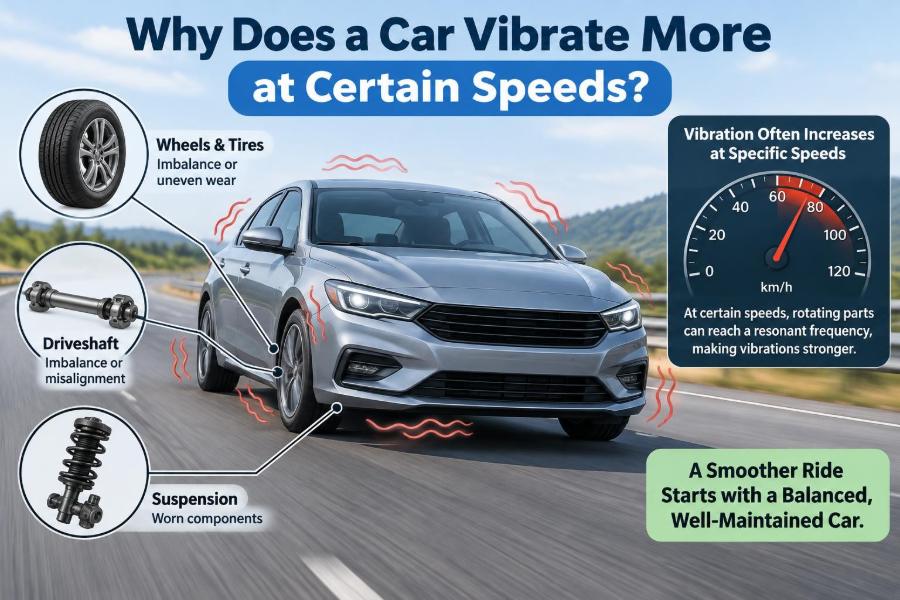

You are driving along a familiar road when the steering wheel begins to tremble at about 80 km/h. Slow down, and it fades away. Accelerate past that point, and the car may feel smoother again. The experience can be puzzling because the vehicle is not vibrating equally at every speed.
Sometimes the shake is felt through the steering wheel; sometimes through the seat, floor, pedals, or even the rear-view mirror. A vibration may be a minor comfort issue, but it can also be the first visible symptom of a wheel, tyre, brake, driveline, engine, or suspension problem.
The speed at which a vibration appears is one of the most useful diagnostic clues. It tells us something about the frequency of the rotating or moving component that is exciting the vehicle structure.
Understanding the pattern helps drivers describe the fault accurately and helps engineering students connect vibration theory with a real automotive system.
🚘 Vibration Is Motion Repeated Over Time
A vibration is an oscillating motion around a position of rest. In a car, it may be a small up-and-down movement, side-to-side shake, twisting motion, or a repeated force transmitted through components.
Every vehicle produces some vibration. Tyres roll over textured roads, engine cylinders fire, gears mesh, and shafts rotate. The aim of automotive design is not to eliminate all movement, but to keep it below levels that affect comfort, control, durability, or safety.
A noticeable vibration means the force has become large enough, or is being transmitted efficiently enough, for occupants to feel it.
📈 Speed Changes the Frequency of Excitation
As vehicle speed rises, wheels, driveshafts, and many other rotating parts turn faster. Their vibration frequency therefore increases. A tyre with a slight irregularity may give the suspension one disturbance per wheel revolution; at a higher road speed, those disturbances arrive more often.
For a rotating part, frequency is related to rotational speed:
frequency (Hz) = rotational speed (rpm) / 60
The actual road speed corresponding to a given wheel speed depends on effective rolling radius. That radius changes slightly with tyre size, inflation pressure, load, and tyre construction, so a diagnosis should use speed bands rather than assume one exact value.
🎵 Why a Specific Speed Can Feel Worse
The crucial reason is often resonance. Every elastic system has one or more natural frequencies at which it prefers to vibrate. A simplified example is a ruler clamped to a desk: flick it, and it bends at a characteristic rate.
A vehicle contains many flexible systems: tyres, springs, bushes, body panels, steering linkages, exhaust mounts, engine mounts, seats, and the body structure itself. When an excitation frequency approaches one of their natural frequencies, the vibration response can grow sharply.
This is why a small wheel imbalance can feel severe at one speed and much less obvious slightly below or above it.
🧠 Forced Vibration and the Vehicle Response
A rotating tyre, brake disc, or shaft can apply a repeating force to the car. This is called forced vibration. The component provides the input, while the suspension, steering, body, and cabin determine the response that the driver feels.
Two cars with a similar wheel issue may not feel identical. Their wheelbase, tyre construction, suspension stiffness, damper condition, body structure, and steering design alter how the force travels through the vehicle.
Therefore, the loudest or most noticeable location is not always where the fault began. A rear-wheel disturbance, for example, may be felt most clearly through the seat rather than seen directly at the rear axle.
⚙️ The Role of Mass, Stiffness, and Damping
Three physical properties largely control vibration behaviour. Mass resists acceleration, stiffness resists deflection, and damping dissipates vibration energy as heat.
A stiffer system generally has a higher natural frequency. More mass generally lowers it. Damping, supplied by items such as shock absorbers, rubber bushes, and engine mounts, reduces how strongly the system responds near resonance.
Worn dampers do not usually create wheel imbalance, but they can allow a wheel-and-suspension disturbance to continue longer and feel less controlled after a bump.
🛞 Wheel Imbalance: A Common Speed-Related Cause
Wheel imbalance occurs when mass is not distributed evenly around the wheel-and-tyre assembly. As it rotates, the heavy area creates a centrifugal force that rises rapidly with rotational speed.
At low speed, the force may be too small to notice. At motorway speed, it can excite the steering or suspension strongly enough to produce a shake. The driver may describe it as a vibration that begins around a certain speed and worsens over a range.
Lost balance weights, corrosion where a wheel mounts, mud trapped inside a rim, and a tyre replaced without proper balancing can all contribute.
⚖️ Static and Dynamic Wheel Balance
A wheel can be unbalanced in more than one way. Static imbalance means one area is heavier and tends to rotate downward when the wheel is free to turn. It mainly creates a radial, or hopping, force.
Dynamic imbalance occurs when unequal mass is distributed across the inner and outer planes of the wheel. It can create a wobbling couple, much like a spinning object that wants to twist from side to side.
Modern balancing machines measure where correction weights are needed in one or two planes. A wheel may appear acceptable in static terms yet still generate a steering shake if dynamic imbalance remains.
🧭 Steering-Wheel Shake Often Points Forward
A vibration concentrated in the steering wheel frequently suggests a front wheel, front tyre, brake, steering, or front suspension issue. The steering system provides a direct path from the front contact patches to the driver’s hands.
That is a useful clue, not a certainty. Wheel forces can travel through the body and be felt in several places. A technician should still inspect the full vehicle rather than replace front components solely because the steering wheel shakes.
As a practical observation, a shake that changes mainly with road speed is more likely wheel-, tyre-, or driveline-related than engine-speed-related.
💺 Seat and Floor Vibrations Can Indicate the Rear
When the seat base, floor, or rear cabin area vibrates more than the steering wheel, rear wheels and tyres deserve attention. A rear wheel imbalance often reaches the occupants through the rear suspension and body floor.
Rear tyre irregularity can be especially deceptive because the driver cannot see the rear tyres while driving. The vehicle may feel as though it is gently swaying, droning, or bouncing at a particular speed.
Rotating tyres front to rear can sometimes change the symptom location, but this should follow the vehicle manufacturer’s permitted rotation pattern and should not replace a proper inspection.
🟤 Tyre Runout Makes the Wheel Move Unevenly
Runout is the deviation of a rotating part from a perfectly circular or straight path. Radial runout makes the tyre or wheel effectively taller and shorter once per revolution. Lateral runout makes it move side to side.
A tyre can be balanced and still have excessive runout. Balancing corrects mass distribution; it does not make a distorted rim or an out-of-round tyre circular.
A dial indicator or specialist tyre equipment can measure runout. The result must be interpreted against the vehicle and component specifications, because some small variation is normal.
🛣️ Road-Force Variation Is Not the Same as Imbalance
Tyres are flexible structures, not perfectly uniform rings. Differences in stiffness around the tyre can create road-force variation. As the stiff section enters the contact patch, it transmits a slightly different force into the road and suspension.
This may feel like a rhythmic shake or vertical disturbance even when conventional wheel balancing reports little or no imbalance. Road-force balancing equipment can identify a tyre-and-wheel assembly that needs repositioning, matching, or replacement.
This distinction matters because repeatedly adding weights will not correct a stiffness variation in the tyre carcass.
🕳️ Tyre Damage and Internal Separation
Impact damage from potholes, kerbs, or road debris can bend a rim, damage tyre cords, or cause a visible bulge. Internal belt separation may create an out-of-round condition that becomes more pronounced as the tyre rotates.
Inspect tyres when cold and stationary. Look for bulges, cuts, exposed cords, uneven tread, objects embedded in the tread, or a tread surface that appears wavy. Do not place hands near rotating wheels during an inspection.
A bulge or suspected structural tyre damage is not a balancing issue. It requires prompt professional assessment, because the tyre’s load-carrying structure may be compromised.
📏 Tyre Pressure Changes the Feel, Not Usually the Root Cause
Incorrect inflation pressure changes tyre stiffness, contact-patch shape, and the way the tyre filters road disturbances. Underinflation can make handling less precise and raise heat generation; overinflation can reduce compliance and make sharp impacts more apparent.
However, pressure adjustment rarely cures a distinct speed-specific vibration caused by imbalance, runout, or a worn component. It may alter the intensity enough to confuse diagnosis.
Use the vehicle manufacturer’s recommended cold pressures, normally listed on the vehicle placard or handbook, rather than relying on the maximum pressure printed on the tyre sidewall.
🛑 Brake Judder Has a Different Trigger Pattern
If a vibration appears mainly while braking, brake discs, pads, calipers, hubs, and suspension joints need attention. Drivers often call this “warped discs,” but the underlying cause may include disc thickness variation, uneven friction deposits, corrosion, hub runout, or caliper problems.
As the brake disc turns, variation in thickness or friction can push the pads and caliper back and forth. The resulting brake torque variation may be felt as pedal pulsation, steering-wheel shake, or a vibration through the vehicle.
A vibration present during steady cruising but absent when braking follows a different diagnostic path.
🔥 Why Heat Can Change a Brake Vibration
Brake-related vibration may be weak when components are cool and more noticeable after repeated braking. Temperature changes can alter friction behaviour and reveal problems that are less obvious under light use.
Hard braking immediately after a wheel or brake service should not be used as a casual test. A safe road test requires suitable conditions, correct procedures, and awareness that severe braking vibration can reduce control.
If braking produces strong steering pull, smoke, a burning smell, abnormal noise, or a major loss of braking confidence, the vehicle should not be driven until it has been assessed.
🔩 Loose Wheel Fasteners Are a Safety-Critical Risk
A wheel that is not seated properly against the hub can vibrate, shift, and damage mating surfaces. Incorrectly tightened wheel fasteners, wrong wheel hardware, paint or corrosion trapped between mounting faces, and unsuitable wheel spacers can all create serious problems.
This is not an area for guesswork. Wheel fasteners must be tightened in the specified sequence and to the manufacturer’s torque specification using an appropriate torque tool.
After wheel removal or fitting, any new vibration should be treated seriously. Stop safely and arrange an inspection rather than continuing to test the vehicle at higher speeds.
🧱 Wheel Bearings Can Add Noise and Movement
A worn wheel bearing can allow unwanted movement at the wheel hub and often produces a growling, humming, or rumbling sound that varies with road speed. The sound may become louder or quieter when vehicle load shifts during a gentle turn.
Not every speed-related hum is a bearing; tyre tread patterns can make similar noises. Bearing diagnosis requires checking for play, roughness, noise, and related hub or suspension conditions.
Because a wheel bearing affects wheel location and load transfer, significant wear should be repaired promptly by a qualified person.
🪛 Suspension Joints and Bushes Affect Transmission Paths
Control-arm bushes, ball joints, tie-rod ends, strut mounts, and anti-roll-bar links locate the wheels while allowing designed movement. When worn, they can permit additional motion and make a disturbance more obvious.
For example, a mildly imbalanced wheel may be tolerable with tight steering joints but produce a pronounced steering shake once a bush or tie-rod end has deteriorated. The imbalance is the excitation; the worn joint changes the system response.
Replacing a visibly worn part may improve the symptom, but wheel and tyre condition should still be checked so that the original excitation is not missed.
🧯 Shock Absorbers Control Rebound, Not Wheel Balance
Shock absorbers, more accurately called dampers, resist rapid suspension movement. They help tyres maintain contact with the road and reduce repeated bouncing after disturbances.
A weak damper may allow a wheel to hop after a bump, contribute to uneven tyre wear, and reduce stability over rough surfaces. Yet it does not add or remove mass from a wheel, so it cannot truly balance an assembly.
A common mistake is to blame every highway vibration on shocks. Their condition matters, but diagnosis should begin with the symptom pattern and a complete inspection.
🔄 Driveshaft Vibrations Follow Vehicle Speed
On front-wheel-drive and many all-wheel-drive vehicles, driveshafts and constant-velocity joints rotate in relation to road speed. A bent shaft, damaged joint, or poor shaft balance can create a vibration that rises with vehicle speed.
Driveshaft-related vibration may become more noticeable under acceleration because torque loads the joints and changes their operating angles. In contrast, a tyre imbalance is often present whether the driver is accelerating, coasting, or holding a steady throttle.
This comparison is useful but not absolute. Road gradient, drivetrain layout, and load can change what the driver perceives.
🧩 Universal Joints and Propeller Shafts
Rear-wheel-drive vehicles commonly use a propeller shaft to carry torque from the transmission to the differential. Universal joints, shaft balance, slip joints, centre bearings, and operating angles all influence its smoothness.
Universal joints can create cyclic speed variation when their angles are not correctly matched. A worn joint or incorrect driveline geometry may produce vibration at certain road speeds, especially during acceleration.
Driveline work should be performed carefully. Shaft alignment marks, fastener specifications, and balance relationships are important; an incorrectly assembled shaft can create or worsen vibration.
🏎️ Engine-Speed Vibrations Behave Differently
An engine-related vibration follows engine rpm, not necessarily vehicle speed. If the car vibrates at 2,500 rpm while stationary in neutral or park, the engine, mounts, accessories, combustion quality, or exhaust contact may be involved.
If the vibration occurs at one road speed only but engine rpm changes when the driver selects a different gear, the cause is more likely connected to wheel speed or driveline speed. A manual transmission makes this comparison particularly easy.
Some engine vibration is normal, especially in certain engine layouts. Failed mounts or a misfire can transmit much more of it into the cabin.
🧲 Engine and Transmission Mounts Isolate the Cabin
Powertrain mounts hold the engine and transmission in position while using rubber, hydraulic, or electronically controlled elements to isolate vibration. Their stiffness must be a compromise: too soft allows excess movement; too stiff transmits harshness.
A damaged mount can cause vibration at idle, during gear engagement, under acceleration, or at particular engine speeds. It may also allow the exhaust or another component to contact the body.
Mount replacement should be based on inspection and symptom evidence. Replacing mounts to cure a wheel-speed vibration can waste time and leave the actual fault untouched.
📣 Exhaust Contact Can Mimic a Major Mechanical Problem
An exhaust system expands, moves with the engine, and passes close to shields, crossmembers, and body panels. A broken hanger, loose heat shield, or misaligned pipe can create a buzz or vibration at a narrow engine-speed range.
The sound may seem to come from beneath the driver’s feet, making it easy to mistake for a suspension or gearbox issue. A stationary inspection and a controlled check across engine speeds can help separate it from a road-speed fault.
Allow exhaust components to cool before inspection. They can remain hot long after the engine is switched off.
🌬️ Aerodynamic and Body-Panel Effects at Higher Speeds
Not all speed-related vibration comes from rotating parts. At higher speeds, airflow can excite loose undertrays, wheel-arch liners, trim pieces, roof accessories, and body panels. The result may be a flutter, drumming, buffeting sensation, or wind-related noise.
Aerodynamic vibration often begins above a threshold speed and may be affected by crosswinds or passing large vehicles. It can disappear if a loose panel changes position.
Inspecting damaged underbody panels matters because they can contact moving components or detach further at speed.
🛣️ The Road Surface Can Be the Input
Grooved concrete, bridge joints, corrugated surfaces, and coarse asphalt can create a vibration that resembles a vehicle fault. If the symptom appears only on one road surface and disappears on smooth pavement at the same speed, the road is a strong suspect.
Tyre tread design and vehicle suspension tuning influence this response. A road that feels harsh in one car may feel acceptable in another without either vehicle necessarily being defective.
Still, a known road effect should not be used to dismiss a vibration that also occurs repeatedly on multiple surfaces.
🔍 Use the Symptom Pattern as Diagnostic Data
Before any parts are replaced, record the conditions that create the vibration. Good descriptions are more useful than “the car shakes sometimes.”
- What speed range triggers it?
- Is it felt in the steering wheel, seat, floor, pedals, or body?
- Does it occur while accelerating, coasting, braking, or all three?
- Does engine rpm alter it when a different gear is selected?
- Did it begin after tyre work, a pothole strike, a repair, or wheel removal?
- Are there noises, pulling, warning lights, or uneven tyre wear?
This information narrows the likely frequency source before a technician even lifts the vehicle.
🧪 A Sensible Inspection Sequence
A logical process avoids treating symptoms with random replacements. It also prevents a simple wheel issue from being confused with a more expensive driveline problem.
- Check tyre pressures, tyre condition, tread wear, wheel damage, and wheel-fastener security.
- Confirm that wheels are correctly mounted and that no mud, ice, or debris is trapped in a rim.
- Balance wheels and inspect for runout or road-force variation where appropriate.
- Inspect steering, suspension, bearings, brakes, and driveline components for wear or damage.
- Carry out a controlled road test only when the vehicle is safe and the required expertise is available.
The exact order can vary. For example, an obvious tyre bulge or loose wheel concern takes priority over all routine diagnostic steps.
🧰 What Wheel Balancing Can and Cannot Fix
Wheel balancing is often the right repair for a speed-dependent steering shake, but it has defined limits. It corrects measured mass imbalance in the rotating assembly.
| Condition | Can ordinary balancing correct it? | Typical next step |
|---|---|---|
| Missing or shifted balance weight | Usually yes | Rebalance the wheel assembly |
| Bent rim or excessive runout | No | Measure and repair or replace as suitable |
| Tyre stiffness variation | Not fully | Road-force assessment, matching, or tyre replacement |
| Loose steering joint | No | Inspect and repair the worn component |
| Brake vibration under braking | No | Inspect brake and hub condition |
A balanced wheel can therefore coexist with another fault. The test result must be matched to the driving symptom.
⚠️ Common Mistakes That Delay the Correct Repair
One common mistake is replacing parts based only on where vibration is felt. Another is repeatedly balancing tyres without inspecting the rim, tyre structure, and mounting surfaces.
Drivers may also continue using a vehicle after a severe pothole impact because it “only shakes at speed.” That approach risks worsening tyre, wheel, suspension, or alignment damage.
- Do not ignore a new vibration after wheel fitting or brake work.
- Do not use tyre sealant or added weights as a substitute for identifying structural damage.
- Do not diagnose by holding or touching components near moving wheels, belts, or shafts.
- Do not assume alignment adjustment will cure a vibration; alignment and balance are different issues.
🧭 Alignment Matters, but in a Different Way
Wheel alignment sets angles such as toe, camber, and caster. Incorrect alignment more commonly causes pulling, off-centre steering, poor straight-line behaviour, and uneven tyre wear than a direct high-speed vibration.
However, alignment problems can wear a tyre into an irregular pattern. Once that happens, the worn tyre itself may create noise or vibration even after alignment is corrected.
For this reason, a complete repair may require both correcting the alignment cause and evaluating whether damaged tyres remain serviceable.
🛡️ When to Stop Driving and Seek Help
A mild, familiar vibration that has been scheduled for inspection is different from a sudden, severe, or rapidly worsening shake. Safety takes priority when symptoms suggest a wheel, tyre, brake, or steering problem.
Stop driving and arrange professional help if there is strong vibration after wheel work, a tyre bulge, visible wheel damage, loose fasteners, metallic knocking, major steering instability, brake pull, smoke, or a vibration severe enough to affect control.
Even when the car remains controllable, avoiding high speeds until the cause is checked reduces the load and energy acting on a potentially damaged rotating component.
🎯 The Core Principle: Match Speed to the Source
A car vibrates more at certain speeds because changing speed changes the frequency and magnitude of forces produced by tyres, wheels, shafts, brakes, engines, and airflow. The vehicle then amplifies or suppresses those forces according to its mass, stiffness, damping, and natural frequencies.
The most efficient diagnosis asks two questions: What changes when the vibration appears—road speed, engine speed, braking force, or drivetrain load? And where is the vibration most clearly felt?
A steering-wheel shake near one highway speed often begins with wheel or tyre checks. A shudder only under braking points toward brake and hub inspection. A vibration tied to rpm, even while stationary, shifts attention toward the powertrain. Matching the pattern to the source is the engineering logic behind a reliable repair.
A speed-specific vibration is not random: it is a clue that a repeating force is interacting with the vehicle at a particular frequency. Listen to that clue early, inspect the right system methodically, and the repair becomes safer and more precise. 🚗🛞🔧