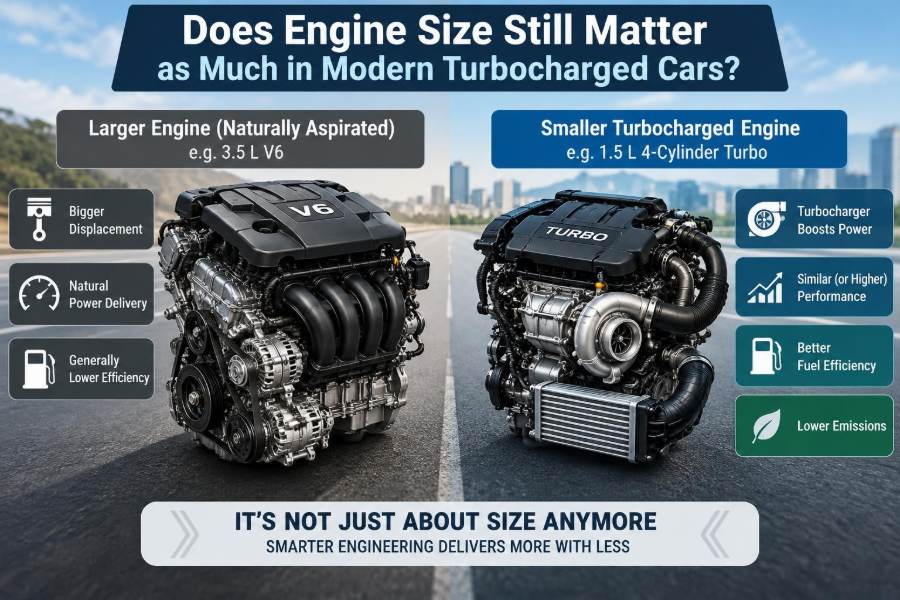

You may have noticed that a family SUV now carries a 1.5-litre engine, while an older version of the same type of vehicle once used a 2.5-litre or even 3.0-litre unit. On paper, that smaller number can feel worrying. Will it be slow with passengers? Will it struggle uphill? Is it being worked too hard?
Modern turbocharged cars have changed the simple rule that a bigger engine always means stronger performance. A small petrol engine can now produce the peak power of a much larger naturally aspirated engine, and often deliver useful pulling force at lower revs.
But engine displacement—the total volume swept by all pistons—has not become irrelevant. It still influences how an engine responds, how it handles heavy loads, how much heat it must manage, and what kind of driving it suits best.
The useful question is no longer just “How many litres is the engine?” It is how the whole powertrain delivers performance in the conditions the vehicle will actually face.
🔍 Engine Size Means Displacement
Engine size usually refers to displacement, stated in litres or cubic centimetres. A 2.0-litre four-cylinder engine displaces about 2,000 cubic centimetres as its pistons travel from top to bottom.
Displacement sets the engine’s basic capacity to draw in air. More air generally permits more fuel to be burned, which can produce more torque. Before widespread turbocharging, this relationship made displacement a particularly useful shortcut for estimating an engine’s capability.
It remains a meaningful physical property, but it is only one part of a much larger system.
📏 Why Bigger Engines Once Told Most of the Story
A naturally aspirated engine relies on atmospheric pressure and piston movement to fill its cylinders. Since it cannot force much extra air into the engine, a larger cylinder volume is a direct route to processing more air each cycle.
That is why an older 3.0-litre engine would usually out-pull a 1.5-litre engine of comparable design. More displacement commonly meant more low-speed torque, more power potential, and less need to operate near the redline.
Camshafts, intake design, compression ratio, and fuel delivery still mattered, but engine size was a very strong first clue.
🌪️ What a Turbocharger Changes
A turbocharger uses energy in the exhaust gas to spin a turbine. That turbine drives a compressor on the intake side, pushing more air into the cylinders than atmospheric pressure alone would allow.
With extra oxygen available, the engine management system can add an appropriate amount of fuel. A 1.5-litre turbo engine can therefore burn an air-and-fuel charge more like that of a substantially larger engine when boost is present.
This is called downsizing: using a smaller turbocharged engine to target the performance of a larger naturally aspirated one, especially in ordinary driving.
💨 Boost Is Not “Free” Engine Capacity
It is tempting to say that boost simply turns a 1.5-litre engine into a 2.5-litre engine. That comparison can be useful as a rough mental model, but it is not literally true.
The boosted engine has smaller cylinders, different airflow paths, different combustion conditions, and often a different torque curve. It also needs hardware to control intake temperature, exhaust temperature, knock, and pressure.
Turbocharging expands what a small engine can do; it does not erase the engineering consequences of its smaller displacement.
🔩 Torque Explains Everyday Pulling Ability
Torque is the twisting force produced at the crankshaft. It is what drivers feel when a car accelerates from low speed, climbs a hill, or pulls away with a full cabin.
Many modern turbo engines produce a broad plateau of torque across a middle range of engine speeds. This makes a small engine feel unexpectedly strong in normal traffic, because the useful force arrives without needing very high rpm.
However, wheel torque also depends on gear ratios. A modest engine paired with well-chosen transmission ratios can feel eager, while a more powerful engine in a tall gear may feel less immediate.
⚡ Power Still Determines Sustained Performance
Power combines torque with engine speed. In simple terms, torque helps create the push, while power describes how quickly the engine can keep doing work.
This distinction becomes clearer during sustained acceleration, high-speed driving, or a long ascent with a loaded vehicle. A turbo engine may offer strong mid-range torque but have less peak power or less power at high rpm than a larger engine designed for those demands.
For comparisons, look at both the torque curve and the power curve rather than relying on one headline figure.
📊 Read the Torque Curve, Not Just the Peak Number
Manufacturers often advertise a single maximum torque value, but the engine speed at which it is available matters greatly. So does how long the engine can maintain it under heat and load.
| Specification | What it can suggest | What it cannot reveal alone |
|---|---|---|
| Displacement | Basic airflow capacity and likely character | Actual boosted performance |
| Peak torque | Potential mid-range pulling force | How quickly torque arrives or lasts |
| Peak power | Potential acceleration at higher speeds | Low-speed response |
| Torque curve | Usable force across the rev range | Transmission behaviour and vehicle mass |
A specification sheet is a starting point, not a road test. Transmission calibration, throttle mapping, vehicle weight, and traction control can all change the impression behind the wheel.
⏱️ Turbo Lag Has Improved, Not Vanished
Turbo lag is the delay between opening the throttle and receiving the expected boost. The turbocharger needs exhaust energy to accelerate, so instant response is physically difficult, especially from very low rpm.
Smaller, lower-inertia turbochargers, electronic boost control, variable-geometry designs in some applications, and better calibration have reduced lag substantially. Many current cars respond smoothly in daily use.
Yet a larger naturally aspirated engine often remains more immediate when the driver requests torque suddenly. That predictable response can matter on a tight road, during precise manoeuvres, or when towing.
🌀 Single, Twin-Scroll, and Twin-Turbo Designs
“Turbocharged” describes a broad family of systems. A single turbocharger is common because it is compact and cost-effective, but its size involves a trade-off between fast response and high-flow capability.
- Twin-scroll turbochargers separate exhaust pulses to improve turbine efficiency and response.
- Sequential or staged systems can use a small turbo at low speed and a larger one as demand rises.
- Parallel twin-turbo systems commonly divide engine cylinders between two similarly sized turbos.
- Electric assistance can support compressor speed in certain advanced powertrains.
These arrangements show why displacement alone says little about the driving behaviour of two turbocharged engines.
❄️ Intercooling Protects the Air Charge
Compressing air raises its temperature. Hot intake air is less dense than cool air and increases the likelihood of knock, an uncontrolled combustion event that can damage an engine if severe.
An intercooler cools the compressed air before it reaches the cylinders. This helps preserve air density and gives engineers more safe operating margin for ignition timing and boost pressure.
On repeated hard acceleration or a hot day, the intercooler’s ability to reject heat can affect whether the engine maintains its advertised performance.
🌡️ Heat Is One of Downsizing’s Main Limits
When a small engine generates high output, its cylinders, pistons, turbocharger, exhaust manifold, and cooling system face substantial thermal loads. The challenge is not merely making power briefly; it is managing it repeatedly and reliably.
Engine control systems may reduce boost, enrich the mixture in some operating conditions, alter ignition timing, or request a lower gear to protect components. Drivers may notice this as less acceleration after repeated hard use.
This is not automatically a defect. It is often a deliberate protection strategy, but it explains why peak figures do not describe every real-world situation.
🧪 Combustion Control Makes Small Turbos Viable
Direct fuel injection, precise ignition control, knock sensors, variable valve timing, and sophisticated engine software allow modern turbo engines to operate close to efficient limits.
Knock sensors listen for abnormal combustion and allow the control system to adjust timing or boost when fuel quality, temperature, or load makes knock more likely. The exact response varies by engine design.
These systems are impressive, but they also mean performance can depend more strongly on correct maintenance, suitable fuel where specified, and healthy sensors than in a simpler older engine.
⛽ Fuel Economy Depends on How You Drive
A smaller turbo engine can consume less fuel during gentle cruising and light-load driving because it has lower pumping losses and less internal friction than a larger engine in many cases. It can operate as a small engine when little power is needed.
Under strong acceleration, steep climbs, or heavy towing, the turbo must create boost and the engine burns more fuel to make more power. The economy advantage can narrow or disappear when the small engine is regularly worked hard.
Downsizing is most effective when the real duty cycle includes plenty of modest-load operation. A vehicle that spends its life heavily loaded may be better matched to more displacement, hybrid assistance, or both.
🛣️ Highway Cruising Is Not the Same as Overtaking
At a steady highway speed on level ground, many engines need only a modest fraction of their maximum output. A small turbo engine can be very relaxed there, particularly with a transmission that allows low engine speed without lugging.
Overtaking at highway speed is different. The transmission may downshift, boost may build, and the engine may operate in a much higher load region. A larger engine often needs fewer downshifts and has more reserve available before reaching its limits.
Neither approach is inherently better; the preferable one depends on how often the driver needs that reserve.
🏔️ Altitude Changes the Comparison
Naturally aspirated engines lose available power at altitude because the air is less dense. Less oxygen enters each cylinder on every intake stroke.
A turbocharger can compensate for some of that loss by increasing compressor pressure, within its design and temperature limits. For this reason, turbocharged engines can retain their performance more effectively than naturally aspirated engines at moderate elevations.
They are not immune to altitude. Turbo speed limits, heat, and control-system limits still apply, particularly under prolonged heavy demand.
🚙 Vehicle Mass Can Make a Small Engine Feel Different
Engine output has to accelerate the whole vehicle, not just itself. A compact hatchback and a large SUV with similar power figures will not deliver the same response because their mass, aerodynamic drag, tyre size, and gearing differ.
Manufacturers can fit a small turbo engine to a heavier vehicle and produce acceptable test-drive performance. The more revealing question is how it behaves with five occupants, luggage, air conditioning, and a steep gradient.
For buyers, comparing power-to-weight ratio and towing requirements is more useful than comparing engine litres in isolation.
🧳 Towing and Payload Reveal Continuous-Duty Needs
Towing exposes an engine to long periods of high load, often at low road speed where cooling airflow is limited. A small turbo engine may meet the official towing rating, but that does not mean every combination will feel equally relaxed.
A larger-displacement engine commonly provides torque with less boost and may hold a gear more comfortably on long inclines. It can also have a cooling system and transmission calibration designed around higher continuous loads.
Check the vehicle handbook for permitted trailer mass, nose weight, cooling guidance, and any conditions attached to the rating. The engine is only one part of the towing system.
⚙️ Transmission Design Can Mask or Magnify Engine Size
Modern automatic transmissions often have many ratios, while continuously variable transmissions can hold the engine near an efficient or powerful speed. This can make a small turbo engine feel more responsive than its displacement suggests.
There is a trade-off. Frequent downshifts or a sustained high-rpm drone may be noticeable when the car is loaded. A larger engine with more low-speed torque may require less ratio management.
During a test drive, try gentle acceleration, a rolling pass, and a hill. Those situations reveal the partnership between engine and gearbox better than a short flat-road launch.
🔋 Hybrid Assistance Changes the Equation Again
Hybrid systems can add electric motor torque almost immediately from low speed. This fills the response gap that a small turbocharger may have before it reaches full operating speed.
A hybrid can also recover braking energy and use the engine more selectively, reducing the need to size the combustion engine for every short burst of acceleration. Some hybrids therefore use naturally aspirated engines; others combine turbocharging and electrification for higher output.
In these vehicles, engine displacement matters, but evaluating it without considering battery capacity, motor output, thermal control, and software strategy is especially misleading.
🔊 Sound and Feel Are Legitimate Differences
Engine character is not merely nostalgia. Cylinder count, firing order, intake sound, vibration, and the way torque builds all influence how a car feels to drive.
A larger naturally aspirated engine may offer linear response and a rising sound as rpm increases. A small turbo engine often delivers a stronger early surge, followed by a flatter response, with more muted intake and exhaust noise.
Preference is subjective, but students of vehicle engineering should recognize that refinement and driver confidence are design outcomes, not just marketing language.
🛠️ Reliability Depends on Design and Care, Not a Simple Rule
A turbocharged engine has additional components, including a turbocharger, charge-air plumbing, boost-control hardware, and usually more demanding thermal management. More complexity creates more potential failure points.
At the same time, modern turbo engines are engineered for their intended output, and many give long service when serviced properly. It is inaccurate to assume all small turbos are fragile or that all larger engines are trouble-free.
Useful ownership habits include:
- Use the specified oil grade and follow sensible service intervals.
- Allow proper warm-up through gentle driving rather than extended idling.
- Avoid repeatedly demanding maximum load from a cold engine.
- Investigate warning lights, oil consumption, smoke, or loss of power promptly.
- Use the fuel grade required or recommended by the manufacturer, especially where high-load performance is expected.
🛢️ Oil Quality Matters More Around a Turbo
The turbocharger shaft rotates at extremely high speed and relies on a thin film of clean engine oil for lubrication and cooling. Oil degraded by excessive heat, contamination, or overdue changes can increase wear risk.
After hard driving, modern water-cooled turbo systems and intelligent cooling strategies reduce the need for old-fashioned rituals such as long idle periods. Still, abruptly switching off after an exceptional high-load climb or track session may not be ideal for every vehicle.
The most reliable guidance is the manufacturer’s handbook, because cooling layouts and recommendations differ.
🧰 Carbon Deposits Need Context
Many direct-injection petrol engines inject fuel straight into the combustion chamber rather than onto the back of the intake valves. Fuel therefore does not wash the intake valves in the same way as in port-injected designs.
Over time, some engines can accumulate deposits through crankcase ventilation gases and exhaust-gas recirculation effects. This is not exclusive to turbocharging, and the severity varies widely by engine, driving pattern, and maintenance history.
A rough idle or reduced performance should be diagnosed rather than blamed automatically on “turbo carbon.” Several unrelated faults can create similar symptoms.
🔧 Modifying Boost Carries Real Engineering Risks
Software tuning can raise boost pressure, alter fueling, or change torque limits. Because turbocharged engines have controllable boost, they can appear to offer easy power gains.
But the original calibration also coordinates combustion safety, turbo speed, exhaust temperature, gearbox limits, clutch capacity, cooling performance, emissions systems, and traction. Altering one target can reduce margin elsewhere.
For road vehicles, modifications may also affect legality, emissions compliance, insurance, warranty, and long-term durability. More peak power is not automatically more usable or responsible performance.
🧠 Common Mistake: Comparing Litres Alone
Comparing a 1.5-litre turbo with a 2.5-litre naturally aspirated engine by displacement alone is like comparing two pumps only by their cylinder size while ignoring pressure, control system, and operating speed.
A better comparison includes the vehicle’s mass, torque and power delivery, transmission, cooling capacity, intended load, and test-drive behaviour. For used cars, service history and condition may matter more than the theoretical advantage of either engine layout.
The badge can guide your first question, but it should not make the final decision for you.
🧾 A Practical Way to Compare Two Cars
When evaluating two otherwise similar vehicles, begin with the job the car must perform. A commuter covering mostly light-load urban and highway miles has different needs from a driver who frequently carries equipment or tows.
- Compare vehicle mass, peak power, peak torque, and the rpm ranges where those figures occur.
- Check official towing and payload limits if those tasks matter.
- Look for the transmission type and number of ratios, not just the engine output.
- Test drive with realistic passengers or cargo where possible.
- Review fuel, oil, and service requirements before treating a lower purchase price as a saving.
This process turns a vague “small versus big engine” debate into a practical engineering assessment.
🚦 City Driving Favors Fast Usable Response
In stop-start traffic, a compact turbo engine can work very well when it develops torque early and is paired with a responsive automatic or manual gearbox. Lower displacement may also reduce fuel use during light-load portions of the trip.
However, repeated short trips can be demanding for any combustion engine because it may not reach full operating temperature. That affects oil condition, condensation, and emissions-system operation more than the engine-size label suggests.
For predominantly urban use, a hybrid or electric vehicle may also be worth considering, depending on charging access and the user’s requirements.
🏎️ Performance Cars Use Displacement Differently
In performance vehicles, turbocharging allows remarkable specific output—power produced per litre of displacement. It also gives engineers flexibility to produce high torque across a broad rpm range.
Yet larger engines still appear in this segment because response, thermal capacity, sound, sustained track use, and prestige can matter as much as maximum power. Some designs use both substantial displacement and turbocharging to create a large performance reserve.
That choice reinforces the main point: turbocharging changes the role of engine size; it does not make size meaningless.
🌍 Emissions Rules Encourage Smaller Engines, With Caveats
Manufacturers pursue lower fuel consumption and carbon dioxide output under prescribed test conditions, while also meeting pollutant-emissions requirements. Downsized turbo engines can help by operating efficiently at low loads.
Real-world results depend on route, temperature, traffic, driving style, vehicle loading, and the calibration of the complete emissions-control system. A small engine driven at high boost much of the time does not behave like a small engine on a gentle certification cycle.
Engineering decisions must balance efficiency, emissions, drivability, durability, and cost. There is no single displacement that is best for every vehicle class.
🎓 What Engineering Students Should Look Beyond
For analysis, displacement is an input variable rather than a complete answer. Consider brake mean effective pressure, often abbreviated BMEP, which relates torque to displacement and helps show how intensively an engine is using its cylinder volume.
Also consider compressor maps, turbine efficiency, transient response, volumetric efficiency, compression ratio, knock margin, cooling-system capacity, and gearbox torque limits. These reveal the constraints behind an apparently simple engine specification.
For working professionals, the same systems view is valuable in diagnosis: a complaint about weak acceleration could arise from boost control, intake leaks, fuel delivery, thermal derating, transmission behaviour, or driver expectation—not just engine size.
✅ The Core Answer: Size Matters, but Context Matters More
Modern turbocharging means a smaller engine can deliver performance that would once have required considerably more displacement. For everyday cars operated at moderate load, this can provide a convincing combination of torque, efficiency, and compact packaging.
Displacement still matters when instant response, sustained high-load operation, towing confidence, thermal margin, refinement, and long-term operating character are priorities. A larger engine often supplies more reserve, while a smaller turbo relies more heavily on boost, cooling, and calibration.
The best assessment is not “small engine versus big engine.” It is whether the engine, turbo system, transmission, vehicle mass, and intended duty cycle are properly matched.
Engine size still matters in modern turbocharged cars, but it is no longer a verdict on performance by itself; it is one clue within a carefully engineered powertrain. 🚗⚙️🌪️