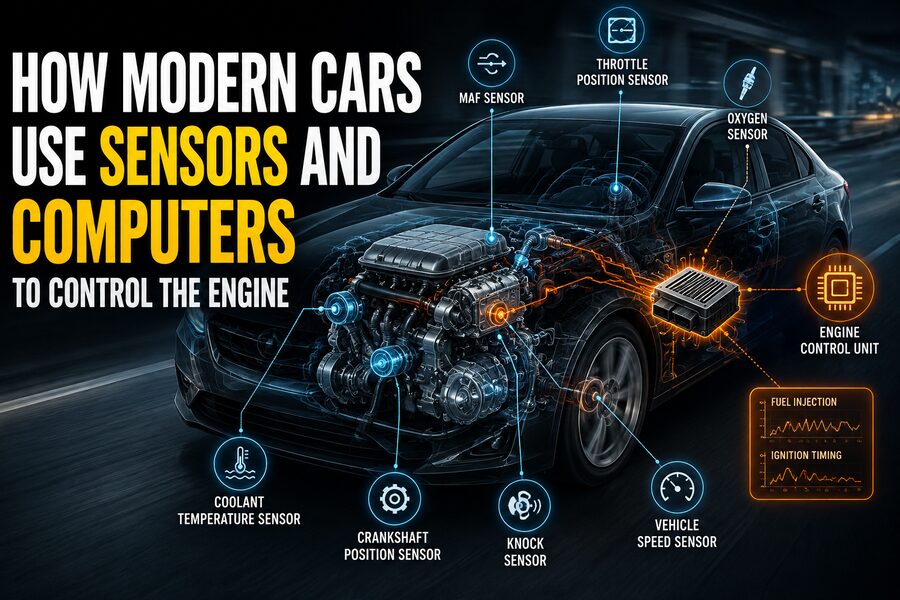

Modern cars may still rely on pistons, valves, fuel, and air to produce power, but the way an engine is controlled has changed dramatically. In older vehicles, many engine functions were handled mechanically using carburetors, distributors, vacuum lines, springs, and cables. Today, much of that work is managed electronically by a network of sensors, computers, and actuators.
At the center of this system is the Engine Control Unit, often called the ECU or Engine Control Module (ECM). It constantly receives information from sensors throughout the vehicle, processes that data, and makes rapid adjustments to systems such as fuel injection, ignition timing, throttle position, emissions equipment, and sometimes turbocharger boost.
This process happens continuously while the engine is running. In just a fraction of a second, the computer can react to changes in temperature, engine speed, altitude, accelerator position, oxygen levels in the exhaust, and many other conditions.
The result is an engine that can produce more power while using less fuel, emitting fewer pollutants, and operating more reliably. 🚘✨
🧠 What Is the Engine Control Unit?
The Engine Control Unit is essentially a specialized computer designed to operate in the harsh environment of a vehicle.
Unlike a laptop or smartphone, an ECU must withstand:
- 🌡️ Extreme temperature changes
- ⚡ Electrical voltage fluctuations
- 🚗 Constant vibration
- 💧 Moisture and contamination
- 🛣️ Years of continuous use
Inside the ECU is a processor that runs software containing detailed instructions for controlling the engine.
The ECU receives electrical signals from sensors. It compares those signals with programmed data tables and mathematical models, calculates the appropriate response, and sends commands to various engine components.
These commands can occur many times per second.
For example, when a driver presses the accelerator pedal, the ECU may instantly calculate how much air is entering the engine, how much fuel should be injected, when the spark plugs should fire, and whether emissions-control systems need adjustment.
📡 Sensors: The Engine’s Eyes and Ears
The ECU cannot directly see what is happening inside the engine.
Instead, it depends on sensors.
Sensors measure physical conditions and convert them into electrical signals that the computer can understand.
Modern engines can use dozens of sensors, each monitoring a particular part of engine operation.
Together, they allow the ECU to build a detailed picture of what the engine is doing at any moment. 🔍
🌬️ Mass Air Flow Sensor
The Mass Air Flow sensor, or MAF sensor, measures how much air is entering the engine.
This information is extremely important because combustion requires the correct mixture of air and fuel.
If too much fuel is injected relative to the amount of air available, combustion may be inefficient and emissions can increase. If too little fuel is injected, the engine may run poorly or produce excessive heat under certain conditions.
The ECU uses MAF sensor information to calculate an appropriate fuel quantity.
Some vehicles instead use, or supplement this measurement with, a Manifold Absolute Pressure sensor, commonly called a MAP sensor.
📊 MAP Sensor
The MAP sensor measures pressure inside the engine’s intake manifold.
Intake manifold pressure changes depending on engine load, throttle position, turbocharger activity, and other factors.
By combining MAP readings with information such as engine speed and intake-air temperature, the ECU can estimate how much air is entering the cylinders.
This allows it to adjust fuel delivery accordingly.
Turbocharged engines also use pressure sensors to monitor boost levels and help prevent excessive pressure.
🌡️ Coolant Temperature Sensor
An engine operates differently when it is cold than when it has reached normal operating temperature.
The Engine Coolant Temperature sensor tells the ECU how hot the engine is.
When a cold engine is first started, the ECU may temporarily provide additional fuel and adjust ignition timing to improve combustion.
As the engine warms up, those settings change.
The ECU may also use coolant temperature data to control electric radiator fans and detect overheating.
If the engine temperature becomes dangerously high, some vehicles can reduce engine power or activate protective strategies.
❄️ Intake Air Temperature Sensor
The Intake Air Temperature sensor, or IAT sensor, measures the temperature of the air entering the engine.
Cold air is denser than hot air, meaning it contains more oxygen molecules within the same volume.
Because the oxygen content affects combustion, the ECU may adjust fuel injection based partly on intake-air temperature.
This sensor is especially useful in changing weather conditions and on turbocharged or supercharged engines, where air temperatures can vary considerably.
🔄 Crankshaft Position Sensor
One of the most critical sensors in a modern engine is the crankshaft position sensor.
The crankshaft converts the up-and-down movement of the pistons into rotating motion.
The crankshaft position sensor tells the ECU:
- 🔁 How fast the engine is rotating
- 📍 The position of the crankshaft
- ⏱️ When certain pistons are approaching important points in the combustion cycle
This information helps the ECU determine exactly when to inject fuel and fire the spark plugs.
If the crankshaft position sensor fails completely, many engines will not run because the computer no longer knows the proper timing for combustion.
⚙️ Camshaft Position Sensor
The camshaft controls the opening and closing of the engine’s valves.
The camshaft position sensor helps the ECU determine which cylinder is currently in a particular part of its combustion cycle.
This information is especially important for sequential fuel injection and modern variable valve timing systems.
Some engines use multiple camshaft sensors because they have separate intake and exhaust camshafts.
🦶 Accelerator Pedal Position Sensor
Many modern vehicles no longer use a physical cable directly connecting the accelerator pedal to the throttle.
Instead, they use electronic throttle control, sometimes called drive-by-wire.
When the driver presses the accelerator pedal, pedal-position sensors measure how far it has been pressed.
The ECU then decides how far the electronic throttle should open.
This may sound unnecessarily complicated, but electronic throttle control allows the computer to coordinate engine power with many other systems, including:
- 🚘 Cruise control
- 🛞 Traction control
- 🛑 Stability control
- ⚙️ Automatic transmissions
- 🌱 Fuel-saving modes
For safety, accelerator pedals often contain multiple sensors so the computer can compare their signals and detect faults.
🚪 Throttle Position Sensor
The throttle regulates how much air can enter a gasoline engine.
A throttle position sensor tells the ECU the actual position of the throttle plate.
In vehicles with an electronic throttle body, an electric motor moves the throttle according to ECU commands.
The computer compares its desired throttle position with the measured position to ensure the throttle is responding correctly.
This is an example of a closed-loop control system, in which the computer continuously measures the result of its commands and makes corrections.
💨 Oxygen Sensors
Oxygen sensors are among the most important components for fuel control and emissions.
They are installed in the exhaust system and measure the amount of oxygen remaining in the exhaust gases.
This information tells the ECU whether combustion is running relatively rich or lean.
A rich mixture contains more fuel relative to air, while a lean mixture contains less fuel.
The ECU can then adjust fuel injector operation to maintain an efficient air-fuel mixture.
This constant monitoring is called closed-loop fuel control.
Many vehicles have oxygen sensors both before and after the catalytic converter.
The downstream sensors can help determine whether the catalytic converter is working effectively.
💥 Knock Sensor
Inside a gasoline engine, combustion is supposed to occur in a controlled way.
Under certain conditions, however, abnormal combustion called engine knock or detonation can occur.
Knock produces pressure waves that can damage engine components if severe or persistent.
A knock sensor detects the characteristic vibrations produced by this abnormal combustion.
When the ECU detects knock, it may temporarily retard ignition timing or make other adjustments to protect the engine.
This allows modern engines to operate close to their optimal performance limits without sacrificing reliability.
⛽ How the ECU Controls Fuel Injection
Older gasoline engines commonly used carburetors to mix fuel with air.
Modern engines generally use electronically controlled fuel injectors.
A fuel injector is essentially a rapidly operating valve.
The ECU determines how long each injector should remain open. This is known as injector pulse width.
A longer opening time generally allows more fuel to enter.
To calculate fuel delivery, the ECU may consider information such as:
- 🌬️ Airflow
- 🔄 Engine speed
- 🌡️ Engine temperature
- 🦶 Accelerator position
- 💨 Exhaust oxygen levels
- 📈 Engine load
Some modern gasoline engines use direct fuel injection, where fuel is sprayed directly into the combustion chamber at high pressure.
These systems require extremely precise computer control.
⚡ Controlling Spark Timing
In gasoline engines, spark plugs ignite the compressed air-fuel mixture.
But exactly when the spark occurs has a major effect on engine performance.
The ECU controls ignition timing based on operating conditions.
At different engine speeds and loads, the ideal spark timing changes.
The ECU may advance or retard the spark to improve:
- 💪 Power
- ⛽ Fuel efficiency
- 🌱 Emissions
- 🔧 Engine reliability
Information from the crankshaft, camshaft, temperature, throttle, and knock sensors all helps determine the correct ignition timing.
Modern electronic ignition systems can control individual ignition coils with remarkable precision.
🔁 Variable Valve Timing
Many modern engines use Variable Valve Timing, or VVT.
Instead of opening and closing the valves at exactly the same timing under all conditions, the ECU can change camshaft timing depending on engine speed and load.
At low engine speeds, one valve timing strategy may improve fuel economy and smoothness.
At high engine speeds, a different setting may improve airflow and power.
The ECU sends commands to oil-control valves or electric actuators that adjust the camshaft timing.
Sensors then confirm the camshaft’s actual position.
Some sophisticated engines can vary not only valve timing but also valve lift and duration.
🌪️ Turbocharger Control
Turbocharged engines use exhaust energy to compress incoming air.
More air allows the engine to burn more fuel and produce more power.
However, boost pressure must be carefully controlled.
The ECU monitors pressure sensors, air temperature, engine load, throttle position, and sometimes exhaust conditions.
It can control devices such as a wastegate or variable-geometry turbocharger mechanism to regulate boost.
If boost becomes excessive, the ECU can reduce pressure to help protect the engine.
🌱 Managing Emissions
Engine computers are also responsible for controlling emissions systems.
Modern vehicles may include technologies such as:
- ♻️ Exhaust Gas Recirculation
- 🔥 Catalytic converters
- 💨 Evaporative emissions controls
- 🧪 Diesel particulate filters
- ⚗️ Selective catalytic reduction systems
The ECU monitors many of these systems using dedicated sensors.
For example, diesel engines may use exhaust temperature and pressure sensors to determine when a particulate filter requires regeneration.
The computer may then modify engine operation to raise exhaust temperature and burn accumulated soot.
🛠️ What Happens When a Sensor Fails?
Because sensors are so important, the ECU continuously checks whether their signals appear reasonable.
Suppose the coolant temperature sensor suddenly reports an impossible temperature.
The ECU may recognize the reading as a fault.
It can store a Diagnostic Trouble Code, commonly called a DTC, and may illuminate the Check Engine Light. ⚠️
In some cases, the computer substitutes an estimated value so the vehicle can continue operating.
This is sometimes referred to as a fail-safe or limp-home strategy.
Performance may be reduced, but the goal is to prevent further damage and allow the vehicle to reach a safe location or repair facility.
🔌 OBD-II and Vehicle Diagnostics
Most modern vehicles include an On-Board Diagnostics system.
Technicians can connect a diagnostic scanner to the vehicle’s OBD-II port and communicate with its computers.
The scanner can retrieve fault codes and display live sensor data.
A technician might examine:
- Engine RPM
- Coolant temperature
- Oxygen sensor readings
- Fuel corrections
- Throttle position
- Intake pressure
- Ignition timing
This information makes diagnosing modern engines far more data-driven than it was in the purely mechanical era.
However, a fault code does not necessarily prove that a specific component is defective. It identifies an abnormal condition that technicians must investigate properly.
🌐 Cars Use More Than One Computer
Although the engine ECU is extremely important, it is only one of many computers found in modern vehicles.
A car may contain separate control modules for:
- ⚙️ Transmission
- 🛑 Anti-lock brakes
- 🛞 Stability control
- 🎈 Airbags
- ❄️ Climate control
- 🔐 Security systems
- 📺 Infotainment
- 🔋 Battery management
These computers communicate over internal vehicle networks such as the Controller Area Network, commonly known as the CAN bus.
This communication allows systems to cooperate.
For example, if traction control detects wheel spin, the stability-control computer can request that the engine ECU temporarily reduce torque.
The engine computer may respond by changing throttle opening, ignition timing, or fuel delivery within milliseconds.
🔄 The Power of Feedback Control
One of the most important concepts behind modern engine management is feedback.
The computer does not simply issue commands and hope they work.
It often measures the result.
For example:
- The ECU commands a particular amount of fuel.
- Combustion takes place.
- The oxygen sensor measures the exhaust.
- The ECU analyzes the measurement.
- Fuel delivery is corrected if necessary.
This loop may happen repeatedly while the engine operates.
Feedback control allows modern vehicles to compensate for changes in temperature, altitude, component aging, fuel quality, and driving conditions.
🚘 Why Electronic Engine Control Matters
Electronic engine management offers several major advantages over older mechanical systems.
It allows engines to start more easily in cold weather, adapt automatically to changing altitude, achieve better fuel economy, produce more power from smaller displacement, and meet increasingly strict emissions requirements.
It also enables advanced technologies such as:
- 🚦 Automatic stop-start
- 🌀 Turbocharging
- ⛽ Direct injection
- 🎛️ Selectable driving modes
- 🔄 Cylinder deactivation
- ⚙️ Variable valve timing
- 🔋 Hybrid powertrain coordination
Without sensors and computers, many of these technologies would be extremely difficult or impossible to operate effectively.
🌟 Final Thoughts
A modern engine is not controlled by one mechanical device. It operates as a sophisticated electronic system in which sensors, computers, and actuators constantly communicate.
Sensors measure what is happening throughout the engine and exhaust system. The ECU analyzes that information using programmed maps and control algorithms. It then adjusts fuel injection, ignition timing, throttle position, valve timing, turbo boost, and emissions equipment.
The entire process occurs continuously and often within milliseconds. ⚡
When you press the accelerator pedal in a modern car, you are not simply opening a mechanical valve. You are making a request to a computer-controlled powertrain. That computer considers engine temperature, speed, airflow, traction, emissions, transmission conditions, and many other variables before determining how the engine should respond.
This invisible electronic coordination is one of the main reasons modern engines can be simultaneously more powerful, more efficient, cleaner, easier to drive, and more adaptable than their predecessors.
So beneath the hood of today’s car, traditional mechanical engineering is working side by side with electronics and software. 🚗💻⚙️ The modern automobile is not merely a machine—it is a networked control system constantly measuring, calculating, and adjusting itself every second it is on the road.