
A driver approaches a familiar junction on a rainy evening. The headlights adapt their beam around oncoming traffic, the windscreen wipers change speed as rain intensifies, and a warning appears when a cyclist enters a blind spot. None of these actions requires the driver to understand the electronics behind them, yet each depends on complex engineering.
At the same time, the car may be using a battery pack rather than a fuel tank for most of its energy, recovering power while braking, and receiving a software update overnight. The automobile is no longer only a mechanical machine with an engine, gearbox, steering system, and brakes. It is increasingly a connected electromechanical system.
This shift matters to drivers because it changes ownership, maintenance, safety, cost, and privacy. It matters to engineers because vehicle design now requires mechanical, electrical, software, control, and systems thinking to work together.
Understanding the technology beneath the dashboard helps students see where the industry is heading and helps professionals make better decisions about design, diagnosis, and responsible adoption.
🚘 From Mechanical Product to Cyber-Physical System
A modern vehicle is a cyber-physical system: a physical machine whose behaviour is monitored and controlled by computing. Its suspension moves over a pothole, but sensors measure wheel motion; control software interprets the data; and actuators may alter damping force in response.
Mechanical engineering remains fundamental. Tyres still create grip, structures still manage crash energy, and bearings still need lubrication. What has changed is that many vehicle functions are now achieved by coordinating hardware with code.
🧠 Why Software Has Become a Core Vehicle Component
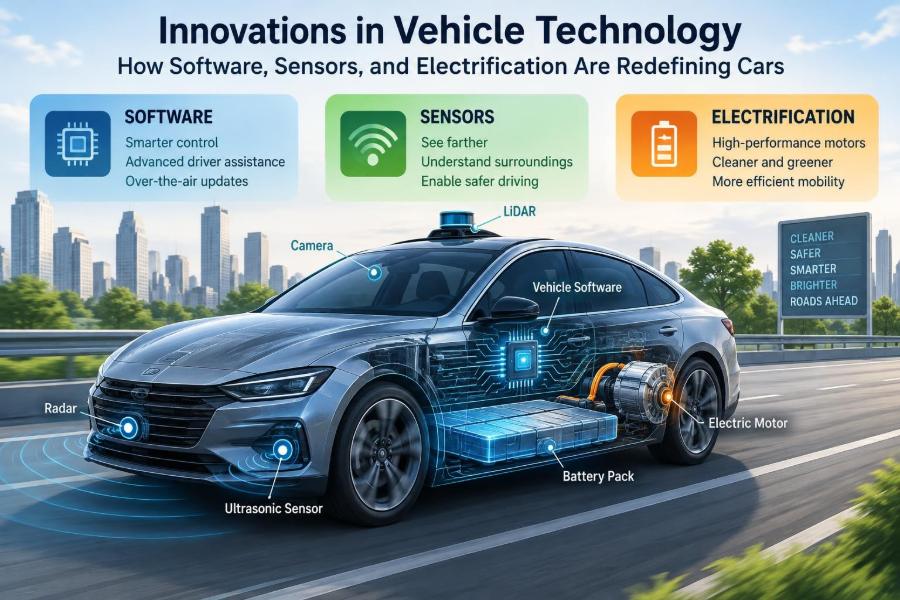
Software determines how many components behave, from battery charging limits to automatic emergency braking logic. A vehicle can contain numerous electronic control units, commonly called ECUs, each responsible for a domain such as powertrain, body electronics, braking, or infotainment.
The key distinction is that software does not merely display information. It can influence torque, steering assistance, thermal management, and occupant protection. That makes software quality a safety and engineering issue, not simply an entertainment feature.
🧩 Understanding Electronic Control Units
An ECU is a rugged embedded computer designed for automotive temperature ranges, vibration, electrical noise, and long service life. It receives inputs, runs programmed logic, and sends commands to output devices.
For example, an engine ECU combines signals from crankshaft, airflow, temperature, and oxygen sensors to control fuel injection and ignition timing. In an electric vehicle, a motor controller instead manages inverter switching to deliver requested torque efficiently and smoothly.
🔌 Vehicle Networks: The Wiring You Cannot See
ECUs need to exchange information. Rather than connecting every device with a separate wire, vehicles use communication networks such as CAN, LIN, FlexRay, and automotive Ethernet. Each has different speed, cost, and reliability characteristics.
CAN, or Controller Area Network, is widely used for robust real-time messages. A wheel-speed signal can be shared with the anti-lock braking system, stability control, instrument cluster, and driver-assistance functions without duplicating the sensor.
| Network approach | Typical strength | Common use |
|---|---|---|
| LIN | Low cost for simple devices | Window motors and seat controls |
| CAN | Robust real-time control | Powertrain and chassis systems |
| Automotive Ethernet | High data capacity | Cameras, displays, and central computing |
📡 Sensors Give the Vehicle Its Awareness
A sensor converts a physical quantity into a usable electrical signal. Temperature, pressure, acceleration, wheel rotation, steering angle, current, and position are all measured in modern cars.
Sensor quality affects the whole control chain. A precisely designed algorithm cannot compensate indefinitely for a drifting, contaminated, poorly calibrated, or incorrectly installed sensor. Engineers must consider accuracy, response time, failure modes, and environmental exposure.
👁️ Cameras, Radar, Ultrasonics, and LiDAR
Different sensing technologies see different aspects of the environment. Cameras identify lane markings, signs, object shapes, and colours. Radar estimates distance and relative speed well in many poor-visibility conditions. Ultrasonic sensors are useful at short range, especially for parking.
LiDAR measures distance using reflected light and can create detailed three-dimensional geometry, but its cost, packaging, cleaning, and performance in adverse conditions require careful engineering. No sensor type is universally best.
🔍 Why sensor fusion matters
Sensor fusion combines information from multiple sources. A camera may classify an object while radar helps estimate its closing speed. Agreement increases confidence; disagreement can trigger caution or a fallback strategy. Fusion reduces some limitations, but it also adds complexity and must be validated thoroughly.
🛑 Advanced Driver Assistance Is Not Autonomous Driving
Advanced driver-assistance systems, or ADAS, can warn, assist, or intervene in defined situations. Examples include adaptive cruise control, lane-keeping assistance, automatic emergency braking, and blind-spot monitoring.
These systems are often misunderstood as a substitute for attentive driving. Their capability depends on road markings, sensor visibility, weather, map data, operating conditions, and the specific system design. Drivers must understand the manufacturer’s instructions and remain responsible whenever supervision is required.
⚙️ The Control Loop Behind Vehicle Assistance
Most intelligent vehicle functions follow a control loop: sense, estimate, decide, act, and monitor. The vehicle measures its surroundings, estimates what those measurements mean, selects an action, commands actuators, and checks whether the intended response occurred.
Consider adaptive cruise control. It measures a vehicle ahead, calculates a safe following response within its design limits, requests propulsion or braking, then continuously reassesses the gap. Delays, uncertain measurements, and tyre-road conditions all influence the final result.
🧪 Validation Matters More Than an Impressive Demo
A smooth demonstration on a clear road does not establish safe performance across the countless situations found in public traffic. Engineering validation uses simulation, laboratory testing, proving grounds, software review, and controlled road evaluation.
Rare but serious cases deserve attention: faded lane markings, sun glare, sensor obstruction, unusual vehicles, roadworks, and conflicting sensor data. A robust design needs safe behaviour when confidence is low, not only strong performance under ideal conditions.
⚡ Electrification Changes the Energy Path
In an internal-combustion vehicle, chemical energy in fuel becomes heat, then mechanical motion through an engine and drivetrain. In a battery-electric vehicle, electrical energy from the battery is converted by an inverter and motor into wheel torque.
Electric motors can provide high torque from very low speed and can respond quickly to driver input. However, the vehicle’s range, charging experience, mass, thermal behaviour, and packaging depend strongly on the battery system and the surrounding infrastructure.
🔋 What a Battery Pack Really Contains
A traction battery is not one large cell. It is an assembly of cells arranged into modules or structural groups, with electrical connections, fuses, contactors, cooling paths, sensors, enclosure protection, and a battery management system.
Cells store energy, but the pack must also manage high voltage safely, resist vibration and crash loads, prevent water ingress, and maintain suitable operating temperatures. Pack design is therefore a structural, electrical, thermal, and manufacturing challenge.
📊 The Battery Management System as a Guardian
The battery management system, or BMS, measures cell voltages, currents, and temperatures. It estimates state of charge, manages charging and discharging limits, balances cells where appropriate, and detects conditions that may require reduced power or isolation.
State of charge is an estimate rather than a simple fuel-gauge reading. Battery behaviour changes with temperature, load, age, and rest time, so estimation relies on measurements and models. Accuracy protects both customer expectations and battery life.
🌡️ Thermal Management Protects Performance
Batteries, motors, inverters, and charging equipment generate heat. Cold conditions can also reduce available battery power and charging acceptance. Thermal management uses air or liquid circuits, heat exchangers, pumps, valves, and control logic to keep components within intended ranges.
Poor thermal design can lead to uneven cell ageing, restricted performance, slower charging, or durability concerns. The challenge is not simply removing heat; it is doing so efficiently without adding excessive mass, cost, complexity, or noise.
🔄 Regenerative Braking Recovers Energy
When an electric motor operates as a generator during deceleration, it converts some vehicle kinetic energy into electrical energy for the battery. This is regenerative braking. It can reduce friction-brake use and improve energy efficiency, particularly in stop-start driving.
Recovery is limited by battery temperature, state of charge, tyre grip, motor capability, and stability requirements. Friction brakes remain essential for hard stops, low-speed stopping behaviour, emergency braking, and situations where electrical regeneration is unavailable.
🔌 Charging Is an Engineering System, Not Just a Plug
Charging performance depends on the vehicle, battery temperature, charger capability, connector standard, grid supply, and battery state. The advertised maximum power of a charger does not guarantee that every vehicle can accept that power at every moment.
AC charging generally uses the vehicle’s onboard charger to convert alternating current to direct current. DC charging supplies direct current through equipment designed to communicate with the vehicle and manage high-power transfer safely.
🏗️ Power Electronics Control Electric Motion
The inverter is a central power-electronic device in an electric drivetrain. It converts battery direct current into controlled alternating current for the traction motor. By adjusting switching patterns, it controls motor speed and torque.
Power electronics must handle high currents and voltages while limiting losses and managing heat. Semiconductor choice, cooling design, electromagnetic compatibility, and packaging all affect efficiency, reliability, and cost.
🌀 Electric Motors Bring New Design Trade-Offs
Electric motors are compact, responsive, and capable of high efficiency over useful operating ranges. Common traction-machine designs include permanent-magnet synchronous motors and induction motors, each with different material, control, thermal, and supply-chain considerations.
A motor choice is never made in isolation. Engineers assess torque requirements, high-speed operation, inverter compatibility, cooling, manufacturing capability, service strategy, and the availability of critical materials.
🧱 Vehicle Architecture Is Being Reconsidered
Electric platforms can package components differently because they do not need a conventional engine, exhaust system, or multi-speed transmission in the same locations. A battery may be integrated beneath the floor, lowering the centre of mass while creating new structural and repair considerations.
Designers must protect the energy storage system in side and underbody impacts, provide safe high-voltage isolation, and avoid compromising occupant space. The best architecture balances safety, stiffness, weight, manufacturability, and service access.
🛞 Software Can Change Vehicle Dynamics
Vehicle dynamics software coordinates braking, propulsion, steering assistance, and damping systems. Electronic stability control, for instance, can detect a developing loss of directional control and apply selective braking or reduce drive torque.
In electric vehicles, rapid motor torque control can support traction and stability functions. Yet physics still sets the boundary: software cannot create grip on an icy surface or overcome worn tyres. Good control works with sound mechanical fundamentals.
🧑🔧 Diagnostics Are Becoming Data-Driven
Traditional diagnosis often begins with visible symptoms: a leak, noise, vibration, or warning lamp. Modern diagnosis also uses diagnostic trouble codes, live sensor data, network messages, event logs, and guided test routines.
A trouble code points to a detected condition, not always the failed part. Replacing a component without checking wiring, connectors, supply voltage, calibration, and related systems is a common and costly mistake. Technicians need systematic fault isolation.
📲 Over-the-Air Updates Extend the Vehicle Lifecycle
Over-the-air, or OTA, updates allow approved software changes to be delivered without a workshop visit in some cases. They can improve interfaces, correct software defects, refine energy management, or add compatible features.
Updates must be carefully managed. A vehicle needs adequate power, secure authentication, rollback or recovery strategies, and a process that prevents a failed update from affecting safety-critical operation. Convenience does not remove the need for rigorous configuration control.
🔐 Connectivity Creates a Cybersecurity Responsibility
Connected vehicles may communicate with phones, charging equipment, service tools, fleet platforms, and cloud services. Every connection can provide useful functionality, but it can also increase the attack surface: the set of possible ways an unauthorized party might try to affect a system.
Cybersecurity requires layered design, including secure software development, access control, encrypted communications where appropriate, authenticated updates, intrusion monitoring, and timely vulnerability management. Safety and security are closely linked when digital systems influence physical motion.
🗃️ Data Privacy Requires Clear Boundaries
Vehicle data can support maintenance, crash analysis, navigation, insurance products, and fleet operations. It may also reveal sensitive patterns such as routes, driving times, contacts, or device identifiers.
Responsible data practice means collecting only what is needed, explaining why it is collected, protecting it, retaining it appropriately, and giving users meaningful choices where applicable. Engineers should treat privacy as a design requirement rather than a legal afterthought.
🧭 Human-Machine Interface Must Reduce, Not Add, Distraction
A touch screen can consolidate functions, but a poorly designed interface can make a simple task require too much visual attention. Physical controls, tactile feedback, voice interaction, clear alerts, and sensible menu design each have a place.
Warnings need prioritisation. If every message looks urgent, drivers may ignore the truly critical one. Effective human-machine interfaces communicate the right information at the right time without overloading the driver.
🛡️ Functional Safety Addresses Failures Systematically
Functional safety is the discipline of reducing unreasonable risk caused by malfunctioning electrical or electronic systems. It considers what could go wrong, how severe the consequence could be, how likely exposure is, and whether a driver can control the situation.
Possible safeguards include independent monitoring, plausibility checks, degraded operating modes, fault detection, and safe shutdown. For example, if two signals intended to represent accelerator demand disagree beyond acceptable limits, the system should respond predictably rather than blindly trusting one value.
♻️ Sustainability Includes More Than Tailpipe Emissions
Electrification can reduce local tailpipe emissions in use, but a full environmental assessment also considers electricity generation, material extraction, manufacturing, vehicle mass, battery longevity, repairability, and end-of-life recovery.
Longer-lasting components, efficient production, responsible sourcing, and effective recycling can all improve outcomes. There is no single environmental score that applies equally to every vehicle, route, electricity supply, climate, and ownership pattern.
🔧 Maintenance Skills Are Shifting, Not Disappearing
Electric vehicles have fewer routine engine-related service items, but they still require tyres, brakes, suspension, cooling systems, cabin filtration, body repair, and inspections. High-voltage systems introduce additional procedures, protective equipment, and training requirements.
For workshops, the future is not “mechanics versus electronics.” It is multidisciplinary competence. Technicians who can interpret scan data, understand electrical safety, and retain strong mechanical diagnostic habits will be especially valuable.
🎓 Skills Future Automobile Engineers Need
Vehicle engineering increasingly rewards people who can work across disciplines and communicate clearly between teams. Deep expertise in one area remains valuable, but systems awareness prevents local decisions from causing problems elsewhere.
- Mechanical fundamentals: structures, materials, dynamics, manufacturing, and thermal systems.
- Electrical knowledge: circuits, machines, high-voltage safety, sensors, and power electronics.
- Software literacy: embedded programming, control logic, testing, version control, and data analysis.
- Systems thinking: requirements, interfaces, fault analysis, validation, and lifecycle management.
⚠️ Common Misunderstandings About Smart Vehicles
One mistake is assuming more sensors automatically mean more safety. Sensor placement, cleaning, calibration, software interpretation, driver behaviour, and fallback design matter just as much. Another is assuming an electric vehicle has no maintenance needs because it has no engine oil.
It is also misleading to treat software features as permanent and identical across all models. Capability can depend on hardware, region, legal requirements, subscriptions, updates, and operating conditions. Read specifications carefully rather than relying on broad labels.
🧭 A Practical Way to Evaluate New Technology
When evaluating a feature, begin with the problem it is intended to solve. Ask what inputs it depends on, what conditions limit it, how it fails, what the driver or technician must do, and whether its benefits fit the actual use case.
- Identify the function: convenience, efficiency, safety assistance, or performance.
- Check operating limits, maintenance needs, and environmental dependencies.
- Consider lifecycle issues: repair, updates, training, cost, and data handling.
- Separate useful assistance from unrealistic expectations of full automation.
🌍 The Road Ahead Is Integrated Engineering
The next generation of vehicles will not be defined by one breakthrough alone. Progress will come from better integration of batteries, motors, sensors, software, communication networks, materials, and human-centred design.
The central principle is straightforward: vehicle technology delivers real value when intelligent software, reliable hardware, and responsible human use are designed as one system. Cars are becoming more capable, but their success will still depend on sound engineering judgement, careful validation, and an honest understanding of limits.
The future automobile is not simply electric or digital; it is an integrated machine whose safety, usefulness, and sustainability depend on how well every system works together. 🚗⚡🛠️