
Driving on a long highway can become tiring, especially when traffic constantly speeds up and slows down. Traditional cruise control helps by keeping a vehicle at a fixed speed, but it cannot normally react to slower traffic ahead. If another car enters the lane or begins traveling more slowly, the driver must brake manually and then reset the cruising speed.
Adaptive Cruise Control (ACC) solves much of this problem. 🚘📡
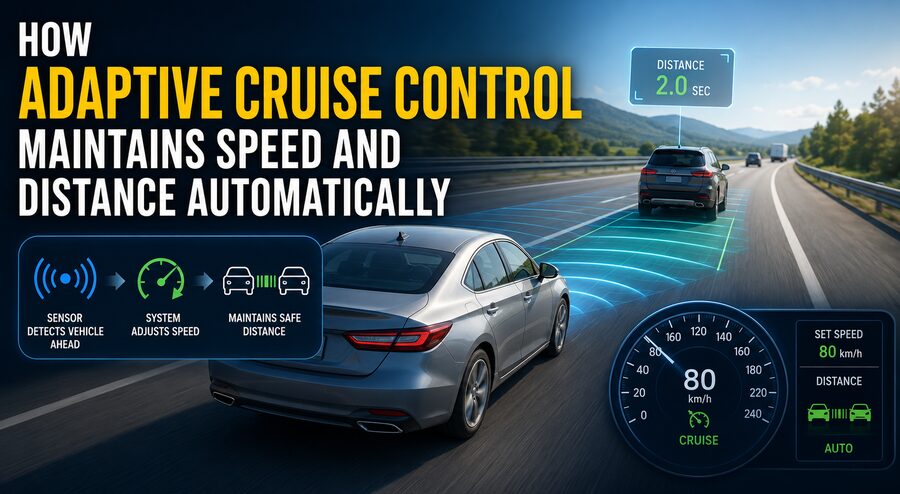
Instead of simply maintaining one selected speed, Adaptive Cruise Control continuously monitors the road ahead and automatically adjusts the vehicle’s speed to maintain a safe or selected following distance from traffic.
Using sensors such as radar, cameras, and sometimes lidar, ACC can detect vehicles ahead, estimate how far away they are, calculate how quickly the distance is changing, and command the throttle or brakes when necessary.
The result is a system that can accelerate and decelerate automatically while the driver remains responsible for supervising the road. 🛣️
🚦 What Is Adaptive Cruise Control?
Adaptive Cruise Control is an advanced driver-assistance system designed to perform two main tasks:
- Maintain a speed selected by the driver when the road ahead is clear.
- Reduce speed automatically when a slower vehicle is detected ahead.
The driver might set the cruise control to 100 km/h, for example. If no vehicle is blocking the lane, the car attempts to remain near that speed.
But imagine the vehicle approaches another car traveling at 85 km/h.
Instead of continuing at 100 km/h until the driver intervenes, Adaptive Cruise Control detects the slower vehicle and automatically reduces speed. 🚗➡️🚙
Once a suitable following distance is reached, the ACC system attempts to match the speed of the vehicle ahead.
If that vehicle later moves away or changes lanes, the system can accelerate back toward the driver’s original selected cruising speed.
📡 How Does the Vehicle Know What Is Ahead?
Adaptive Cruise Control depends heavily on environmental sensors.
One of the most important is automotive radar.
Radar sensors are commonly installed behind the front grille, bumper, manufacturer badge, or another forward-facing location.
The sensor emits radio waves toward objects ahead. When those waves strike another vehicle or obstacle, some of the energy reflects back toward the sensor.
By analyzing the returning signal, the vehicle can estimate important information such as:
- Distance to the vehicle ahead
- Relative speed
- Direction of movement
- Rate at which the gap is changing
Radar is particularly useful because it can operate in darkness and may continue working in some conditions where visual sensing becomes difficult. 📡
Modern ACC systems often combine radar with forward-facing cameras.
Cameras can help identify lane markings, vehicles, motorcycles, and other road features. Combining information from multiple sensors is known as sensor fusion.
📏 Measuring Following Distance
Knowing that a vehicle is ahead is not enough. Adaptive Cruise Control must determine whether the distance between the two vehicles is appropriate.
Rather than always using a fixed distance in meters, ACC systems commonly use a time gap.
For example, the driver may be able to choose a following setting such as short, medium, or long.
These settings often represent different approximate amounts of time between the driver’s vehicle and the vehicle ahead.
Suppose the selected following interval is approximately two seconds.
The system attempts to maintain enough distance so that, at the current speed, the driver’s vehicle would reach the position of the leading vehicle roughly two seconds later.
This means the physical distance automatically becomes larger at higher speeds. 🛣️
At 30 km/h, a two-second gap might be relatively short in meters.
At 100 km/h, the corresponding physical gap is much greater.
Using time rather than a fixed distance therefore creates a following strategy that can adapt to vehicle speed.
🧠 The Control Computer Makes Constant Calculations
Once the sensors detect a vehicle ahead, electronic control units continuously analyze the information.
The ACC system compares several values:
Driver’s selected speed
Current vehicle speed
Distance to the vehicle ahead
Relative speed of the leading vehicle
Selected following interval
The system then decides whether to accelerate, maintain speed, coast, or brake.
These calculations happen repeatedly—far more frequently than a human driver consciously checks the speedometer.
The control system effectively asks:
Is the road ahead clear enough to maintain the selected cruising speed?
If yes, the vehicle maintains or gradually returns toward the selected speed.
If not, the system prioritizes following the vehicle ahead at the chosen distance.
⚙️ How Adaptive Cruise Control Controls the Throttle
Modern engines use electronic throttle control, sometimes called drive-by-wire throttle.
When the driver presses the accelerator pedal, the pedal usually sends an electronic request to the engine-management system rather than directly pulling a mechanical throttle cable.
This electronic architecture makes it easier for Adaptive Cruise Control to regulate engine power.
If ACC determines that the vehicle needs to accelerate, the control system can request additional engine or motor torque. ⚡
In an electric vehicle, this may mean commanding the electric motors to produce more propulsion.
In a gasoline or diesel vehicle, the engine-management system can adjust throttle position, fuel delivery, transmission behavior, and other parameters.
The vehicle accelerates until it reaches either the driver’s selected speed or the appropriate following distance behind traffic.
🛑 How ACC Automatically Slows the Vehicle
Reducing speed is equally important.
When the vehicle begins approaching slower traffic, the ACC system calculates the closing rate.
Suppose your car is traveling at 100 km/h while a vehicle ahead is moving at 90 km/h.
Your car is gaining on it at approximately 10 km/h.
The system recognizes that the distance will continue shrinking unless something changes.
Initially, ACC may simply reduce engine power.
If more deceleration is required, it can request braking through the vehicle’s electronic braking system. 🛑
In hybrid and electric vehicles, regenerative braking may also contribute to slowing the vehicle while recovering some energy.
The system attempts to make these changes smoothly so passengers do not experience unnecessarily abrupt acceleration or braking.
📐 Distance Is Only Half the Equation
An important concept in Adaptive Cruise Control is relative velocity.
Imagine two vehicles are 50 meters apart.
Scenario A:
Both vehicles are traveling at 100 km/h.
The distance between them remains approximately constant.
Scenario B:
Your vehicle is traveling at 100 km/h, but the vehicle ahead is traveling at 60 km/h.
Although the initial distance is still 50 meters, the situation is completely different because the gap is shrinking rapidly.
ACC therefore considers both distance and relative speed.
Advanced radar sensors can estimate relative velocity using the Doppler effect, in which the characteristics of reflected radio waves change depending on how objects move relative to the sensor. 📡
This allows the system to recognize closing traffic before the following gap becomes dangerously small.
🚘 What Happens When Traffic Speeds Up Again?
Suppose you have set Adaptive Cruise Control to 110 km/h.
A slower vehicle ahead causes your car to reduce its speed to 85 km/h.
Eventually, the slower vehicle changes lanes.
The sensors detect that the lane ahead is now clear.
The ACC controller then commands gradual acceleration toward the original 110 km/h setting. 🚀
The driver does not usually need to press the accelerator or reset cruise control.
This continuous cycle of sensing, calculating, accelerating, and decelerating is what makes ACC especially convenient during long highway journeys.
🚦 Stop-and-Go Adaptive Cruise Control
More advanced versions of Adaptive Cruise Control can operate at very low speeds.
These systems are often described as full-speed-range ACC or stop-and-go cruise control.
In heavy traffic, the vehicle may automatically follow another car as traffic repeatedly slows and accelerates.
Some systems can even bring the vehicle to a complete stop. 🛑
If traffic begins moving again shortly afterward, the car may resume automatically.
Other vehicles require the driver to tap the accelerator or press a resume button before movement restarts.
The exact behavior depends on the vehicle and manufacturer.
Stop-and-go ACC can significantly reduce the repetitive pedal work associated with traffic jams, although the driver must remain attentive.
🎥 Why Cameras Are Often Used With Radar
Radar is excellent at measuring range and relative speed, but cameras can provide additional contextual information.
A forward-facing camera may help determine whether a detected vehicle is actually in the same lane.
This matters because a radar sensor might detect vehicles traveling in neighboring lanes.
Modern systems can combine:
Radar: Excellent for distance and relative speed.
Camera: Useful for lane geometry and visual classification.
Ultrasonic sensors: Useful mainly at shorter distances.
Lidar: Used in some advanced sensing architectures for precise three-dimensional measurements.
Combining these technologies helps the vehicle develop a better understanding of its surroundings. 🧠📡📷
🌀 What Happens on Curved Roads?
Curves create an interesting challenge.
Imagine a highway bends left while another vehicle is traveling in a neighboring lane.
A simple forward-facing sensor might initially interpret that vehicle as being directly ahead.
Modern ACC systems use additional information such as steering angle, lane markings, camera data, and predicted vehicle paths to determine which detected object is most relevant.
Software attempts to identify the vehicle traveling in the same intended path—sometimes called the target vehicle.
This is another reason why Adaptive Cruise Control requires much more than a simple distance sensor.
⚠️ Adaptive Cruise Control Is Not Autonomous Driving
A common misconception is that Adaptive Cruise Control makes a vehicle self-driving.
It does not.
ACC primarily manages longitudinal control, meaning acceleration and deceleration along the direction of travel.
Keeping the vehicle centered in its lane is usually handled by a separate technology such as Lane Keeping Assistance or Lane Centering Assist.
Some cars combine Adaptive Cruise Control and lane-centering technologies into more advanced driver-assistance packages. 🤖🚗
Even then, drivers typically remain responsible for monitoring traffic and being prepared to intervene.
ACC may not reliably respond to every road user or situation.
🌧️ Conditions That Can Affect Adaptive Cruise Control
Like any sensor-based technology, Adaptive Cruise Control has limitations.
Its performance may be reduced by:
- Heavy rain 🌧️
- Snow ❄️
- Fog
- Ice covering sensors
- Mud or dirt on the radar area
- Bright glare affecting cameras
- Sharp curves
- Construction zones
- Unusual road geometry
- Vehicles cutting suddenly into the lane
A warning may appear if the system determines that sensors are blocked or conditions prevent reliable operation.
Drivers should therefore understand that ACC is an assistance feature rather than a substitute for attention.
🏍️ Detecting Motorcycles and Smaller Objects
Object detection is another complex challenge.
Cars, trucks, motorcycles, bicycles, and stationary objects present very different sensor signatures.
Modern systems use increasingly sophisticated algorithms to classify what they detect.
Radar might determine that an object exists at a certain distance and speed, while the camera helps identify it as a vehicle.
The control software then evaluates whether the object is relevant to the vehicle’s path.
These algorithms have improved considerably over time, but performance still varies among vehicles and conditions.
🚨 ACC and Automatic Emergency Braking Are Different
Adaptive Cruise Control and Automatic Emergency Braking (AEB) often use some of the same sensors, but they serve different purposes.
ACC is designed primarily for comfort and following-distance management.
Automatic Emergency Braking is a collision-mitigation safety feature.
If the system detects an imminent collision and the driver does not respond sufficiently, AEB may apply strong braking to reduce the severity of the crash or possibly avoid it.
ACC braking, by comparison, is generally intended to manage normal traffic changes smoothly.
The two systems can work together, but they should not be considered identical. 🛡️
🧮 The Mathematics Behind Smooth Following
Adaptive Cruise Control can be viewed as a feedback-control problem.
The system has a desired state:
Maintain selected speed unless traffic requires a larger following gap.
Sensors continuously measure the actual state.
The computer calculates the difference between the desired and actual conditions and adjusts acceleration accordingly.
If the gap becomes slightly too small, the system may gently reduce speed.
If it becomes much too small, stronger deceleration may be commanded.
If the gap becomes larger again, acceleration can resume.
This process resembles many other automated control systems used in engineering, where continuous feedback allows machines to correct their behavior in real time. ⚙️
🌱 Adaptive Cruise Control and Efficiency
ACC can sometimes contribute to smoother driving because computers can make gradual throttle adjustments without the unnecessary acceleration and braking that human drivers occasionally produce.
Smooth speed changes can help reduce energy consumption.
However, efficiency depends on traffic conditions, road gradients, vehicle programming, and driving style.
More advanced systems may also integrate information from navigation systems and electric powertrains to optimize speed management.
Future vehicles could combine ACC with predictive systems that anticipate curves, hills, intersections, and speed-limit changes before they appear directly ahead. 🌍🔋
🚗 The Future of Adaptive Cruise Control
Adaptive Cruise Control is an important step in the evolution from manually controlled vehicles toward increasingly automated transportation.
The technology demonstrates how several automotive systems can work together:
📡 Sensors observe the road.
🧠 Computers interpret the situation.
⚙️ Electronic controls manage propulsion.
🛑 Brake systems control deceleration.
🎥 Cameras provide visual context.
Modern vehicles are increasingly integrating these technologies with lane-centering systems, navigation data, vehicle-to-vehicle communication, and artificial intelligence.
Future systems may become better at predicting traffic behavior rather than simply reacting to it.
🏁 Conclusion
Adaptive Cruise Control is far more sophisticated than traditional cruise control.
Traditional cruise control essentially says:
“Maintain this speed.”
Adaptive Cruise Control adds another instruction:
“Maintain this speed when possible, but keep an appropriate distance from traffic ahead.” 🚗📏
Radar and cameras monitor vehicles in front, while computers continuously calculate distance, relative speed, and the desired following interval. Electronic throttle and braking systems then accelerate or decelerate the vehicle automatically.
When traffic slows, the vehicle slows.
When traffic clears, it accelerates toward the driver’s selected speed.
Advanced versions can even handle stop-and-go traffic.
The technology reduces repetitive pedal operation and can make highway driving more comfortable, but it does not eliminate the driver’s responsibility to monitor the road. Adaptive Cruise Control is best understood as an intelligent assistant—one that continuously watches the traffic ahead and manages speed so the driver does not have to make every small acceleration and braking adjustment manually. 🚘🧠📡