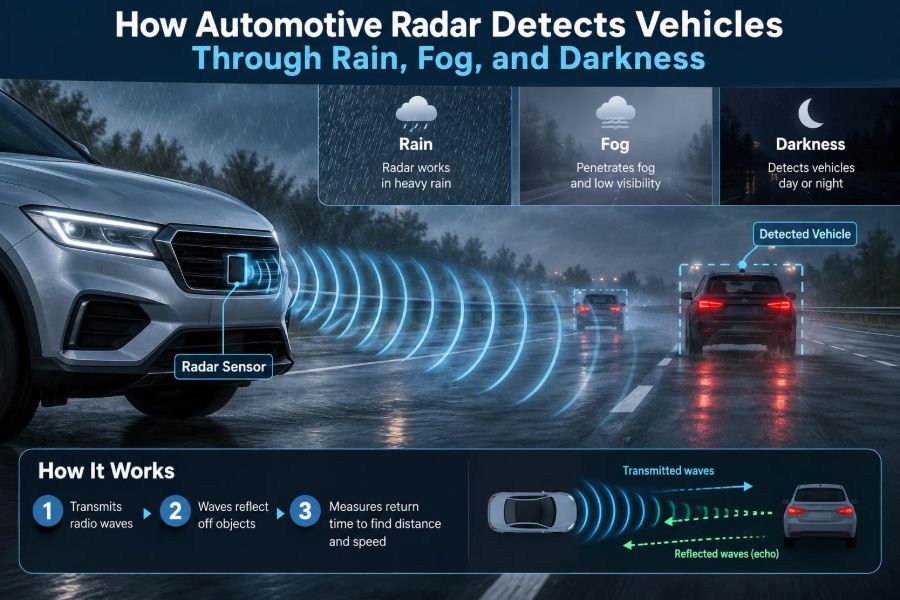

A driver is travelling on a wet motorway after sunset. Spray from heavy trucks hangs in the air, headlamps reflect from the road, and the outline of the vehicle ahead appears only at the last moment. For a human driver, this is a demanding visual task.
For an advanced driver-assistance system, the same situation raises a different question: can the vehicle still sense another road user when cameras are blinded by glare and lidar light is scattered by droplets? Automotive radar is designed to remain useful in many of these conditions.
Radar does not “see” a car as a camera does. It transmits radio waves, receives tiny echoes, and uses signal processing to estimate where objects are, how fast they are moving, and sometimes their direction of travel.
Its weather capability is one reason radar has become a central sensor in adaptive cruise control, automatic emergency braking, blind-spot monitoring, and parking assistance. Understanding its strengths and limits is essential for engineers, technicians, and anyone working with modern vehicles. 🌧️
📡 1. Radar Begins with Electromagnetic Waves
Radar stands for radio detection and ranging. A radar sensor sends electromagnetic energy into its surroundings and listens for energy reflected back from objects.
Because radio waves do not depend on visible light, radar can operate at night and can often work when fog, rain, dust, or smoke make camera images less useful. It is not unaffected by weather; rather, its operating wavelength gives it important advantages.
🔁 2. The Basic Send-and-Receive Cycle
An automotive radar repeatedly transmits a controlled waveform through an antenna. When that wave reaches a vehicle, guardrail, pedestrian, or other object, part of its energy scatters in many directions.
A small fraction returns to the radar receiver. The sensor compares the transmitted and received signals, then calculates target information from their delay, frequency change, and spatial pattern.
- Transmit: emit a known radio waveform.
- Propagate: let the wave travel through the environment.
- Reflect: collect echoes from objects.
- Process: estimate targets and track them over time.
⏱️ 3. Distance Comes from Travel Time
Radio waves travel close to the speed of light. If an echo returns after a measured round-trip time, the radar estimates range by dividing that travel distance by two.
The basic relationship is range = c × delay / 2, where c is the speed of light. In practice, automotive radar commonly extracts range through frequency analysis of a modulated signal rather than by directly timing a very short pulse.
🎵 4. Why FMCW Radar Is Common in Cars
Most automotive systems use frequency-modulated continuous-wave, or FMCW, radar. Instead of sending one isolated pulse, the radar transmits a continuous signal whose frequency changes in a controlled ramp, often called a chirp.
An echo arrives delayed relative to the currently transmitted chirp. Mixing the received and transmitted signals produces a lower-frequency beat signal, from which the processor can determine range.
FMCW architectures suit vehicles because they can measure short and long ranges while supporting compact, relatively low-power electronic hardware.
🚗 5. Relative Speed Comes from Doppler Shift
A target moving toward or away from the vehicle changes the frequency of its returned echo. This is the Doppler effect, the same physical principle that changes the pitch of a passing siren.
Radar processing separates the range-related beat information from Doppler-related information across multiple chirps. It can then estimate radial relative velocity: the part of the target’s motion directly toward or away from the sensor.
A vehicle crossing the road may have substantial sideways motion but a smaller radial velocity. This is one reason direction estimation and tracking are so valuable.
🧭 6. Angle Estimation Locates the Target
One antenna alone can indicate that an echo exists, but it provides limited angular information. Automotive radars use multiple antenna elements arranged in carefully designed arrays.
An arriving echo reaches each element with a tiny phase difference. By comparing those differences, the radar estimates an object’s azimuth angle and, in some designs, elevation angle.
This process is often called beamforming or angle-of-arrival estimation. It helps distinguish a vehicle in the same lane from one on an adjacent lane.
📊 7. The Radar Data Cube
Modern radar processing is frequently described as building a data cube. Its dimensions commonly represent range, Doppler velocity, and angle.
Peaks in this multi-dimensional data correspond to possible reflections. Algorithms must decide whether a peak is a meaningful target, clutter, noise, or interference from another radar.
🌫️ 8. Why Fog Is Often Less Severe for Radar
Fog consists of small suspended water droplets. Visible and near-infrared light can scatter strongly from those droplets, which reduces contrast for cameras and can limit optical ranging sensors.
Automotive radar uses much longer wavelengths than visible light. Relative to the radar wavelength, many fog droplets are small scatterers, so the wave can often travel through fog with much less attenuation than optical light.
“Less affected” does not mean “perfectly transparent.” Dense fog and wet sensor surfaces can still reduce performance, especially when a radar must detect weak targets.
🌧️ 9. Rain Has a More Noticeable Effect
Raindrops are larger than fog droplets and can scatter or absorb more radar energy. Heavy rain therefore increases propagation loss and raises the background of unwanted echoes.
The practical result can be a shorter effective detection distance, reduced confidence, or more challenging target separation. A large metal vehicle usually remains a strong reflector, but a small or distant object may become harder to detect.
Rain also creates another problem: water can accumulate on the bumper cover or radar radome in front of the antenna.
❄️ 10. Snow, Ice, and Slush Need Special Attention
Snow conditions vary widely. Dry, light snow may affect radar differently from wet snow, compacted slush, or an ice layer on the sensor cover.
A layer of water, ice, mud, or snow can attenuate and distort the signal before it even leaves the vehicle. This obstruction is often more important than scattering in the air.
- Keep the radar’s exterior area clean when safe to do so.
- Do not paint, repair, or attach accessories over a radar location without approved procedures.
- Recognise warning messages as a possible indication of sensor obstruction, not necessarily a sensor failure.
🌙 11. Darkness Is Not a Radar Problem
Radar does not need sunlight, street lighting, or headlamp illumination. A completely dark road does not inherently reduce its ability to transmit waves and receive echoes.
This makes radar a valuable complement to cameras, which need enough usable light and contrast. However, darkness may still affect the entire driving system indirectly if other sensors or human supervision are needed for a decision.
🪞 12. Vehicles Reflect Radar Unevenly
A vehicle is not one uniform reflector. Its metal body panels, wheel assemblies, engine bay structures, licence-plate region, bumper geometry, and underbody can return energy in different ways.
The apparent radar strength of an object is described by its radar cross section. It depends on shape, material, orientation, frequency, and viewing angle, not simply on physical size.
A broad flat surface may reflect energy away from the radar at one angle, while corners and complex structures can produce strong returns at another.
📐 13. Radar Cross Section Explains Surprising Detections
A large object is not always easier to detect than a smaller one. A metal guardrail, a truck’s rear structure, or a roadside sign can produce a stronger echo than an object with less reflective geometry.
Engineers therefore do not treat echo strength as a direct measurement of vehicle size. The processor combines strength with range, velocity, angle, shape over time, and knowledge of the driving scene.
🛣️ 14. Roads Create Clutter
Clutter is unwanted radar energy from the environment. Road surfaces, barriers, curbs, bridge structures, parked vehicles, drainage covers, and vegetation may all generate returns.
Wet roads can alter reflection behavior and create complex multipath paths. The radar must identify a relevant moving lead vehicle without reacting inappropriately to every stationary roadside reflection.
↔️ 15. Multipath Can Move an Echo
In a direct path, the wave travels from radar to target and back. In a multipath situation, it may reflect from the road or another surface before reaching the target or receiver.
That extra route changes delay and angle. It can create ghost-like detections, make a target appear at an incorrect position, or strengthen and weaken returns as the vehicle moves.
Tracking filters and scene-consistency checks are used to reduce the influence of these effects.
🧹 16. Signal Processing Separates Targets from Noise
The receiver contains thermal noise, electronic imperfections, environmental clutter, and possible interference. A useful target echo may be very weak after travelling to an object and back.
Processing applies filtering, Fourier transforms, detection thresholds, and adaptive methods that consider local noise conditions. The objective is to detect real echoes while limiting false alarms.
A threshold set too low creates excessive false detections; one set too high can miss weak but important targets. This is a fundamental engineering trade-off.
🎯 17. Detection Is Different from Classification
Radar may first detect a cluster of reflected energy. That does not automatically establish whether the object is a car, motorcycle, pedestrian, barrier, or discarded item.
Classification uses features such as motion, size of the cluster, reflection distribution, persistence, and history. Some systems also combine radar evidence with camera or other sensor information.
🧩 18. Tracking Makes Individual Measurements Useful
A single radar frame can be ambiguous. A tracker associates detections across successive frames and estimates a target’s position, speed, acceleration, and likely path.
Tracking can maintain an object temporarily when its echo fades behind spray or another vehicle. It must also remove tracks when the object is no longer credible, avoiding an outdated belief that a target remains present.
🛞 19. The Sensor Measures Relative Motion
Radar naturally measures motion relative to the radar-equipped vehicle. A stationary guardrail appears to move backward in the vehicle’s reference frame as the car drives forward.
Vehicle speed, yaw rate, steering behavior, and inertial measurements help transform radar observations into a more meaningful road-based interpretation. This is important for distinguishing parked objects, infrastructure, and moving traffic.
🧠 20. Sensor Fusion Adds Context
No production driving sensor is ideal in every situation. Cameras provide rich visual classification, radar supplies robust range and velocity information, and other sensors may contribute geometry or proximity data.
Sensor fusion combines complementary evidence. A camera may help identify lane markings and object type, while radar may retain a reliable speed estimate through darkness, glare, or haze.
| Sensor type | Useful strength | Typical weather-related challenge |
|---|---|---|
| Radar | Range and relative velocity in low light | Clutter, multipath, blocked radome, reduced performance in heavy precipitation |
| Camera | Visual detail, colour, signs, lane context | Darkness, glare, fog, spray, obscured lens |
| Lidar | Detailed geometric ranging | Optical scattering and attenuation from fog, rain, snow, and contamination |
📶 21. Radar Bands Shape Sensor Design
Automotive radar systems operate in radio-frequency bands allocated for such applications, with designs commonly associated with frequencies around the tens-of-gigahertz region. Frequency choice affects antenna size, available bandwidth, resolution, propagation, and regulatory design constraints.
Higher bandwidth can support finer range separation. Antenna arrays and advanced modulation support angular and velocity measurements, but every improvement involves hardware, computation, cost, and integration trade-offs.
🔍 22. Resolution Is Not the Same as Accuracy
Range resolution is the ability to separate two nearby objects in distance. Accuracy describes how close an estimated value is to the true one after calibration and processing.
Angular resolution determines whether objects at similar range can be separated side by side. A radar may accurately estimate the position of a clear isolated vehicle yet struggle to resolve several tightly spaced objects.
🚚 23. Large Vehicles and Roadside Structures Challenge Interpretation
Trucks can produce many separate reflection points from their rear, sides, wheels, and trailers. A curve in the road can also bring barriers, signs, and vehicles into similar angular regions.
The system must decide which returns belong together and which object is relevant to the planned path. This is why real-world radar behavior is more complex than a simple “object detected” indicator.
🏙️ 24. Urban Driving Adds Dense Reflection Environments
City streets contain parked vehicles, metal street furniture, building facades, tram infrastructure, tunnels, and frequent crossing traffic. These elements create crowded radar scenes.
Good radar performance depends on robust object association, clutter suppression, and fusion with other sensing and map or vehicle-motion information where available. Weather resilience does not remove this scene complexity.
⚠️ 25. Interference Is an Engineering Concern
Many nearby vehicles may operate radar sensors at the same time. If another radar’s energy enters a receiver, it can resemble noise or create unwanted structures in the processed data.
Waveform design, timing strategies, interference detection, and signal-processing techniques help manage this issue. The goal is graceful operation in dense traffic rather than assuming the radio environment is empty.
🧪 26. Validation Must Include Real Weather
Engineers evaluate radar using controlled tests, simulation, laboratory measurements, and road testing. Real weather matters because rainfall rate, droplet size, road wetness, spray, contamination, temperature, and target geometry interact.
Testing should include representative situations: a lead vehicle in spray, roadside barriers on wet curves, low-reflectivity objects, dirty radomes, tunnels, and transitions between open road and urban areas.
🔧 27. Installation and Repair Affect Performance
A radar can be capable on the bench but perform poorly if mounted incorrectly. Its position, orientation, bumper material, surrounding brackets, wiring, and calibration all influence the measurement.
After certain collision repairs, bumper replacements, suspension changes, or alignment work, manufacturer procedures may require sensor inspection, aiming, or calibration. Ignoring these steps can compromise driver-assistance functions.
👤 28. Driver Assistance Still Has Limits
A radar-equipped feature is an assistance system, not a guarantee that every hazard will be detected in every condition. Small objects, unusual shapes, severe contamination, abrupt cut-ins, close-range blind regions, and complex reflections can challenge sensing.
Drivers must follow the vehicle instructions, remain attentive, and maintain responsibility for safe operation. Engineers should communicate system capability clearly without implying certainty beyond the sensor’s design limits.
✅ 29. The Core Principle: Useful Echoes, Not Perfect Vision
Automotive radar detects vehicles by transmitting radio waves and interpreting returned echoes for range, relative speed, and direction. Its long-wavelength operation lets it remain effective in darkness and often more resilient than optical sensors in fog, spray, and rain.
Yet radar performance is shaped by weather severity, target reflectivity, sensor-cover contamination, clutter, multipath, interference, and processing quality. The strongest systems use radar as part of a carefully engineered sensing stack rather than as a standalone substitute for every other source of information.
Radar succeeds in difficult weather not because it sees everything, but because it measures motion and distance with radio waves that often travel where human vision and optical sensors struggle. 📡🚗🌧️