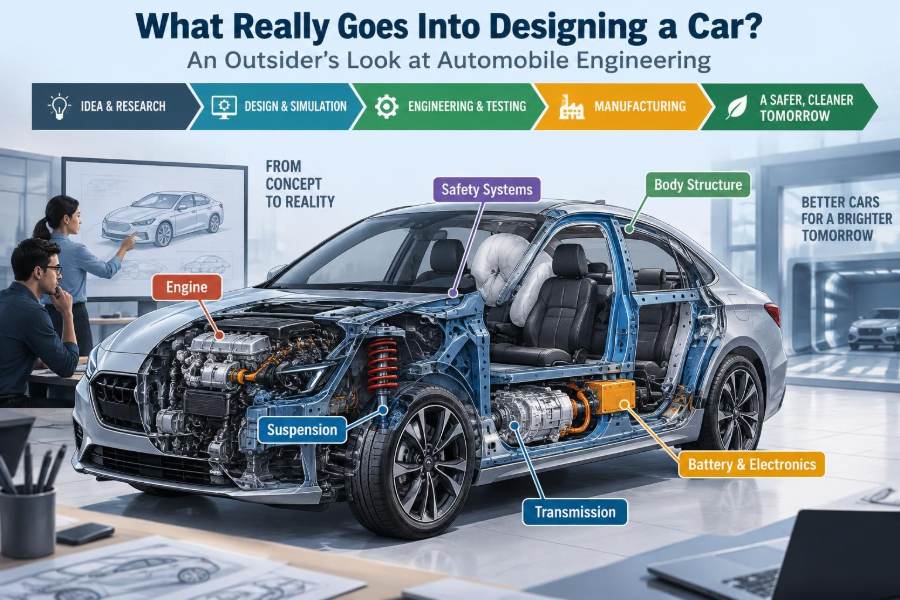

A car can look deceptively simple from the outside. You choose a colour, notice the headlights, sit in the cabin, press a pedal, and expect it to move safely and comfortably through traffic, rain, heat, potholes, and long highway trips.
But consider an everyday moment: a family loads luggage into a hatchback, a driver brakes suddenly for a pedestrian, and the air-conditioning keeps the cabin comfortable on a hot afternoon. Each ordinary experience depends on hundreds of design decisions made years before the car reached the road.
That is why automobile engineering is much more than drawing attractive body shapes or selecting a powerful engine. It is the work of making many systems function together, often under conflicting requirements.
For students considering the field, and professionals who work alongside vehicle teams, an outsider’s view is useful: it reveals both the visible product and the careful engineering hidden beneath it.
🧩 A Car Is a System, Not a Single Machine
An automobile is best understood as a system of systems. The structure, powertrain, suspension, brakes, electronics, software, interior, cooling system, and body panels all affect one another.
For example, fitting a larger battery may extend an electric vehicle’s range, but it also adds mass. That mass can change acceleration, braking distance, suspension tuning, tyre wear, structural requirements, and the space available for passengers.
Automobile engineers therefore spend much of their time managing connections between parts rather than improving one component in isolation.
🎯 The Design Brief Starts With Real Use
Before engineers select materials or create computer models, the team needs a clear vehicle brief. It describes who will use the vehicle, where it will operate, what it should carry, and what priorities it must meet.
A compact urban car, for instance, may prioritise easy parking, efficiency, visibility, low-speed ride comfort, and an affordable manufacturing approach. A utility vehicle may need higher ground clearance, towing ability, durable suspension, and useful cargo access.
A good brief turns broad intentions into engineering targets. Without it, teams can optimise the wrong feature very efficiently.
👥 Understanding the Intended Driver
Vehicle design begins with people, not hardware. Engineers and designers consider body sizes, seating postures, reach to controls, visibility around pillars, ease of entering the cabin, and the effort required to close a tailgate or operate a switch.
This work is often called ergonomics or human factors. It recognises that a technically capable vehicle can still feel poor if the driver cannot see clearly, find a control quickly, or remain comfortable over a long journey.
Designing for a range of users is harder than designing for an “average” person. The smallest and tallest expected occupants may reveal conflicts that a sketch cannot show.
📏 Packaging: Making Everything Fit
Packaging is the discipline of arranging components within limited space. It determines where occupants sit, how much cargo volume remains, where the fuel tank or battery pack goes, and how crash structures, wiring, cooling ducts, and suspension parts coexist.
A vehicle may have impressive individual components but still fail as a package. A rear seat that folds awkwardly, a battery that intrudes into foot space, or a service point hidden behind major parts can create lasting problems.
Packaging is especially demanding because the same space is wanted by several teams. The front of a vehicle might need room for crash absorption, cooling hardware, lighting, steering, suspension movement, and styling surfaces.
✏️ Styling Must Become Buildable Geometry
Exterior styling gives a car its character, but sketches are only the beginning. Designers create surfaces that communicate proportion and identity; engineers must ensure those surfaces can be manufactured, assembled, painted, repaired, and kept within dimensional tolerances.
A sharp crease may look striking, yet require difficult stamping tools or create inconsistent reflections if the panel flexes. A very low bonnet may improve appearance and aerodynamic flow while leaving too little space for pedestrian-impact requirements or under-bonnet components.
The strongest designs emerge when styling and engineering develop together, rather than treating one as a late obstacle to the other.
🌬️ Aerodynamics Shapes More Than Speed
Aerodynamics examines how air flows around, through, and under a vehicle. At motorway speeds, aerodynamic drag has a major influence on the energy needed to maintain speed, whether the vehicle uses petrol, diesel, electricity, or another energy source.
Engineers use wind-tunnel testing and computational fluid dynamics, often shortened to CFD, to study airflow. They look for ways to reduce drag, control lift, manage cooling air, limit wind noise, and keep windows, cameras, and lights usable in poor weather.
A smoother shape is not automatically best. Cooling openings, brake temperatures, cabin ventilation, styling intent, and stability in crosswinds all create trade-offs.
⚖️ Mass Is a Design Constraint Everywhere
Reducing vehicle mass can help energy consumption, acceleration, braking, and handling. Yet lightweight design is not simply a matter of replacing steel with a lighter material.
Materials differ in cost, stiffness, crash behaviour, corrosion resistance, joining methods, repairability, and availability. An aluminium panel, high-strength steel reinforcement, plastic trim, and composite component may all be appropriate in different locations.
Engineers focus on the right mass in the right place. Lowering mass high in the body can improve stability, while strategically strong structures can protect occupants without adding material indiscriminately.
🏗️ The Body Structure Carries Hidden Responsibilities
The body-in-white is the welded or bonded structural shell before paint, trim, glass, and mechanical components are fitted. It supports loads from the suspension, protects the passenger compartment, provides attachment points, and helps determine how solid the vehicle feels.
Structural stiffness matters because a flexible body can allow noise, vibration, and harshness to enter the cabin. It can also make suspension tuning less predictable, since the suspension mounts are moving relative to each other.
At the same time, the structure must be practical to manufacture repeatedly. A design that works for one hand-built prototype may not work on a production line producing many vehicles.
🛡️ Crash Safety Is Planned, Not Added Later
Crashworthiness is engineered into the vehicle architecture from the start. The aim is to manage crash energy while maintaining a survivable space for occupants and supporting restraint systems such as seat belts and airbags.
Different crash directions create different problems. Frontal impacts need controlled energy absorption ahead of the cabin; side impacts leave less physical space to manage loads; roof strength matters in rollover events; rear impacts affect fuel, battery, and seat considerations.
Physical crash tests remain essential, while computer simulation allows teams to explore many design changes before building every test vehicle. Simulations are powerful, but their usefulness depends on accurate material and component data.
🧍 Restraints Work With the Vehicle Structure
Seat belts, seats, head restraints, airbags, sensors, and the body structure form one safety system. An airbag is not a universal cushion; its timing, shape, inflation behaviour, and interaction with the occupant must suit the crash scenario.
Seat design is particularly important because it positions the occupant and transfers loads during a crash. Head restraints also help reduce the relative motion between the head and torso in certain rear-impact situations.
Real occupants vary in size, posture, and seating position. This is one reason safety engineering is complex and why correct seat-belt use remains essential even in vehicles with extensive protective technology.
🛞 Tyres Are the Vehicle’s Only Road Contact
All steering, braking, acceleration, and cornering forces reach the road through four small tyre contact patches. That makes tyre selection and tyre-pressure management central to vehicle behaviour.
A tyre must balance dry grip, wet grip, rolling resistance, noise, wear, ride quality, load capacity, and cost. Improving one characteristic can compromise another, so there is no single perfect tyre for every vehicle and climate.
For drivers, worn tread, incorrect pressure, or mismatched tyres can undermine the performance that engineers worked to create. The tyre is not an accessory; it is part of the vehicle’s dynamic system.
🪀 Suspension Balances Comfort and Control
The suspension allows wheels to move over uneven roads while helping the body remain controlled. Springs support the vehicle, dampers control oscillation, and links guide wheel movement through bump, braking, and cornering.
A soft setup can improve comfort on broken roads but may allow more body movement. A firmer setup can feel more controlled in fast direction changes but may transmit sharper impacts into the cabin.
Suspension tuning also depends on vehicle mass distribution, tyre properties, body stiffness, wheel size, and the intended road conditions. A specification that feels excellent on a smooth test track may be unsuitable for rough daily roads.
🧭 Steering Creates the Driver’s Connection
Steering design is about more than turning the wheels. It influences how accurately a driver places the car in a lane, how stable it feels at speed, how much effort parking requires, and how much road feedback reaches the driver.
Modern vehicles commonly use electric power steering. It can reduce energy use compared with systems that continuously drive a hydraulic pump, and it can support functions such as lane-keeping assistance.
However, assistance must be calibrated carefully. Steering that is too light may feel vague; steering that is too heavy can be tiring. Good steering gives the driver confidence without demanding constant correction.
🛑 Braking Is Heat Management as Well as Stopping Power
When a moving vehicle slows down, much of its kinetic energy becomes heat in the braking system. Disc brakes, pads, calipers, and related components must produce predictable braking force while controlling temperature and wear.
Anti-lock braking systems monitor wheel behaviour and reduce the chance of sustained wheel lock during heavy braking. Stability-control systems can use individual wheel braking to help manage loss of directional control in certain situations.
Braking performance is influenced by tyres, road surface, vehicle load, temperature, and maintenance. Technology assists the driver, but it cannot create grip where the road and tyres provide very little.
🔧 Powertrain Choices Change the Whole Vehicle
The powertrain supplies motion, but its influence extends far beyond acceleration. It affects vehicle mass, packaging, cooling, sound, vibration, maintenance needs, energy storage, and the shape of the underbody.
| Powertrain approach | Core design focus | Typical engineering trade-off |
|---|---|---|
| Internal-combustion engine | Fuel delivery, combustion, exhaust treatment, transmission integration | Useful energy density, but complex thermal and emissions management |
| Hybrid system | Coordination of engine, motor, battery, and controls | Can recover energy, but adds system complexity and packaging demands |
| Battery-electric system | Battery protection, motor efficiency, charging, thermal control | Quiet and efficient operation, but battery mass and charging needs shape the design |
No approach eliminates engineering compromises. The appropriate solution depends on use case, infrastructure, cost targets, regulations, and the vehicle’s intended life.
🔥 Thermal Management Keeps Components in Their Working Range
Engines, electric motors, inverters, batteries, brakes, cabin occupants, and electronic modules all generate or respond to heat. Thermal management is the system of moving heat where it is needed and removing it where it is harmful.
In an electric vehicle, a battery may need cooling during demanding operation and conditioning for efficient charging or cold-weather performance. In a combustion vehicle, coolant and oil temperatures must be controlled while the cabin may also need heat.
Thermal design is often hidden behind grilles, ducts, pumps, heat exchangers, valves, and software. Yet it strongly affects durability, efficiency, comfort, and performance consistency.
🔋 Electrical Architecture Is the Vehicle’s Nervous System
Modern vehicles contain wiring harnesses, controllers, sensors, actuators, communication networks, and power-distribution hardware. Together, these form an electrical and electronic architecture that allows systems to share information.
A wheel-speed sensor can contribute to braking control, traction control, instrument displays, and driver-assistance functions. This sharing can add useful capability, but it also means faults must be diagnosed carefully.
Wiring itself is a packaging challenge. Harnesses must be routed away from heat, sharp edges, water paths, moving parts, and areas that could be damaged in a collision.
💻 Software Now Defines Much of the Driving Experience
Software determines how many vehicle systems behave: motor response, automatic transmission shifts, battery control, climate settings, display information, locking functions, and driver-assistance features.
Calibration is the process of setting control parameters so a system responds appropriately in many conditions. For example, the same accelerator movement may be interpreted differently depending on selected drive mode, traction conditions, battery state, and component temperatures.
Software enables updates and flexible functionality, but it introduces new responsibilities. Engineers must consider reliability, cybersecurity, fault handling, validation, and how the vehicle behaves when a sensor signal is missing or implausible.
📡 Driver Assistance Requires Clear Limits
Features such as emergency braking support, parking sensors, lane-centering assistance, and adaptive cruise control can reduce workload or help in specific hazards. They rely on combinations of cameras, radar, ultrasonic sensors, maps, and software logic.
These systems have operating limits. Rain, glare, dirt, unusual road markings, hidden objects, sharp curves, and sensor obstruction can affect performance. A driver-assistance feature is not the same as a universally capable autonomous driver.
Clear warnings, intuitive handover behaviour, and accurate user information are engineering requirements, not merely legal details. A feature that is technically advanced but easily misunderstood can create risk.
🔇 Refinement Means Managing Noise, Vibration, and Harshness
Engineers often use the term NVH for noise, vibration, and harshness. It covers booming sounds in the cabin, tyre roar, wind noise, steering-wheel vibration, powertrain shudder, rattles, and the sharpness felt over bumps.
NVH work identifies both the source of a disturbance and the path by which it reaches occupants. A vibration may begin at a motor mount, travel through a structural member, and become noticeable as a buzzing trim panel.
Adding insulation can help, but it also adds cost and mass. Better solutions may involve changing a component’s stiffness, mount tuning, panel shape, gear design, or control strategy.
🪑 Interior Engineering Handles Daily Friction
The interior is where users judge a vehicle every day. Engineers consider seating comfort, storage, displays, switch placement, climate airflow, material durability, glare, cleaning, child-seat access, and the sound of controls operating.
Small details matter. Can a driver use a frequently needed control without looking away from the road? Does a cup holder secure different container shapes? Does a touchscreen remain usable with gloves, vibration, or bright sunlight?
Interior teams also manage safety requirements, manufacturing tolerances, and the need to fit airbags, ducts, wiring, and structural cross-members behind apparently simple surfaces.
🌧️ Durability Means Expecting Unkind Conditions
Cars face vibration, heat, cold, humidity, dust, salt, water, ultraviolet exposure, potholes, repeated door slams, and uneven maintenance. Durability engineering asks how components age under these real-world stresses.
Testing can include corrosion exposure, thermal cycling, rough-road running, repeated operation of mechanisms, and checks for water intrusion. The purpose is not to make a vehicle indestructible; it is to find likely weak points before customers do.
Design choices should also account for variation. A part that works only when assembled perfectly, maintained precisely, and used in mild weather is not robust enough for ordinary service.
🏭 Designing for Manufacturing Changes the Answer
Manufacturing engineering asks whether a vehicle can be built safely, consistently, and economically at the intended production volume. It considers tool access, welding or bonding sequences, robot paths, part handling, inspection points, and assembly time.
A component with an elegant shape may be difficult to stamp or mould. A fastener may be impossible to reach after another part is installed. A tolerance stack-up—small dimensional variations accumulating across several parts—can create uneven panel gaps or squeaks.
Design for manufacture does not reduce creativity. It turns a promising design into a repeatable product rather than a one-off prototype.
🔩 Serviceability Matters After the Sale
Vehicles need inspection, repair, and replacement parts throughout their lives. Serviceability considers whether technicians can safely access filters, brakes, sensors, high-voltage components, diagnostic connections, and common wear items.
Poor access can increase repair time, cost, and the chance of accidental damage. It can also discourage proper maintenance when a simple task requires removing many unrelated parts.
For electrified vehicles, service procedures need particular care because high-voltage systems require isolation methods, trained personnel, and clearly designed protection against unintended contact.
♻️ Sustainability Includes the Entire Vehicle Life
Environmental thinking in automobile engineering goes beyond tailpipe emissions. It includes material extraction, component manufacture, energy use during operation, maintenance, battery or fuel supply, repair, and end-of-life recovery.
Recycled materials, efficient manufacturing, longer component life, lower energy consumption, and easier disassembly can all contribute in different ways. Yet each decision needs context: a material that is easily recycled may not suit every structural or thermal requirement.
A life-cycle perspective avoids simplistic claims. The most responsible design is usually the one that examines where the largest impacts occur for that vehicle’s real operating pattern.
📜 Regulations Set Boundaries, Not a Complete Design
Vehicles must satisfy applicable requirements related to areas such as safety, lighting, braking, emissions, electromagnetic compatibility, and occupant protection. Requirements vary by market, so a global vehicle may need adaptations.
Compliance is essential, but meeting a minimum rule is not identical to creating an excellent vehicle. Engineers still make choices about comfort, durability, usability, and performance that are not fully dictated by regulations.
Requirements can also change during a vehicle programme. Teams need disciplined documentation and verification so they can show that the finished vehicle matches the intended specification.
🧪 Prototypes Turn Assumptions Into Evidence
Virtual models are central to modern development, but prototypes remain invaluable. Physical vehicles reveal interactions that are difficult to capture fully: an unexpected rattle, uncomfortable seat pressure, awkward visibility, water paths, or a control response that feels unnatural.
Prototype stages serve different purposes. Early models may check package space and proportions; engineering prototypes may test systems and structures; later vehicles help validate assembly methods and production-quality parts.
A test result is only useful when engineers understand the conditions behind it. Repeating a test without a clear hypothesis can consume time while producing little learning.
🔄 Vehicle Development Is Iterative, Not Linear
Popular diagrams can make car development look like a neat sequence from concept to production. In practice, it involves loops. A crash result may require a structural change; that change may affect mass, styling surfaces, assembly, and suspension calibration.
Good teams manage these loops early, when changes are easier to make. Late changes tend to be expensive because many connected drawings, tools, suppliers, tests, and software functions may need revision.
This is why communication is an engineering skill. Mechanical, electrical, software, manufacturing, purchasing, quality, and design teams need a shared understanding of priorities and constraints.
⚠️ Common Outsider Misunderstandings
One common misconception is that a feature can be judged separately from the rest of the car. In reality, “just add a bigger battery,” “just make it lower,” or “just use thicker metal” can create a chain of new problems.
- More power may demand stronger cooling, tyres, brakes, driveline parts, and thermal protection.
- More cabin space may conflict with crash zones, luggage volume, wheel travel, or exterior length.
- More screens can add information but may create distraction, glare, and software complexity.
- More sound insulation can improve quietness while increasing mass and material use.
Engineering is not resistance to ideas. It is the disciplined process of exposing their consequences before they reach the customer.
🎓 Skills That Matter in Automobile Engineering
Strong foundations in mechanics, materials, thermodynamics, electronics, controls, and mathematics are valuable. So are practical abilities: reading drawings, using test data, understanding manufacturing processes, and communicating findings clearly.
Students should avoid seeing the field as only engines or only electric vehicles. The industry needs specialists, but systems thinking makes specialists more effective because they understand how their decisions affect adjacent teams.
Curiosity is equally useful. Taking apart a mechanism, observing how a car behaves over a speed bump, or asking why a component is shaped a certain way can develop the habit of engineering observation.
🤝 The Core Takeaway: Trade-Offs Create the Car
Designing a car means balancing safety, cost, energy use, reliability, comfort, manufacturing, regulations, performance, and customer expectations. These goals do not naturally align, so every successful vehicle is a collection of intentional compromises.
The best compromise is not always the one with the most impressive specification on paper. It is the one that suits the vehicle’s purpose, works consistently in real conditions, can be built and maintained responsibly, and communicates its limits honestly to the user.
That is the outsider’s most useful insight into automobile engineering: behind every door handle, brake pedal, body line, and battery pack is a network of decisions working together.
A car is not designed by adding features one by one; it is engineered by making thousands of connected choices work as one dependable whole. 🚗⚙️🔍