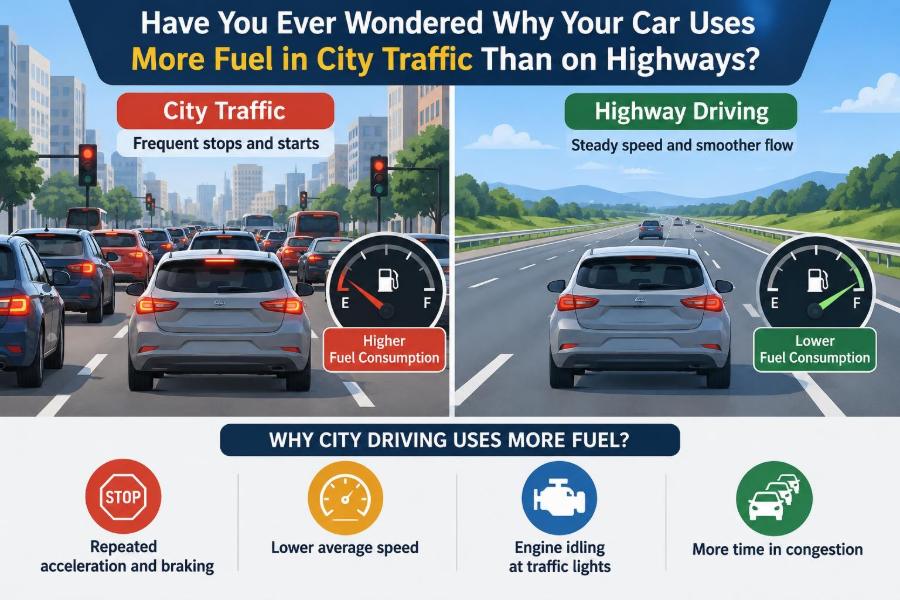

You leave home with a nearly full tank, travel only a few kilometres through signals, queues, speed breakers, and crowded junctions, and notice the fuel gauge falling faster than expected. Later, the same car covers a much longer distance on an open highway with surprisingly less fuel.
That difference is not simply a matter of “city driving is harder.” It comes from the way an engine, transmission, tyres, accessories, and the driver all respond to repeated changes in speed and load.
For students of automobile engineering, urban fuel use is a useful real-world example of energy conversion and vehicle dynamics. For drivers, understanding it helps explain the trip computer, plan journeys more realistically, and identify wasteful habits or maintenance issues.
The central idea is simple: a vehicle uses fuel most effectively when it moves steadily at a moderate load. City traffic repeatedly prevents that condition.
🚦 The Short Answer: Stop, Start, and Repeat
City driving contains frequent acceleration, braking, waiting, low-speed crawling, and gear changes. Each event either demands extra energy from the engine or wastes energy that was already used to make the car move.
On a clear highway, the engine can operate at a relatively stable speed and the vehicle can keep rolling for long periods. The fuel used per kilometre is therefore often lower, even though the distance covered is greater.
⛽ Fuel Economy Is Measured Per Distance, Not Per Minute
A key source of confusion is the difference between fuel used per hour and fuel used per kilometre. An idling engine consumes fuel while the car covers no distance at all.
If a car spends several minutes waiting at signals, its fuel consumption per minute may not seem dramatic. But when divided by a very small travelled distance, the result is poor fuel economy.
This is why a short, congested commute can show high litres-per-100-kilometres or low kilometres-per-litre figures. The engine has been running, but the odometer has barely advanced.
🏁 Acceleration Requires a Large Burst of Energy
To accelerate a car, the powertrain must increase the vehicle’s kinetic energy: the energy associated with motion. Kinetic energy rises with the square of speed, so bringing a vehicle repeatedly from rest to urban road speed requires meaningful energy each time.
Consider a hypothetical commute with ten traffic lights. If the driver accelerates from rest after each light and then brakes to stop again, the energy used to build speed is repeatedly removed at the brakes. A highway journey may need only one major acceleration, followed by long steady cruising.
Gentle acceleration is usually more economical than aggressive acceleration because it avoids unnecessarily high engine speed and large power demand. However, taking an excessively long time to reach traffic speed can also keep the engine in an inefficient operating condition. Smooth, purposeful acceleration is the practical target.
🛑 Braking Turns Motion into Heat
In a conventional vehicle, friction brakes convert the car’s kinetic energy into heat in the brake discs or drums and pads or shoes. That heat is dissipated to the surrounding air and cannot propel the vehicle again.
Every unnecessary brake application usually means fuel was previously burned to create motion that has now been discarded. Looking ahead, maintaining space from the vehicle ahead, and easing off the accelerator early can reduce this cycle.
Braking is still essential for safety. The goal is never to avoid braking at the expense of safe following distance, pedestrian awareness, or legal speed control.
🔄 Why Regenerative Braking Changes the Picture
Hybrid and electric vehicles can recover part of the energy normally lost during deceleration. Their traction motor operates as a generator, converting some vehicle motion back into electrical energy and storing it in the battery.
This is called regenerative braking. It makes city operation comparatively favourable for many hybrids and EVs, because frequent deceleration creates frequent recovery opportunities.
Recovery is not complete. Battery limits, motor limits, tyre grip, low battery temperature, and hard braking can reduce regeneration, while friction brakes may still be needed. Even so, regenerative braking is a major reason a hybrid’s city fuel economy can equal or sometimes exceed its highway result.
⚙️ Engines Have an Efficiency Sweet Spot
An internal-combustion engine does not convert fuel into useful mechanical work equally well at every speed and load. It generally performs better when moderately loaded and operating within a suitable engine-speed range.
At urban speeds, the engine may spend time lightly loaded, repeatedly changing speed, or operating at inefficient points between accelerations. It must also overcome its own internal friction, pump air, drive accessories, and remain ready to respond to the next movement.
At a steady highway cruise, a suitable gear can place the engine closer to a more efficient combination of load and revolutions per minute. The exact sweet spot differs between engines, transmissions, vehicle masses, and road conditions.
🌬️ Pumping Losses at Light Load
In a petrol engine, the throttle restricts incoming air when the driver requests little power. The pistons must work to draw air past this restriction, creating what are known as pumping losses.
Low-load urban operation can therefore be less efficient than a somewhat more loaded steady cruise. Diesel engines control power differently and often have lower throttling losses, but they still lose efficiency through idling, transients, and repeated acceleration.
Modern engines use technologies such as variable valve timing, direct injection, turbocharging, cylinder deactivation, and start-stop systems to reduce losses. These technologies help, but they do not eliminate the basic penalty of interrupted traffic flow.
🕹️ Gear Selection Matters in a Manual Car
In a manual transmission, a lower gear multiplies torque at the wheels, making acceleration easier. The trade-off is higher engine speed for a given road speed, which can raise fuel consumption if the gear is held longer than necessary.
Shifting up smoothly once adequate acceleration has been achieved generally reduces unnecessary engine speed. Shifting too early, however, can make the engine labour or shudder, requiring more throttle and reducing drivability.
A sensible rule is to choose the highest gear that allows the engine to run smoothly and respond safely to traffic conditions. The tachometer, engine sound, gradient, load, and manufacturer guidance all matter.
🔁 Automatic Transmissions in Slow Traffic
Automatic transmissions make dense traffic easier to manage, but repeated low-speed operation can involve frequent ratio changes, torque-converter slip, or clutch engagement and disengagement, depending on the design.
Modern torque-converter automatics, dual-clutch transmissions, continuously variable transmissions, and automated manuals use different strategies. Their urban efficiency can vary considerably because calibration matters as much as the hardware type.
A transmission that keeps the engine at high rpm for rapid response may use more fuel than one that upshifts earlier, but it may also feel more responsive. Manufacturers balance economy, smoothness, emissions control, durability, and driver expectations.
🧊 Cold Starts Use More Fuel
Many city trips begin with a cold engine. Until the coolant, engine oil, transmission fluid, catalyst, and other components reach operating temperature, friction and fuel use can be higher.
Petrol engines may also use richer operating strategies after starting to ensure stable combustion and help the emissions-control system warm up. Short journeys may end before these systems reach their most efficient condition.
Combining suitable errands into one trip can reduce repeated cold-start penalties. This should be done practically and safely, not by making unnecessary detours merely to warm the engine.
🅿️ Idling Produces Zero Kilometres
When a conventional engine idles, it burns fuel to keep itself running and to operate items such as the alternator, coolant pump, oil pump, and air-conditioning compressor. The wheels receive no useful propulsion.
Long waits in a parked vehicle therefore reduce average fuel economy. Where safe, legal, and appropriate for the vehicle, avoiding prolonged idling is sensible.
There are exceptions. Extreme weather, passenger safety, visibility needs, battery condition, traffic movement, and local regulations can affect the decision. Never switch off an engine where it would compromise control, safety, or the ability to move promptly.
🔌 Start-Stop Systems Save Fuel, with Limits
Automatic start-stop systems shut the engine off during suitable stationary periods and restart it when the driver releases the brake, presses the clutch, or requests movement. They are designed around stronger starter systems, batteries, and control logic than older vehicles.
They are most useful when stops are long enough to offset the restart event. In very brief stop-and-go movement, a system may choose not to activate, or its benefit may be limited.
Drivers may notice that start-stop is unavailable when the battery is low, cabin cooling demand is high, the engine is not warm, or the vehicle is on a steep grade. This is usually deliberate system protection rather than a fault.
❄️ Air Conditioning Adds an Urban Load
The air-conditioning compressor requires energy. In conventional cars, that energy ultimately comes from fuel; in EVs, it comes from the traction battery.
At highway speed, the compressor load is spread across many kilometres. In slow traffic, the same cooling demand continues while the car covers little distance, so its effect on fuel economy is more noticeable.
Cabin cooling, demisting, and occupant comfort are legitimate needs. A practical approach is to park in shade where possible, use ventilation before strong cooling on a very hot day, and maintain the HVAC system correctly rather than avoiding climate control at the cost of safety or comfort.
🔋 Electrical Accessories Are Not Completely Free
Headlamps, rear defoggers, blower motors, heated seats, infotainment systems, and charging devices draw electrical power. In an internal-combustion vehicle, the alternator supplies much of this power, increasing engine load.
Individual accessories may have a modest effect, but combined loads become more relevant during low-speed operation. The rear window defogger, for example, is intended for temporary use and should normally be switched off once clear visibility has been restored.
In an EV, accessory use affects driving range instead of liquid-fuel consumption. The underlying energy-balance principle remains the same.
🛞 Low Speed Does Not Mean Low Resistance
At city speeds, aerodynamic drag is lower than on the highway, but several other resistances remain. Tyres deform as they roll, bearings and drivetrain parts create friction, and the vehicle must repeatedly climb small gradients or cross uneven surfaces.
Rolling resistance is strongly influenced by tyre construction, pressure, load, and road surface. Underinflated tyres increase deformation and can raise fuel use while also affecting handling and tyre wear.
Highway driving has more aerodynamic drag, especially at high speed. Yet a moderate, steady highway speed can still be more economical overall than congested city movement because it avoids repeated acceleration and idle time.
🌪️ Why Very High Highway Speeds Also Consume More Fuel
Highway efficiency is not unlimited. Aerodynamic drag rises rapidly with speed, and the power needed to push air aside rises even more sharply.
Once speed becomes high, wind resistance can dominate the energy demand. The engine may need a richer power setting or a lower transmission ratio, while tyres and drivetrain also rotate faster.
That is why the most economical road trip is usually not achieved by driving as fast as possible. A steady legal speed, chosen for conditions and safety, is normally kinder to both fuel consumption and driver workload.
📊 City and Highway Driving at a Glance
| Operating factor | Typical city condition | Typical steady-highway condition |
|---|---|---|
| Vehicle speed | Constantly changing | Mostly stable |
| Engine operation | Idling, low load, rapid transients | Moderate, more consistent load |
| Braking energy | Frequently lost as heat | Less frequent |
| Gear changes | Frequent | Limited |
| Distance per minute | Often low | Usually high |
| Aerodynamic drag | Lower | Higher, especially at high speed |
The table describes common patterns, not a universal rule. A steep, windy highway or an empty urban bypass can produce very different results.
🗺️ Route Choice Can Matter More Than Distance
The shortest route on a map is not always the lowest-fuel route. A slightly longer road with smoother flow, fewer complete stops, and fewer steep gradients may use less fuel than a short route through repeated congestion.
Navigation systems can estimate travel time well when traffic data is available, but their fuel predictions may not fully account for your vehicle, driving style, payload, or air-conditioning use. Treat them as guidance rather than exact measurement tools.
For a regular commute, compare routes over several trips under similar conditions. One unusual day of rain, construction, or heavy traffic is not enough to judge a route fairly.
👀 Anticipation Is an Engineering-Friendly Driving Skill
Good fuel-efficient driving is largely about preserving momentum safely. Scan ahead for red lights, slowing traffic, pedestrians, merging vehicles, and road geometry, then release the accelerator early when a stop appears likely.
This gives the vehicle time to coast in gear or decelerate gently. It can reduce harsh braking and the need for another aggressive acceleration.
Anticipation must never become coasting through uncertainty. Keep attention on the road, obey signals, maintain safe gaps, and use the brakes whenever conditions require them.
↔️ Following Distance Prevents Wasteful Oscillation
Tailgating often creates a cycle of brake-accelerate-brake movement. A small speed change by one vehicle can amplify through traffic, forcing drivers behind to react more sharply.
Leaving an appropriate gap gives you time to respond gradually. It improves safety and can smooth your own speed, particularly in queues that are moving slowly but continuously.
This does not mean driving so slowly that you obstruct traffic. It means maintaining a safe, lawful space that matches speed, weather, visibility, and road conditions.
📱 Trip Computers Need Careful Interpretation
Instantaneous fuel-economy displays can fluctuate wildly in city traffic. At a stop, the calculated consumption per distance may show an extremely poor figure because fuel is being used while distance is nearly zero.
Average consumption over a full tank or several hundred kilometres is more useful for spotting trends. Resetting the display after every short trip can make normal variation look like a mechanical problem.
For better records, note distance travelled and fuel added over multiple fill-ups, using a consistent method. Even then, filling variation, traffic, weather, and route changes mean that small differences should not be overinterpreted.
🔧 Maintenance Problems That Raise City Consumption
Not every poor city fuel figure is normal. A maintenance issue can make the urban penalty worse because stop-start conditions expose poor combustion, excess drag, and weak battery performance.
- Incorrect tyre pressure increases rolling resistance.
- A dragging brake can waste energy and may cause heat or pulling to one side.
- A dirty air filter, worn spark plugs, or fuel-system fault can affect combustion in applicable engines.
- Incorrect engine oil specification can increase friction or affect designed operation.
- Faulty sensors or warning lights may indicate an emissions or engine-management problem.
If consumption changes suddenly without a clear change in route, load, weather, or driving pattern, consult the owner’s manual and have the vehicle inspected by a qualified technician.
🧳 Mass and Roof Loads Increase the Demand
Extra passengers and cargo increase the energy required for acceleration and for climbing. Their effect is especially noticeable in city traffic because the added mass must be accelerated repeatedly.
A roof box, bicycle carrier, or open roof rack can also increase aerodynamic drag. This matters most at highway speed, where air resistance is already significant.
Remove temporary external carriers when they are no longer needed, and avoid carrying unnecessary heavy items for months. Do not compromise emergency preparedness or vehicle stability merely to save a small amount of fuel.
⛰️ Hills, Surfaces, and Weather Change the Result
Urban routes are rarely flat and uniform. Climbing a hill demands extra energy, rough roads increase rolling losses, and wet roads can add resistance through water displacement.
Cold weather can lengthen warm-up time and increase the need for cabin heating or window clearing. Hot weather raises cooling demand, while strong winds alter aerodynamic resistance even on roads that appear level.
These factors explain why the same driver and vehicle can return different fuel-economy figures from one week to the next without any defect being present.
🚙 Vehicle Type Makes a Difference
A small, light car generally needs less energy to accelerate than a larger, heavier SUV or pickup, all else being equal. Vehicle shape, tyre size, drivetrain layout, engine type, and transmission calibration also influence urban consumption.
Turbocharged petrol engines can provide strong low-speed torque, but fuel use still rises when frequent acceleration demands boost. Diesel vehicles may be efficient at certain loads, yet their real-world city result depends on trip length, emissions-system operation, and traffic pattern.
Comparisons should be made between similar vehicles and similar routes. A single published consumption value cannot predict every owner’s daily commute.
🔋 Hybrids Use Their Hardware Where Cities Hurt Most
A hybrid can switch off its engine at some stops, assist acceleration with an electric motor, recover energy during braking, and manage engine operation more selectively. These features directly address common urban losses.
That does not mean every hybrid always uses less fuel than every conventional car. Battery state, temperature, speed, terrain, trip length, and driving conditions all influence the outcome.
Plug-in hybrids can use very little petrol on short trips only when they are charged and operated within an appropriate electric-driving range. Once the battery’s readily available charge is low, they may carry additional mass and behave more like a conventional hybrid or petrol vehicle.
⚡ Electric Vehicles Face a Different City-Highway Trade-Off
Electric motors are efficient over a broad operating range, and regenerative braking recovers part of deceleration energy. As a result, EVs often perform well in stop-start traffic compared with combustion vehicles.
At higher highway speeds, aerodynamic drag becomes a major drain on battery energy. Cabin heating or cooling, cold weather, hills, and fast driving can also reduce range.
So the principle is broader than petrol or diesel: stable motion reduces some losses, but each powertrain has its own strengths. For EVs, city traffic may be less damaging to efficiency than fast highway travel; for conventional cars, the reverse is commonly true.
🧠 Common Fuel-Saving Myths to Avoid
Some habits sound economical but are unsafe or counterproductive. Coasting downhill in neutral removes engine braking and can reduce control; in many modern fuel-injected vehicles, decelerating in gear may use very little or no injected fuel under suitable conditions.
Another mistake is accelerating extremely hard to “get it over with.” Rapid acceleration generally demands high power and often uses more fuel. The opposite extreme, crawling far below the natural traffic flow, can create hazards and may not save much.
Do not ignore tyre pressures, warning lights, or brake drag while trying to improve driving technique. Mechanical condition is the foundation of meaningful fuel-economy improvement.
✅ A Practical City-Driving Checklist
- Plan departures to avoid predictable peak congestion when possible.
- Check tyre pressures when tyres are cold, using the vehicle manufacturer’s recommended values.
- Accelerate smoothly and shift appropriately without labouring the engine.
- Look ahead and lift off early when a stop is developing.
- Maintain a safe following distance to reduce unnecessary speed changes.
- Avoid extended idling where safe, legal, and practical.
- Remove unnecessary cargo and temporary roof accessories.
- Track fuel use over enough distance to identify a real trend.
These steps work best as a system. One perfect gear change cannot offset a heavily congested route, underinflated tyres, and repeated aggressive braking.
🎓 The Engineering Takeaway: Manage Energy, Not Just Fuel
Fuel consumption in city traffic is fundamentally an energy-management problem. Fuel energy must overcome engine losses, drivetrain friction, rolling resistance, accessory loads, gradients, and—most visibly—the repeated creation and destruction of vehicle motion.
Highway driving often improves fuel economy because the vehicle can sustain motion with fewer interruptions and the powertrain can settle into a stable operating region. At very high speeds, however, aerodynamic drag reverses part of that advantage.
The best practical approach is not to chase a single display number. It is to drive smoothly, preserve momentum safely, maintain the vehicle properly, and recognise that traffic conditions set real physical limits on what any car can achieve.
Your car uses more fuel in city traffic mainly because it spends more time idling, repeatedly accelerates mass, and loses momentum through braking before covering much distance. Understanding that energy flow turns a frustrating fuel gauge observation into a clear engineering lesson—and a useful guide for everyday driving. 🚗⛽🔧