
You are cruising on a level highway in a large sedan, SUV, or pickup. The engine has more than enough power in reserve, yet the dashboard shows surprisingly modest fuel use. Nothing feels different at the accelerator, and there is no obvious change in engine sound.
In many modern vehicles, that smooth efficiency comes from cylinder deactivation. When the engine is lightly loaded, its control system can temporarily stop selected cylinders from producing power. Press the accelerator harder, and the full engine returns almost immediately.
The idea can sound counterintuitive. Why build an engine with six or eight cylinders, only to run it on fewer? The answer lies in the way gasoline engines lose energy at light load.
Cylinder deactivation is not a substitute for careful driving, good maintenance, or electrification. It is a targeted engineering solution that helps an internal-combustion engine operate more efficiently during the conditions where many vehicles spend much of their time.
🔧 What cylinder deactivation means
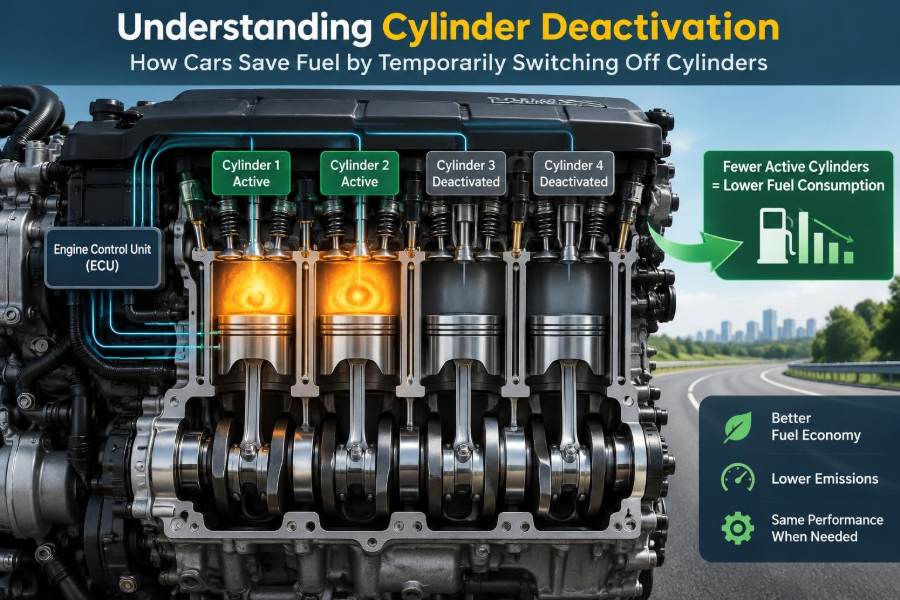
Cylinder deactivation, also called variable displacement or active fuel management, is a system that allows an engine to operate with fewer active cylinders when full output is unnecessary. A V8 may run as a four-cylinder, for example, while certain four-cylinder engines can operate on two cylinders.
“Deactivated” does not mean a cylinder disappears mechanically. Its valves are controlled so that it does not exchange air with the intake and exhaust systems, and fuel injection is stopped. The piston usually continues moving because it remains connected to the crankshaft.
🚦 Why engines rarely need maximum power
An engine is sized for demanding situations: brisk acceleration, steep climbs, full passenger or cargo load, towing, and high-speed operation. Those conditions require substantial torque, but they are not constant.
Holding a steady speed on level ground commonly needs only a fraction of the engine’s potential. Running every cylinder under this low demand can be less efficient than asking fewer cylinders to work at a more useful load.
🌬️ The hidden loss called pumping work
A spark-ignition gasoline engine normally controls power with a throttle. At light load, the throttle is partly closed, creating low pressure in the intake manifold. Each piston must draw air past that restriction during its intake stroke.
This effort is called pumping loss. It is not the only loss in an engine, but reducing it is a central reason cylinder deactivation can save fuel. With fewer cylinders firing, the remaining ones can open their throttles further for the same road power.
⚙️ The basic operating sequence
The engine control unit continuously reads inputs such as accelerator position, engine speed, load, temperature, gear selection, and sometimes road-grade estimates. When conditions are suitable, it commands a transition into reduced-cylinder operation.
- Fuel delivery stops to the selected cylinders.
- The valvetrain prevents their intake and exhaust valves from opening in the normal cycle.
- The throttle and ignition strategy adjust for the active cylinders.
- When demand rises, the system restores normal valve operation and fuel injection.
The transition is designed to occur quickly enough that the driver ordinarily does not need to manage it.
🛠️ Why the valves are usually closed
Simply cutting fuel would prevent combustion, but an unfueled cylinder could still pump air through the engine. That would retain much of the pumping work and could create undesirable emissions or exhaust-temperature effects.
Keeping both valves closed traps gas in the cylinder. As the piston moves up and down, that gas compresses and expands like a spring. Some energy is lost to heat, but less work is wasted than if the cylinder were repeatedly drawing in and expelling air.
🧩 The hardware behind the change
Different manufacturers use different mechanisms. Many systems use special hydraulic lifters that can collapse on command, disconnecting camshaft motion from selected valves. Others use switchable rocker arms, movable camshaft elements, or electrohydraulic valve-control components.
These parts must operate accurately at high engine speed, under hot oil conditions, and over many cycles. Cylinder deactivation is therefore much more than a software feature; it is a coordinated mechanical, hydraulic, electrical, and calibration system.
🧠 The control unit as the decision-maker
The ECU does not deactivate cylinders whenever the throttle is barely open. It must predict whether reduced-cylinder operation will remain smooth, clean, and efficient. Frequent unnecessary switching could make the drivetrain feel unsettled.
Calibration maps define permitted ranges of load, speed, temperature, transmission gear, and other conditions. The software also monitors the result of each transition and can return to full-cylinder mode if combustion stability or driver demand changes.
⏱️ When the system is likely to activate
Steady, modest-load driving is the most favorable situation. Typical examples include relaxed motorway cruising, a gently rolling suburban route, or maintaining speed on a flat rural road.
Activation is less likely during cold operation, rapid acceleration, heavy towing, steep climbing, high engine speed, or conditions requiring strong catalyst temperature control. The exact behavior depends on the vehicle and cannot be judged solely from its engine size.
🏁 What happens when the driver asks for power
Pressing the accelerator farther signals a request for more torque. The ECU reactivates the resting cylinders, restores their valve events and fueling, and adjusts ignition and throttle settings to deliver the needed output.
In a well-calibrated vehicle, this change is often difficult to notice. A slight alteration in exhaust note or a brief change on an economy display may be the only clue. The full cylinder count is available whenever the operating conditions demand it.
🎵 Why smoothness is a major challenge
Every engine layout has a characteristic firing rhythm. Removing cylinders changes the intervals between combustion events and can introduce vibration, booming noise, or a coarse exhaust tone.
Engineers manage this with mounts, flywheel and crankshaft design, transmission calibration, active noise cancellation, exhaust tuning, and carefully selected deactivation patterns. A system that saves fuel but makes the vehicle unpleasant at cruise would not be a successful design.
🔇 Active engine mounts and noise control
Some vehicles use active engine mounts that vary their response to oppose particular vibrations. Others use the audio system to generate sound that reduces an intrusive low-frequency boom inside the cabin.
These measures do not create efficiency directly. They make it practical to operate in a mode whose altered firing pattern might otherwise be obvious to occupants. This illustrates how fuel-saving technologies often depend on supporting systems.
🧮 Cylinder deactivation versus start-stop
Both technologies can reduce fuel consumption, but they address different moments. Start-stop turns the engine off when the vehicle is stationary, such as at a traffic light. Cylinder deactivation improves efficiency while the vehicle is moving under light load.
| Feature | Cylinder deactivation | Automatic start-stop |
|---|---|---|
| Main operating condition | Light-load driving | Vehicle stopped |
| Engine state | Running on selected cylinders | Temporarily not running |
| Main target | Part-load pumping losses | Idling fuel use |
| Driver experience | Usually subtle during cruising | Noticeable restart when moving off |
A vehicle may have either system, both systems, or neither.
⚡ How it differs from hybrid assistance
A hybrid powertrain adds an electric machine and battery so that electric propulsion, energy recovery, and engine operating points can be managed differently. Cylinder deactivation remains an internal-combustion-engine strategy.
The two can coexist. In a hybrid, the engine may shut off completely under some conditions, while at other times it may run with only some cylinders active. Whether this is beneficial depends on the specific architecture and calibration.
🚘 Common engine layouts that use it
V6 and V8 engines are familiar applications because they have ample power capacity and can deactivate an entire bank or selected cylinders. However, the technology is not restricted to large engines.
Some inline four-cylinder engines use two-cylinder mode at light load. The engineering difficulty can be greater because fewer remaining firing events make noise and vibration more noticeable. Layout alone does not reveal how refined a system will feel.
🔥 Combustion quality in the active cylinders
When fewer cylinders provide the same total road power, each active cylinder operates at a higher load. This can reduce throttling and move the engine closer to an efficient operating region.
There are limits. Excessive load can increase knock tendency, raise component temperatures, or require fuel-enrichment strategies in some designs. The ECU stays within a calibrated window rather than pursuing reduced-cylinder operation at all costs.
🌡️ Temperature and emissions considerations
Exhaust aftertreatment systems work best within suitable temperature ranges. During cold starts and certain transient conditions, maintaining catalyst performance can matter more than a small fuel-saving opportunity.
For this reason, cylinder deactivation may remain unavailable until the engine and emissions-control system have warmed up. It may also be suspended when thermal protection or emissions-control requirements take priority.
🛢️ Oil quality matters to the mechanism
Many deactivation mechanisms rely on engine oil pressure to move locking pins or change lifter behavior. Oil with the specified viscosity and approval is therefore not merely a lubrication preference; it can affect the response of hydraulic valvetrain components.
Late oil changes, incorrect oil, sludge formation, or a restricted oil passage can contribute to unreliable operation. That does not mean every engine problem is caused by cylinder deactivation, but it does make disciplined maintenance especially worthwhile.
🔍 Sensors that protect the engine
Modern engines use signals from crankshaft and camshaft position sensors, oxygen sensors, knock sensors, oil-pressure monitoring, temperature sensors, and airflow or pressure sensors. These inputs help the ECU confirm that combustion and valve timing are behaving as expected.
If the control system detects a condition outside its acceptable range, it can inhibit cylinder deactivation and store a diagnostic trouble code. A warning light should be investigated with proper diagnostic equipment rather than guessed at from dashboard behavior alone.
🧰 Symptoms worth checking
A brief mode change is not automatically a fault. However, persistent roughness, misfire sensations, unusual ticking, loss of power, oil-pressure warnings, or an illuminated malfunction indicator deserve attention.
- Record when the symptom occurs: cold, warm, cruising, accelerating, or towing.
- Check the oil level and use the manufacturer-specified oil at the next service.
- Have stored fault codes read before replacing parts.
- Avoid assuming that a deactivation-related code identifies one failed component.
Ignition, fueling, vacuum leaks, mechanical wear, and wiring faults can produce similar symptoms.
🚫 Why disabling the system is not a simple cure
Some owners consider aftermarket devices or software changes that prevent cylinder deactivation. The motivation may be a preference for a constant exhaust sound, concern about a suspected fault, or a desire for more predictable response.
Disabling a factory strategy can affect fuel use, emissions compliance, diagnostics, warranty coverage, and the way the transmission and engine controls work together. It may conceal a repairable issue instead of solving it. Any modification should be evaluated with full awareness of local regulations and technical consequences.
📉 Real-world fuel savings are conditional
Cylinder deactivation is most useful when a vehicle spends meaningful time at stable light load. A long, calm journey may offer frequent opportunities; dense stop-and-go traffic, aggressive acceleration, steep terrain, and heavy loads may offer few.
Its contribution also sits beside aerodynamic drag, tire pressure, driving speed, vehicle mass, weather, accessory use, and transmission behavior. It is better understood as one part of an efficiency package than as a guaranteed fuel-economy figure.
🛣️ A simple highway example
Consider a hypothetical V8-powered vehicle travelling steadily on a nearly level road. The engine may have enough torque capacity that four cylinders can maintain the required speed without strain. The throttle can open further, reducing the intake restriction faced by the active cylinders.
If the road rises or the driver overtakes, the request for torque increases. The system promptly returns to eight-cylinder operation. The benefit comes from matching the engine’s active capacity more closely to the momentary demand.
🏙️ Why city driving can be less favorable
Urban driving has frequent starts, braking events, gear changes, and short bursts of acceleration. These transients leave less time in the stable operating zone that cylinder deactivation prefers.
That does not make the feature useless in town, but the opportunity is often lower than during consistent cruising. In such driving, start-stop systems, regenerative braking in hybrids, route choice, and smooth acceleration may have a larger influence.
🧪 Development and calibration work
Engineers must validate cylinder deactivation across hot and cold weather, altitude, fuel variation, component aging, different loads, rough roads, and countless driver inputs. They also tune transitions to avoid a hesitation that could be mistaken for poor throttle response.
The difficult part is not only making a cylinder stop firing. It is making the vehicle preserve drivability, durability, emissions control, noise comfort, and diagnostic capability through its intended operating life.
🔩 Durability concerns in context
Any added mechanism adds parts, control logic, and possible failure modes. Special lifters, oil-control solenoids, rocker mechanisms, and associated passages must all remain dependable. Design quality, service history, operating conditions, and model-specific details matter more than broad claims about every deactivation system.
It is also misleading to assume that every engine with the feature will develop a problem. A sensible approach is to follow the maintenance schedule, use correct consumables, respond early to warnings, and consult reliable model-specific service information when diagnosing faults.
📚 Reading service information carefully
Workshop procedures can differ sharply between engines that sound similar in casual conversation. One design may use deactivating lifters, while another uses a switching rocker assembly or a distinct oil-control circuit.
For technicians and students, always identify the exact engine code, model year, and calibration family before drawing conclusions. A generic explanation is valuable for understanding principles, but it is not a replacement for manufacturer repair data.
🎓 What students should learn from it
Cylinder deactivation is an excellent systems-engineering case study. Thermodynamics explains the pumping-loss benefit; mechanical design enables valve control; electronics decide when to use it; and vehicle refinement disciplines manage what the driver hears and feels.
It also shows why an apparently simple question—“Why not use fewer cylinders?”—has a multi-disciplinary answer. Effective automotive engineering usually comes from integrating many modest improvements without compromising the vehicle’s core duties.
👷 Practical advice for owners and professionals
Owners do not normally need to activate, monitor, or manually manage this feature. The useful actions are conventional but meaningful: maintain the oil correctly, avoid ignoring warning lights, and describe symptoms accurately if a fault is suspected.
For service professionals, begin with evidence. Scan data, oil condition, pressure checks where appropriate, wiring inspection, and manufacturer test procedures are more reliable than replacing deactivation parts based solely on an internet anecdote.
🔮 Where the technology fits in future powertrains
As manufacturers pursue lower fuel consumption and emissions, cylinder deactivation remains relevant where combustion engines continue to be used. It can be paired with turbocharging, advanced valve timing, mild-hybrid systems, conventional hybrids, and more efficient transmissions.
Its future role will vary by market, vehicle class, regulation, and electrification strategy. The underlying lesson remains durable: an engine should not consume the fuel associated with full capacity when the vehicle only needs a small share of that capacity.
✅ The core takeaway
Cylinder deactivation saves fuel by reducing the number of cylinders producing power during light-load operation. The active cylinders work more effectively, particularly because the engine can reduce throttling losses, while the inactive cylinders are managed to avoid unnecessary air pumping.
It is not magic and it is not active all the time. Its value depends on driving conditions, accurate controls, robust valvetrain hardware, emissions requirements, and careful integration with the rest of the vehicle.
Cylinder deactivation is a practical example of automotive engineering matching engine capacity to real driving demand, rather than wasting energy on capability the driver is not currently using. 🚗⚙️🌿