
Driving on a wet, icy, snowy, muddy, or gravel-covered road can quickly reduce the amount of grip available between a vehicle’s tires and the road surface. When a driver presses the accelerator too aggressively under these conditions, the driven wheels may begin rotating faster than the vehicle is actually moving. This is known as wheel spin. 🌧️❄️
Wheel spin can make a car harder to control, reduce acceleration, and cause the vehicle to slide sideways—especially during cornering. To reduce this problem, many modern vehicles use a safety system called traction control, often abbreviated as TCS, meaning Traction Control System.
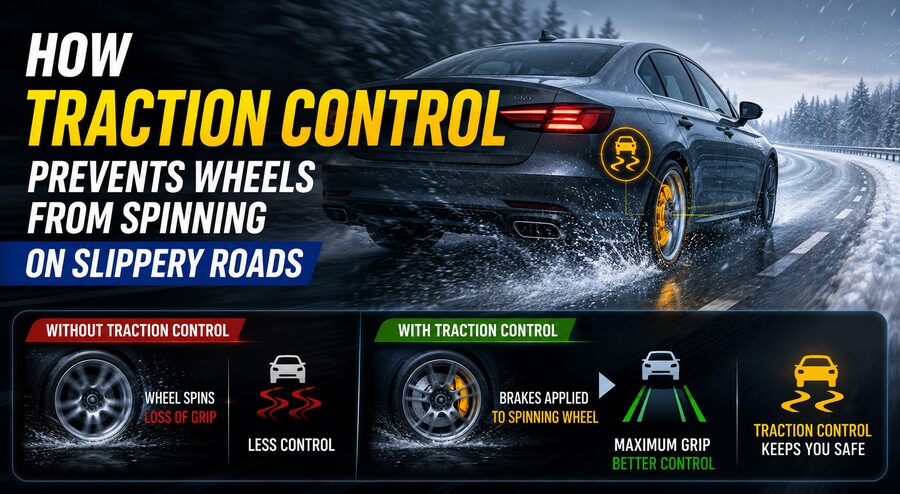
Traction control automatically detects when one or more driven wheels begin losing grip and then takes corrective action. It may reduce engine power, apply braking force to a spinning wheel, or use a combination of both methods.
The entire process can happen in a fraction of a second. ⚙️🚘
🛞 What Exactly Is Wheel Spin?
A tire can only transfer a limited amount of force to the road.
When there is enough friction between the tire and the road surface, the tire grips the pavement and converts engine torque into forward movement.
But slippery conditions reduce that friction.
For example, imagine accelerating from a stop on an icy road.
The engine sends torque through the transmission and drivetrain to the powered wheels. If the torque exceeds the amount of grip available, the tires may begin spinning.
Instead of pushing the vehicle forward efficiently, the wheels rotate rapidly against the surface.
This can result in:
- Poor acceleration
- Reduced directional control
- Vehicle instability
- Increased risk of skidding
- Difficulty climbing slippery hills
- Faster tire wear in severe cases
Traction control is designed to recognize this situation and reduce the amount of wheel slip. 🧠
📡 How Does Traction Control Know a Wheel Is Spinning?
Traction control relies heavily on wheel-speed sensors.
These sensors are usually located near each wheel and are often shared with the vehicle’s Anti-lock Braking System, or ABS.
Each sensor continuously monitors how fast its wheel is rotating.
The system’s electronic control unit compares the speeds of the wheels.
Imagine a front-wheel-drive car traveling slowly on a wet road.
The front wheels are responsible for delivering engine power to the road. If the driver presses the accelerator and the front-left wheel suddenly begins rotating much faster than the other wheels, the computer can recognize that something unusual is happening.
The vehicle itself has not accelerated enough to explain the difference.
Therefore, the system concludes that the front-left tire is probably spinning.
This comparison happens extremely quickly and repeatedly while the vehicle is moving.
🧠 The Basic Traction Control Feedback Loop
Traction control operates using a type of electronic feedback process.
The sequence can be simplified as:
Measure wheel speed ➡️ Detect excessive slip ➡️ Reduce torque or brake the wheel ➡️ Restore grip ➡️ Monitor again
Suppose a tire begins spinning on ice.
The wheel-speed sensor reports the sudden increase in rotational speed.
The traction control computer compares that information with data from the other wheels and sometimes additional vehicle sensors.
If the difference exceeds the acceptable amount, the system intervenes.
Once the wheel regains traction, the intervention is reduced or stopped.
The process may repeat many times within a short period if the road remains slippery.
⚙️ Method 1: Reducing Engine Power
One of the primary ways traction control prevents wheel spin is by temporarily reducing the amount of torque reaching the wheels.
Modern engines are electronically controlled, making it possible for the vehicle’s computer to adjust engine output very quickly.
Depending on the vehicle, the system may reduce power by:
- Closing the electronic throttle slightly
- Reducing fuel delivery
- Adjusting ignition timing
- Limiting boost pressure in a turbocharged engine
- Requesting lower torque from an electric motor
The exact method depends on the vehicle’s powertrain.
For example, if the driver presses the accelerator hard while driving on snow, the driver may be requesting more engine torque than the tires can handle.
Traction control effectively says:
“The tires cannot use this much power right now.”
The system then temporarily reduces torque until the tires regain grip.
🚘 This can sometimes make the car feel as though the engine is hesitating or losing power, but the system is intentionally limiting output to maintain traction.
🛑 Method 2: Braking an Individual Spinning Wheel
Traction control can also use the braking system.
Suppose a car’s left drive wheel is on ice while the right drive wheel is on dry pavement.
The wheel on the ice may begin spinning because it has very little resistance.
The traction control system can selectively apply the brake to that spinning wheel.
This accomplishes two important things.
First, it slows the wheel so that the tire has a better chance of regaining grip.
Second, in some drivetrain configurations, adding resistance to the spinning wheel can help the differential send more usable torque toward the wheel with better traction.
This electronic braking action can happen automatically without the driver pressing the brake pedal.
The driver might hear a clicking or pulsing noise or feel a slight vibration when the system is working.
That is often normal.
🔄 How Traction Control Works With ABS
Traction control and ABS are closely related, but they solve opposite problems.
ABS is designed primarily to prevent wheels from locking during braking.
Traction control is designed primarily to prevent driven wheels from spinning excessively during acceleration.
Think of it this way:
ABS: Wheel rotating too slowly while braking? Reduce braking force.
Traction control: Wheel rotating too quickly while accelerating? Reduce drive torque or apply braking force.
Because both systems need to know how fast the wheels are turning, they commonly share wheel-speed sensors and hydraulic braking components.
This integration helps reduce complexity and allows multiple safety systems to cooperate.
🌧️ What Happens on a Wet Road?
Imagine a car stopped at a traffic light during heavy rain. 🌧️
Oil, dirt, and water can make the road surface especially slippery.
When the light turns green, the driver presses the accelerator aggressively.
The sequence may look like this:
- 🚗 Engine torque is sent to the drive wheels.
- 🛞 One tire begins spinning faster than the vehicle’s actual road speed.
- 📡 Wheel-speed sensors detect the difference.
- 🧠 The traction control computer identifies excessive slip.
- ⚙️ Engine torque is reduced.
- 🛑 The system may briefly brake the spinning wheel.
- ✅ The tire regains traction.
- 🚘 The car accelerates more smoothly.
The entire process can happen so quickly that the driver may notice only a flashing traction-control indicator on the dashboard.
❄️ How Traction Control Helps on Snow and Ice
Snow and ice create some of the most difficult conditions for tire traction.
On dry pavement, tires can generally handle much greater acceleration forces.
On ice, however, available grip can be dramatically lower.
Even moderate accelerator input may cause the wheels to spin.
Traction control helps by continually adjusting the amount of power reaching the road.
Rather than allowing the tires to spin rapidly, the system attempts to keep wheel slip within a range where the tires can still generate useful traction.
This can be especially useful when:
- Starting from a stop
- Climbing a snowy hill
- Accelerating through a slippery intersection
- Driving over patches of ice
- Transitioning between surfaces with different amounts of grip
However, traction control cannot create grip where none exists. ⚠️
If all four tires are on extremely slippery ice, the system can reduce wheel spin, but the vehicle may still have very little ability to accelerate, steer, or stop.
🏁 Is Some Wheel Slip Actually Useful?
Interestingly, zero wheel slip is not always the ideal situation.
A tire often needs a small amount of controlled slip to produce maximum acceleration.
Traction-control engineers therefore do not necessarily attempt to make every driven wheel rotate at exactly the same speed as the road surface at all times.
Instead, the system aims to prevent excessive slip.
The optimal amount depends on factors such as:
- Road surface
- Tire design
- Vehicle speed
- Driving mode
- Steering angle
- Vehicle type
Performance cars may allow more wheel slip in sport or track modes, while normal road settings generally intervene earlier for increased stability.
🚦 Why Does the Traction Control Light Flash?
Most vehicles have a dashboard symbol associated with traction or stability control.
It commonly looks like a car with wavy skid marks behind it. 🚗〰️
If this light flashes while driving, it often means the system is actively intervening.
For example, the tires may be slipping while accelerating on a wet road.
A flashing light is therefore not necessarily a warning that something has failed.
However, if the traction-control warning light remains continuously illuminated, it may indicate:
- The system has been manually switched off
- A wheel-speed sensor has failed
- An ABS-related fault exists
- A traction-control component has malfunctioned
- Another vehicle-control fault has disabled the system
The exact meaning depends on the vehicle, so the owner’s manual should be consulted.
🔘 Why Do Some Cars Allow Traction Control to Be Turned Off?
Many vehicles include a button that allows the driver to reduce or disable traction-control intervention.
This may seem strange for a safety system, but there are situations where controlled wheel spin can be useful.
For example, a vehicle stuck in:
- Deep snow
- Loose sand
- Thick mud
may sometimes need additional wheel spin to build momentum and escape.
Traction control could repeatedly reduce engine power in these conditions, making it harder to move.
Some performance driving modes also allow increased wheel slip for specialized driving situations.
However, for ordinary road driving—especially in rain, snow, or ice—traction control is usually best left active. ✅
🧭 Traction Control vs. Electronic Stability Control
Traction control is also closely connected with Electronic Stability Control, often called ESC.
Traction control mainly focuses on preventing excessive wheel spin during acceleration.
Electronic Stability Control looks at the motion of the entire vehicle.
ESC may monitor information from:
- Wheel-speed sensors
- Steering-angle sensors
- Yaw-rate sensors
- Lateral acceleration sensors
- Brake-system sensors
Imagine the driver turns the steering wheel left, but the vehicle begins sliding straight ahead.
ESC can recognize that the actual movement of the car does not match the driver’s intended direction.
It may then brake individual wheels and reduce engine torque to help stabilize the vehicle.
Modern cars frequently integrate ABS, traction control, and stability control into a single coordinated safety system. 🧠🚘
⚡ How Traction Control Works in Electric Vehicles
Electric vehicles can perform traction control particularly quickly because electric motors can change torque almost instantly.
A combustion engine has mechanical processes involving airflow, fuel combustion, rotating components, and transmissions.
An electric motor’s torque can often be adjusted much faster through electronic control.
If an EV detects wheel spin, the motor controller can reduce torque in milliseconds.
Vehicles with multiple electric motors may have even more advanced control.
For example, an all-wheel-drive EV with separate front and rear motors may adjust how much torque is delivered to each axle.
Some advanced systems can manage torque at individual wheels.
This allows extremely precise traction management. ⚡🛞
🛞 Tires Still Matter More Than Electronics
Traction control is powerful, but it cannot overcome the basic laws of physics.
The tires are the only parts of the vehicle normally touching the road.
Their condition has a major influence on available grip.
Traction control cannot compensate fully for:
- Worn-out tires
- Incorrect tire pressure
- Tires unsuitable for winter conditions
- Excessive driving speed
- Standing water
- Severe ice
- Unsafe steering or braking inputs
For example, proper winter tires can dramatically improve grip in cold, snowy conditions because their rubber compounds and tread patterns are designed for low temperatures and snow.
Traction control can then make better use of that available grip.
Electronics help manage traction, but good tires provide the traction in the first place. 🛞✅
⚠️ Traction Control Does Not Make a Car Impossible to Crash
One common misunderstanding is that electronic safety systems can eliminate the dangers of slippery roads.
They cannot.
Traction control can help prevent excessive wheel spin, but it does not shorten every stopping distance, eliminate hydroplaning, or guarantee that the vehicle can safely negotiate a corner.
Driving too fast for the conditions can overwhelm the available tire grip regardless of how advanced the vehicle’s computers are.
Safe driving on slippery roads still requires:
- Lower speeds
- Smooth acceleration
- Gentle steering
- Increased following distance
- Proper tires
- Early braking
- Awareness of changing road conditions
Technology provides assistance, not immunity from physics. 🌨️🚗
🔍 A Simple Real-World Example
Imagine a rear-wheel-drive car accelerating from a stop on a snowy street.
The right rear tire is on packed snow while the left rear tire is on a slightly clearer section of pavement.
The driver presses the accelerator.
The right rear tire begins spinning rapidly.
Within moments:
- 📡 The wheel-speed sensor detects unusually high rotation.
- 🧠 The control computer compares it with the other wheels.
- ⚠️ Excessive wheel slip is identified.
- 🛑 The system may brake the right rear wheel.
- ⚙️ Engine torque may also be reduced.
- 🛞 The spinning tire slows.
- ✅ Traction improves.
- 🚗 The vehicle continues accelerating with greater stability.
This process may repeat several times as the tires encounter different patches of snow and pavement.
🌟 The Bigger Picture
Traction control is essentially an intelligent system that prevents a vehicle from sending more power to the tires than the road can effectively handle.
Using wheel-speed sensors, electronic control units, engine-management systems, and individual wheel braking, the system detects excessive wheel spin and reacts almost immediately.
When the road becomes slippery, traction control may reduce engine torque, brake a spinning wheel, or perform both actions together.
Its goal is not simply to stop the wheels from spinning—it is to keep the tires operating within a range where they can transfer useful force to the road.
Combined with ABS and Electronic Stability Control, traction control has become an important part of modern vehicle safety technology. 🚗🛡️
Yet even the most sophisticated system remains limited by tire grip and road conditions. Smooth driver inputs, appropriate speeds, and good tires are still essential.
In the end, traction control works as a fast electronic assistant—constantly monitoring the wheels and quietly making tiny corrections to help the driver maintain grip when the road becomes slippery. 🌧️❄️🛞