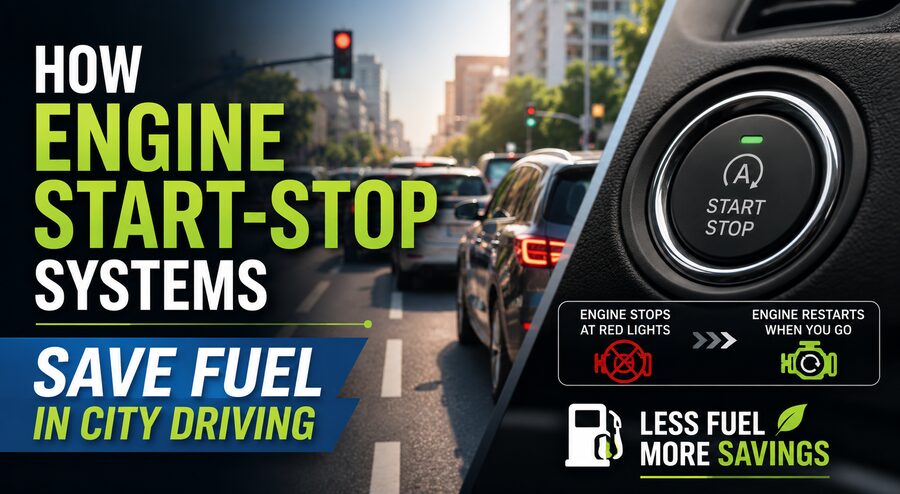

Modern cars contain many technologies designed to improve fuel economy, and one of the most common is the engine start-stop system. You may have noticed it while sitting at a traffic light: the engine suddenly switches off, then restarts almost instantly when you lift your foot from the brake or press the clutch. 🚦🔄
Although the interruption may last only a few seconds, repeatedly shutting the engine down while the vehicle is stationary can reduce unnecessary fuel consumption—especially in congested city traffic.
Start-stop technology is particularly useful in urban driving because cars spend a surprising amount of time idling at traffic lights, intersections, railway crossings, and traffic jams. During these periods, a conventional gasoline or diesel engine continues burning fuel even though the vehicle is not moving.
By automatically switching the engine off when it is not needed, a start-stop system helps eliminate much of this wasted fuel. ⛽📉
🔧 What Is an Engine Start-Stop System?
An engine start-stop system is an automatic vehicle technology that temporarily shuts down the internal combustion engine when the car comes to a complete stop and restarts it when the driver is ready to move again.
The exact operation depends on the vehicle.
In many automatic-transmission cars, the system may shut off the engine when:
- the vehicle reaches a complete stop,
- the driver keeps the brake pedal pressed,
- the engine is sufficiently warm,
- the battery has enough charge,
- climate-control requirements allow the engine to stop.
When the driver releases the brake pedal or presses the accelerator, the engine restarts automatically. ⚙️
In manual-transmission vehicles, the engine may stop when the vehicle is stationary, the transmission is in neutral, and the clutch pedal has been released. Pressing the clutch again signals the system to restart the engine.
The process usually happens in a fraction of a second.
⛽ Why Does Idling Waste Fuel?
An internal combustion engine requires fuel whenever it is running.
Even when a vehicle is stationary, the engine continues operating to maintain its idle speed. Fuel is burned to keep the crankshaft rotating, power accessories, maintain engine systems, and prepare the car to accelerate again.
However, while the car is stopped, that fuel produces no useful forward motion.
Imagine spending several minutes during every commute waiting at traffic lights. Over hundreds of trips, those short periods of idling can accumulate into many hours of unnecessary engine operation.
Start-stop systems attack this inefficiency directly.
Instead of allowing the engine to consume fuel while the vehicle waits, the system simply switches it off. 🚗💤
🚦 Why Start-Stop Technology Works Best in City Driving
The fuel-saving benefits of start-stop systems depend heavily on driving conditions.
On a highway, a vehicle may travel continuously for an hour or more without stopping. In that situation, a start-stop system has almost no opportunity to operate.
City driving is completely different.
Urban vehicles frequently encounter:
- traffic signals,
- pedestrian crossings,
- stop signs,
- congested intersections,
- toll queues,
- school traffic,
- railway crossings,
- rush-hour traffic jams.
Each stop creates an opportunity to prevent unnecessary idling.
The more frequently a vehicle stops—and the longer those stops last—the greater the potential fuel savings. 🏙️⛽
This is why start-stop systems can be especially valuable for drivers who spend much of their time commuting through crowded urban areas.
🔋 How the Engine Restarts So Quickly
A traditional starter motor is designed to start an engine only a limited number of times during normal vehicle operation.
A car with start-stop technology may restart its engine dozens of times during a single city journey.
For that reason, vehicles equipped with start-stop systems typically use more durable components.
These may include:
- reinforced starter motors,
- high-cycle batteries,
- advanced battery-management electronics,
- upgraded electrical systems,
- specialized alternators or starter-generators.
Some vehicles use an enhanced conventional starter, while others use a belt-integrated starter generator or similar electric motor system.
These systems can restart the engine smoothly and rapidly. ⚡🔄
Mild-hybrid vehicles may make the process even more seamless because their electric motor-generator can start the engine with less vibration than a conventional starter motor.
🔋 Why Start-Stop Cars Need Special Batteries
One important difference between start-stop vehicles and conventional vehicles is the battery.
Traditional cars typically start their engines only a few times each day. Start-stop vehicles can cycle their engines many more times.
Their batteries must therefore support repeated charging and discharging.
Common start-stop battery technologies include Enhanced Flooded Batteries (EFB) and Absorbent Glass Mat (AGM) batteries.
AGM batteries are particularly well suited to vehicles with demanding electrical systems because they can tolerate frequent cycling and provide high levels of electrical power.
Using the correct replacement battery is extremely important.
Installing an ordinary battery in a vehicle designed for start-stop operation can lead to reduced battery life, poor start-stop performance, or system faults. 🔧🔋
Some vehicles also require the replacement battery to be electronically registered with the battery-management system.
🧠 The System Does Not Switch the Engine Off Every Time
Modern start-stop systems continuously monitor numerous vehicle conditions before deciding whether shutting down the engine is appropriate.
The engine may remain running if:
- the battery charge is too low,
- the engine has not reached operating temperature,
- the cabin requires significant heating or cooling,
- the windshield needs rapid defogging,
- the vehicle is on a steep incline,
- the driver is maneuvering,
- engine or emissions conditions require continued operation.
This intelligent control helps prevent fuel savings from interfering with safety, reliability, comfort, or vehicle performance. 🧠🚘
For example, on a very hot day, the engine may continue running so the air-conditioning system can maintain the requested cabin temperature.
📉 How Much Fuel Can Start-Stop Systems Save?
There is no single percentage that applies to every vehicle.
Actual fuel savings depend on:
- traffic conditions,
- average stop duration,
- driving style,
- engine size,
- vehicle weight,
- climate-control use,
- journey length,
- system calibration.
In stop-heavy city traffic, the benefit can be noticeable because a meaningful portion of the journey may otherwise be spent idling.
In contrast, drivers who mainly travel on highways may experience very little improvement from start-stop technology.
Even modest fuel savings can become important over the lifespan of a vehicle.
If millions of vehicles avoid unnecessary idling every day, the combined reduction in fuel consumption can be substantial. 🌍📊
🌱 Start-Stop Systems Can Also Reduce Emissions
Saving fuel does more than reduce fuel costs.
Internal combustion engines release carbon dioxide when they burn gasoline or diesel. They can also produce other pollutants depending on engine type, operating conditions, and emissions-control systems.
When the engine is shut off instead of idling, no fuel is being burned during that period.
This can help reduce:
- carbon dioxide emissions,
- fuel consumption,
- local exhaust emissions during stationary periods.
The environmental benefit is particularly relevant in crowded urban areas where many vehicles may be idling simultaneously. 🏙️🌱
Start-stop technology is therefore one part of a broader effort to improve the efficiency of conventional and hybrid vehicles.
💰 Can Start-Stop Systems Save Drivers Money?
Reduced fuel consumption can lower operating costs, although the financial benefit depends on how and where the vehicle is driven.
A driver who regularly spends long periods in congested traffic may benefit more than someone who primarily travels on open roads.
The savings from each individual stop are small, but start-stop technology works automatically during thousands of stops over the vehicle’s lifetime.
Those small savings can accumulate over time. ⛽💰
However, vehicles with start-stop systems may use more expensive batteries and specialized starting components. These maintenance costs should also be considered when evaluating overall ownership expenses.
🛠️ Does Frequent Restarting Wear Out the Engine?
Many drivers worry that repeatedly starting the engine must cause excessive wear.
This concern makes sense because traditional engines experience some wear during startup.
However, start-stop-equipped vehicles are specifically engineered for repeated restarting.
Manufacturers may use:
- stronger starter components,
- improved bearings,
- optimized lubrication systems,
- advanced engine-management software,
- batteries designed for frequent cycling.
Also, most start-stop events occur after the engine has already warmed up and oil has circulated through the lubrication system.
This is very different from a cold start after the vehicle has been parked overnight. ❄️➡️🔥
A warm restart usually places less stress on the engine than a completely cold startup.
❄️ What Happens to Air Conditioning When the Engine Stops?
This depends on the vehicle design.
Traditional air-conditioning compressors are often driven directly by the engine. When the engine stops, the compressor may also stop temporarily.
The cabin fan can continue blowing using battery power, but cooling may gradually decrease.
If the cabin temperature begins moving too far from the driver’s selected setting, the vehicle may automatically restart the engine.
Some hybrids and newer vehicles use electrically powered air-conditioning compressors. ⚡❄️
These systems can continue cooling the cabin even when the gasoline engine is switched off.
🚘 Why Some Drivers Turn Start-Stop Off
Many vehicles include a button that allows the driver to temporarily disable the automatic start-stop feature.
Some drivers do this because they dislike the sensation of the engine stopping and restarting.
Others may disable it when:
- parking,
- maneuvering in tight spaces,
- driving in extremely hot weather,
- traveling in unusually slow creeping traffic,
- towing under certain conditions.
In many vehicles, the system automatically becomes active again the next time the car is started.
Modern systems have become increasingly smooth, particularly in mild hybrids where electric motor-generators can restart the engine almost imperceptibly.
⚡ Start-Stop Systems and Hybrid Vehicles
Start-stop technology becomes even more effective when combined with hybridization.
A mild-hybrid system may use an electric motor-generator that performs several functions:
- starting the engine,
- recovering energy during braking,
- providing electrical assistance during acceleration,
- powering vehicle systems,
- enabling longer engine-off periods.
Some full hybrids can travel short distances using electric power alone.
In these vehicles, shutting down the combustion engine is not limited to traffic lights—the engine may also switch off while the vehicle is moving under certain conditions. 🔋⚡
This represents a more advanced evolution of the same basic efficiency principle: do not run the combustion engine when it is unnecessary.
📊 A Simple Example of Fuel Savings
Consider two identical cars waiting at a traffic light for 90 seconds.
The first car keeps its engine idling throughout the entire stop.
The second car uses start-stop technology and shuts its engine down after coming to rest.
The first vehicle continues burning fuel for nearly the entire 90 seconds.
The second consumes essentially no engine fuel during most of that stationary period.
One traffic light may not make a major difference.
But imagine repeating this process at 20 stops per day, five days per week, for several years. 🚦
The accumulated reduction in idle time becomes significant.
This demonstrates why start-stop technology is based on many small efficiency improvements adding up over time.
🌍 Small Stops, Meaningful Efficiency Gains
Engine start-stop systems are a relatively simple concept supported by sophisticated electronics, durable electrical components, advanced batteries, and intelligent control software.
Their purpose is straightforward: prevent the engine from wasting fuel when the vehicle is stationary and does not need power from the combustion engine.
The technology is most effective in congested city environments, where repeated stops create frequent opportunities to shut the engine down. 🚗🏙️
By reducing unnecessary idling, start-stop systems can improve fuel economy, lower fuel costs, and reduce emissions. Their impact on any single stop is small, but over thousands of stops across millions of vehicles, the collective savings can become substantial.
The next time your car becomes quiet at a red light and automatically restarts when you move away, that brief moment of silence represents an important principle of efficient engineering: if the engine does not need to be running, do not burn fuel keeping it running. 🚦⛽🌱