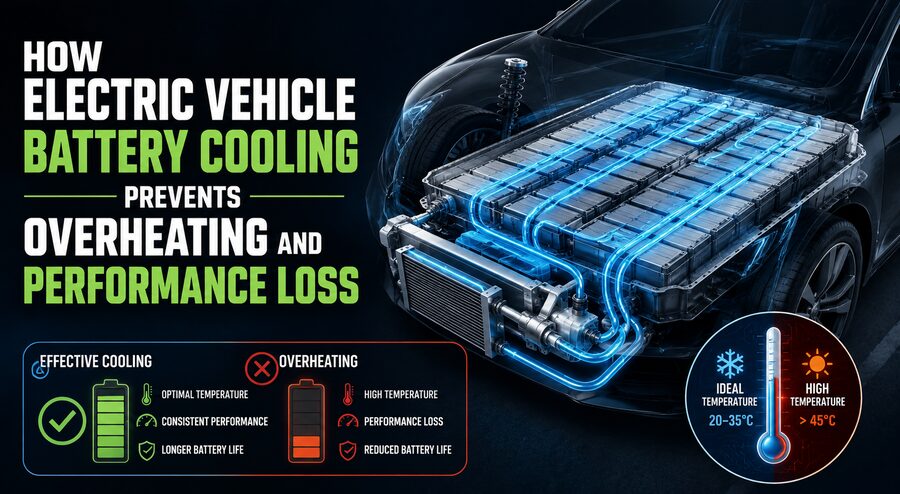

Electric vehicles (EVs) rely on large lithium-ion battery packs to store the energy needed for propulsion. These batteries can deliver impressive acceleration, long driving ranges, and high energy efficiency, but they also generate heat whenever they are charged or discharged. If that heat is not managed properly, battery temperatures can rise beyond their ideal operating range, reducing performance, accelerating degradation, and in extreme cases creating serious safety risks. 🌡️⚡
This is why modern electric vehicles use sophisticated battery thermal management systems, often referred to as battery cooling systems. Their purpose is to maintain battery cells within a safe and efficient temperature range under very different operating conditions—from slow city driving to highway cruising, rapid acceleration, and high-power fast charging.
Battery cooling is not simply about preventing a pack from becoming dangerously hot. It also helps preserve power output, charging speed, efficiency, range, battery life, and consistency between individual cells.
Understanding how these systems work reveals why thermal management is one of the most important engineering challenges in electric vehicle design.
🌡️ Why EV Batteries Generate Heat
A lithium-ion battery does not convert stored chemical energy into electrical energy with perfect efficiency. Some energy is lost as heat because of internal electrical resistance and electrochemical processes inside the cells.
The amount of heat produced generally increases when the battery handles higher electrical current.
For example, an EV battery may generate significant heat during:
- 🚀 Hard acceleration
- 🛣️ Sustained high-speed driving
- ⛰️ Climbing steep hills
- ⚡ DC fast charging
- 🏁 Performance driving
- 🔄 Strong regenerative braking
- 🌞 Operation in hot ambient temperatures
A simplified electrical relationship helps explain why high current is so important.
Resistive heat generation is approximately proportional to:
Heat ∝ I²R
where I represents current and R represents electrical resistance.
Because current is squared, increasing current can dramatically increase heat production. This is one reason rapid charging and high-performance driving place significant demands on an EV’s cooling system.
🔥 What Happens When an EV Battery Gets Too Hot?
Lithium-ion batteries operate best within a controlled temperature range. The exact preferred range depends on battery chemistry and design, but excessive heat can create several problems.
⚡ Reduced Power Output
When battery temperature becomes too high, the vehicle’s battery management system may limit how much electrical current can flow.
That means the vehicle can temporarily reduce available motor power.
A high-performance EV may therefore accelerate more slowly after repeated hard acceleration if the battery and drivetrain become too hot.
This reduction in output is sometimes called thermal derating.
Rather than allowing components to exceed their safe limits, the vehicle electronically reduces performance until temperatures return to an acceptable level.
🚘 Reduced Fast-Charging Speed
Fast charging can produce substantial battery heat.
When a battery is cool and within its optimal charging range, it may be able to accept high charging power. If temperatures become excessive, however, the charging system may reduce current to protect the cells.
The result is slower charging.
An effective cooling system therefore helps an EV maintain higher charging rates for longer periods.
This becomes particularly important on long-distance journeys where drivers rely on high-power DC charging stations. ⚡🔌
📉 Faster Battery Degradation
High temperatures accelerate many chemical reactions.
Inside lithium-ion batteries, excessive heat can speed up unwanted side reactions that gradually reduce battery capacity and increase internal resistance.
Over thousands of charge and discharge cycles, prolonged exposure to elevated temperatures may contribute to:
- Reduced usable capacity
- Increased resistance
- Lower power capability
- Shorter service life
Effective thermal management therefore helps protect the long-term health of the battery pack.
⚠️ Increased Safety Risk
In extreme situations, excessive battery temperature can contribute to a condition known as thermal runaway.
Thermal runaway occurs when heat-producing reactions inside a cell become self-sustaining. Rising temperature causes additional reactions, which generate even more heat.
Modern EV battery packs use multiple layers of protection to minimize this risk, including thermal monitoring, electrical isolation, cell spacing, protective enclosures, cooling systems, and battery management software.
Cooling is therefore one element of a broader battery safety strategy.
❄️ What Is an EV Battery Cooling System?
An EV battery cooling system removes excess heat from the battery pack and transfers it somewhere else.
Depending on the vehicle, cooling may use air, liquid coolant, refrigerant, or a combination of methods.
Modern systems usually work together with the Battery Management System (BMS).
Temperature sensors located throughout the battery pack continuously monitor conditions. The BMS can then activate pumps, fans, valves, compressors, or other components to maintain safe operating temperatures.
In advanced EVs, thermal management is highly dynamic. The system can adjust cooling based on vehicle speed, driving behavior, battery state of charge, charging rate, weather conditions, and predicted future demand. 🤖
💨 1. Air Cooling
Air cooling is one of the simplest battery thermal management methods.
Air is circulated around or through the battery pack using natural airflow or electric fans.
The moving air absorbs heat from the cells and carries it away.
Advantages of Air Cooling
Air-cooled systems can be:
- Relatively simple
- Lightweight
- Less expensive
- Easier to package
- Free from liquid coolant leakage concerns
However, air has a relatively low heat capacity compared with liquids.
That means it cannot absorb and transport heat as efficiently as a liquid cooling system.
Air cooling may therefore be more suitable for lower-power battery packs or vehicles where heat generation is relatively moderate.
💧 2. Liquid Cooling
Liquid cooling is widely used in modern electric vehicles because it offers much greater thermal performance.
A coolant—usually a mixture designed for automotive thermal systems—is circulated through channels, plates, or tubes positioned close to the battery cells.
The coolant absorbs heat from the cells and carries it toward a heat exchanger.
From there, the heat can be released to the outside air or transferred into another part of the vehicle’s thermal system.
A typical liquid battery cooling circuit may include:
- Coolant channels
- Electric pumps
- Temperature sensors
- Radiators
- Valves
- Heat exchangers
- Chillers
- Electronic controllers
Liquid cooling provides much more precise temperature control than basic air cooling.
🧊 Cooling Plates and Channels
Many EV battery packs contain cooling plates positioned underneath or between battery modules.
Coolant flows through internal passages in these plates.
Heat travels from the battery cells through conductive materials into the cooling plate and then into the circulating coolant.
Another approach involves coolant channels positioned along the sides of cells or modules.
The engineering goal is not merely to make the battery cold. Instead, designers try to maintain a uniform temperature across the entire battery pack.
This distinction is extremely important.
🌡️ Why Temperature Uniformity Matters
An EV battery pack may contain hundreds or even thousands of individual cells.
If some cells operate much hotter than others, they may age more quickly.
Over time, uneven degradation can create imbalances within the pack.
The vehicle’s usable battery capacity may eventually become limited by weaker cells, even if many other cells remain healthy.
A well-designed thermal management system therefore tries to minimize temperature differences between cells.
Keeping the entire pack close to the same temperature helps promote:
- Consistent electrical performance
- More balanced cell aging
- Accurate battery monitoring
- Longer battery life
- Improved charging behavior
❄️ Refrigerant-Based Cooling
Some EV thermal systems can use the vehicle’s air-conditioning refrigerant to provide additional battery cooling.
A component called a chiller may transfer heat between the battery coolant loop and the refrigerant circuit.
This allows the air-conditioning compressor to actively remove heat from the battery when outside-air cooling alone is insufficient.
Such systems are particularly useful during very hot weather or rapid charging.
They can maintain battery temperature even when ambient air is too warm to provide enough cooling through a normal radiator.
⚡ Why Fast Charging Needs Powerful Cooling
DC fast charging can transfer enormous amounts of electrical energy into a battery in a relatively short time.
Higher charging power generally means higher current, and higher current can create more heat inside the cells and electrical connections.
Without adequate cooling, temperature could rise rapidly.
The charging system would then have to reduce power.
This is why some EVs actively cool the battery before and during fast charging.
The process is sometimes called battery preconditioning.
When a driver selects a fast-charging station as a navigation destination, some vehicles can begin preparing the battery before arrival.
The thermal system attempts to bring the cells into a temperature range that allows them to accept high charging power efficiently. 🔌🔋
🧊 Cooling and Heating Work Together
Battery thermal management is not only about cooling.
Lithium-ion batteries can also perform poorly when they become extremely cold.
Low temperatures can increase internal resistance, reduce available power, limit regenerative braking, and slow charging.
For this reason, many EVs use systems capable of both heating and cooling the battery.
Battery heaters, heat pumps, coolant heaters, or waste heat from other components may be used to warm the pack.
The objective is to keep the cells inside an optimal thermal window regardless of outside conditions.
In winter, the system may warm the battery.
During fast charging or aggressive driving, it may cool it.
This two-way thermal control helps deliver consistent performance throughout the year. ❄️☀️
🚀 How Cooling Prevents Performance Loss
When an EV battery remains within its intended operating temperature, it can usually supply electrical current more consistently.
If the pack overheats, the BMS may reduce current to avoid damage.
That current reduction can directly limit motor power.
Effective cooling delays or prevents this thermal limitation.
As a result, the vehicle may be able to maintain:
- Strong acceleration
- Higher continuous power
- Stable regenerative braking
- Consistent high-speed performance
- Faster charging rates
This is especially important for high-performance electric vehicles, which may repeatedly demand hundreds of kilowatts from their battery packs.
🏁 Why Performance EVs Need Advanced Thermal Management
Performance-oriented EVs face particularly demanding thermal conditions.
Repeated acceleration causes high battery discharge currents, while powerful electric motors and inverters also create heat.
On a racetrack, the vehicle may repeatedly accelerate, brake, and accelerate again with very little time for components to cool.
An inadequate thermal system could cause the vehicle to reduce power after only a few hard laps.
Advanced cooling allows the battery, motors, and power electronics to sustain performance for longer periods.
This is one reason EV thermal systems increasingly manage multiple vehicle components together.
🔄 Integrated Thermal Management
Modern electric vehicles often use an integrated thermal system rather than completely separate cooling circuits.
The system may coordinate heat transfer between:
- 🔋 Battery pack
- ⚡ Electric motors
- 🔌 Power electronics
- 🚗 Passenger cabin
- ❄️ Air-conditioning system
- ♨️ Heat pump
This allows thermal energy to be reused.
For example, waste heat from the electric motor or inverter may sometimes help warm the cabin or battery in cold conditions.
Conversely, the air-conditioning system may provide additional battery cooling in hot conditions.
Integrated thermal management can improve overall vehicle energy efficiency.
📊 Battery Cooling and Driving Range
Cooling systems consume energy.
Pumps, fans, and compressors all require electricity.
However, letting the battery become excessively hot would create larger problems.
Engineers therefore try to operate cooling equipment only as aggressively as necessary.
Efficient thermal management can indirectly support driving range by keeping the battery, motors, and electronics near their most efficient operating temperatures.
Heat pumps and intelligent valve networks can further reduce the amount of energy needed for climate and battery conditioning.
🧠 The Role of Software
Modern EV thermal management depends heavily on software.
The vehicle control system can continuously analyze information such as:
- Battery temperature
- Cell voltage
- State of charge
- Charging power
- Motor load
- Ambient temperature
- Coolant temperature
- Driver demand
Algorithms then determine the appropriate cooling strategy.
Some vehicles can even predict future thermal requirements.
If navigation indicates that the vehicle is approaching a fast charger, for example, the system may begin conditioning the battery ahead of time.
If sustained high-performance driving is detected, cooling may become more aggressive before temperatures reach critical levels.
Predictive thermal control allows engineers to balance performance and energy efficiency more effectively.
🔬 Future EV Battery Cooling Technologies
Battery cooling technology continues to evolve.
Researchers and manufacturers are investigating advanced approaches such as:
- Immersion cooling
- Improved thermal interface materials
- Direct refrigerant cooling
- Advanced cold plates
- Phase-change materials
- Smarter predictive thermal controls
Immersion cooling is particularly interesting.
Instead of relying only on cooling plates or tubes, battery cells can be surrounded by a specially designed electrically nonconductive fluid.
This fluid can absorb heat directly from a larger portion of the cell surface.
Such systems may offer excellent cooling performance, although cost, materials compatibility, maintenance, and system complexity must all be considered.
🛡️ Cooling Is Only One Part of Battery Safety
It is important to remember that battery cooling does not work alone.
EV battery safety depends on several protective systems operating together.
These may include:
- Cell temperature monitoring
- Battery management software
- Electrical fuses and contactors
- Crash-resistant enclosures
- Pressure-relief mechanisms
- Fire-resistant barriers
- Cell isolation strategies
- Automatic charging limits
The thermal system reduces temperature-related stress, while these additional systems help protect against electrical, mechanical, and chemical hazards.
🌍 Why Better Battery Cooling Matters
As electric vehicles become more powerful and charging systems become faster, thermal management becomes increasingly important.
Future EVs may operate with higher charging voltages, greater battery capacities, and increasingly powerful motors.
Those improvements create greater demands on cooling systems.
Better thermal management can help manufacturers deliver faster charging without sacrificing battery longevity.
It can also help smaller battery packs provide stronger performance because the cells can operate closer to their optimal thermal conditions.
Efficient battery cooling therefore contributes not only to safety but also to the overall practicality of electric transportation. 🚘⚡
✨ Conclusion
Electric vehicle battery cooling prevents overheating by continuously removing excess heat generated during charging, acceleration, regenerative braking, and normal electrical operation.
Without effective thermal management, high battery temperatures can increase degradation, limit charging speed, reduce available motor power, and place greater stress on battery cells.
Modern EVs solve this problem using technologies such as liquid cooling loops, cooling plates, refrigerant chillers, temperature sensors, pumps, heat exchangers, and intelligent battery management software.
The objective is not simply to keep the battery as cold as possible. Instead, engineers aim to maintain the entire pack within an optimal and uniform temperature range.
When temperatures rise, cooling systems remove heat. When temperatures fall too low, heating systems can warm the battery. Software coordinates these processes to maintain efficiency, safety, charging capability, and performance.
As electric vehicles continue to evolve, sophisticated thermal management will become even more important. 🔋🌡️
Ultimately, a powerful EV battery is only as useful as its ability to manage the heat produced while delivering that power. By keeping thousands of electrochemical reactions within the right temperature range, battery cooling systems help EVs remain fast, efficient, reliable, and durable for years of driving. 🚗⚡🌍