
Modern cars are expected to do something that sounds simple but is actually very difficult: remain stable, predictable, and fast while changing direction. During a corner, a vehicle’s four tires are not doing exactly the same job. The wheels travel different distances, experience different loads, and may have different amounts of available grip. 🛞
Traditional differentials allow the left and right drive wheels to rotate at different speeds, which is essential when turning. But torque vectoring takes this idea much further. Instead of merely allowing the wheels to rotate differently, a torque-vectoring system can actively control how much driving force, or torque, is sent to individual wheels.
By intelligently distributing torque, the vehicle can create a turning effect that helps it rotate into a corner, improves traction, reduces unwanted understeer, and enhances stability. 🏎️💨
Torque vectoring is now used in everything from high-performance sports cars to electric SUVs, and it is becoming especially powerful in electric vehicles where separate motors can control individual wheels with remarkable speed and precision.
⚙️ What Is Torque Vectoring?
Torque vectoring is a vehicle-control technology that varies the amount of torque delivered to different driven wheels.
In a conventional drivetrain, engine torque may be divided relatively evenly between two wheels. A traditional differential primarily exists to let those wheels rotate at different speeds.
A torque-vectoring system can deliberately send more torque to one wheel than another.
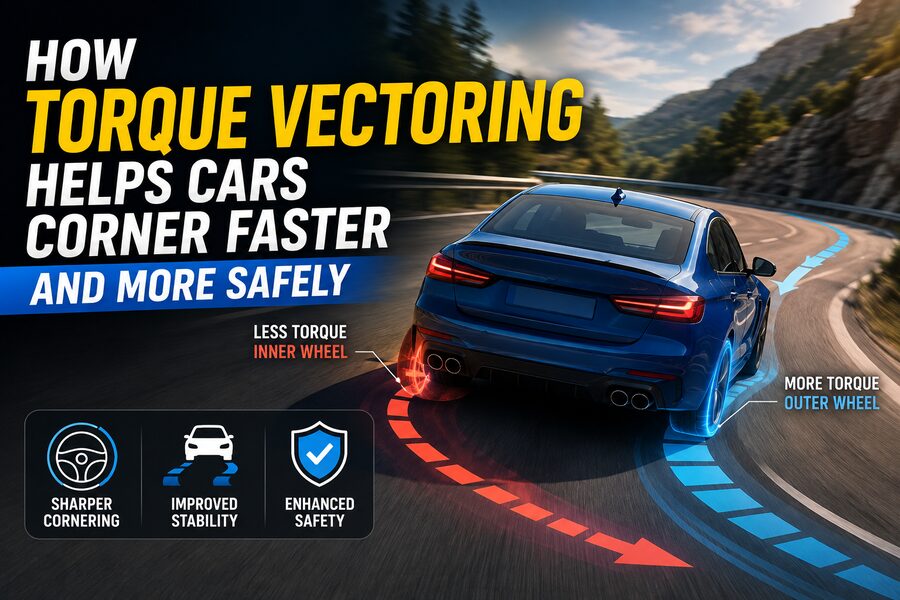
For example, when a car turns right, the outside left wheel travels along a larger-radius path than the inside right wheel.
A torque-vectoring system may send additional driving torque to the outside wheel. The extra forward force on that side creates a rotational moment around the vehicle’s vertical axis.
This rotational effect is called yaw moment. 🔄
That yaw moment can help point the car into the corner.
Instead of relying only on the steering angle and tire forces generated by the front wheels, torque vectoring actively assists the vehicle’s rotation.
🧭 Understanding Yaw
To understand torque vectoring, it helps to understand the three basic ways a vehicle can rotate.
Pitch occurs when the front or rear of the vehicle moves vertically relative to the other, such as during acceleration or braking.
Roll occurs when the body leans sideways in a corner.
Yaw occurs when the vehicle rotates left or right around an imaginary vertical line through the car.
Torque vectoring primarily influences yaw.
Imagine pushing one side of a shopping cart forward harder than the other. The cart will begin rotating.
A torque-vectoring car uses a much more precise version of the same principle. 🚗🔄
By creating carefully controlled differences in wheel force, the system can encourage or resist vehicle rotation.
🛞 Why Do Wheels Need Different Torque During a Corner?
When a car corners, its four tires experience different conditions.
The outside tires generally carry more vertical load because the vehicle’s mass shifts outward due to lateral acceleration.
Meanwhile, the inside tires become more lightly loaded.
The wheels also travel different distances.
Suppose a vehicle turns left.
The right-side wheels are on the outside of the corner, so they follow a larger arc. The left-side wheels follow a smaller arc.
If all four wheels were forced to rotate at exactly the same speed, some tires would have to scrub or slip.
Traditional differentials solve the wheel-speed problem.
Torque vectoring addresses something more advanced: how wheel force can be used to control the vehicle’s direction and stability.
🏎️ How Torque Vectoring Makes a Car Turn Faster
A car’s cornering ability depends heavily on how effectively its tires use available grip.
When entering or accelerating through a corner, a conventional car may begin to experience understeer.
Understeer happens when the front tires cannot produce enough lateral force to follow the driver’s intended path. The vehicle therefore turns less sharply than commanded and tends to run toward the outside of the corner.
Torque vectoring can help reduce this tendency.
Imagine the vehicle is turning left.
If the system sends more torque to the outside right wheel, that wheel pushes the right side of the vehicle forward more strongly.
This creates a yaw moment encouraging the vehicle to rotate left.
The driver may therefore need less steering correction, and the car can feel more eager to turn. 🎯
In performance driving, this can allow the vehicle to maintain a more effective cornering line and begin accelerating sooner.
🛡️ How Torque Vectoring Improves Safety
Torque vectoring is not only about lap times.
The same technology that makes a sports car more agile can help everyday vehicles remain stable in difficult conditions.
Vehicle sensors continuously monitor factors such as:
- 🧭 Steering-wheel angle
- 🛞 Individual wheel speed
- 🔄 Yaw rate
- 📐 Lateral acceleration
- 🚗 Vehicle speed
- 🦶 Accelerator position
- 🛑 Brake input
- ⚡ Motor or engine torque
- 🌧️ Available tire grip estimates
The control computer compares what the driver appears to want with what the vehicle is actually doing.
If the vehicle begins rotating too little or too much, torque distribution can be adjusted.
The system may help correct the vehicle before the driver even realizes significant instability is developing.
↗️ Fighting Understeer
Understeer is particularly common in front-heavy vehicles and in situations where the driver enters a corner too quickly.
Suppose a car is turning right but begins drifting toward the outside of the road.
The front tires are approaching their grip limit.
A torque-vectoring system can create additional rightward yaw by adjusting drive torque across the wheels.
In some systems, additional torque is sent to the outside wheels.
In others, torque may be reduced at certain wheels while increased elsewhere.
The exact strategy depends on drivetrain layout, road conditions, vehicle speed, and the particular system.
The result can be a car that follows the driver’s intended line more naturally. 🛣️
🔄 Controlling Oversteer
The opposite situation is oversteer.
Oversteer happens when the rear tires lose enough lateral grip that the rear of the vehicle begins rotating outward.
If uncontrolled, excessive oversteer can develop into a spin.
Torque vectoring can help reduce excessive yaw.
Instead of encouraging further rotation, the control system can change torque distribution to produce a stabilizing moment.
This functionality can complement electronic stability control, which may also selectively apply individual brakes.
Together, these technologies can make a vehicle significantly more controllable during emergency maneuvers or low-grip conditions. 🌧️❄️
⚙️ Mechanical Torque Vectoring Differentials
One way to achieve torque vectoring is with a specialized mechanical differential.
Traditional open differentials allow different wheel speeds but have limited ability to actively choose how torque is distributed.
Advanced torque-vectoring differentials may use electronically controlled clutch packs.
These clutches can connect drivetrain components in different ways, allowing the system to deliberately direct more torque toward one wheel.
For example, a performance rear differential may send additional torque toward the outside rear wheel while cornering.
The result is a stronger yaw moment and more responsive handling.
Systems of this type have been used in many performance-oriented all-wheel-drive and rear-wheel-drive vehicles. 🔧
🛑 Brake-Based Torque Vectoring
Not every torque-vectoring system requires an expensive active differential.
Some vehicles use brake-based torque vectoring.
Instead of sending additional torque directly to an outside wheel, the vehicle lightly applies the brake to an inside wheel.
This generates a difference in wheel force that helps rotate the vehicle.
For example, during a left-hand corner, gently braking the inside left wheel can create a yaw moment that encourages leftward rotation.
This approach can be relatively inexpensive because modern vehicles already have electronically controlled anti-lock braking and stability-control hardware.
However, there are disadvantages.
Using the brakes converts kinetic energy into heat. 🔥
Repeated use during aggressive driving can therefore increase brake temperatures and cause additional brake wear.
A true active differential or independent electric motor system can redistribute propulsion torque without relying as heavily on friction brakes.
⚡ Electric Cars Take Torque Vectoring to Another Level
Electric vehicles are particularly well suited to torque vectoring.
Internal-combustion vehicles often require mechanical differentials, clutch packs, driveshafts, and other components to vary torque between wheels.
Electric vehicles can use multiple motors.
An EV might have:
One motor per axle – enabling front-to-rear torque distribution.
Two motors on one axle – allowing direct left-to-right control.
Four motors – potentially giving independent control of every wheel.
Because electric motors can alter torque extremely quickly, an EV’s control system can make rapid adjustments many times per second.
This creates extremely precise vehicle dynamics. ⚡🧠
If the computer wants more yaw, it can increase torque on certain wheels and reduce it on others almost instantly.
Some advanced systems can even use negative torque through regenerative braking at one wheel while applying positive driving torque at another.
That level of control would be extremely complicated using purely mechanical drivetrains.
🔋 Torque Vectoring and Regenerative Braking
Electric vehicles introduce another advantage: wheel torque does not always have to be positive.
Electric motors can operate as generators during deceleration.
Instead of using friction brakes alone, the motors can recover kinetic energy and return some of it to the battery.
An advanced EV can therefore combine torque vectoring with regenerative braking.
Imagine an electric performance car entering a corner.
The system could reduce or negatively torque one wheel while continuing to drive another wheel.
This produces a yaw effect while also recovering some energy. 🔋
The exact strategy depends on battery condition, motor limits, tire grip, thermal conditions, and stability requirements.
🧠 The Software Behind Torque Vectoring
Modern torque vectoring is as much a software technology as a mechanical one.
The vehicle’s control system receives information from sensors around the car.
The computer may calculate:
Where the driver wants to go based on steering and accelerator input.
Where the car is actually going based on yaw rate and acceleration sensors.
How much grip each tire may have available.
How much torque each wheel can safely receive.
The software then determines the optimal torque distribution.
These calculations happen extremely quickly.
The driver usually does not feel individual torque adjustments. Instead, the car simply feels stable, responsive, and predictable. 🤖
📐 The Tire Grip Limit
Torque vectoring cannot violate the laws of physics.
Every tire has a finite amount of grip.
A useful concept in vehicle dynamics is the traction circle, sometimes called the friction circle.
A tire’s available grip must be shared between:
➡️ Longitudinal forces from acceleration or braking
↔️ Lateral forces from cornering
If a tire is already using nearly all its available grip for cornering, asking it to produce a large amount of additional acceleration force may cause it to slip.
Torque-vectoring software must therefore be careful about how much torque it sends to each wheel.
The goal is not simply to maximize torque.
The goal is to use the available tire grip intelligently. 🛞
🌧️ Torque Vectoring on Wet or Slippery Roads
Torque vectoring becomes particularly valuable when road grip is uneven.
Imagine one side of the vehicle is driving over wet pavement while the other remains on dry asphalt.
The available traction may differ dramatically between the left and right tires.
A sophisticated drivetrain can reduce torque at wheels with limited grip while directing more propulsion to wheels with better traction.
This can improve acceleration and stability.
The same principle applies on:
❄️ Snow
🧊 Ice
🌧️ Heavy rain
🪨 Gravel
🌱 Mud
🏔️ Loose surfaces
Torque vectoring can therefore benefit off-road vehicles and everyday SUVs, not just racing-inspired cars.
🏁 Faster Corner Exit
One of torque vectoring’s biggest performance benefits appears when accelerating out of a corner.
Without torque vectoring, applying too much throttle can cause one wheel to spin or push the car toward understeer.
With intelligent torque distribution, the drivetrain can use the available grip more efficiently.
More torque can be directed to wheels capable of handling it.
This may allow the driver to begin accelerating earlier while maintaining the intended trajectory.
On a racetrack, saving even a fraction of a second at each corner can produce a significant improvement over an entire lap. ⏱️🏆
🛞 Torque Vectoring vs. Limited-Slip Differential
Torque vectoring is sometimes confused with a limited-slip differential, or LSD.
They are related but not identical.
A limited-slip differential reduces excessive speed differences between driven wheels.
If one tire begins spinning, the differential can redirect more torque toward the tire with better traction.
An active torque-vectoring differential goes further.
It can intentionally create a torque difference even when neither wheel is slipping.
In other words:
LSD: primarily responds to differences in wheel behavior and traction.
Torque vectoring: actively uses torque differences to influence vehicle handling.
Some advanced differentials combine both capabilities.
🛑 Torque Vectoring vs. Stability Control
Electronic stability control also manipulates individual wheel forces, so it might sound similar to torque vectoring.
However, their typical roles differ.
Stability control is primarily a safety system. It often intervenes when the car begins deviating significantly from the driver’s intended direction.
Torque vectoring can operate continuously—even during completely normal driving.
It may subtly improve cornering response before instability develops.
Advanced vehicles increasingly integrate both systems.
Instead of separate technologies acting independently, the drivetrain, brakes, steering, suspension, and stability systems can communicate through centralized vehicle-dynamics software. 🧠🚗
🏎️ Rear-Wheel-Drive Torque Vectoring
Performance rear-wheel-drive cars can benefit significantly from active rear torque vectoring.
During a corner, sending additional torque to the outside rear wheel creates a yaw moment that helps rotate the vehicle.
This can make a large or heavy car feel surprisingly agile.
The system can also reduce the amount of steering input required in certain situations.
However, excessive torque vectoring could make a vehicle feel unnatural or unstable.
Manufacturers therefore carefully tune these systems to create the desired driving character.
A luxury sedan may prioritize smoothness.
A sports car may prioritize sharp response.
An off-road SUV may prioritize traction and stability.
🚙 All-Wheel-Drive Torque Vectoring
All-wheel-drive vehicles offer even more possibilities.
Torque can potentially be varied:
⬅️➡️ Between the left and right wheels
⬆️⬇️ Between the front and rear axles
During normal cruising, the system might prioritize efficiency.
During acceleration, it could send more torque toward the axle with greater traction.
During cornering, it might shift torque outward to generate useful yaw.
During slippery conditions, it could redistribute power toward whichever tires have the strongest grip.
This flexibility helps explain why sophisticated all-wheel-drive systems are widely used in high-performance vehicles.
⚠️ Does Torque Vectoring Make a Car Impossible to Lose Control Of?
No.
Torque vectoring increases the ability of the vehicle to manage available tire grip, but it cannot create unlimited traction.
If a driver enters a corner far too quickly, the tires may simply be incapable of producing enough lateral force.
Weather, tire condition, tire pressure, road surface, vehicle weight, and speed still matter enormously.
Electronic systems help the driver operate within physical limits.
They do not eliminate those limits. ⚠️
🔧 Challenges and Disadvantages
Torque vectoring offers significant benefits, but it also introduces engineering challenges.
Mechanical systems can add:
⚙️ Complexity
⚖️ Weight
💰 Cost
🔥 Heat generation
🔧 Maintenance requirements
Brake-based systems may increase brake wear.
Multi-motor electric systems require sophisticated electronics and software.
Control algorithms must also be carefully calibrated.
If torque adjustments are too aggressive, the vehicle may feel unpredictable. If they are too conservative, the benefits may barely be noticeable.
The best systems work almost invisibly.
🚀 The Future of Torque Vectoring
Torque vectoring is likely to become even more sophisticated as vehicles increasingly use electric drivetrains and software-based controls.
Future vehicles may coordinate torque vectoring with:
🧠 Artificial intelligence
🛞 Active suspension
🔄 Rear-wheel steering
🛑 Brake-by-wire
🎮 Steer-by-wire
📡 Road-condition sensors
⚡ Individual-wheel electric motors
Imagine a vehicle approaching a corner while its cameras and sensors analyze the road surface.
The control system could predict available grip before the tires reach the corner.
It could then adjust suspension stiffness, steering response, regenerative braking, and individual-wheel torque simultaneously.
Instead of reacting after the car begins slipping, future systems may increasingly anticipate instability before it occurs.
🌟 Conclusion
Torque vectoring makes cars corner faster and more safely by controlling where driving force is applied.
Rather than distributing torque equally to every driven wheel, an advanced system can send different amounts of force to individual wheels. This creates carefully controlled yaw moments that help the vehicle rotate, maintain its intended trajectory, and use tire grip more effectively.
The technology can reduce understeer, control excessive oversteer, improve traction, enhance corner exits, and stabilize vehicles on slippery surfaces. 🏎️🛡️
Mechanical torque-vectoring differentials already provide impressive capabilities, but electric vehicles are pushing the technology even further. With multiple motors and extremely fast electronic control, EVs can potentially adjust individual-wheel torque almost instantaneously.
Ultimately, torque vectoring demonstrates how modern cars are becoming increasingly intelligent.
A vehicle no longer simply responds passively to the forces acting on it. Through sensors, software, electric motors, brakes, and advanced drivetrains, it can actively manage those forces.
The result is a car that can feel more agile when driven quickly, more predictable during everyday driving, and more stable when conditions become difficult. 🚗⚡🛞