
A city bus pulls away from a stop, a delivery truck merges into traffic, and a construction machine begins a long shift. All may use diesel engines because diesel powertrains deliver strong low-speed torque, good durability, and efficient operation under heavy loads.
But diesel combustion also creates pollutants that cannot simply be ignored once they leave the cylinders. What comes out of the tailpipe depends not only on the engine, but also on a carefully engineered chain of filters, catalysts, sensors, injectors, pipes, and electronic controls.
This chain is called the exhaust aftertreatment system. It treats exhaust gases after combustion, converting or capturing harmful components before they enter the atmosphere.
For automotive engineering students and working professionals, understanding aftertreatment is essential because modern diesel diagnosis is no longer just about fuel injection, air intake, and mechanical condition. Emissions control is a connected chemical, thermal, electrical, and control-system problem. 💨
🚛 1. Why Diesel Exhaust Needs Treatment
Diesel engines operate with excess air for much of their working range. This supports efficient combustion, but it also creates conditions in which certain pollutants, especially nitrogen oxides and particulate matter, can form.
Engine designers reduce pollutants inside the cylinder first. However, combustion changes that lower one emission can increase another, so exhaust aftertreatment provides a necessary second stage of control.
🧪 2. The Main Pollutants in Diesel Exhaust
Diesel exhaust is mostly nitrogen, carbon dioxide, water vapour, and unused oxygen. The emissions of greatest concern are present in far smaller quantities, yet they have important health and environmental effects.
- Nitrogen oxides (NOx): chiefly nitric oxide and nitrogen dioxide, formed at high combustion temperatures.
- Particulate matter (PM): very small solid and liquid particles, including carbon-rich soot.
- Carbon monoxide (CO): a product of incomplete oxidation.
- Hydrocarbons (HC): unburned or partially burned fuel-derived compounds.
Aftertreatment hardware targets these substances using oxidation, reduction, filtration, and controlled regeneration.
🔥 3. The Fundamental Combustion Trade-Off
Higher combustion temperature and abundant oxygen can improve the oxidation of soot and reduce some incomplete-combustion products. Yet high temperature also encourages NOx formation from nitrogen and oxygen in the cylinder charge.
Measures that lower NOx in-cylinder, such as exhaust gas recirculation, can make soot control more difficult. Modern diesel systems therefore divide the job: the engine manages combustion, while downstream devices clean the remaining exhaust.
🧭 4. A Typical Exhaust Treatment Layout
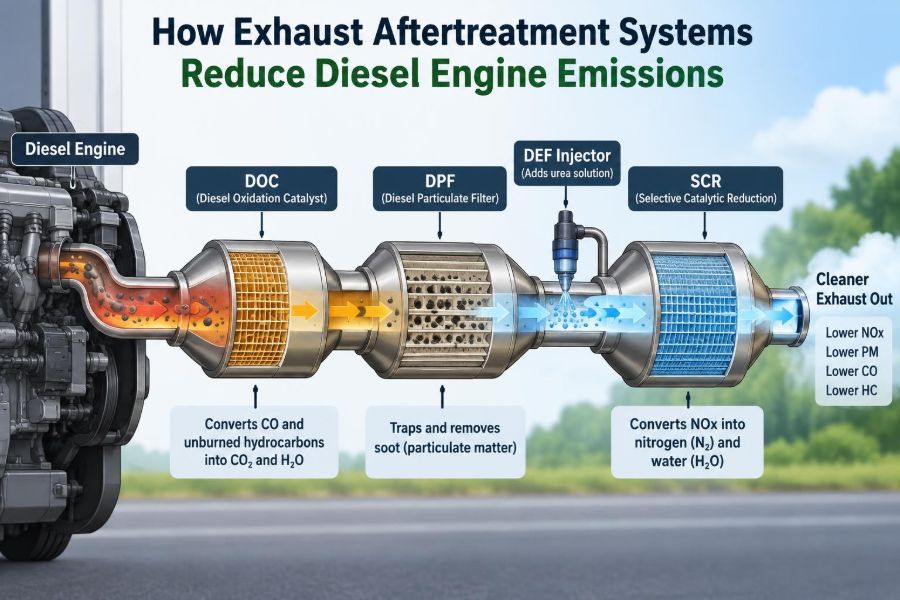
The exact order varies with engine size, emissions target, installation space, and manufacturer design. A common modern layout includes a diesel oxidation catalyst, a diesel particulate filter, an SCR catalyst, and an ammonia-slip catalyst.
| Component | Primary task | Key process |
|---|---|---|
| DOC | Reduce CO and HC; support downstream functions | Oxidation |
| DPF | Capture soot particles | Filtration and regeneration |
| SCR catalyst | Reduce NOx | Ammonia-based reduction |
| ASC | Limit excess ammonia | Ammonia oxidation |
These components are not independent accessories. Their temperatures, chemical states, sensor readings, and flow restrictions affect one another.
🟠 5. The Diesel Oxidation Catalyst
The diesel oxidation catalyst, or DOC, is often the first major catalyst in the exhaust stream. Exhaust flows through a honeycomb substrate coated with catalytic materials that promote oxidation reactions.
When conditions are suitable, the DOC converts carbon monoxide and hydrocarbons into carbon dioxide and water. It can also oxidize part of the nitric oxide in the exhaust into nitrogen dioxide.
That nitrogen dioxide can assist particulate-filter regeneration, making the DOC valuable even when its direct CO and HC conversion role is less obvious.
⚗️ 6. Why Catalysts Need the Right Temperature
A catalyst does not consume pollutants like a filter. It provides a surface that allows desired reactions to proceed more readily, but those reactions depend strongly on exhaust temperature.
After a cold start or during low-load operation, catalyst activity may be limited because the exhaust is cool. This is why thermal management is a central challenge in urban vehicles, short-trip duty cycles, and lightly loaded engines.
Engine control strategies may deliberately change combustion or fuel injection timing to raise exhaust temperature when safe and necessary. 🌡️
🧱 7. The Diesel Particulate Filter
The diesel particulate filter, commonly called a DPF, removes particulate matter from the exhaust. Its ceramic wall-flow structure has alternately plugged channels, forcing exhaust through porous channel walls.
Gas molecules pass through the wall, while soot is trapped on and within the filter structure. The cleaned gas then leaves through adjacent outlet channels.
A DPF is highly effective only when it remains intact, correctly matched to the engine, and periodically regenerated.
🌑 8. What the DPF Actually Collects
The material retained by a DPF is not all the same. Soot is primarily carbonaceous material generated by combustion and can be oxidized during regeneration.
Ash is different. It comes largely from non-combustible material, including trace elements associated with lubricating oil additives, fuel contamination, and component wear.
Regeneration removes soot, but it does not remove ash. Over a long service life, ash accumulation reduces available filter volume and may require professional cleaning or replacement.
🔥 9. Passive DPF Regeneration
Passive regeneration occurs when normal exhaust conditions are hot enough for soot oxidation to take place without a dedicated temperature-raising event. Nitrogen dioxide formed upstream can help this process occur at lower temperatures than oxygen-only soot oxidation.
Steady, adequately loaded driving can provide favourable conditions. The process is gradual and may occur without the driver noticing it.
Passive regeneration is useful, but vehicle engineers cannot rely on it for every route, climate, or operating pattern.
🔁 10. Active DPF Regeneration
When soot loading rises and passive regeneration is insufficient, the engine management system can initiate active regeneration. Its aim is to raise the temperature at the DPF so trapped soot oxidizes at a controlled rate.
One method uses late or post fuel injection to send additional energy into the exhaust stream. The DOC helps oxidize these fuel-derived compounds, releasing heat upstream of the filter.
Active regeneration must be monitored closely. Excessive temperature can damage the filter or nearby components, while inadequate temperature leaves soot behind.
📏 11. How the ECU Knows the Filter Is Loading
The electronic control unit estimates DPF soot loading using several sources of information. A differential-pressure sensor measures the pressure difference between the inlet and outlet of the filter.
The ECU also uses exhaust temperature, engine operating history, airflow, fuel use, and mathematical soot models. Pressure alone is not a perfect soot measurement because flow rate, ash loading, and sensor condition also influence it.
Combining physical measurements with a model improves control accuracy and helps identify implausible sensor signals.
⚠️ 12. Why Interrupted Regeneration Causes Problems
Repeatedly stopping a regeneration event can allow soot loading to keep rising. The vehicle may eventually request a longer drive, restrict performance, store diagnostic faults, or require workshop intervention.
Extremely high soot loading is hazardous because an uncontrolled or overly intense regeneration can overheat the substrate. A technician must follow the manufacturer’s approved diagnostic procedure rather than forcing a regeneration without checking the cause.
The underlying fault may be a sensor problem, intake leak, injector issue, turbocharger fault, excessive oil consumption, or unsuitable operating pattern.
🌬️ 13. Exhaust Gas Recirculation Works Upstream
Exhaust gas recirculation, or EGR, is not an aftertreatment device in the narrowest sense because it acts before combustion. Still, it is closely linked to the aftertreatment system.
EGR routes a controlled amount of exhaust back into the intake. This dilutes the fresh charge and can lower peak combustion temperature, reducing in-cylinder NOx formation.
Too much EGR can reduce oxygen availability and increase soot tendency. The DPF and SCR system allow engineers to balance these competing effects more effectively.
💧 14. Selective Catalytic Reduction Explained
Selective catalytic reduction, or SCR, is the principal NOx-control technology on many modern diesel engines. It injects a precisely metered aqueous urea solution into the hot exhaust upstream of an SCR catalyst.
Heat converts the urea-derived fluid into ammonia. Inside the catalyst, ammonia reacts selectively with NOx, ideally producing nitrogen and water.
The word “selective” describes the catalyst’s preference for promoting the intended NOx-reduction reaction rather than broadly oxidizing every exhaust constituent.
🧴 15. What Diesel Exhaust Fluid Does
The urea solution used by SCR systems is commonly referred to as diesel exhaust fluid, or DEF. It is carried in a dedicated tank and is separate from diesel fuel.
DEF quality, concentration, cleanliness, and storage condition matter. Contamination or an incorrect fluid can damage the dosing system, form deposits, or prevent the system from meeting emissions requirements.
Drivers and technicians should never treat the DEF filler as an alternative fuel opening. The two fluids serve entirely different systems.
🧬 16. The Chemistry Behind NOx Reduction
In simplified form, urea decomposes in the hot exhaust to provide ammonia. The SCR catalyst then uses ammonia as a reducing agent to convert NOx into harmless nitrogen and water.
A representative reaction can be written as:
4 NO + 4 NH3 + O2 → 4 N2 + 6 H2O
Real exhaust chemistry is more complex because the NO-to-NO2 ratio, temperature, catalyst formulation, flow distribution, and ammonia storage behaviour all influence conversion efficiency.
🎯 17. Why Precise DEF Dosing Matters
Too little DEF means too little ammonia is available, allowing NOx to pass through the SCR catalyst. Too much DEF can leave excess ammonia in the exhaust, a condition called ammonia slip.
The ECU calculates dosing from exhaust mass flow, NOx sensor signals, catalyst temperature, stored-ammonia estimates, and operating conditions. It must also account for the time needed for injected fluid to evaporate, decompose, and mix with exhaust gas.
Good spray distribution and sufficient mixing distance are essential; chemistry cannot compensate for poor physical mixing.
🛡️ 18. The Ammonia-Slip Catalyst
An ammonia-slip catalyst, also called an ASC, is often fitted downstream of the SCR catalyst. Its purpose is to reduce excess ammonia that might otherwise reach the tailpipe.
This is an important safeguard because ammonia is itself an undesirable emission. The ASC must be designed and controlled carefully to limit ammonia while avoiding unwanted by-products under changing exhaust conditions.
Its presence illustrates a wider rule: solving one emissions problem must not create another one downstream.
📡 19. Sensors Make Aftertreatment Intelligent
Modern aftertreatment systems depend on sensors as much as they depend on catalysts and filters. A sensor fault can make a healthy catalyst appear ineffective, or cause the ECU to use conservative protection strategies.
Common monitored signals
- Exhaust gas temperature before and after important components
- Differential pressure across the DPF
- Upstream and downstream NOx concentration
- DEF tank level, temperature, and fluid-quality information
- Engine airflow, speed, load, and fuel-injection data
The control system checks whether these signals agree with one another, not merely whether each individual reading lies within a possible range.
🧠 20. Control Software Coordinates the System
The ECU decides when to dose DEF, begin regeneration, limit torque, heat the exhaust, or warn the driver. These decisions are based on calibrated maps, models, sensor feedback, component protection limits, and legal emissions requirements.
For example, a regeneration request may be postponed when exhaust conditions are unsuitable, while SCR dosing may be adjusted as catalyst temperature changes. The system must work during cold starts, motorway cruising, idling, towing, climbing, and stop-start traffic.
Aftertreatment control is therefore a practical example of closed-loop automotive mechatronics. 🧠
🌡️ 21. Cold Starts and Low Loads Are Difficult
At low exhaust temperatures, the DOC may be less active, DPF regeneration is difficult, and urea decomposition and SCR conversion can be limited. These conditions commonly occur shortly after starting or during low-speed, lightly loaded use.
Engineers address this with close-coupled catalyst placement, thermal insulation, exhaust heating strategies, calibrated engine operation, and catalyst materials designed for useful low-temperature activity.
There is no single universal solution because packaging, fuel economy, durability, and duty cycle all influence the design.
🏗️ 22. Different Vehicles Need Different Designs
A passenger car, long-haul truck, agricultural tractor, locomotive, and stationary industrial engine do not produce the same exhaust temperature profile or have the same packaging space. Their aftertreatment layouts may therefore differ significantly.
Heavy-duty vehicles often have more room for large catalyst volumes, while compact vehicles face tight underfloor packaging. Off-road machinery may encounter dust, vibration, prolonged idling, and load changes that demand robust thermal and mechanical design.
The core chemistry is similar, but the engineering implementation is application-specific.
🔧 23. Common Faults and Their Symptoms
Aftertreatment faults may trigger a warning lamp, reduced power mode, increased fuel use during frequent regeneration, or a message related to DEF or emissions control. Symptoms alone rarely identify the failed part.
- Blocked pressure lines can distort DPF differential-pressure readings.
- Failed temperature sensors can prevent safe regeneration control.
- DEF crystallization or deposits can restrict the injector or mixer.
- Exhaust leaks can admit air or alter sensor readings.
- Engine faults can generate abnormal soot and overwhelm a healthy DPF.
Effective diagnosis begins with fault codes and live data, then confirms the physical cause rather than replacing components by guesswork.
🧰 24. Service Practices That Protect the System
Using the correct low-ash engine oil helps limit the rate at which non-combustible ash accumulates in the DPF. Correct fuel, clean DEF, approved filters, and proper repair procedures also protect the system.
Technicians should inspect exhaust clamps, sensor wiring, pressure hoses, insulation, dosing connections, and signs of leaks or impact damage. Any repair that changes exhaust flow or temperature can affect emissions performance.
Cleaning or replacing a DPF addresses filter restriction, but it does not automatically correct the engine or sensor fault that caused excessive soot loading.
🚫 25. Why Removal or Tampering Is Not a Solution
Removing, bypassing, or electronically disabling aftertreatment equipment increases pollution and can create reliability, legal, inspection, warranty, and resale problems. It also hides useful diagnostic information about the engine’s combustion quality.
A vehicle engineered as a complete emissions system should be repaired as a complete system. A properly functioning DPF, SCR system, and control strategy are part of the powertrain, not optional add-ons.
For professionals, the right approach is accurate diagnosis, compliant parts, and documented repair work.
🔍 26. A Logical Diagnostic Sequence
A disciplined workflow avoids unnecessary replacement of expensive aftertreatment components. Start by reading stored faults, freeze-frame information, and relevant live data before clearing anything.
- Confirm the customer complaint and operating history.
- Check for exhaust leaks, damaged wiring, blocked lines, and fluid contamination.
- Verify plausible temperature, pressure, NOx, and dosing-related signals.
- Identify upstream engine problems that raise soot or alter exhaust temperature.
- Perform approved functional tests and service procedures.
- Confirm the repair with data and a suitable road test where permitted.
This sequence reflects a key engineering principle: treat measurements as evidence, then test the most likely physical explanation.
📚 27. Core Principle: Clean Exhaust Requires a System
Diesel aftertreatment reduces emissions by combining several complementary functions. The DOC oxidizes selected pollutants and supports heat management, the DPF captures particulate matter, SCR converts NOx with ammonia derived from DEF, and the ASC controls excess ammonia.
None of these devices performs perfectly under all conditions by itself. Their effectiveness depends on exhaust temperature, flow, fuel quality, sensor accuracy, software calibration, component condition, and the engine’s underlying combustion behaviour.
The central lesson is that modern diesel emissions control is a coordinated system: prevent what you can in-cylinder, then chemically convert or physically capture what remains in the exhaust. Understanding those connections leads to better design, smarter diagnosis, and cleaner real-world operation. 🌍🔧💨