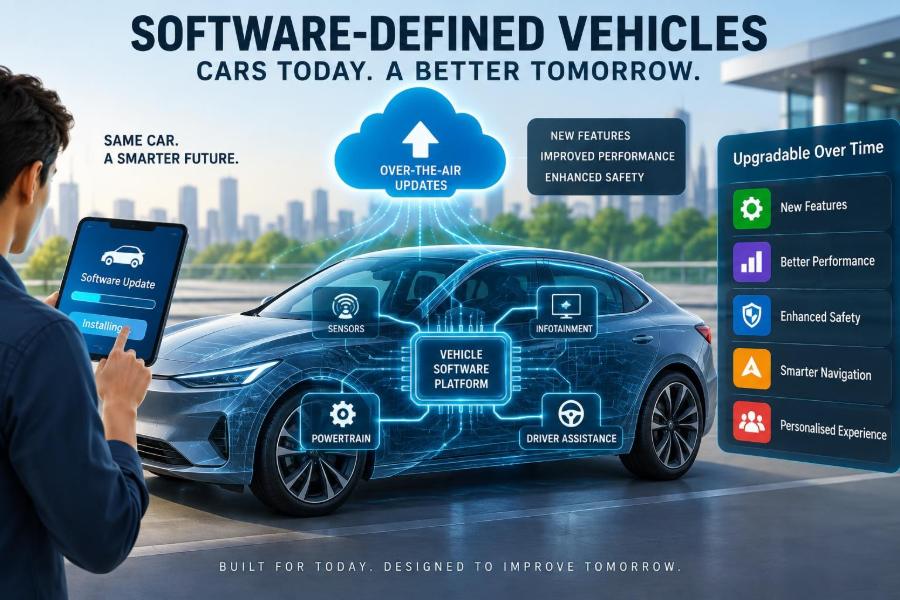

A driver buys a new car, uses it for several months, and then discovers that its navigation interface has improved overnight. The route planner now considers charging stops more intelligently, the voice controls understand more natural requests, and a new driver-assistance feature is available after an on-screen activation.
That experience would have seemed unusual when most vehicle functions were fixed at the factory. Today, it is becoming part of a broader shift: the vehicle is no longer only a mechanical product with electronic add-ons. It is increasingly a computer-controlled platform whose capabilities can be refined throughout its service life.
For students, this changes what automobile engineering means. For working professionals, it changes product development, diagnostics, cybersecurity, maintenance, regulations, and even the relationship between manufacturers and owners.
The term software-defined vehicle, or SDV, describes this shift. It does not mean that hardware has stopped mattering. Rather, it means software is taking a much larger role in defining what the vehicle does, how it behaves, and how it evolves.
🚗 What a Software-Defined Vehicle Actually Is
A software-defined vehicle is a vehicle in which many features and functions are controlled, coordinated, or changed primarily through software. These functions can include infotainment, displays, energy management, driver-assistance logic, body electronics, connectivity, and parts of chassis control.
Traditional vehicles also contain software, often in dozens of electronic control units (ECUs). The difference is architectural. In an SDV, manufacturers aim to make vehicle software more centralized, reusable, remotely updateable, and less tied to one dedicated control box.
The useful mental model is a smartphone with wheels, but only up to a point. A car operates in a far harsher and more safety-critical environment, so updates and failures must be managed much more carefully.
🧩 From Fixed Features to Evolving Capabilities
Historically, a vehicle’s equipment level was largely decided when it left the factory. Changing a function later often required a physical replacement, dealer coding, or an entirely new model year.
An SDV can separate some capability from installation timing. Hardware such as sensors, computing capacity, or a heated-seat module may be fitted during production, while software determines whether and how a feature is enabled.
This does not mean every feature can be added later. A vehicle cannot receive a camera-based parking system through software if it lacks the required cameras, wiring, computing resources, and validated integration. Software can extend prepared hardware; it cannot remove physical constraints.
⚙️ Why Conventional Vehicle Electronics Became Difficult to Manage
Modern vehicles accumulated electronic features over decades. A power-window controller, engine controller, airbag controller, instrument cluster, parking module, and infotainment unit were often developed as separate systems, sometimes by different suppliers.
This distributed approach worked well for individual functions, but it created complexity as features began to interact. A driver-assistance function, for example, may need information from braking, steering, cameras, radar, maps, displays, and vehicle networking.
Adding a feature can therefore become less like attaching one part and more like coordinating an orchestra whose musicians use different scores. SDV architectures attempt to reduce that integration burden.
🧠 The Role of Vehicle Computers
Instead of assigning every function to a small dedicated ECU, newer architectures use more powerful domain controllers or central computing units. A single computer can run several related applications while communicating with sensors, actuators, and lower-level controllers.
A domain controller typically manages a functional area such as cockpit systems, body functions, or advanced driver assistance. A more centralized design may use a high-performance computer for multiple domains, supported by local controllers near physical devices.
This approach can reduce duplicated computing hardware, but it concentrates responsibility. The central computer must meet demanding requirements for processing power, heat management, reliability, and functional safety.
🗺️ Zonal Architecture Changes the Vehicle Layout
One major SDV design trend is zonal architecture. Rather than organizing electronics mainly by function, the vehicle is divided into physical zones such as front-left, front-right, cabin, and rear.
A zone controller gathers signals from nearby lights, doors, seats, sensors, and switches. It then communicates with central computers over a high-speed network. This can shorten wiring runs and simplify the vehicle’s electrical distribution.
Less wiring can mean lower mass and fewer connection points, but the transition is not automatic. Engineers must carefully design power distribution, network redundancy, electromagnetic compatibility, and fault isolation.
🔌 The Electrical Backbone Behind Digital Functions
Software needs a dependable path to sensors, actuators, storage, and power. The vehicle’s electrical and electronic architecture, often called E/E architecture, is the foundation beneath every digital feature.
Older in-vehicle networks were designed for relatively small, periodic messages. Modern cameras, high-resolution displays, and centralized computing require much greater bandwidth, so automotive Ethernet is increasingly used alongside networks such as CAN and LIN.
Different networks remain useful for different tasks. A simple door switch does not need the bandwidth of a camera stream, while a safety-related control message may require predictable timing rather than maximum data rate.
📡 Data Is the Vehicle’s New Working Material
An SDV produces and consumes data continuously. Sensor readings describe the surrounding environment, vehicle-state data describes speed and battery condition, and diagnostic data indicates whether systems are operating as intended.
Data alone has little value without context. A wheel-speed value becomes useful when software knows which wheel it belongs to, when it was measured, whether it is plausible, and which systems may rely on it.
Engineers therefore need clear data definitions, time synchronization, access rules, and quality checks. A poorly governed signal can create inconsistent behavior even when every individual component appears to work.
🧱 Software Layers Keep Complexity Under Control
Vehicle software is usually organized in layers. At the bottom are hardware drivers and basic services that communicate with processors, memory, networks, sensors, and actuators. Above them are operating systems, middleware, and applications.
Middleware is the software layer that helps applications communicate without each one needing to know every hardware detail. It can make a function more portable from one vehicle model to another.
This separation is valuable, but not absolute. Brake control, steering control, and other time-critical functions may need tightly controlled software close to the hardware to meet timing and safety requirements.
🧰 Platform Software and Vehicle Applications
A useful distinction is between platform software and applications. Platform software provides shared foundations: identity management, diagnostics, communication, logging, update mechanisms, and access to hardware resources.
Applications deliver visible or functional behavior, such as a parking visualization, charging scheduler, cabin-preconditioning screen, or driver-profile service. A common platform allows teams to build these applications without repeatedly creating the same basic infrastructure.
For manufacturers, this can improve reuse across models. For customers, it can make functions feel more consistent. However, a common platform also means that a platform defect can affect several products if release controls are weak.
☁️ Connectivity Makes Remote Improvement Possible
An SDV commonly uses cellular, Wi-Fi, or other communication links to exchange information with backend services. This enables remote diagnostics, map delivery, account synchronization, and over-the-air updates.
Connectivity is not required for every driving function. Critical control systems should continue to work safely if a mobile signal disappears. The vehicle must never depend on a cloud response for an immediate safety action.
Connection quality also varies by region, parking location, data plan, and vehicle age. Good system design anticipates interruptions instead of assuming the car is always online.
🔄 Over-the-Air Updates Are More Than Downloads
An over-the-air update, often shortened to OTA, is the remote delivery and installation of new software or calibrated data. It may correct defects, improve compatibility, enhance an interface, or introduce a feature that has completed validation.
The update process normally includes downloading, checking authenticity, confirming compatibility, preparing storage, installing files, verifying the result, and recovering safely if something fails. A dashboard message is only the visible final stage.
Updates differ in risk. Updating a music-streaming app is not equivalent to updating software that affects propulsion, braking coordination, or driver assistance. The validation depth and installation conditions must reflect that difference.
🛡️ Safe Update Design Requires Rollback and Recovery
Reliable updating requires a plan for what happens when power is lost, a file is corrupted, or the installed version does not start correctly. One strategy uses separate software partitions so the vehicle can retain a known working version while a new version is installed.
Before an update, the vehicle may check battery state, charging connection, gear position, door status, and whether the vehicle is parked. These conditions reduce the chance of interruption or unexpected operation.
Even with safeguards, remote updates are not risk-free. Manufacturers need monitoring, staged deployment, clear owner communication, and service support for the small number of vehicles that may require physical intervention.
🔐 Cybersecurity Becomes a Core Engineering Discipline
A connected, updateable vehicle has more potential entry points than an isolated machine. Interfaces can include mobile apps, wireless networks, diagnostic ports, cloud services, USB devices, and supplier software components.
Cybersecurity engineering aims to protect confidentiality, integrity, and availability. In simple terms, data should not be exposed without permission, commands should not be altered or forged, and essential functions should remain available.
Useful measures include authenticated software, encryption where appropriate, secure boot, network segmentation, access control, vulnerability management, and event monitoring. No single measure is sufficient; protection must be built in layers.
🧯 Functional Safety and Cybersecurity Are Related but Different
Functional safety concerns hazards caused by malfunctioning electrical or electronic systems. A sensor failure, software bug, or communication fault may lead to unsafe behavior unless the system detects the problem and responds appropriately.
Cybersecurity concerns deliberate or unauthorized actions that may compromise a system. A cyberattack can create a safety problem, but the two disciplines ask different questions and use different analyses.
For example, a steering-control system may need a safe response if it receives implausible data, regardless of whether that data came from an accidental fault or malicious interference. Designing these disciplines together is increasingly necessary.
🚦 Driver Assistance Shows the Promise and Limits of SDVs
Advanced driver-assistance systems combine sensors, software, vehicle controls, and human-machine interfaces. Features may warn about lane departure, maintain a selected gap to traffic, support parking, or assist with emergency braking under defined conditions.
Software can refine object classification, improve alerts, or adjust control logic after validation. But a software update does not eliminate the physical limits of sensor placement, visibility, weather, road markings, or the system’s operating design domain.
Drivers must understand the difference between assistance and automation. An interface that overstates capability can encourage misuse, so clear communication and driver monitoring can be as important as the underlying algorithm.
🔋 Electric Vehicles Benefit from Software Coordination
Electric vehicles make the SDV concept especially visible because software coordinates battery management, thermal systems, charging, regenerative braking, route planning, and energy-use displays.
A battery-management system estimates state of charge and helps keep cells within suitable voltage and temperature limits. Thermal-control software may decide when to cool, heat, or condition the battery based on operating conditions.
Improvements to energy prediction or charging guidance can be valuable, but software cannot change the fundamental capacity of an installed battery. It can, however, help use available energy more intelligently and protect battery health under appropriate conditions.
🎛️ The Cabin Becomes a Digital Interface
In an SDV, displays are not merely decorative screens. They can present vehicle status, assist with configuration, manage user profiles, explain alerts, and provide access to connected services.
Good interface design reduces cognitive load. Controls for frequent or safety-relevant tasks should remain easy to find, quick to operate, and understandable without forcing the driver through deep menus.
A common mistake is treating every physical control as obsolete. Touch interfaces can be flexible, but tactile buttons, stalks, and switches may still be safer and faster for certain actions, especially when the vehicle is moving.
👤 Personalization Must Not Undermine Usability
Software can remember seat positions, display preferences, preferred charging times, audio settings, and navigation destinations for different users. This can make a shared vehicle feel more accommodating.
Personalization should not hide essential information or create confusion when another driver uses the car. Safety settings, warning behavior, and basic controls need sensible defaults and clear indication of who is currently signed in.
Owners should also be able to understand what personal data is stored, where it is processed, and how it can be removed when the vehicle is sold or transferred.
🏭 Manufacturing Changes When Software Is Part of the Product
Software-defined vehicles change the production process. Assembly plants must load software, configure modules, verify network communication, calibrate sensors, and confirm that each vehicle matches its intended hardware and software configuration.
Traceability becomes crucial. If a software issue appears later, engineers need to know which hardware revision, calibration, supplier component, and software version were fitted to each affected vehicle.
This does not replace traditional quality control for welds, paint, fasteners, seals, and mechanical assemblies. It adds a digital quality layer to the physical manufacturing system.
🧪 Validation Must Cover the Whole Vehicle System
A feature can work perfectly in a laboratory yet fail in a vehicle because of latency, temperature, vibration, electrical noise, unexpected driver behavior, or interaction with another controller. SDV validation therefore needs multiple levels of testing.
Engineers use simulation, software-in-the-loop testing, hardware-in-the-loop testing, test benches, proving grounds, and road evaluations. Each method exposes different problems and allows risk to be managed before broad release.
Testing must also consider updates. A change to one application may affect shared services, network load, boot time, diagnostics, or user interfaces elsewhere in the vehicle.
🧾 Configuration Management Prevents Version Chaos
One vehicle model may exist in many combinations of battery size, engine type, sensors, regional rules, options, and supplier parts. Software must recognize which configuration it is running on and avoid enabling incompatible functions.
Configuration management is the disciplined tracking of approved hardware, software, calibration, and feature combinations. Without it, diagnosing a fault or approving an update becomes increasingly difficult.
For technicians, the practical consequence is clear: “same model” may no longer mean “same system.” Accurate vehicle identification and software-version information are necessary before repair work begins.
🔧 Service Technicians Need Digital Diagnostic Skills
Mechanical expertise remains essential, but service work increasingly requires network diagnostics, software flashing procedures, data interpretation, and cybersecurity-aware access control. A fault may originate in a sensor, connector, software configuration, network message, or backend service.
A disciplined diagnostic process starts with the customer symptom, stored fault information, vehicle configuration, and relevant service instructions. Replacing components without confirming the cause can be expensive and may introduce new compatibility issues.
Technicians also need to protect vehicle and customer data. Diagnostic tools should be authorized, kept updated, and used according to approved procedures rather than treated as ordinary consumer devices.
💳 Features on Demand Create New Ownership Questions
Some manufacturers can enable optional software features after purchase, sometimes permanently and sometimes through a time-limited subscription. Examples might include enhanced navigation services, connected convenience functions, or performance-related modes where the vehicle is engineered and approved for them.
This model can offer flexibility, especially when owners’ needs change. Yet it can also create frustration if customers feel they are repeatedly paying to use hardware already installed in their vehicle.
Clear terms matter. Buyers should know whether a function is included, trial-based, transferable to a new owner, dependent on connectivity, or likely to remain available for the vehicle’s expected life.
⚖️ Data Privacy Requires Meaningful Choices
Connected vehicles can process location history, charging behavior, voice commands, diagnostics, driving events, and account information. Some data is necessary for a requested function; other collection may be optional or used to improve services.
Good privacy practice means collecting only what is reasonably needed, explaining the purpose in understandable language, protecting stored data, and providing meaningful controls. Consent should not be hidden behind vague menus.
Different jurisdictions apply different privacy requirements, and these rules evolve. Engineers and product teams should involve legal, security, and privacy specialists early rather than adding notices after the system is built.
🌍 Longer Product Life Is Possible, Not Automatic
An updateable vehicle may remain useful for longer if software defects can be corrected, interfaces can be improved, and compatible services can continue without replacing major hardware. This could reduce some pressure to replace a vehicle simply for newer digital features.
However, long life depends on sustained support. Aging processors, obsolete cellular networks, discontinued cloud services, unavailable spare parts, and battery degradation can still limit ownership.
A credible long-term strategy includes maintainable software, replacement-part planning, backward compatibility where practical, and a clear approach to service continuity. Digital capability should not become disposable by design.
📉 Common SDV Mistakes to Avoid
The most visible mistakes are often strategic rather than purely technical. A large touchscreen or a mobile app does not by itself make a vehicle software-defined.
- Centralizing too quickly: moving functions to a central computer without adequate timing, redundancy, and safety analysis.
- Treating OTA as a shortcut: using updates to compensate for incomplete validation instead of improving a mature product responsibly.
- Ignoring service realities: designing features without considering diagnostic access, repair time, workshop tools, or rural connectivity.
- Confusing data volume with insight: collecting signals without defined engineering, customer, or safety value.
- Overpromising automation: allowing marketing language or interfaces to imply capability beyond the system’s actual operating limits.
🧭 A Practical Development Approach
Successful SDV development starts with a system architecture, not a collection of apps. Teams need to define which functions are safety-critical, which data is shared, where software runs, how updates are approved, and what happens under faults or loss of connectivity.
A practical sequence is to establish secure computing and networking foundations, create stable platform services, develop applications against clear interfaces, validate across realistic scenarios, and release changes in controlled stages.
Cross-functional work is essential. Mechanical, electrical, software, cybersecurity, safety, manufacturing, service, legal, and user-experience teams influence the final vehicle. A digital platform cannot be designed successfully in isolation from the physical product.
🎓 Skills Automobile Engineers Need to Build
Future vehicle engineers do not all need to become full-time programmers, but software literacy is becoming highly valuable. Understanding networks, sensors, control systems, data flows, diagnostics, and basic cybersecurity improves communication across disciplines.
Useful capabilities include requirements engineering, systems thinking, version control, test planning, embedded software concepts, model-based design, and the ability to interpret data without losing sight of physical behavior.
Equally important is humility about uncertainty. A model can be impressive and still be wrong outside its assumptions. Engineers must ask what the system knows, what it cannot know, and how it should behave when confidence is low.
🔭 What Will Remain Physical in a Digital Vehicle
Software can coordinate a vehicle, but tires still generate grip, brakes still convert motion into heat, structures still manage crash energy, and electrical connectors still corrode if poorly designed. The laws of mechanics, thermodynamics, materials, and human factors remain unchanged.
In fact, digitization can make physical engineering more visible. A sophisticated control algorithm cannot compensate indefinitely for poor tire condition, weak sensor placement, inadequate cooling, or an unsuitable chassis design.
The strongest vehicles will combine robust hardware with adaptable software. Neither side is a substitute for the other.
🏁 The Core Principle: Cars Are Becoming Managed Systems
The defining shift is not that vehicles contain more screens or receive occasional updates. It is that manufacturers are increasingly designing the vehicle as a managed system: hardware, software, data, services, and lifecycle support are planned together.
This can deliver meaningful improvements in convenience, diagnostics, energy management, personalization, and defect correction. It also introduces obligations involving cybersecurity, privacy, validation, repairability, customer clarity, and long-term support.
For automobile engineers, the SDV is a reminder that vehicle design now extends beyond the factory gate. Engineering responsibility continues through updates, service events, changing user needs, and the real-world conditions in which people depend on their cars.
Software-defined vehicles will succeed not by making cars feel like gadgets, but by using software to make fundamentally sound vehicles safer, clearer, more adaptable, and easier to support over time. 🚘🔧🌐