
A commuter pulls away from a traffic light in an electric car and notices two things: there is no engine vibration, and the car responds almost immediately to the accelerator. Later, the same driver may wonder where the energy came from, how far the battery will last, and what happens when it eventually needs replacing.
For automobile engineers, that ordinary journey represents a major redesign of the vehicle. The change is not simply replacing a fuel tank with a battery. It affects propulsion, body structure, software, manufacturing, servicing, energy supply, and the skills expected of the people who design and maintain vehicles.
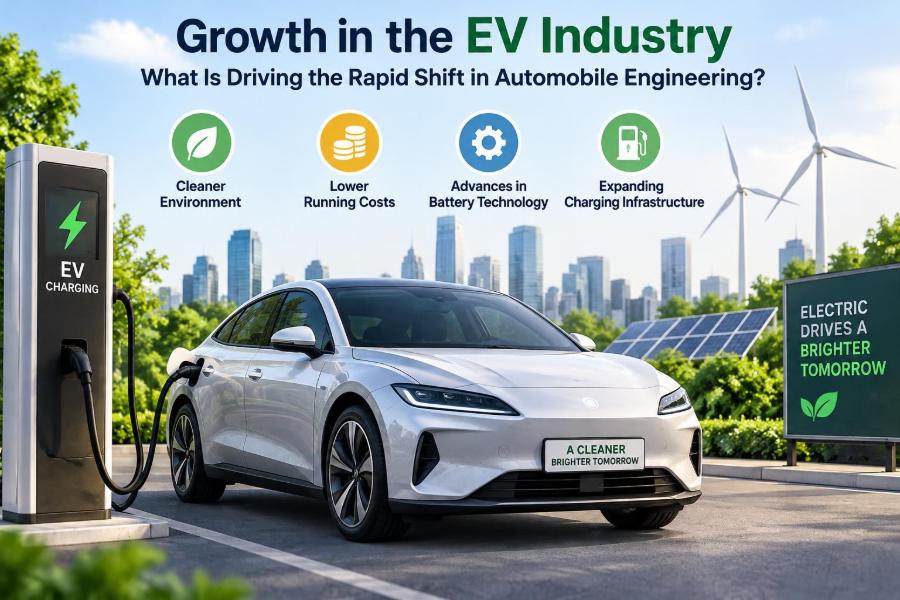
Electric vehicles, or EVs, are growing because several forces are moving in the same direction: technical progress, policy pressure, changing customer expectations, and new industrial competition. Yet the shift is neither uniform nor frictionless.
Understanding what is driving it helps students identify the engineering disciplines that matter most, and helps working professionals see why familiar automotive methods are being adapted rather than discarded.
⚡ EV Growth Is an Engineering System Change
An EV uses electric machines and stored electrical energy for propulsion. A battery-electric vehicle has no internal combustion engine; hybrid vehicles combine an engine with electric drive in different ways.
The rapid industry shift is best understood as a system-level transition. A conventional vehicle is centered on an engine, transmission, exhaust system, and fuel delivery. An EV reorganizes the vehicle around a high-voltage battery, power electronics, motors, thermal systems, and control software.
This is why EV growth reaches far beyond vehicle sales. It changes component suppliers, grid operators, workshop practices, raw-material supply chains, and university curricula.
🌍 Air Quality and Climate Pressures
Road transport produces local air pollutants and greenhouse-gas emissions when fuel is burned. Governments, cities, fleets, and customers therefore have reasons to reduce tailpipe emissions, particularly where traffic is dense.
A battery-electric vehicle has no tailpipe emissions during operation. Its full environmental impact still depends on battery production, electricity generation, vehicle use, and end-of-life processing. That distinction matters: an EV is not automatically impact-free, but it can reduce operational emissions substantially when electricity is generated with lower-carbon sources.
Urban air-quality goals are especially influential because they connect vehicle technology with a problem people can experience directly: polluted streets near homes, schools, and workplaces.
🏛️ Regulation Creates a Clearer Direction
Emissions rules, fuel-economy requirements, zero-emission vehicle programs, and city access restrictions influence product planning. Manufacturers make vehicles years before customers buy them, so a predictable regulatory direction encourages investment in platforms, factories, and supplier capacity.
Rules vary by country and can change over time. Engineers should avoid treating one market’s requirements as universal. The practical lesson is that compliance is now designed into architecture choices, not added near the end of development.
Regulation also accelerates measurement. Manufacturers must validate energy consumption, battery safety, electromagnetic compatibility, and increasingly the software behavior connected with vehicle functions.
🔋 Better Batteries Enable More Useful Vehicles
The lithium-ion battery has been central to modern EV adoption because it stores far more energy for its mass than older common rechargeable battery types. Improvements in cell chemistry, pack design, manufacturing scale, and battery management have made EVs more practical for a wider range of journeys.
Battery development is not a single race for maximum range. Engineers balance energy density, power capability, charging behavior, lifespan, safety, cost, cold-weather performance, and material availability.
A larger battery can extend driving range, but it also adds mass, cost, and resource demand. A well-engineered EV therefore matches battery capacity to vehicle purpose rather than treating the biggest pack as the only solution.
🧪 Cell Chemistry Is a Design Trade-Off
A battery cell contains electrodes, an electrolyte, and separators that allow controlled electrochemical reactions. Cell chemistry affects how much energy a pack can store, how quickly it can deliver power, and how it should be cooled and charged.
Some chemistries prioritize high energy density; others emphasize durability, lower material cost, or thermal stability. No chemistry is ideal for every vehicle. A city delivery van, a long-range passenger car, and a high-performance vehicle may reasonably make different choices.
Pack engineers also choose cell formats, arrange modules, protect them from impact, connect them electrically, and design serviceable structures. The battery is both an energy source and a structural, thermal, and safety-critical subsystem.
🧠 Battery Management Protects Performance
The battery management system, usually called the BMS, monitors cell voltages, temperatures, current, and insulation status. It estimates state of charge and state of health, then limits charging or discharge when conditions approach unsafe ranges.
Cells do not age identically. The BMS helps keep the pack balanced so that one weaker cell does not unnecessarily restrict the entire battery. Its estimates are never perfect; temperature, driving pattern, age, and charging history all affect accuracy.
For engineers, this makes battery control a blend of electronics, embedded software, data estimation, and safety engineering.
🌡️ Thermal Management Is Not Optional
Heat is generated when a battery charges or discharges, when an inverter switches current, and when an electric motor works hard. Very low temperatures can also reduce available battery power and slow charging.
Thermal management uses air, liquid coolant, refrigerant-based systems, heat pumps, valves, pumps, sensors, and control logic to maintain suitable operating conditions. The best strategy differs by climate, battery chemistry, vehicle duty cycle, and cost target.
Cabin heating presents a notable challenge. An engine produces waste heat that can warm passengers; an EV must supply heat from electrical energy or use a heat pump. In cold weather, that can affect usable range.
🔌 Charging Networks Make Ownership Practical
Most private passenger EV charging occurs while the vehicle is parked for long periods, often at home or work. Public charging becomes more important for apartment residents, long-distance travel, taxis, delivery fleets, and drivers without dedicated parking.
Charging convenience depends on more than the number of chargers. Reliability, location, payment access, connector compatibility, lighting, queuing, and clear information about charger status all influence confidence.
Infrastructure growth and vehicle growth reinforce each other. More EVs justify investment in charging, while better charging reduces hesitation among prospective buyers.
⏱️ Charging Speed Has Physical Limits
Charging power is the rate at which energy enters the battery. Higher power can reduce stopping time, but only when the vehicle, charger, cable, battery temperature, and battery state of charge allow it.
Charging typically slows as a battery approaches a high state of charge. This is deliberate: the control system reduces stress and heat near the upper end of the charge window. A quoted peak charging power therefore does not describe the entire charging session.
Drivers and fleet operators benefit from planning around useful charging windows rather than assuming that every stop should charge to full. This is analogous to refilling only the amount needed to reach the next practical stop.
⚙️ Electric Motors Change Vehicle Dynamics
Electric machines can produce high torque from very low speed, which contributes to the immediate response many drivers notice. They also operate efficiently across a broad range, allowing many EVs to use a simple fixed reduction gear instead of a multi-speed transmission.
Motor types differ in cost, efficiency, controllability, material needs, and packaging. Engineers select motor architecture according to performance targets, supply availability, and the desired drive layout.
Multiple motors can enable all-wheel drive and finely controlled torque distribution. That offers performance and traction benefits, although it adds hardware, software complexity, and potential cost.
🔄 Regenerative Braking Recovers Some Energy
When a conventional car slows, much of its kinetic energy becomes heat in the brakes. During regenerative braking, the electric motor acts as a generator and sends part of that energy back to the battery.
Recovery is limited by tire grip, battery temperature, battery state of charge, motor capability, and stability-control requirements. Friction brakes remain essential for emergency stops, low-speed stopping, and situations where regeneration is restricted.
Blending regenerative and friction braking smoothly is a demanding controls problem. The driver should receive predictable pedal feel even when the vehicle changes the balance between the two braking methods.
🧱 Dedicated Platforms Improve Packaging
Early EVs were often adapted from combustion-engine vehicles. This can shorten development time, but it may compromise space, mass distribution, and battery placement.
Dedicated EV platforms allow designers to place a large battery pack low in the floor, optimize crash structures, create more interior room, and package power electronics efficiently. A low battery can lower the center of gravity, though engineers must still manage overall mass and handling balance.
Platform design is a major reason EV engineering involves body, chassis, electrical, and manufacturing teams from the earliest concept stage.
🛡️ High-Voltage Safety Shapes Every Design
EV propulsion systems operate at voltages far above conventional 12-volt vehicle circuits. High-voltage safety requires insulation monitoring, sealed connectors, contactors that disconnect power, service interlocks, clearly identified cables, and crash-triggered shutdown strategies.
Battery packs also need mechanical protection from road debris and collision loads. Engineers assess intrusion paths, containment, venting, electrical isolation, and rescue access during vehicle development.
Safe work procedures are equally vital. Technicians need verified isolation methods, appropriate protective equipment, and training that treats high-voltage systems as a serious hazard rather than an unfamiliar extension of ordinary wiring.
🔥 Thermal Events Require Layered Prevention
Damage, manufacturing defects, severe overheating, or internal failures can create hazardous battery conditions. Engineers reduce risk through cell selection, quality control, sensing, cooling, electrical protection, robust enclosures, and fault-detection software.
No complex energy-storage system can be described as risk-free. The appropriate approach is layered safety: prevent faults where possible, detect abnormal behavior early, limit propagation, and provide controlled responses if a failure occurs.
Emergency response procedures must be specific to vehicle design and local guidance. General assumptions from fuel-vehicle fires do not always translate directly to high-voltage battery incidents.
💻 Software Is Now Part of the Powertrain
An EV depends on software to coordinate torque delivery, charging, thermal control, driver displays, regenerative braking, diagnostics, and fault handling. The vehicle’s behavior is increasingly defined by calibration as well as mechanical hardware.
Over-the-air updates can correct software issues or refine functions after delivery, but they require robust validation, cybersecurity, version control, and clear procedures for safety-critical changes.
For automobile engineers, programming literacy is becoming valuable even in traditionally mechanical roles. The goal is not that every engineer becomes a software specialist, but that teams can communicate across disciplines.
🔐 Connectivity Raises Cybersecurity Requirements
Connected vehicles exchange data with mobile applications, charging equipment, service tools, and cloud systems. Each connection can improve convenience or diagnostics, but it may also create an attack path if poorly designed.
Cybersecurity engineering includes secure communication, access control, authenticated updates, anomaly monitoring, and separation between systems of different safety importance. It is a continuous lifecycle responsibility, not a feature installed once at launch.
Privacy also matters. Location, charging behavior, and driving data can reveal sensitive patterns. Good engineering considers what data are necessary, who can access them, and how long they should be retained.
🏭 Manufacturing Is Being Reconfigured
EVs generally have fewer moving powertrain parts than combustion vehicles, but manufacturing is not automatically simpler. Battery assembly demands clean processes, precise joining, electrical testing, sealing, traceability, and careful handling of heavy components.
Factories must adapt material flow, lifting systems, worker training, quality checks, and end-of-line tests. A defect in a battery pack or high-voltage connection can be difficult and expensive to correct after assembly.
The transition also redistributes value across suppliers. Demand grows for cells, electronics, semiconductors, thermal components, charging hardware, and software, while some engine- and exhaust-related work declines.
⛏️ Materials and Supply Chains Matter
Battery production depends on minerals and processed materials whose availability, price, geographic concentration, and social impacts can vary. Supply-chain resilience has therefore become an engineering and business concern, not merely a purchasing issue.
Designers can respond through chemistry choices, material-efficient pack designs, reuse of manufacturing scrap, better traceability, and recycling. However, recycling capacity and collection systems must grow alongside vehicle deployment to deliver their full benefit.
A responsible EV transition requires attention to extraction, processing, transport, manufacturing, use, and recovery—not only the emissions visible at the tailpipe.
♻️ Battery Life Extends Beyond the Car
A battery that no longer meets a vehicle’s range or power requirement may still have useful capacity for less demanding stationary applications. Whether second-life use is practical depends on testing, transport safety, economics, standardization, and the battery’s known history.
Eventually, recycling aims to recover valuable materials for new production. Battery packs must first be safely discharged, dismantled or processed, and separated using methods appropriate to their construction.
Design for disassembly can make future recovery easier, but it must be balanced against present-day demands for crash safety, sealing, low mass, and affordable manufacturing.
📉 Total Cost Matters More Than Sticker Price
Vehicle purchase price is highly visible, but ownership cost also includes energy, maintenance, insurance, taxes, charging access, downtime, and resale value. The balance varies greatly by market and by driver.
EVs may reduce some routine maintenance because they do not require engine oil changes and have fewer conventional powertrain wear components. Tires, suspension, brakes, cooling systems, and body repairs still require attention; vehicle mass and driving style can influence tire wear.
Fleet operators often examine duty cycles closely. A delivery vehicle that returns to a depot and charges predictably may be easier to electrify than a vehicle with irregular, long-distance operation.
🚚 Different Vehicles Electrify at Different Speeds
Small urban vehicles, buses with planned routes, and depot-based fleets can benefit from predictable daily distances and regular charging opportunities. Long-haul trucks, remote-service vehicles, and some heavy-duty applications face more demanding energy, payload, and infrastructure constraints.
This does not mean difficult segments cannot electrify. It means their solution may require larger packs, high-capacity charging, route redesign, opportunity charging, or in some cases consideration of other low-emission technologies.
Good engineering begins with the actual duty cycle: distance, load, terrain, ambient temperature, idle time, parking duration, and required reliability.
🚦 The Electricity Grid Must Adapt Too
EV charging adds electrical demand, but its impact depends strongly on where and when vehicles charge. A neighborhood where many vehicles charge simultaneously in the evening may need local distribution upgrades even if total annual energy demand is manageable.
Smart charging can shift charging to periods of lower demand or greater renewable generation, subject to driver needs. Managed charging is often more practical than building oversized infrastructure everywhere.
Vehicle-to-grid and vehicle-to-building concepts may eventually provide flexibility in suitable cases, but they involve battery warranty questions, communication standards, market rules, and user consent. Their value is context-dependent.
📏 Range Is a Planning Question, Not One Number
Advertised range is measured under defined test procedures, while real-world range changes with speed, temperature, elevation, payload, wind, tire condition, cabin heating or cooling, and driving behavior. Highway driving and winter conditions can be particularly demanding.
Drivers benefit from route-aware estimates that account for these variables. Engineers must provide accurate energy prediction without creating false confidence when conditions are uncertain.
For many daily users, the relevant question is not the maximum possible distance on one charge. It is whether the vehicle can reliably complete normal travel and recharge conveniently before the next demanding trip.
🔧 Service Workshops Need New Competencies
Diagnostics in EVs include high-voltage isolation checks, battery health assessment, cooling-system inspection, charger communication faults, and software analysis. Technicians need procedures that identify whether a fault is electrical, mechanical, thermal, or digital.
A common mistake is assuming an EV needs almost no service. It needs different service. Brake components may corrode if lightly used, coolant systems still require attention, and collision damage around the pack requires careful assessment.
Training should combine theory with supervised practical work. Knowing the purpose of an orange cable is not the same as being competent to make a vehicle safe for repair.
🎓 Skills for the Next Automobile Engineer
The most valuable professionals will connect disciplines rather than viewing electrical and mechanical engineering as separate worlds. Core foundations remain essential: mechanics, materials, thermodynamics, manufacturing, controls, and safety.
- Electrical engineering: machines, power electronics, high-voltage architecture, and charging.
- Controls and software: embedded systems, estimation, calibration, diagnostics, and cybersecurity awareness.
- Mechanical engineering: structures, crashworthiness, thermal design, vibration, and packaging.
- Systems engineering: requirements, interfaces, verification, failure analysis, and lifecycle thinking.
Students can build credibility through practical projects: instrumenting an electric kart, modelling battery cooling, analyzing charging demand, or learning safe high-voltage laboratory procedures.
⚖️ Common Claims Need Careful Evaluation
Debates about EVs often collapse complex questions into slogans. “Zero emissions” can describe tailpipe operation, but it does not describe the entire lifecycle. “Long range” may be meaningful for one driver and irrelevant for another.
Likewise, a comparison between an EV and a combustion vehicle must state the use case, electricity source, climate, vehicle size, manufacturing assumptions, and lifespan. Without those boundaries, a confident claim may be less informative than it sounds.
Engineers should practice asking: compared with what, under which conditions, and measured over which part of the lifecycle?
🧭 A Sensible Way to Assess EV Suitability
For an individual or organization, the decision should start with travel patterns and charging access rather than brand preference. A short assessment can prevent mismatched expectations.
- Record typical and longest journeys, including seasonal changes.
- Identify reliable places and times for charging.
- Consider payload, towing, terrain, and required downtime.
- Compare total operating needs, not just purchase price or headline range.
- Check service support, electrical installation requirements, and local safety guidance.
This approach is useful for engineers as well. It turns a broad technology debate into specific design requirements.
🌐 Competition Is Accelerating Development
Established manufacturers, new EV-focused companies, battery producers, software firms, and charging providers are all shaping the market. Competition encourages faster iteration in batteries, electronics, interfaces, manufacturing methods, and cost reduction.
It also creates pressure to launch quickly. That makes disciplined validation more important, not less. Reliability, repairability, safety, spare-parts access, and honest range communication remain essential measures of a successful vehicle.
The strongest designs will not merely be technologically impressive; they will work consistently in ordinary ownership.
🔮 The Transition Will Be Uneven
EV adoption will not follow one identical path across all regions or vehicle classes. Electricity prices, housing patterns, climate, public charging, local manufacturing, regulations, and consumer priorities all influence the pace.
Internal combustion, hybrid, battery-electric, and potentially other low-emission powertrains may coexist for years in different roles. Engineers should avoid false either-or thinking and focus on the best technical fit for the application.
The direction of travel is clear, but the route includes practical constraints that must be solved market by market.
🚀 The Core Takeaway for Automobile Engineering
The EV industry’s growth is being driven by a convergence of cleaner-transport goals, advancing batteries, improving charging infrastructure, policy direction, software capability, and industrial investment. None of these forces is sufficient alone; together, they make electrification increasingly viable.
The central engineering challenge is to create vehicles that are safe, efficient, affordable, durable, repairable, and suitable for real driving conditions. That requires whole-system thinking—from minerals and cells to grids, workshops, and end-of-life recovery.
For students and professionals, the opportunity is larger than learning one new powertrain. It is learning to design mobility as an integrated electrical, mechanical, digital, and environmental system.
The rapid shift toward EVs is reshaping automobile engineering because it changes not only how vehicles move, but how they are designed, built, powered, maintained, and responsibly retired. 🚗⚡🌍