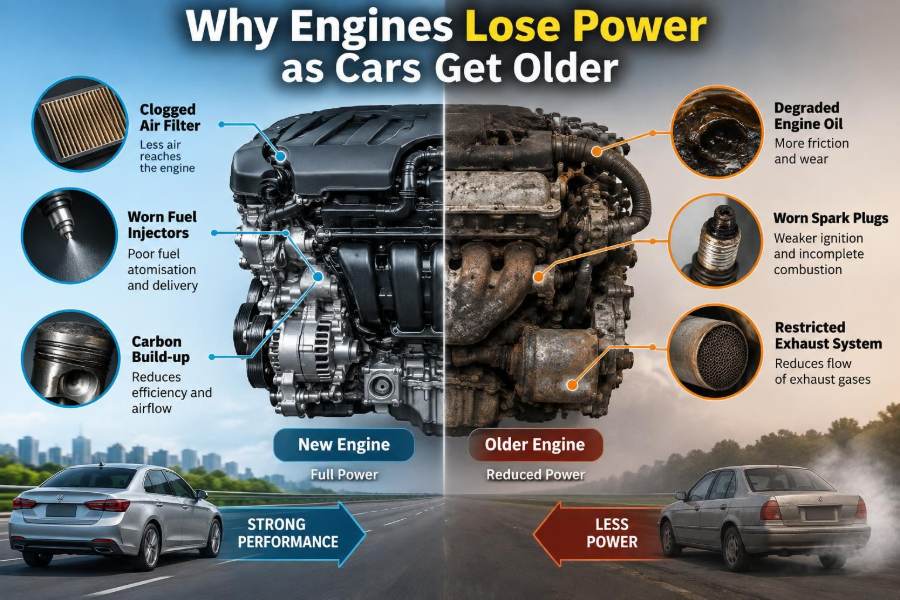

A car that once felt eager can gradually become less responsive. It may need more throttle to climb a familiar hill, hesitate when joining a highway, or feel strained with passengers and air conditioning switched on.
Owners often describe this as “the engine getting tired.” That description is understandable, but it hides an important point: power loss is rarely caused by one ageing part alone. An engine is an air pump, fuel-metering system, ignition system, mechanical assembly, and emissions-control system working together.
Some loss of performance can develop slowly enough that the driver adapts to it. Other cases are early warnings of a fault that can become expensive or unsafe if ignored, especially when overtaking or carrying heavy loads.
Understanding where power goes helps students diagnose systematically and helps owners spend maintenance money on the real cause rather than on random replacement parts.
⚙️ What “Losing Power” Actually Means
Engine power is the rate at which the engine can do useful work. In simple terms, it depends on how effectively the cylinders draw in air, add the correct amount of fuel, burn the mixture at the right time, and expel exhaust gases.
A vehicle can feel slow for reasons outside the engine too. A slipping transmission, dragging brake, low tyre pressure, or failed turbocharger can all create the same driver complaint: poor acceleration.
Diagnosis starts by separating a genuine reduction in engine output from increased resistance or a driveline fault.
🧪 The Combustion Triangle Behind Performance
For a spark-ignition petrol engine, useful torque requires adequate air, correctly metered fuel, a reliable spark, and sufficient cylinder compression. Diesel engines also require clean air, accurate fuel injection, high compression, and correctly timed combustion.
If one input is restricted or poorly controlled, the engine management system may reduce fuelling or alter timing to prevent damage. The result is often a noticeable reduction in torque, particularly under load.
Think of an engine as a breathing athlete: restricted breathing, poor nutrition, or weak coordination will all limit output, even if the athlete is otherwise healthy.
📉 Why Gradual Decline Is Easy to Miss
Most wear-related changes happen over thousands of operating cycles, not overnight. Drivers unconsciously compensate by pressing the accelerator farther, changing gear later, or avoiding demanding manoeuvres.
A sudden loss of power is easier to recognize and often points to a distinct fault, such as a disconnected intake hose or failed sensor. A gradual decline is more likely to involve deposits, wear, neglected servicing, or several small issues acting together.
Comparing current performance with service history, fuel economy, warning lights, and previous behaviour is more useful than relying on memory alone.
🌬️ Restricted Air Filters and Intake Paths
An engine needs a large volume of clean intake air. A heavily contaminated air filter raises restriction, so the cylinders cannot fill as effectively at higher engine speed or load.
Blocked filters are more likely where cars operate on dusty roads, construction sites, or unpaved routes. Rodent nests, leaves, damaged intake ducting, and collapsed flexible hoses can also obstruct airflow.
A clean filter helps, but fitting an unsuitable high-flow filter or leaving the airbox poorly sealed is not a solution. Unfiltered dust can accelerate internal wear and contaminate airflow sensors.
🌀 Carbon Deposits in the Intake System
Deposits can build on throttle bodies, intake manifolds, intake valves, and ports. Their effect depends heavily on engine design and operating conditions.
Direct-injection petrol engines are particularly prone to intake-valve deposits because fuel is injected directly into the cylinder rather than washing over the back of the valve. Exhaust-gas recirculation and oil vapour from the crankcase ventilation system can add material to the intake tract.
Deposits may disturb airflow, reduce effective port area, and contribute to rough running. Cleaning methods must suit the engine; aggressive or poorly performed cleaning can create new problems.
🛢️ Fuel Filters, Pumps, and Delivery Pressure
Fuel must arrive at the injectors at the required pressure and volume. A restricted fuel filter, weak electric pump, contaminated pickup strainer, leaking line, or pressure-control fault can starve the engine when demand rises.
This often appears as hesitation during hard acceleration, high-speed driving, or uphill work. At idle, the same vehicle may seem almost normal because the fuel requirement is small.
Many modern petrol vehicles have non-serviceable filters integrated into the tank module, while some diesel systems use replaceable filters that require regular attention. The correct service procedure depends on the vehicle.
💉 Dirty or Worn Fuel Injectors
Injectors meter fuel in extremely small, timed pulses. Deposits can alter spray pattern and flow, while electrical faults or internal wear can make one injector behave differently from the others.
A poor spray pattern does more than reduce power. It can cause uneven combustion, increased emissions, misfires, hard starting, or piston damage in severe diesel-injection faults.
Cleaning additives may help with light deposits in some cases, but they cannot repair an electrically failed injector or a mechanically worn one. Testing injector balance and commanded versus actual fuel data is more meaningful than guessing.
🔥 Spark Plugs and Ignition Coils
Petrol engines need a strong spark at the correct moment. Spark plug electrodes wear gradually, widening the gap and increasing the voltage required to jump it, especially when cylinder pressure is high during acceleration.
A weak ignition coil may fire adequately at idle but break down under load. The driver may feel a shudder, hesitation, flashing warning light, or a sudden drop in power.
Using the correct plug type, heat range, and gap matters. A plug that physically fits is not automatically suitable for the engine’s combustion chamber and ignition system.
⏱️ Valve Timing That Is No Longer Correct
Camshaft timing controls when valves open and close. A stretched timing chain, worn tensioner, incorrectly installed belt, or variable-valve-timing fault can shift those events away from their intended positions.
Even a modest timing error can reduce cylinder filling and weaken torque. More serious errors may allow valves and pistons to contact each other in interference engines, causing major mechanical damage.
Rattling on start-up, fault codes related to cam and crank correlation, and reduced performance deserve timely assessment rather than continued driving.
🔧 Compression Loss from Cylinder Wear
Compression is the pressure created when the piston compresses the trapped charge in a cylinder. Worn piston rings, scored cylinder walls, damaged pistons, leaking valves, or a failing head gasket can reduce that pressure.
Lower compression makes combustion less effective, particularly during starting and at low engine speed. Symptoms may include oil consumption, blue exhaust smoke, crankcase pressure, rough idle, or persistent misfires.
A compression test is useful, but it is not the whole diagnosis. A leak-down test, in which compressed air is introduced into a cylinder, can help identify whether leakage is past rings, valves, or the head gasket.
🧱 Valve-Train Wear and Poor Sealing
Valves must seal against their seats during the compression and combustion strokes. Burnt valves, worn seats, carbon trapped on a seat, weak valve springs, or incorrect valve clearance can compromise that seal.
Tight valve clearance is especially problematic because it may prevent a valve from fully closing as components expand with heat. The engine can lose compression only after warming up, making the fault harder to spot.
Engines with scheduled valve-clearance inspection should not have that requirement ignored merely because they still start and run.
🛢️ Oil Control and Internal Friction
Engine oil creates a protective film between moving surfaces, carries heat away, and suspends contaminants for removal by the filter. Incorrect viscosity, severe oil degradation, low oil level, or sludge can increase friction and accelerate wear.
Friction alone does not usually explain a dramatic power loss, but poor lubrication can damage timing components, turbocharger bearings, piston rings, and valve-train parts that do affect output.
Oil changes should follow the manufacturer’s specification and operating conditions. Very short trips, heavy towing, dusty use, and frequent idling can justify more cautious servicing than idealized schedules suggest.
🌡️ Overheating and Heat-Related Damage
An overheated engine may temporarily reduce power because the control module protects it by changing ignition timing, fuelling, boost, or throttle opening. Continued overheating can permanently distort cylinder heads, damage gaskets, and worsen ring or valve sealing.
Cooling-system problems often begin outside the engine itself: low coolant, leaking hoses, blocked radiator passages, stuck thermostats, weak water pumps, or inoperative cooling fans.
Never treat repeated overheating as a minor inconvenience. Stopping safely and investigating the cause is usually far less costly than continuing until mechanical damage occurs.
🧠 Sensors, Control Modules, and Limp Mode
Modern engines rely on sensors for air mass, manifold pressure, throttle position, crankshaft speed, camshaft position, oxygen content, temperature, and knock. Incorrect information can lead to incorrect fuelling, ignition timing, or boost control.
When the engine control module detects a condition that could damage the engine, turbocharger, catalytic converter, or transmission, it may enter a reduced-power strategy commonly called limp mode.
Limp mode is a protective response, not a diagnosis. Clearing a warning light without identifying the stored fault can remove evidence while leaving the underlying defect active.
📡 Airflow and Pressure Sensors
A mass airflow sensor estimates how much air enters the engine, while a manifold absolute pressure sensor measures intake pressure. Their readings help the controller calculate fuel quantity and, on turbocharged engines, monitor boost.
Oil vapour, dust contamination, wiring faults, intake leaks, and sensor ageing can produce implausible values. The engine may then run rich, lean, or conservatively limited.
Sensor replacement should ideally follow data checks, wiring inspection, and intake-leak testing. Replacing parts based only on a generic code can be wasteful.
🌪️ Turbocharger and Supercharger Problems
Forced-induction engines use compressed intake air to pack more oxygen into each cylinder. A leak in an intercooler hose, loose clamp, split charge pipe, sticking wastegate, failed boost-control actuator, or worn turbocharger can sharply reduce performance.
Turbo faults may be accompanied by unusual whistling, excess smoke, oil consumption, or a power band that disappears above a certain load. But these symptoms overlap with other faults, so inspection is essential.
Driving hard with low boost does not fix the problem. If lubrication or turbine damage is involved, continued operation can make the repair substantially larger.
🚧 Exhaust Restriction and Back Pressure
Exhaust gases must leave the cylinders with limited resistance. A damaged catalytic converter, blocked diesel particulate filter, collapsed muffler internals, or crushed exhaust pipe can create excessive back pressure.
The engine then spends more work pushing gases out, and fresh charge may not enter as effectively. A restricted exhaust can feel like an engine that cannot breathe at higher rpm.
Replacing an emissions component without proving the cause of the restriction is risky. Misfires, oil burning, incorrect fuelling, or sensor faults can damage the replacement component as well.
♻️ EGR and Emissions-System Effects
Exhaust-gas recirculation, or EGR, sends a controlled amount of exhaust back into the intake under certain conditions to reduce combustion temperatures and emissions. If an EGR valve sticks open when it should close, too much inert gas can dilute the intake charge and reduce power.
Diesel engines may also reduce output when particulate-filter regeneration is interrupted repeatedly or when soot loading becomes excessive. Short journeys can make successful regeneration more difficult.
Removing or disabling emissions equipment is not a sound repair. It can create legal, environmental, drivability, and diagnostic problems, besides masking the actual fault.
🚘 Transmission Faults That Mimic Engine Weakness
Engine speed and vehicle speed should rise together in a healthy driveline. If rpm climbs but the car does not accelerate proportionally, a slipping clutch, worn automatic-transmission clutch pack, torque-converter problem, or continuously variable transmission fault may be responsible.
A transmission in fail-safe mode can also limit available ratios and make the vehicle feel lethargic. The engine may be producing normal torque but unable to use it effectively at the wheels.
Before condemning the engine, observe the tachometer, shift behaviour, warning messages, and fluid condition where the manufacturer permits inspection.
🛑 Brakes, Bearings, and Rolling Resistance
A seized brake caliper, sticking parking brake, damaged wheel bearing, or severely underinflated tyre makes the vehicle harder to move. The driver experiences sluggishness even though engine output has not changed.
After a normal drive, one wheel that is much hotter than the others can indicate brake drag, though wheels and brakes can be dangerously hot. Inspection should be done carefully and by a qualified technician when needed.
This distinction matters because adding engine parts cannot overcome a mechanical resistance fault economically or safely.
🧭 Fuel Quality and Octane Requirements
Fuel that is contaminated, stale, or unsuitable for the vehicle can reduce performance and cause rough running. Petrol engines designed for a particular minimum octane may retard ignition timing when knock is detected, reducing torque to protect the engine.
Higher octane than required does not automatically create extra power. It simply provides greater resistance to knock; the benefit depends on whether the engine’s calibration can use it.
For diesel engines, water contamination and poor filtration are particularly serious because high-pressure fuel-system components depend on clean fuel for reliable operation.
🔊 Knock, Detonation, and Protective Retard
Knock is abnormal combustion in which pressure waves develop after ignition in an uncontrolled way. It is not the same as every mechanical ticking or rattle heard from an engine.
Knock sensors allow many petrol engines to detect this condition and retard timing. That protects the engine, but delayed ignition produces less useful torque.
Persistent knock control can point to incorrect fuel, excessive deposits, overheating, boost problems, or an engine calibration issue. It should be investigated rather than treated as normal ageing.
📊 A Practical Symptom Guide
| Observed symptom | Possible direction for diagnosis |
|---|---|
| Power loss mainly at high load | Fuel delivery, ignition breakdown, boost leak, exhaust restriction |
| Rough idle plus weak acceleration | Misfire, injector fault, intake leak, compression or valve issue |
| Rpm rises without matching road speed | Clutch or transmission slip |
| Sudden reduced power with warning light | Stored fault, sensor issue, boost control, emissions-system protection |
| Oil use, smoke, and low power | Rings, turbo seals, valve seals, or other mechanical wear |
These are starting points, not conclusions. Several faults can produce the same symptom, and one fault can produce several symptoms.
🧰 The Right Diagnostic Order
Efficient diagnosis moves from simple checks to more invasive tests. Start with the complaint: when does power fall away, is the engine hot or cold, does the fault occur under load, and are warning lights present?
- Check service history, fluid levels, obvious leaks, intake hoses, filters, and electrical connectors.
- Scan for diagnostic trouble codes and examine live data rather than reading codes alone.
- Confirm ignition, fuel pressure, airflow, boost, and exhaust behaviour as relevant to the engine.
- Use compression or leak-down testing when mechanical condition is suspected.
This order reduces the common mistake of replacing expensive components before basic faults have been ruled out.
🧑🔧 What a Professional Workshop Can Verify
A well-equipped workshop can compare commanded values with actual values while driving or using controlled tests. Examples include fuel-rail pressure, turbo boost, airflow readings, oxygen-sensor response, injector correction values, and camshaft timing correlation.
Technicians may use smoke testing to find intake leaks, pressure testing for charge-air systems, oscilloscopes for ignition and sensor signals, and exhaust back-pressure tests for suspected restriction.
Not every shop needs every tool, but a diagnosis should connect measurements to the symptom. “It might be this” is not the same as evidence.
📅 Maintenance That Preserves Power
Maintenance cannot reverse all mechanical wear, but it prevents many avoidable causes of power loss. Follow the manufacturer’s schedule for oil, filters, plugs, fuel filters where applicable, coolant, and timing components.
- Use the specified engine oil and change it before it becomes severely degraded.
- Inspect intake pipes, vacuum lines, and clamps during routine service.
- Address warning lights, misfires, overheating, and unusual smoke promptly.
- Allow a cold engine to warm under gentle load rather than immediately demanding full power.
- Use quality fuel from reliable sources and avoid storing fuel for long periods where possible.
Regular highway operation may help some vehicles complete emissions-system processes, but it is not a cure for an established mechanical or sensor fault.
❌ Common “Fixes” That Miss the Cause
Changing spark plugs, pouring in additives, fitting a louder intake, or disconnecting the battery may temporarily change how a car feels, but none is a universal solution. In some cases, these actions can hide evidence or introduce faults.
Aftermarket performance modifications deserve particular caution on older vehicles. More boost or aggressive tuning increases cylinder pressure and heat, which can expose weak cooling, fuelling, transmission, or internal-engine components.
The best repair is the one that restores the intended system function, not the one with the most dramatic marketing claim.
⚖️ When Age Is Not the Real Problem
Calendar age and odometer distance are imperfect measures of engine health. A carefully maintained high-mileage engine can perform strongly, while a newer engine exposed to poor lubrication, overheating, contaminated fuel, or neglected repairs can lose power early.
Operating pattern matters too. Short cold trips encourage moisture and deposits; frequent towing adds thermal and mechanical load; long idle periods can affect some diesel emissions systems.
The useful question is not simply, “How old is the car?” It is, “Which system is no longer delivering what the engine needs?”
💰 Deciding Between Repair and Replacement
A blocked filter, coil fault, boost hose, sensor, or brake drag may be relatively straightforward to repair. Low compression across several cylinders, severe bore damage, or a badly damaged transmission can require major rebuilding or replacement.
Decision-making should include the vehicle’s overall condition, repair quality, parts availability, safety, emissions compliance, and expected remaining service—not just the cost of the immediate job.
An accurate diagnosis is especially valuable here. Spending modestly to identify a major internal fault can prevent repeated spending on parts that were never the cause.
🏁 The Core Principle: Restore the Whole System
Engines lose power as cars age because their supporting systems accumulate wear, contamination, leaks, calibration errors, and occasionally serious mechanical damage. The symptom is shared, but the mechanisms are not.
Airflow, fuel delivery, ignition, compression, timing, exhaust flow, electronic control, drivetrain efficiency, and rolling resistance must all be considered in a logical order. That approach protects both the vehicle and the owner’s budget.
The most reliable way to recover lost performance is to diagnose the limiting system with evidence, then repair the cause rather than treating “old age” as the diagnosis.
A slower car is not automatically a worn-out car. Careful observation, routine maintenance, and targeted testing can often restore safe, dependable performance—or clearly show when a larger repair decision is justified. 🚗🔧📈