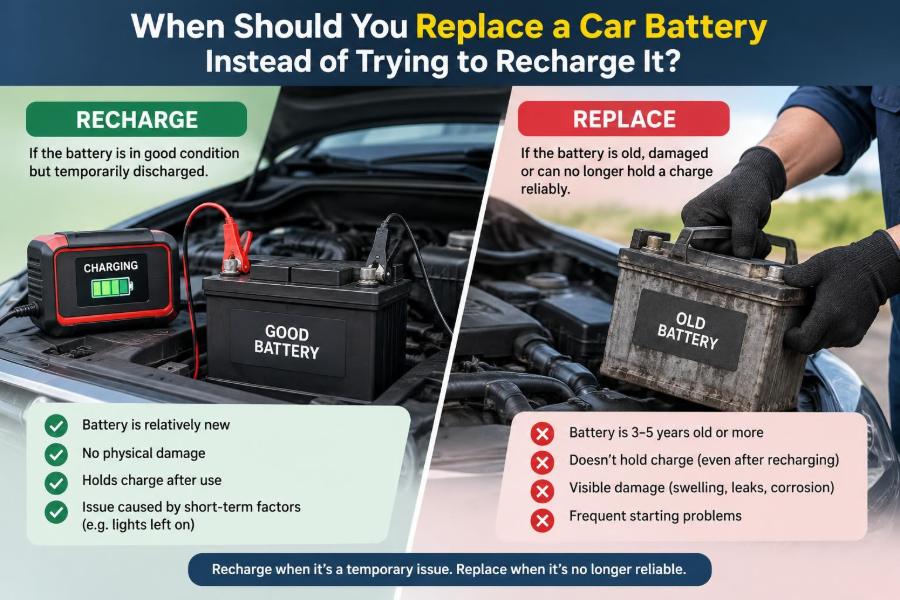

The familiar click-click-click at the start of a day can create an immediate question: is the battery merely flat, or has it reached the end of its useful life? The answer affects more than whether the engine starts this morning.
A healthy battery can be discharged by leaving a lamp on, taking many short trips, or parking for an extended period. In those cases, a correct recharge may restore normal service. But charging cannot reverse every type of battery failure.
Modern cars rely on stable electrical power for engine management, safety systems, infotainment, and start-stop operation. A weak battery may still start the vehicle occasionally while causing intermittent warnings, slow cranking, or electronic faults.
Knowing when to recharge and when to replace protects the charging system, reduces breakdown risk, and avoids spending time trying to revive a battery with damaged internal components.
🔋 What a Car Battery Actually Does
The familiar 12-volt lead-acid battery stores chemical energy and releases it as electrical current. Its first major job is supplying a large burst of current to the starter motor.
With the engine running, the alternator supplies most vehicle electrical power and replenishes the battery. The battery also stabilizes voltage when electrical demand changes suddenly, such as when cooling fans, lights, or heated screens operate.
Starting ability depends not only on battery voltage but also on capacity and cold cranking amps (CCA). Capacity describes how much energy it can store; CCA describes its ability to deliver high current in cold conditions.
⚡ A Flat Battery Is Not Always a Failed Battery
A discharged battery still has usable internal materials; it simply lacks enough stored charge to do its job. A failed battery has lost the ability to accept, hold, or deliver charge adequately.
For example, a healthy battery drained by an interior light may recover after a proper slow charge. A battery with a shorted cell or badly corroded plates may show some voltage after charging but fail as soon as a real load is applied.
This distinction matters because jump-starting only gets the engine running. It does not diagnose the battery or confirm that the alternator can recharge it.
🧪 Understanding Voltage, Charge, and Condition
Voltage is a useful clue, but it is not a complete health report. A rested conventional 12-volt lead-acid battery near full charge will commonly measure around 12.6 volts, while a significantly discharged one will read lower.
However, a weak battery can show an apparently respectable voltage with no meaningful ability to supply starting current. This is sometimes called a surface charge: immediately after charging, the voltage looks promising but falls quickly under load.
Battery testers assess electrical response, and some estimate CCA or internal resistance. Their results are more informative than voltage alone, although correct testing procedures and the battery type still matter.
🕰️ Age Is a Strong Replacement Clue
All lead-acid batteries gradually lose capacity through normal chemical aging. Heat, deep discharges, vibration, and frequent high electrical loads can shorten their practical service life.
There is no universal replacement date. Climate, driving pattern, battery quality, and vehicle design all influence lifespan. Still, once a battery is several years old and begins showing repeat symptoms, replacement is often more sensible than repeated charging.
Check the date code or manufacturing label if available. Age should not condemn a battery by itself, but it gives important context to any test result.
🌡️ Heat Does More Damage Than Many Drivers Expect
High under-bonnet and ambient temperatures accelerate chemical reactions inside a battery. Over time, this can increase water loss, corrosion, and deterioration of the active material on the plates.
The failure may become obvious later, often during a cold morning when the weakened battery must provide more cranking current. In that situation, cold weather exposes the damage; it may not have caused all of it.
Vehicles operated in consistently hot conditions deserve earlier battery inspection, especially if the battery is near the end of its expected service period.
❄️ Why Cold Weather Reveals Battery Weakness
Cold temperatures slow the battery’s chemical reactions, reducing the current it can supply. At the same time, engine oil is thicker and the starter motor needs more effort to turn the engine.
A battery that seems acceptable in mild weather may therefore crank slowly or fail during a cold spell. Recharging may help if the battery was simply low, but it will not restore capacity already lost to aging or internal damage.
Do not assume a winter no-start automatically means “the cold killed the battery.” Test both the battery and charging system before deciding.
🔄 Short Trips Can Leave a Good Battery Undercharged
Starting an engine consumes a noticeable amount of energy. A very short drive, particularly with lights, blowers, demisters, seat heaters, and audio systems in use, may not fully replace it.
Repeated short journeys can leave a sound battery chronically undercharged. This encourages sulfation and makes starting performance progressively worse.
If testing indicates that the battery is fundamentally healthy, an appropriate external charger or a longer normal drive may correct the situation. The key is to identify whether low charge is the cause, rather than assuming low charge is the whole diagnosis.
🧱 Sulfation Explains Why Some Batteries Will Not Recover
When a lead-acid battery remains discharged, lead sulfate crystals form on its plates. Some sulfate is part of normal battery operation and reverses during charging.
When low charge persists, the crystals can become larger and harder to convert back. This process, called sulfation, reduces plate area available for the chemical reaction and lowers capacity.
A smart charger may recover a mildly sulfated battery, but severe sulfation is often permanent. A battery that repeatedly needs charging yet soon becomes weak is a replacement candidate, not a dependable repair project.
🪫 One Bad Cell Usually Means Replacement
A conventional 12-volt lead-acid battery contains six cells connected in series. Each cell contributes roughly two volts. If one cell fails internally, the entire battery cannot provide normal voltage and current.
A resting reading near roughly 10 to 11 volts can suggest a failed cell, though a professional test is the safer basis for diagnosis. Charging such a battery rarely creates a lasting solution.
Internal cell failure may result from plate damage, shedding active material, or a short circuit. These are physical faults, not merely a shortage of charge.
🔍 Visible Case Damage Is a Clear Warning
Replace rather than recharge a battery with a cracked case, leaking electrolyte, severely swollen sides, or melted terminal areas. Such damage can create chemical, electrical, and fire hazards.
Bulging may indicate overcharging, freezing damage, or internal failure. Do not squeeze, puncture, or attempt to open a sealed battery.
Wear eye protection and avoid flames or sparks around any suspected leaking battery. If acid has escaped, follow the vehicle and battery manufacturer’s safety guidance rather than handling the problem casually.
👃 A Rotten-Egg Smell Requires Immediate Attention
A strong sulfur or rotten-egg smell can indicate hydrogen sulfide gas from a battery that is overcharging or failing internally. This is not a normal sign of routine charging.
Stop charging if it is safe to do so, ventilate the area, and keep ignition sources away. The underlying cause may be the battery, the alternator regulator, unsuitable charger settings, or damaged wiring.
Replacing the battery without checking why it gassed excessively can lead to the same issue with the new one.
🚙 Slow Cranking Is a Symptom, Not a Verdict
A slow, laboured crank often points to low battery output, but it can also come from corroded terminals, poor earth connections, a failing starter motor, heavy engine oil, or an engine mechanical problem.
Listen for the pattern. Repeated rapid clicks often mean insufficient current reaching the starter; a single heavy click may suggest a starter circuit issue. These clues guide diagnosis but do not replace testing.
If a fully charged battery passes a load or conductance test and cranking remains slow, investigate cables, connections, and the starter before buying a battery.
💡 Electrical Warnings Can Have Several Causes
Dim lights at idle, flickering displays, warning messages, or erratic accessories can occur when voltage is low. A weak battery is one possibility, especially before starting.
But with the engine running, such symptoms may point to an alternator, belt, wiring, ground connection, or control-system issue. Treating every electrical warning with a new battery can hide the true fault.
Modern vehicles are sensitive to voltage changes, so scan-tool fault codes and a charging-system check may be worthwhile when warnings persist.
🔌 The Alternator Must Be Tested Too
The alternator converts engine rotation into electricity and maintains the battery while driving. If it undercharges, a new battery will soon become discharged. If it overcharges, it can damage the battery and vehicle electronics.
A basic charging-voltage reading can offer a clue, but many modern vehicles use smart charging strategies that intentionally vary voltage. Manufacturer procedures or a capable workshop test are more reliable than applying one fixed number to every vehicle.
Before declaring a battery dead, ask a simple question: did the battery fail to retain a charge, or was it never being charged correctly?
🕵️ Parasitic Drain Can Mimic Battery Failure
A parasitic drain is electrical current drawn when the vehicle is switched off. Some standby consumption is normal for alarms, clocks, and control modules, but excessive drain can flatten a good battery during parking.
Examples include a glovebox lamp that stays on, an accessory wired incorrectly, a module that does not enter sleep mode, or an aftermarket dash camera with poor power management.
If a recently charged and tested battery repeatedly goes flat after standing, diagnose the drain before replacement. Otherwise, the replacement battery may suffer the same fate.
🧰 Terminal Corrosion Can Be Fixed Without Replacing the Battery
Blue-green or white corrosion around terminals increases resistance. That resistance can prevent full charging and reduce the current available to the starter, producing symptoms that resemble battery failure.
With the vehicle safely switched off and following appropriate precautions, terminals can be inspected, cleaned, dried, and tightened. Disconnect order and memory-retention needs vary by vehicle, so consult the manufacturer guidance.
Corrosion alone does not prove the battery is bad. However, recurring corrosion may signal leakage, overcharging, or a poor connection that deserves further investigation.
📏 Load Testing Separates Charge From Capability
A load test examines how battery voltage behaves while significant current is demanded. This is much closer to the real task of starting an engine than a simple open-circuit voltage check.
Many workshops use electronic conductance testers instead. These estimate battery condition without applying the traditional high load and are widely useful for modern batteries when used correctly.
A battery that charges to normal voltage but fails a valid capacity or conductance test should be replaced. It has demonstrated that stored voltage is not translating into reliable usable power.
🔌 Recharge First When the Cause Is Clearly Temporary
Recharging is reasonable when the battery is relatively healthy, there is a credible one-time cause of discharge, and testing does not show an internal fault. Leaving lights on, a door not fully latched, or an extended period of storage are typical examples.
Use a charger compatible with the battery chemistry and follow its instructions. Slow, controlled charging is generally less stressful than repeatedly using jump-starts and relying on a short drive to recover the battery.
After charging, verify that the battery holds its charge and that the vehicle’s charging system operates correctly. A single successful start is not the same as confirmed recovery.
🚫 Replace When Charging Produces Only a Brief Improvement
The most practical replacement signal is recurrence. If the vehicle starts after charging but becomes weak again within a short period, either the battery cannot retain energy or the vehicle has a charging or drain fault.
When a test identifies poor battery health and the alternator and parked-current checks are satisfactory, replacement is the logical next step. Continuing to charge a depleted, aged battery only postpones the no-start.
Think of charging as filling a container. If the container has lost most of its usable volume or has a leak, filling it again does not restore its original function.
🏷️ Choose the Correct Replacement Battery Type
Replacement is not just about fitting any battery that physically fits. The new unit must match the required voltage, terminal layout, dimensions, hold-down arrangement, and electrical specification.
Vehicles with start-stop systems commonly require enhanced flooded battery (EFB) or absorbent glass mat (AGM) technology. Fitting a basic flooded battery where AGM or EFB is specified can lead to poor durability and improper charging behaviour.
Do not choose a much higher CCA rating as a substitute for checking compatibility. The manufacturer’s battery specification and vehicle documentation are the starting point.
🧠 Battery Registration Matters on Some Cars
Many newer vehicles use a battery monitoring sensor and energy-management system. After replacement, the vehicle may need battery registration, coding, or adaptation so it recognizes the new battery’s type, capacity, and age.
Without this step, the charging strategy may continue treating the new unit as an old one. The result can be undercharging, overcharging, reduced start-stop availability, or shortened battery life.
This requirement varies by make and model. Check service information rather than assuming that a simple physical swap is sufficient.
🔧 Safe Charging Requires the Right Setup
Charge batteries in a well-ventilated area with compatible equipment. Verify chemistry and charger mode: conventional flooded, AGM, gel, and lithium-based systems do not necessarily use identical charging profiles.
Inspect cables and terminals before connecting. Avoid sparks near the battery, remove metal jewellery, and never charge a visibly damaged or frozen battery.
Some vehicles have designated remote charging points. Using them may protect battery monitoring systems and reduce access difficulties, so follow the owner’s manual.
🆘 Jump-Starting Is Emergency Assistance, Not Treatment
A jump-start can be useful when a safe, temporary way to start the vehicle is needed. It does not recharge the battery fully and should not be used repeatedly as a routine operating method.
Incorrect connections can damage electronics, create sparks, or injure people. Follow the vehicle’s specified connection points and sequence, and use a jump pack or donor vehicle only as instructed.
After a jump-start, arrange proper diagnosis. Repeatedly needing assistance is itself evidence that the electrical system needs attention.
🛑 Avoid Deeply Discharging a Battery Repeatedly
Starter batteries are designed to deliver short, high-current bursts and then be promptly recharged. They are not designed for frequent deep discharge in the way some deep-cycle batteries are.
Repeatedly draining a starter battery can accelerate sulfation and reduce its future capacity. This is why a battery that has survived one accidental discharge may not tolerate a pattern of them.
For seasonal vehicles or cars parked for long periods, an appropriate maintenance charger can be more effective than allowing the battery to fall flat and then attempting recovery.
📋 A Practical Decision Sequence
Use evidence in a sensible order rather than replacing parts based only on a no-start event.
- Inspect for leaks, cracks, swelling, loose cables, and serious corrosion.
- Consider age, recent use, weather, and any obvious discharge event.
- Charge a safe, undamaged battery with the correct charger if it is low.
- Test battery condition after charging, not merely its immediate voltage.
- Check alternator operation and investigate abnormal parked-current drain when symptoms recur.
- Replace the battery if it fails testing, has physical damage, has a failed cell, or cannot retain useful charge.
This sequence prevents two costly mistakes: replacing a healthy battery because of a drain, and retaining a failed battery because it briefly accepts charge.
⚠️ Common Diagnosis Mistakes to Avoid
- Judging by dashboard lights alone: lights may work even when the battery cannot supply starter current.
- Testing immediately after charging only: surface charge can make voltage look better than real capacity.
- Ignoring cable condition: resistance at terminals and ground straps can imitate a weak battery.
- Replacing the battery without checking charging: an alternator fault can damage or drain the replacement.
- Using the wrong battery technology: start-stop vehicles have specific electrical demands.
Good diagnosis is less about one magic reading and more about matching symptoms, inspection, charging history, and test results.
♻️ Dispose of the Old Battery Responsibly
Lead-acid batteries contain lead and corrosive electrolyte, both of which require controlled recycling. Do not place an old car battery in household waste or leave it where it can leak.
Battery retailers, workshops, and recycling facilities commonly accept used units through established collection routes. Transport it upright where possible and protect the terminals from accidental short circuits.
Proper recycling recovers valuable materials and prevents hazardous substances from entering the environment.
✅ The Core Rule: Replace a Battery That Cannot Reliably Do Its Job
Recharge when there is a temporary, explainable discharge and testing shows the battery remains healthy. Replace when testing shows poor capability, one cell has failed, the case is damaged, or charging provides only short-lived improvement after other faults have been ruled out.
The goal is not to obtain one more start. It is to restore dependable electrical operation without overlooking an alternator issue, poor connection, or parasitic drain that could affect the next battery too.
A charger restores energy; it cannot repair worn-out plates, a failed cell, or physical battery damage. That principle makes the recharge-versus-replace decision much clearer.
Replace a battery when evidence shows it can no longer store and deliver reliable power, but investigate the vehicle system whenever the cause of discharge is uncertain. A measured diagnosis is safer, more economical, and far more reliable than repeatedly hoping a weak battery will recover. 🔋🚗🛠️