
A driver planning a weekend trip in an electric vehicle usually thinks about kilometres, charging stops, weather, and luggage—not ions moving through a liquid inside a sealed battery pack. Yet those ions determine whether the route feels simple or requires careful planning.
Range is not increased by one dramatic trick. It is the combined result of battery chemistry, cell design, thermal control, electronics, vehicle efficiency, and realistic use. Chemistry matters because it sets the energy a cell can store, the power it can release, and how gracefully it ages.
For students, these developments show how electrochemistry becomes a vehicle-level engineering decision. For working professionals, they explain why a promising material in a laboratory may still take years to appear in a production car.
The most useful question is not whether one “breakthrough battery” will replace everything. It is which chemical improvements solve a particular constraint—range, cost, charging speed, safety, or durability—without creating a worse problem elsewhere.
🔋 Range Begins With Usable Energy
An EV’s driving range depends primarily on usable battery energy divided by energy consumption. A larger usable energy reserve can extend range, but so can lower consumption from aerodynamics, tyres, motors, and climate-control systems.
Battery chemistry influences the first term directly. It determines how much energy can be stored for a given mass and volume, while the battery-management system protects part of that energy as a buffer at the top and bottom of the charge window.
⚛️ The Basic Chemistry Inside a Lithium-Ion Cell
A conventional lithium-ion cell contains a positive electrode, or cathode; a negative electrode, or anode; an electrolyte; and a separator. During discharge, lithium ions travel internally from anode to cathode while electrons travel through the external circuit to power the vehicle.
During charging, the process reverses. The materials do not simply “hold electricity”; they reversibly host lithium ions within their structures. How many ions they can accommodate, and at what voltage, governs stored energy.
📏 Energy Density Is Not One Measurement
Gravimetric energy density measures energy per unit mass, usually expressed in watt-hours per kilogram. It matters for vehicle mass, payload, and performance.
Volumetric energy density measures energy per unit volume. It matters when the battery must fit beneath the floor without compromising cabin space, ground clearance, or crash structure. A chemistry can be strong in one measure and less impressive in the other.
🧪 Why Cathodes Have Driven Many Gains
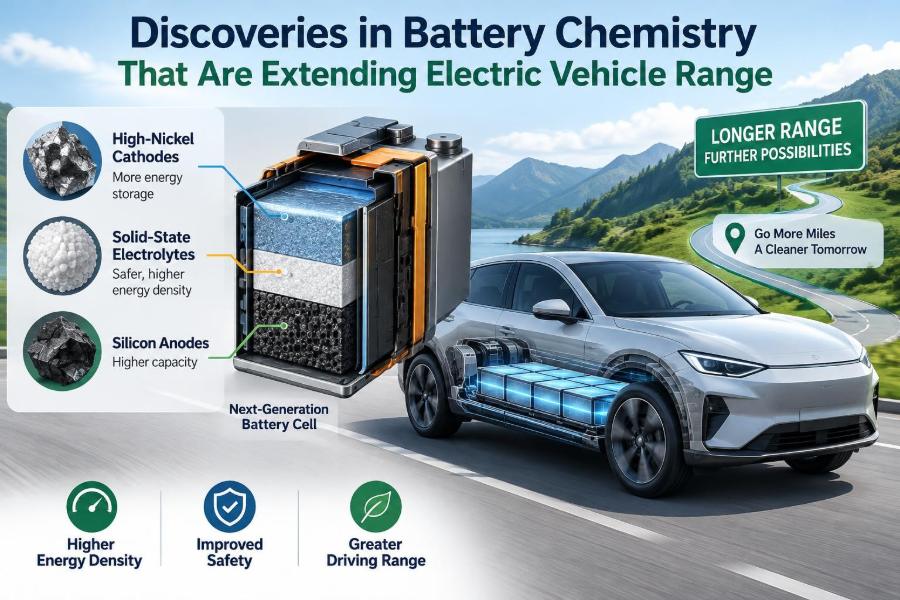
The cathode commonly contributes a large share of a cell’s energy and material cost. Its crystal structure and transition metals establish the voltage and the amount of lithium that can be reversibly extracted and returned.
Nickel-rich layered oxides have attracted attention because nickel can support high capacity. But raising nickel content also makes stability, moisture handling, thermal behaviour, and manufacturing consistency more demanding. Higher energy is useful only if the cell remains durable and safe.
🔩 Nickel, Manganese, and Cobalt in Context
Nickel-manganese-cobalt, often abbreviated NMC, describes a family rather than one fixed recipe. Manufacturers can adjust the proportions to balance energy density, power capability, life, cost, and supply-chain exposure.
Cobalt can help stabilize layered structures, but it is costly and supply-constrained. Manganese can support stability and cost control. The engineering challenge is not merely removing cobalt; it is retaining acceptable cycle life and safety as the composition changes.
🧱 Lithium Iron Phosphate Has a Different Strength
Lithium iron phosphate, or LFP, generally offers lower cell-level energy density than many nickel-rich cathodes. Its appeal is a robust phosphate structure, good thermal stability, long cycle-life potential, and avoidance of nickel and cobalt.
That makes LFP especially attractive where affordability, durability, and safety margin matter more than maximum range from a limited package volume. Better cell packaging and vehicle integration have helped narrow the practical range gap in some applications.
🪨 Manganese-Rich Cathodes Seek a Middle Ground
Manganese is comparatively abundant and can reduce reliance on more expensive metals. Researchers and manufacturers are exploring manganese-rich layered cathodes and lithium manganese iron phosphate variants to combine reasonable energy with material-cost advantages.
The difficulty is maintaining structural and voltage stability over repeated cycling. Some manganese-containing systems can suffer from gradual voltage loss or metal dissolution if the composition and electrolyte are not carefully controlled.
🖊️ Silicon Is Changing the Anode Conversation
Graphite is the established anode material in most EV cells. Silicon can store substantially more lithium by mass, so even a modest silicon addition to a graphite anode can increase cell energy density.
Its obstacle is expansion during lithiation. Silicon can swell dramatically, stressing particles, binder, and electrical contacts. Modern approaches often use engineered silicon particles, carbon coatings, elastic binders, and limited silicon fractions rather than replacing graphite entirely.
🧩 Why a Small Silicon Addition Matters
A battery cell is a tightly balanced system. If an anode can store more lithium without becoming unstable, designers may reduce inactive material or increase usable capacity within the same cell envelope.
However, greater anode capacity does not automatically produce proportional pack-level range. Cathode capacity, electrolyte behaviour, safety buffers, cooling plates, modules, and structural housings all influence the final vehicle result.
🧊 The Interphase Layer Determines Cell Life
When a lithium-ion cell first charges, electrolyte components react at the anode surface to form a thin protective film called the solid-electrolyte interphase, or SEI. A useful SEI allows lithium ions to pass while limiting continued electrolyte decomposition.
An unstable SEI consumes lithium and electrolyte, increases resistance, and accelerates capacity loss. Silicon’s changing surface makes this particularly challenging, which is why interphase-forming additives and coatings are central to silicon-anode development.
💧 Electrolytes Are Active Engineering Components
The electrolyte is often described as the liquid that carries lithium ions, but its role is broader. It must remain conductive across a useful temperature range, resist oxidation at the cathode, form protective interfaces, and behave predictably during abuse conditions.
New salt formulations, solvents, and additives can enable higher-voltage cathodes or improve fast-charge behaviour. These gains must be tested at full-cell level because an additive that helps one electrode can harm another.
🚧 Separators Prevent a Dangerous Shortcut
The separator is a porous membrane between the electrodes. It permits ion movement but prevents electronic contact. If it fails, an internal short circuit can release energy rapidly.
Improved separator coatings, shutdown features, and heat-resistant materials support safer operation. They add little energy themselves, yet they can allow designers to use higher-energy materials with a more credible safety margin.
🌡️ Temperature Changes What the Chemistry Can Deliver
Cold conditions slow ion transport and interfacial reactions, raising resistance and reducing available power and energy. Heat accelerates many unwanted chemical reactions and can speed degradation.
This is why battery thermal management affects real-world range. Preconditioning a pack before fast charging or a winter departure can place cells nearer their effective operating range, though it also consumes energy.
⚡ Fast Charging Is a Chemistry Test
Fast charging requires lithium ions to enter the anode quickly and uniformly. If conditions are unfavourable—particularly low temperature, high charge rate, or high state of charge—lithium can deposit as metal on the anode instead of entering its structure.
This phenomenon, called lithium plating, can reduce capacity and create reliability concerns. A cell that accepts high power briefly in a laboratory is not necessarily suitable for repeated public fast-charging over years.
🛡️ Better Charging Windows Protect Range Over Time
Battery-management systems limit current, voltage, and usable state of charge according to temperature and cell condition. These safeguards can seem conservative, but they protect the chemistry from the extremes that cause rapid ageing.
For many drivers, using the full displayed range occasionally is normal. The more relevant habit is avoiding unnecessary long periods at very high charge, especially in hot conditions, when the vehicle maker recommends a lower daily target.
🔌 High Voltage Helps Reduce Electrical Losses
For a given power level, increasing pack voltage reduces current. Lower current can reduce resistive heating in cables, busbars, and power electronics, which supports efficient high-power charging and propulsion.
A higher-voltage architecture is not a cathode discovery, but it helps convert cell capability into vehicle performance. Insulation, connector design, component ratings, and safety procedures must all evolve with it.
🏗️ Cell-to-Pack Design Recovers Valuable Space
Range improvements increasingly come from packaging. Cell-to-pack and structural-pack approaches reduce or remove some intermediate modules, freeing space that can be used for cells or reducing mass from housings and connectors.
This strategy cannot compensate for weak chemistry indefinitely, and it can complicate repair, thermal isolation, and crash engineering. Still, it shows why pack energy density can improve faster than the chemistry alone suggests.
🔬 Solid-State Batteries Change the Electrolyte
Solid-state battery designs replace the usual liquid electrolyte with a solid ion-conducting material. Potential benefits include different safety behaviour and compatibility with high-capacity lithium-metal anodes in some designs.
“Solid-state” does not describe one universal battery. Sulfide, oxide, polymer, and hybrid electrolytes have different conductivity, processing, moisture sensitivity, interface, and pressure requirements. Demonstrating a small cell is easier than manufacturing a long-lived automotive pack.
🪙 Lithium Metal Offers High Potential and Hard Problems
Using lithium metal as the anode could reduce inactive anode mass and raise energy density. The material is highly reactive, however, and repeated plating and stripping can create uneven deposits and unstable interfaces.
Suppressing dendrite-like growth, maintaining intimate contact with solid electrolytes, and achieving reliable cycle life are major engineering tasks. It is a promising direction, not a simple drop-in replacement for graphite.
🔁 Sodium-Ion Broadens the Design Options
Sodium-ion batteries use sodium rather than lithium as the mobile ion. Sodium is more abundant, and sodium-ion chemistries can reduce dependence on certain constrained materials.
Because sodium ions are larger and cell voltage or capacity can differ, sodium-ion cells generally face an energy-density disadvantage for long-range passenger vehicles. They may nevertheless suit lower-cost vehicles, short-range use, or stationary storage, where mass and volume are less restrictive.
🧫 Lithium-Sulfur Remains a High-Energy Research Path
Lithium-sulfur chemistry has theoretical appeal because sulfur is light and abundant. In practice, sulfur conversion reactions can create soluble intermediate species and large volume changes, which undermine cycle life and efficiency.
Porous carbon hosts, protective layers, and electrolyte engineering seek to control these effects. The lesson is valuable: attractive theoretical energy does not guarantee practical automotive performance.
📊 Comparing Chemistry Priorities
| Approach | Primary opportunity | Key engineering constraint |
|---|---|---|
| Nickel-rich lithium-ion | High energy density | Thermal stability and ageing control |
| LFP | Durability, cost, thermal robustness | Lower package efficiency for maximum range |
| Silicon-graphite anode | Higher anode capacity | Expansion and interphase stability |
| Solid-state / lithium metal | Potential step-change in energy | Interfaces, manufacturability, cycle life |
| Sodium-ion | Material availability and cost potential | Lower energy density |
No row is a universal winner. The best choice depends on vehicle segment, desired range, charging environment, production scale, and warranty target.
🏭 Manufacturing Quality Is Part of Battery Chemistry
Microscopic contamination, uneven coating thickness, trapped moisture, poor electrode alignment, or inconsistent electrolyte filling can shorten cell life or create safety risks. A formulation that works in a controlled research batch must be reproducible across very large production volumes.
Dry-room conditions, coating processes, formation cycling, inspection, and traceability are therefore central to practical range gains. Consistent cells allow narrower design margins and more predictable usable capacity.
♻️ Recycling Can Influence Future Cell Choices
End-of-life packs contain valuable metals and materials, but recovering them economically and with suitable purity is technically demanding. Battery designs also vary in ease of dismantling and material separation.
Recycling will not eliminate the need for new materials in a growing fleet, yet recovered material can reduce some supply pressure. Designs that consider disassembly, diagnostics, and material recovery early may have long-term advantages.
🚙 Vehicle Efficiency Makes Chemical Gains Go Further
Suppose two vehicles use the same usable battery energy. The one with lower aerodynamic drag, efficient tyres, a well-calibrated heat pump, and lower mass can travel farther without a new cell chemistry.
For engineers, this prevents a common mistake: treating battery capacity as the only range lever. For buyers, it explains why official range comparisons should be considered alongside vehicle size, speed conditions, temperature, and accessory loads.
🧠 Avoiding Common Claims About “Breakthrough” Batteries
Battery announcements should be read with a few questions in mind:
- Was the result shown in a full-size automotive cell or a small laboratory cell?
- How many charge-discharge cycles were demonstrated, and under what temperature and charge rate?
- Is the reported figure cell-level, module-level, or pack-level?
- Does the design rely on unusual pressure, limited capacity, or a test condition unlike vehicle use?
These questions do not dismiss innovation. They distinguish early electrochemical promise from a battery that can survive real driving, fast charging, vibration, crashes, and a long warranty period.
🧭 What Drivers Can Realistically Expect
Near-term EV range improvements will often arrive as incremental combinations: optimized cathode composition, a silicon-containing anode, better electrolytes, improved pack packaging, and smarter thermal control. A modest improvement in several places can be more valuable than a fragile leap in one place.
Actual range will still vary with speed, elevation, wind, temperature, tyre pressure, payload, and cabin heating or cooling. Chemistry expands the available energy window; driving conditions decide how quickly that energy is used.
🎓 The Core Engineering Takeaway
The central discovery in modern battery development is not a single miracle material. It is that useful EV range comes from managing interfaces and trade-offs across the entire electrochemical system.
A higher-capacity electrode must work with a compatible electrolyte, a stable interphase, a safe separator, effective cooling, reliable manufacturing, and a vehicle designed to use every watt-hour carefully. This systems view is what turns promising chemistry into dependable mobility.
Electric vehicle range will keep improving most reliably when advances in battery chemistry are matched by equally careful cell, pack, thermal, and vehicle engineering. That is less dramatic than a headline-grabbing “super battery,” but far more meaningful for everyday drivers. 🔋🚗⚙️