
A driver stops at a fast charger during a winter journey, watches the charging rate slow, and begins calculating whether the next leg is realistic. Another driver reads about an electric vehicle fire and wonders whether a different battery could make EVs both safer and easier to own.
Solid-state batteries are often presented as the answer: more range, faster charging, better safety, and lighter vehicles. Those promises are appealing because battery compromises still shape almost every EV decision, from price and packaging to cold-weather performance.
But a laboratory cell that works beautifully is not the same thing as a battery pack that survives years of potholes, heat, rapid charging, and millions of vehicles rolling off an assembly line.
The useful question is not whether solid-state batteries are exciting. They are. The question is which problems they can realistically solve, what engineering barriers remain, and when drivers are likely to notice a difference.
🔋 What “Solid-State” Actually Means
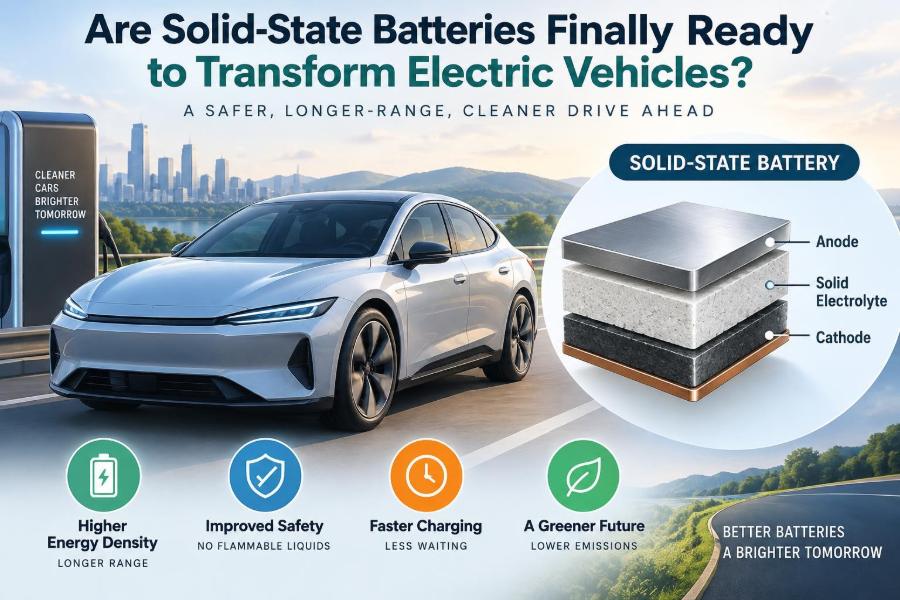
Most current EVs use lithium-ion cells with a liquid electrolyte, the material that lets lithium ions travel between electrodes during charging and discharging. A solid-state battery replaces that liquid with a solid ion-conducting material.
The cathode remains the positive electrode and the anode remains the negative electrode. The change is mainly in the electrolyte and, often, the way the anode is designed. “Solid-state” is therefore a battery architecture, not one single chemical formula.
⚙️ The Simple Charge-and-Discharge Mechanism
When an EV charges, lithium ions move through the electrolyte and are stored at the anode. When it drives, the ions return toward the cathode while electrons travel through the external circuit to power the motor.
Think of ions as passengers crossing between two terminals, while electrons take the road outside the terminal. The electrolyte must allow the ion traffic while preventing an internal electronic shortcut.
🧪 Why Liquid Electrolytes Have Dominated
Liquid electrolytes have been commercially successful because they wet electrode surfaces well, conduct ions effectively at ordinary temperatures, and fit mature manufacturing methods. They are not simply a weak technology waiting to be replaced.
However, many conventional electrolyte formulations are flammable under certain failure conditions. Cell makers control that risk with separators, additives, robust enclosures, sensing, cooling, and battery-management systems.
🧱 The Solid Electrolyte’s Central Job
A solid electrolyte must perform several demanding tasks at once. It needs high ionic conductivity, very low electronic conductivity, chemical stability beside both electrodes, mechanical durability, and manufacturability at automotive scale.
Improving one property can worsen another. A material that is mechanically strong may be brittle; one with excellent room-temperature conductivity may be sensitive to moisture or difficult to integrate into a thin, defect-free layer.
🧬 Major Solid Electrolyte Families
Researchers and manufacturers are pursuing several material families, each with different trade-offs.
- Sulfides can offer high ion conductivity and relatively soft contact with electrodes, but may require careful moisture handling.
- Oxides can be chemically robust but are often hard and difficult to keep in intimate contact with electrodes.
- Polymers are flexible and processable, though many work best at elevated temperatures or have lower conductivity at room temperature.
- Halides and composites seek useful balances of stability, conductivity, and processing.
📏 Energy Density: The Biggest Attraction
Energy density describes how much energy a battery stores for its mass or volume. Higher cell-level energy density can allow more range in the same space, or similar range with less battery mass.
Solid-state designs are attractive partly because they may enable a lithium-metal anode. Lithium metal has far greater theoretical charge-storage capacity than the graphite commonly used in today’s lithium-ion anodes.
🪶 Why a Lithium-Metal Anode Matters
Graphite stores lithium by inserting ions between carbon layers. A lithium-metal anode can, in principle, eliminate much of that host material. That frees volume and mass for stored energy.
Yet lithium metal is not a drop-in upgrade. Its surface changes as the battery cycles, and uneven deposition can damage the interface. Making it operate reliably is one of the defining engineering challenges.
📦 Cell Gains Do Not Equal Vehicle Gains
Battery announcements often focus on cell-level results. A vehicle needs modules, pack structure, electrical connections, cooling, crash protection, sensors, and control hardware.
A better cell can still improve the vehicle, but the pack-level gain is smaller than the headline cell gain. Engineers call this the difference between cell-to-pack efficiency: how much of the pack is active cell material rather than supporting hardware.
🔥 Safety: A Real Advantage With Limits
Replacing a flammable liquid electrolyte could reduce one pathway to fire. A solid electrolyte may also be less prone to leakage. These are meaningful potential advantages for automotive design.
But “solid” does not mean impossible to damage. Internal shorts, electrical abuse, manufacturing defects, overheating, high-energy cathodes, and crash damage can still create serious hazards. Safe EVs require pack engineering, not just safer chemistry.
⚡ Fast Charging Is an Interface Problem
Fast charging demands rapid ion movement and uniform current distribution. If current concentrates in small regions, lithium can deposit unevenly, generate heat, and accelerate degradation.
Solid-state batteries may eventually support fast charging, but a solid-solid interface has less ability to flow into tiny gaps than a liquid does. The limiting factor may be interfacial contact rather than bulk electrolyte conductivity.
🌡️ Temperature Changes the Equation
All batteries are temperature-sensitive. Cold slows ion transport and reaction rates, while heat can accelerate unwanted chemical reactions and ageing.
Some solid electrolytes perform well in particular temperature ranges but lose conductivity or contact quality outside them. An EV battery must work after a frozen overnight parking period and during a hot motorway charge, not only in a controlled laboratory.
🧩 The Challenge of Electrode Interfaces
At the boundary between electrolyte and electrode, atoms and ions must cross efficiently. Small gaps, reaction layers, or mismatched expansion can raise resistance, reducing power and producing local heat.
This is why a battery can contain excellent individual materials and still disappoint as a full cell. Interface engineering may involve coatings, graded material layers, controlled pressure, and carefully chosen processing conditions.
🪨 Mechanical Pressure Is Not a Minor Detail
Some solid-state cells need sustained stack pressure to keep layers touching as they expand and contract. Laboratory setups can apply this relatively easily; a car must achieve it through a compact, crashworthy, long-life pack.
Springs, frames, and compression systems add mass, volume, and cost. Any architecture that depends on pressure must also retain contact after vibration, thermal cycling, and thousands of charge-discharge cycles.
🌿 Dendrites Are More Complicated Than a Slogan
A dendrite is a needle-like or filament-like lithium growth that can form under unfavorable conditions. If it crosses the electrolyte, it may create an internal short circuit.
A hard solid electrolyte can sometimes resist such growth, but hardness alone is not a guarantee. Defects, pores, grain boundaries, and local current hotspots can provide pathways. Engineers must control both material quality and charging conditions.
🔄 Cycle Life Means Useful Life, Not One Good Test
Cycle life measures how capacity and resistance change with repeated use. For a car, meaningful testing includes different depths of discharge, charging rates, temperatures, storage periods, and vibration—not just repeating one gentle laboratory cycle.
A cell can retain capacity reasonably well yet develop rising resistance that limits acceleration or charging speed. Automotive qualification therefore examines energy, power, safety, consistency, and ageing together.
🏭 Manufacturing Is the Hardest Scale Test
Making a few high-performing prototype cells proves scientific possibility. Producing millions with repeatable quality proves industrial readiness.
Solid-state manufacturing may require ultra-dry environments, precise powder handling, thin electrolyte layers, lamination, sintering, or pressure-sensitive assembly. Every added process must be fast, controllable, safe, and economically viable.
🔍 Yield Determines More Than Factory Pride
Yield is the share of manufactured cells that meet specification. A tiny crack, contamination particle, uneven layer, or poor seal can turn an expensive cell into scrap.
Low yield raises cost directly and makes supply unreliable. It also complicates quality assurance because latent defects may emerge only after cycling. Early production programs must learn not just how to build cells, but how to detect weak ones quickly.
💰 Why Early Packs Will Likely Cost More
New materials, specialized equipment, low production volumes, and conservative quality controls usually make first-generation technologies expensive. The cost question is broader than electrolyte material price.
If a solid-state pack can reduce cooling needs, pack mass, or the number of cells required for a target range, some costs may be offset. Whether that balance works depends on the specific design and production scale.
🚙 Which Vehicles May Get Them First
Premium or limited-volume vehicles are plausible early candidates because they can absorb higher battery cost and demonstrate the technology under close monitoring. Performance models may value reduced mass, high power, or compact packaging.
Mass-market cars need a different proof point: durable, affordable cells made in enormous volumes. Commercial fleets may adopt them where duty cycles and charging conditions strongly favor a particular design.
🚌 Heavy-Duty Use Is Not Automatically Easier
Trucks and buses have large battery packs, long operating hours, and demanding charging schedules. Higher energy density could be valuable, especially where payload is limited by battery mass.
But heavy-duty systems also need exceptionally robust cycle life and thermal behavior. A technology optimized for a premium passenger car may not suit repeated high-power fleet charging without major adaptation.
🔌 Charging Infrastructure Still Matters
A battery capable of accepting high power does not automatically make every charger faster. Charging time also depends on station capability, grid connection, cable limits, pack voltage, thermal controls, and the vehicle’s charging curve.
Drivers care about the time required to add useful distance, not a peak power number shown briefly. Future solid-state EVs will still need well-designed charging networks and clear route-planning information.
🧠 The Battery Management System Remains Essential
The battery management system, or BMS, monitors voltage, current, temperature, insulation, and cell balance. It estimates usable energy and limits operation before damaging conditions develop.
Solid-state packs will require BMS strategies matched to their chemistry, including temperature-dependent charging limits and detection of resistance changes. Better chemistry reduces burdens; it does not remove the need for intelligent control.
♻️ Recycling Needs Early Design Attention
Recycling is easier when material streams are identified and pack disassembly is considered from the beginning. New electrolyte types can introduce unfamiliar separation and recovery challenges.
Designers should avoid treating end-of-life as an afterthought. Clear pack architecture, safe discharge procedures, material traceability, and repair pathways can improve both environmental outcomes and resource resilience.
🔋 Semi-Solid and Hybrid Designs Blur the Boundary
Not every advanced battery is fully solid-state. Some designs use gel-like, polymer-rich, or reduced-liquid electrolytes, while others pair solid layers with limited liquid components.
These approaches may capture certain benefits while easing manufacturing or interface challenges. For readers comparing announcements, the useful question is: what exactly is solid, and what performance conditions apply?
📣 How to Read Battery Announcements Critically
Battery claims need context. Ask whether results refer to a tiny test cell, an automotive-format cell, a module, or a complete pack. Check whether figures are measured at room temperature, under pressure, after cycling, or at a particular charge rate.
- Is the anode lithium metal or a conventional material?
- What cycle life and capacity retention conditions are stated?
- Does the result include cold-weather and fast-charge operation?
- Is manufacturing yield or production scale discussed?
⚖️ Comparison With Today’s Lithium-Ion Packs
| Feature | Conventional lithium-ion | Solid-state potential |
|---|---|---|
| Electrolyte | Usually liquid-based | Primarily solid ion conductor |
| Manufacturing maturity | Highly established | Still developing at scale |
| Energy density | Strong and continuously improving | Potentially higher, especially with lithium metal |
| Safety design | Requires careful thermal and electrical controls | May reduce some flammability risks, but still needs full protection |
| Main challenge | Cost, material supply, ageing, thermal management | Interfaces, durability, yield, and scalable production |
🛠️ What Automotive Engineers Must Design Around
Vehicle engineers cannot wait for a “perfect battery.” They must define package space, crash loads, cooling paths, electrical isolation, service procedures, software behavior, and manufacturing tolerances around real cell constraints.
The most successful solid-state integration may not look radically different from the outside. Its value may appear as a lighter pack, more cabin space, simpler thermal hardware, or a more stable charging experience.
🎓 Skills Worth Building for This Field
Students interested in advanced batteries benefit from crossing disciplines. Electrochemistry explains reactions, materials science explains microstructure, mechanical engineering explains pressure and packaging, and electrical engineering explains controls and power delivery.
Useful practical skills include interpreting charge-discharge curves, understanding thermal management, reading safety requirements carefully, and distinguishing cell data from pack-level performance. Battery development is collaborative engineering.
⏳ Are Solid-State Batteries Ready Now?
They are ready for serious development, prototype vehicles, pilot production, and targeted early applications. That is different from being ready to replace conventional lithium-ion batteries across every EV category tomorrow.
Progress will likely arrive unevenly. Some products may use hybrid approaches first, while conventional lithium-ion cells continue improving in cost, charging, energy density, and safety. Competition between architectures is healthy because vehicle requirements vary.
🧭 The Core Takeaway for EV Buyers and Engineers
Solid-state batteries are best understood as a promising route to better EVs, not a magic material that cancels every trade-off. Their greatest opportunity lies in combining higher energy density with improved safety characteristics, provided interfaces, lithium-metal behavior, durability, and manufacturing can be controlled.
For buyers, the sensible approach is to evaluate the complete vehicle: usable range, charging behavior, warranty, cold-weather performance, repair support, and price. For engineers, the lesson is equally clear: a battery breakthrough becomes transformative only when it works reliably as a pack, in a vehicle, at scale.
Solid-state batteries may transform electric vehicles, but their true arrival will be measured by durable, affordable, mass-produced packs rather than impressive laboratory headlines. 🚗🔋⚙️