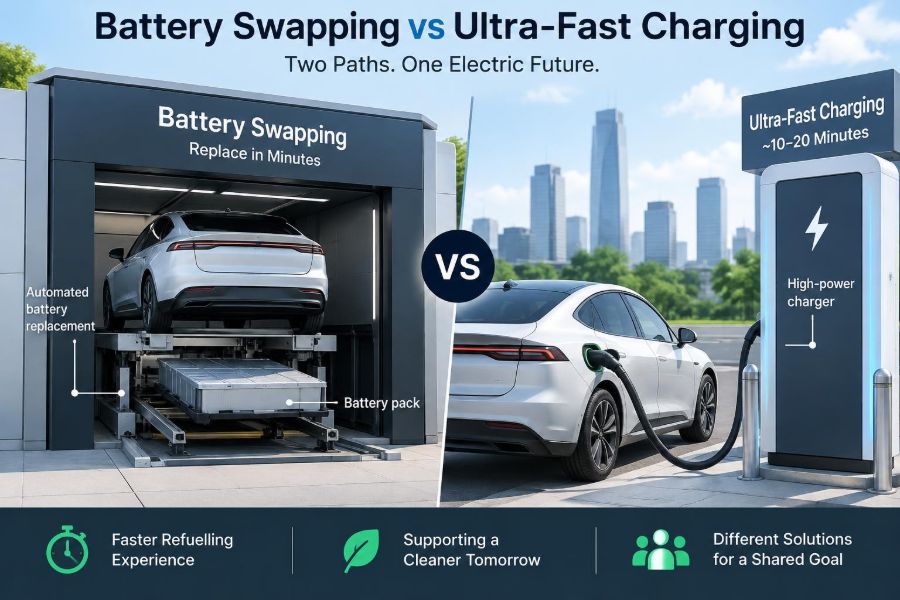

Imagine arriving at a busy highway service area with an electric vehicle whose battery is nearly empty. One driver plugs in at a high-power charger, buys a coffee, and waits. Another enters a lane beside a compact building, where machinery removes the vehicle’s depleted battery and installs a charged one before the coffee is ready.
Both experiences promise to make electric travel feel less constrained by charging stops. Yet they solve the problem in very different ways. One delivers energy directly into the vehicle; the other replaces an energy-storage component that has already been charged elsewhere.
This distinction matters well beyond convenience. It affects vehicle design, grid demand, battery ownership, safety procedures, station economics, and whether drivers can confidently travel outside their home city.
Battery swapping is often presented as an alternative to ultra-fast charging. In reality, the two approaches compete in some operating conditions, complement each other in others, and face very different engineering barriers.
🔌 The Two Ways to Refill an EV
Ultra-fast charging transfers electrical energy from the grid into the battery installed in the vehicle. It commonly uses high-power direct current (DC), with the vehicle’s battery-management system continuously controlling voltage, current, temperature, and charging rate.
Battery swapping removes a depleted traction battery and fits a compatible charged pack. The charging process still occurs, but it happens in the station’s battery inventory rather than while the driver waits. The central question is therefore not whether swapping avoids charging, but where and when the charging occurs.
⚡ What Ultra-Fast Charging Actually Means
“Ultra-fast” has no single universal threshold. It generally describes DC charging powerful enough to add meaningful driving range during a short rest stop, provided the vehicle, connector, battery temperature, and charger can all support that power.
The charger’s nameplate rating is not a promise of the same power throughout a session. Battery cells accept energy fastest over a limited state-of-charge range, usually slowing as the pack approaches full charge to protect cell life and manage heat.
🔄 The Basic Battery-Swapping Sequence
At a swapping station, the vehicle is identified and positioned precisely. The station checks the pack, unlocks it, removes it with automated equipment, inspects key interfaces, and installs a charged pack that meets the required specification.
The station then performs electrical and mechanical verification before releasing the car. Meanwhile, the returned battery joins a managed inventory and is charged at a rate chosen by the operator. A smooth exchange depends on accurate alignment, reliable robotic handling, and standardized communication.
⏱️ Why Stop Time Shapes Driver Preference
For taxi fleets, delivery vans, and intercity drivers on tight schedules, time spent stationary is expensive. A swap can potentially make the energy stop resemble a conventional refuelling stop, especially when there is no queue and the correct battery is available.
Charging can also fit naturally into a journey when the driver already needs a meal, a rest break, or overnight parking. The practical comparison is not simply “minutes at a station”; it is unproductive waiting time after the driver’s normal activities are considered.
📉 Charging Curves Limit the Simple Power Race
Battery charging follows a curve rather than a flat line. At lower to mid state of charge, a suitably warm battery may accept high power. Near a high state of charge, the battery-management system reduces current as cell voltage approaches its safe limit.
This means a short charge from a low level to a travel-ready level can be much quicker than charging from low to nearly full. Drivers who plan around charging curves often make faster trips than those who always seek a 100% charge.
🧠 Battery Preconditioning Makes a Real Difference
Lithium-ion cells operate best within a controlled temperature range. In cold conditions, charging a cold battery aggressively can damage it; in hot conditions, extra heat must be removed. Many EVs therefore use battery preconditioning, warming or cooling the pack before reaching a fast charger.
A swapping station can charge its stored batteries in a controlled environment, which is an operational advantage. But it must also ensure that the installed pack is at a suitable temperature for immediate driving, not merely electrically full.
🏗️ Station Hardware Is Not the Same Problem
A fast-charging site requires grid connection equipment, power electronics, charging dispensers, cables, parking layout, and often cooling equipment. Its mechanical interaction with the car is comparatively simple: plug in a connector.
A swapping station needs charging equipment too, plus lifting systems, pack storage, robotics, alignment mechanisms, inspection processes, and fire-safety design for stored batteries. It trades the complexity of a long customer charging session for the complexity of a small automated warehouse.
🔋 Standardized Packs Are the Make-or-Break Requirement
Swapping only works at scale if a station can physically and electrically serve many vehicles. That requires agreement on pack dimensions, mounting points, high-voltage connectors, cooling connections where applicable, communication protocols, and safety interlocks.
Cars are not designed around one common underfloor shape. Wheelbases, crash structures, floor height, pack capacity, and cooling architecture differ. A battery that is safely removable in one model may not fit another without compromising structure or packaging.
🚘 The Battery Is Part of the Vehicle Structure
In many modern EVs, the battery pack is a large structural element beneath the cabin. It contributes to stiffness, protects cells within a reinforced enclosure, and must survive water exposure, road debris, vibration, and crash loads.
Designing it for repeated automated removal introduces additional engineering demands. Locks must remain secure throughout the vehicle’s life, seals must tolerate repeated handling, and connectors must resist wear while maintaining reliable high-voltage isolation.
🛡️ Safety Depends on More Than Automation
High-voltage batteries require careful isolation before any exchange. The station must confirm that connectors are de-energized, mechanical latches are fully engaged, insulation resistance is acceptable, and the installed pack is correctly recognized by the vehicle.
Automation can improve repeatability, but it does not eliminate risk. Sensors, software, emergency stops, damaged-pack detection, thermal monitoring, and trained maintenance staff remain essential. A station must handle unusual cases such as impact-damaged vehicles or a battery reporting a fault.
📦 Inventory Is Swapping’s Hidden Constraint
A charging station can serve a car whenever a connector and electrical capacity are available. A swapping station needs enough compatible charged packs to meet demand peaks. Each extra battery represents costly stored energy capacity and capital tied up in inventory.
If several drivers arrive with the same pack type after a holiday rush, the station can run short of charged replacements even while it holds depleted batteries. This is analogous to a retailer having stock in the wrong size: the total inventory may be large, but the needed item is unavailable.
📊 A Side-by-Side Operating Comparison
| Factor | Ultra-fast charging | Battery swapping |
|---|---|---|
| Driver interaction | Park, connect, wait, disconnect | Position vehicle; station completes exchange |
| Energy location | Transferred into the vehicle during the stop | Charged into station-held batteries before arrival |
| Vehicle requirement | Compatible charge port and battery capability | Compatible removable pack and mounting system |
| Peak-demand response | Requires substantial grid power or local buffering | Can charge inventory over a longer period |
| Key bottleneck | Charging curve, available power, charger queues | Pack standardization and charged-pack inventory |
Neither column automatically wins. The better option depends on vehicle utilization, route predictability, local grid conditions, and how many vehicles share a battery format.
🌐 Grid Connection Changes the Business Case
High-power charging hubs can require substantial electrical infrastructure, particularly where several vehicles charge simultaneously. In areas with limited grid capacity, upgrades can be slow and expensive.
Swapping can spread battery charging over longer periods, allowing the operator to avoid charging every pack at maximum power at the moment drivers arrive. This flexibility may reduce peak demand, although the station still needs enough energy over the day to replenish its fleet of batteries.
🔌 Local Storage Can Also Help Fast Chargers
Swapping is not the only way to buffer grid demand. A fast-charging site can use stationary batteries to store electricity gradually and release it during short, high-power charging sessions. Solar generation may also contribute when available, though it cannot by itself guarantee service at all times.
That comparison is important: a swap station’s battery inventory is both customer-facing inventory and a form of energy storage. A charger with stationary storage separates those functions, which can simplify vehicle compatibility but adds its own equipment cost.
💼 Who Owns the Battery?
Battery swapping can support a model in which the driver owns or leases the vehicle but subscribes to access energy packs. This can lower the vehicle’s upfront battery burden and make a future battery upgrade easier in principle.
It also changes the ownership relationship. The customer needs assurance about minimum usable capacity, pack condition, billing, access to stations, and what happens if service coverage changes. Clear contracts matter because the battery is one of the vehicle’s most valuable components.
🔍 Battery Health Must Be Measured Fairly
All traction batteries gradually lose usable capacity and power capability with age, temperature exposure, and use. In a private vehicle, the owner experiences that particular pack’s ageing. In a swap network, batteries circulate among many users.
Operators need reliable methods to estimate state of health, a measure of remaining battery capability relative to its original condition. They must prevent a system from unfairly assigning weaker packs to certain customers while still keeping the fleet economically usable.
🧾 Billing Needs More Than Kilowatt-Hours
Charging bills can be based on energy delivered, time connected, parking duration, or service conditions, depending on the network and local rules. Swapping adds potential charges for access, pack capacity, battery condition guarantees, and rapid exchange service.
A transparent system should tell the user what is being provided: usable energy, a pack with specified performance, and access to a network. Confusing pricing can undermine a technically capable service because drivers cannot easily predict trip costs.
🚕 Fleet Vehicles Are a Natural Early Market
Vehicles that operate for many hours each day are strong candidates for swapping. Taxis, airport shuttles, urban delivery vehicles, and certain two- and three-wheelers often have predictable routes and lose revenue when parked for charging.
In a closed or semi-closed fleet, standardization is easier because one operator can select compatible vehicles, station locations, and operating procedures. This is very different from persuading every passenger-car manufacturer and every private buyer to use one removable pack format.
🛵 Two-Wheelers Show Why Scale Can Be Simpler
Smaller electric scooters and motorcycles use battery packs that are lighter and easier to standardize than car-sized packs. In some use cases, a rider can exchange a battery manually or with much simpler station hardware.
The lesson does not transfer perfectly to cars, because automotive packs are far larger, heavier, and structurally integrated. Still, it shows that swapping is not one universal technology; its feasibility changes sharply with vehicle mass, battery size, and daily utilization.
🛣️ Highway Travel Favors a Different Logic
Long-distance private travel creates irregular demand peaks. On busy travel days, many drivers may reach the same corridor within a short period, and their destinations, battery sizes, and preferred stopping patterns can vary widely.
Fast-charging networks are flexible because any compatible vehicle can use a charger without requiring a matching physical battery in stock. For highways with diverse vehicle models, this interoperability can be easier to expand than a multi-format battery inventory.
🏙️ Dense Cities Can Favor Swapping
Urban drivers without home charging may value quick replenishment, especially when their vehicles work long shifts. A well-located swap station can reduce curbside dwell time and turn energy access into a brief stop rather than a long parking event.
However, land is scarce in dense cities. The station needs space for vehicles to enter, align, exchange, store packs, and charge them safely. Local planning, traffic flow, and emergency access can be as decisive as the technology itself.
🔧 Maintenance and Uptime Are Central
A failed charging connector may take one bay out of service. A malfunction in a swapping station’s lifting, handling, or verification system can halt the entire exchange process, so redundancy and preventive maintenance are vital.
Operators must also inspect battery enclosures, seals, latches, connectors, cooling interfaces, and robotic calibration. The engineering challenge is not just achieving a successful demonstration; it is maintaining safe, rapid operation through thousands of real-world cycles.
🌧️ Weather, Dirt, and Road Damage Test the Design
Vehicles encounter water, salt, dust, mud, potholes, and underbody strikes. A swappable pack system must preserve its sealing and structural protection after repeated removals under these conditions.
Fast charging has environmental challenges too, including cable handling in rain, connector contamination, and thermal management in extreme weather. Yet the vehicle-side interface is usually smaller and more accessible than a full underbody battery exchange mechanism.
♻️ Swapping Can Support Better Battery Management
Centralized battery ownership may allow operators to charge packs more gently when time permits, remove damaged units promptly, and route ageing packs toward less demanding duties. These practices can potentially improve asset management compared with uncontrolled charging patterns.
That outcome is not automatic. It depends on sound diagnostics, responsible end-of-life processes, and a business model that does not pressure operators to keep degraded packs in service for too long. Circularity comes from management discipline, not from swapping alone.
🧱 Why Automakers Have Been Cautious
Automakers must optimize crashworthiness, manufacturing cost, cabin space, driving range, repairability, and model differentiation. A common battery format may constrain those choices, especially across vehicles with very different sizes and performance targets.
They also assume warranty and liability responsibilities for high-voltage systems. Sharing packs among vehicles introduces questions about software compatibility, diagnostics, thermal behaviour, and responsibility when a fault appears after an exchange.
🔗 Interoperability Matters More Than a Single Design
There are several possible paths to compatibility. Every manufacturer could use one physical pack, or manufacturers could use adapters and common interfaces while retaining different internal pack designs. The latter may be more realistic in some markets, but it adds complexity.
The useful objective is not necessarily identical hardware everywhere. It is dependable interoperability: a vehicle, station, battery, and digital account must recognize one another and complete an exchange without compromising safety or performance.
📍 Network Density Determines Everyday Value
A driver cannot rely on swapping merely because one station exists near home. The service becomes genuinely useful when stations appear along routine routes, near work areas, and on longer travel corridors, with dependable availability.
The same network effect applies to charging. A technically excellent charger is less useful if it is often occupied, inaccessible, or poorly maintained. Infrastructure confidence comes from coverage, uptime, payment simplicity, and accurate status information.
🧭 Drivers Should Avoid a False Either-Or Choice
It is tempting to ask which technology will replace the other. A more practical question is which energy-delivery method best suits a particular vehicle and duty cycle. A commuter who charges overnight, a taxi working two shifts, and a family driving across a country do not face the same problem.
- Home and workplace charging can cover many routine private trips.
- Ultra-fast charging supports flexible travel across mixed vehicle fleets.
- Swapping can be compelling where utilization is high and vehicles are standardized.
- Depot charging remains highly effective when fleets return to a fixed base.
Multiple systems can coexist because transport uses are diverse.
🧪 A Practical Hypothetical Comparison
Consider a delivery operator running identical electric vans on fixed urban routes. If each van needs more energy midway through a long shift, a nearby swap station with ample pack inventory could return vans to work quickly and keep charging demand spread across the day.
Now consider a private driver on an unfamiliar holiday route in a vehicle from a different manufacturer. A public ultra-fast charger is likely easier to use because the driver only needs a compatible charging connection, not a station stocked with that vehicle’s physical battery design. These are hypothetical cases, but they illustrate the operating logic.
⚠️ Common Claims That Need Careful Examination
“Swapping is always faster” ignores queues, station faults, vehicle alignment, and battery availability. “Fast charging always harms batteries” ignores modern thermal control, charging limits, and the fact that battery ageing depends on many interacting conditions.
“Standardization is easy” overlooks vehicle engineering and commercial competition. “One network model fits every market” overlooks housing patterns, electricity infrastructure, vehicle mix, fleet activity, and local land constraints. Good analysis starts by stating the operating conditions.
📈 What Could Improve Each Approach
Fast charging can improve through better charger uptime, more grid capacity, smarter routing, improved thermal systems, vehicles that sustain useful charging power for longer, and clearer pricing. Progress is not only about raising peak kilowatts.
Swapping can improve through modular vehicle platforms, high-cycle durable connectors, robust pack-health tracking, shared interfaces, optimized battery inventory, and carefully selected high-utilization sites. Its strongest path may be focused deployment rather than immediate universal adoption.
🎯 Can Battery Swapping Truly Compete?
Yes, but not on identical terms everywhere. Battery swapping can compete strongly when rapid turnaround has high value, vehicle types are standardized, routes are predictable, and an operator can maintain enough compatible packs. It is especially logical where vehicles earn money while moving.
Ultra-fast charging has a different advantage: it works with a broader range of vehicles without moving a heavy structural component between them. Its ecosystem can grow around common charge interfaces even when battery designs remain different.
The core principle is that EV energy infrastructure should be matched to how vehicles are used, not judged only by the shortest possible stop time. Swapping is a specialized but potentially powerful tool; ultra-fast charging is a flexible public-access tool; and slower charging remains the efficient foundation for many daily journeys.
Battery swapping and ultra-fast charging are best understood as competing solutions in selected markets, not as a winner-takes-all contest. The successful systems will be the ones that deliver safe, reliable energy with the least disruption for the vehicles and people they serve. 🚗⚡🔋