
A car can feel perfectly ordinary on the way to work, then reveal a problem during one familiar moment: the steering wheel sits slightly off-centre on a straight road, the vehicle drifts when the driver relaxes their grip, or a front tyre shows an oddly smooth strip along one edge.
These symptoms are often blamed on tyres, roads, or steering. Sometimes they are caused by something less visible: the angles at which the wheels meet the road and point relative to the vehicle.
Wheel alignment is not simply a workshop adjustment made to straighten a steering wheel. It is a controlled relationship among suspension parts, steering geometry, tyre forces, vehicle loading, and manufacturer specifications.
Understanding toe, camber, and caster helps drivers spot problems earlier and helps engineering students connect suspension geometry to real effects such as tyre wear, stability, steering effort, and cornering behaviour.
🧭 What Wheel Alignment Actually Means
Wheel alignment is the measurement and adjustment of wheel and suspension angles so that the wheels point and operate as the vehicle manufacturer intends. The aim is not to make every angle zero; many vehicles require deliberately positive or negative settings.
An alignment technician compares measured values with a specified range. Those values are assessed relative to the vehicle’s centreline, thrust line, ride height, and suspension condition, not merely by looking at whether the tyres appear straight.
Modern alignment equipment typically uses cameras or electronic sensors mounted to the wheels. It calculates angles while the vehicle is positioned on a level alignment rack, often following a compensation procedure to account for wheel or clamp runout.
🛞 Why Tyres Reveal Alignment Problems First
The tyre contact patch is the small area of rubber touching the road at any instant. Alignment determines how that patch is loaded, how it moves during rolling, and whether it scrubs sideways instead of rolling freely.
A tyre can tolerate normal cornering forces, braking forces, and road irregularities. Continuous unintended scrubbing is different: it converts energy into heat and abrasion, often wearing tread much faster on a particular edge or in a feathered pattern.
Tyre wear is a useful clue, but it is not a perfect diagnosis. Inflation pressure, tyre construction, driving style, worn suspension joints, wheel balance, and rotation history can create overlapping symptoms.
📐 The Three Primary Angles
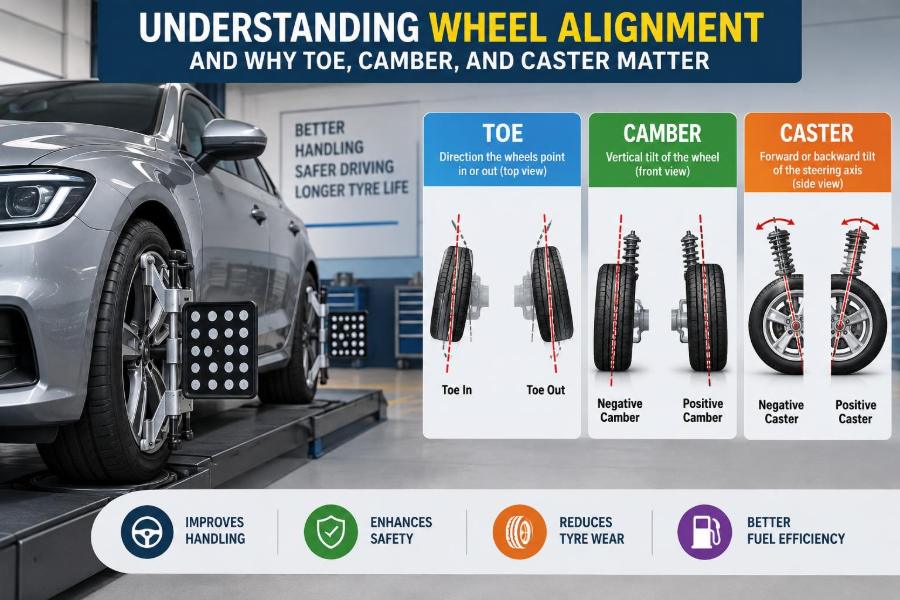
The alignment conversation usually begins with toe, camber, and caster. Each is viewed from a different direction and affects the vehicle in a different way.
| Angle | Viewed from | Primary influence |
|---|---|---|
| Toe | Above the vehicle | Rolling direction, tyre scrub, straight-line tracking |
| Camber | Front of the vehicle | Contact-patch loading and cornering behaviour |
| Caster | Side of the vehicle | Steering return, directional stability, steering feel |
They interact, especially as suspension moves. A change to ride height, a bent component, or worn bushings can alter more than one reading and can change the readings dynamically while driving.
➡️ Toe: Where the Wheels Point
Toe describes whether a pair of wheels points slightly toward each other or slightly away from each other when viewed from above. It is commonly specified as an angle or as a difference in distance between the fronts and rears of the tyres.
If the front edges point inward, the wheels have toe-in. If the front edges point outward, they have toe-out. A vehicle may use a small specified amount of either, depending on its suspension design and intended handling characteristics.
Because toe directly affects the direction each tyre attempts to travel, even a relatively small error can cause substantial tread scrub over many kilometres.
↔️ Toe-In, Toe-Out, and Total Toe
Technicians consider both individual-wheel toe and total toe, the combined toe value across an axle. A correct total may still be misleading if one wheel is pointed significantly differently from the other.
For example, imagine both front wheels having equal toe-in but the steering wheel is not centred after an adjustment. The total toe may be acceptable, yet the rack position or individual settings may be wrong for straight-ahead driving.
Rear toe matters as well. On independent rear suspensions, a rear wheel pointing incorrectly can create a thrust direction that the front wheels must compensate for.
🪶 Feathered Tread and Toe Wear
A classic sign associated with toe error is feathering. When a hand is moved across the tread blocks in one direction, the surface may feel smooth; in the other, it may feel sharp or stepped.
This occurs because the tread is being dragged slightly sideways as the wheel rolls. The pattern can affect the whole tread width rather than only one shoulder, although actual wear patterns vary with the tyre and operating conditions.
Feathering alone does not identify the exact adjustment required. Inspection must include measured alignment values, tyre pressures, play in steering joints, and the vehicle’s ride height.
📏 Camber: The Wheel’s Lean
Camber is the inward or outward tilt of a wheel when viewed from the front. The top of a wheel leaning inward has negative camber; the top leaning outward has positive camber.
Camber changes how vertical load is distributed across the tyre tread. It also affects how the tyre develops lateral force during cornering, where body roll and suspension movement would otherwise shift the contact patch unfavourably.
Most road vehicles use modest camber values tailored to their suspension geometry, tyre characteristics, weight distribution, and intended use. The correct setting is therefore the manufacturer’s target range, not an assumption that negative camber is always better.
🏁 Why Performance Cars Often Use Negative Camber
During a corner, the vehicle body tends to roll outward. Without appropriate geometry, the outside tyre may lean so that its contact patch is not used efficiently under high lateral load.
Negative static camber can help the outside tyre approach a more favourable orientation when the suspension compresses in a turn. This can support cornering grip, particularly in vehicles designed for spirited road use or track operation.
The compromise is clear: excessive negative camber during ordinary straight-line driving can concentrate load toward the inner shoulder. A track-oriented setting may not be suitable for a daily-driven vehicle that spends most of its life travelling straight.
🔍 Camber Wear Patterns and Their Limits
Too much negative camber is often associated with inner-edge wear, while excessive positive camber can wear the outer shoulder. That simple rule is useful, but it should not be treated as a complete diagnosis.
Toe error can accelerate shoulder wear that initially appears to be caused by camber. A worn spring, damaged control arm, collapsed bushing, or accident repair issue may also change camber as the vehicle moves.
Tyres should be inspected across their full width and on both sides of the vehicle. Comparing left and right tyres can reveal whether the problem is likely to be a general setup issue or a fault localized to one corner.
🔄 Camber Gain Through Suspension Travel
Camber gain is the change in camber as the suspension compresses or extends. It is designed into the suspension geometry rather than set directly during a routine alignment.
In a well-designed independent suspension, wheel motion can add negative camber during bump or body roll. This helps preserve tyre contact in a corner. The amount and direction of change depend on control-arm geometry, strut position, link lengths, and compliance in the bushes.
A static alignment reading is therefore a snapshot. Engineers also care about the angle path through suspension travel, steering lock, braking, and different vehicle loads.
🧱 Caster: The Steering Axis Tilt
Caster is the fore-and-aft tilt of the steering axis when viewed from the side. On a conventional front steering system, the steering axis runs through the upper and lower pivot locations, or through the strut top mount and lower ball joint in a MacPherson strut design.
When the top of this axis sits behind the lower pivot, the vehicle has positive caster. Positive caster is common because it contributes to straight-line stability and helps the steering return toward centre after a turn.
Caster is often not directly adjustable on many vehicles. If it falls outside specification, the cause may be a shifted subframe, bent arm, incorrect ride height, collision damage, or a worn or displaced mounting component.
🛒 The Shopping-Caster Analogy
A shopping trolley wheel follows behind its pivot point. When the trolley moves forward, the wheel naturally trails and aligns itself with the direction of travel. Positive caster in vehicle steering uses a related self-aligning principle.
The analogy is helpful, but a car’s steering geometry is more complex. Tyre deformation, steering-axis inclination, trail, power assistance, suspension compliance, and road forces all contribute to the steering feel a driver experiences.
Still, it explains why positive caster generally makes a vehicle feel more settled on a straight road and why steering tends to unwind after a corner.
🌀 Caster’s Effect on Steering Feel
Increasing positive caster generally increases the steering system’s tendency to self-centre and can improve directional stability. It can also increase steering effort, though modern electric or hydraulic power steering reduces how strongly that is felt by the driver.
Caster also produces camber change while the wheels are steered. In a turn, this can help the loaded outside front tyre achieve a useful camber attitude, contributing to cornering behaviour.
Too little positive caster can leave a vehicle feeling less stable or reluctant to return to centre. A significant left-to-right caster difference can contribute to pulling, but it is only one possible cause.
🧩 Related Angles Beyond the Big Three
Alignment reports often include values beyond toe, camber, and caster. These are not unnecessary extras; they help identify where a geometry problem may originate.
- Steering-axis inclination: the inward tilt of the steering axis viewed from the front.
- Included angle: steering-axis inclination combined with camber, useful for detecting bent structural or suspension parts.
- Thrust angle: the direction the rear axle effectively points relative to the vehicle centreline.
- Setback: a difference in wheelbase from side to side, sometimes indicating damage or production variation.
Many of these values are diagnostic rather than routinely adjustable. Their value lies in revealing a bent, shifted, or incorrectly assembled component that a simple toe adjustment would hide.
🎯 The Thrust Line and Four-Wheel Alignment
The thrust line is the direction the rear wheels effectively propel the vehicle. If rear toe is unequal, the thrust line can point slightly left or right of the body centreline.
On a four-wheel alignment, the rear geometry is measured first where adjustment is possible. The front wheels are then aligned relative to the rear thrust line so the vehicle tracks properly and the steering wheel can sit centred.
A front-only alignment may be adequate for some vehicles with a fixed rear axle in sound condition. It is less complete for vehicles with adjustable or independently suspended rear wheels.
🛣️ Why a Car Pulls to One Side
A pull is a vehicle tendency to move left or right on a reasonably level road when the driver momentarily relaxes steering input. It should be assessed carefully because road crown, wind, tyre condition, and brake drag can imitate an alignment fault.
Possible geometry-related causes include unequal camber, unequal caster, rear thrust-angle issues, or a component that moves under load. A tyre can also create a pull due to internal construction variation, sometimes called tyre conicity or radial pull.
A practical diagnostic approach is to verify pressures and tyre condition, inspect brakes and suspension, review alignment data, and—where appropriate—swap tyres side to side or front to rear according to safe tyre-handling practice.
🧰 Parts That Must Be Sound Before Alignment
An alignment adjustment cannot compensate for parts with excessive movement. If a ball joint, tie-rod end, control-arm bushing, wheel bearing, or strut mount is worn, measured angles may change as forces shift during driving.
Before adjustment, a competent inspection checks for looseness, damage, incorrect fasteners, leaking dampers, broken springs, and uneven ride height. The vehicle should also have tyres of suitable size and condition, correctly inflated for the specified load.
Aligning a vehicle before repairing play is like setting the direction of a door whose hinges are loose: the position may look correct briefly, but it will not remain stable in use.
🔧 Common Adjustment Methods
Toe is commonly adjusted by changing tie-rod length at the front. Rear toe may be adjusted by eccentric bolts, threaded links, or shims, depending on the suspension architecture.
Camber adjustment can involve eccentric bolts, slotted mounting holes, shims, adjustable control arms, or movement of a subframe within its permitted mounting range. Caster may be altered by an adjustable control-arm mount, a tension rod, a strut rod, or subframe position.
Adjustment methods vary widely. Forcing a non-adjustable component, enlarging holes without an approved procedure, or fitting unsuitable aftermarket parts can compromise safety, durability, or compliance with the vehicle’s design requirements.
📊 Reading an Alignment Printout
An alignment printout usually shows measured values, manufacturer specification ranges, and often before-and-after readings. Green, red, and other colour indicators are useful visual aids, but they do not replace interpretation.
A value within range may still deserve attention if left-to-right difference is large, if the steering wheel is off-centre, or if tyre wear points to a dynamic problem. Conversely, a small out-of-range value may not be the immediate cause of an obvious drivability complaint.
Ask for the printout and look for more than a pass/fail result. Compare front and rear toe, left and right camber, caster split, thrust angle, and whether values changed after adjustment.
⚖️ Manufacturer Specifications Versus “Perfectly Symmetrical”
Factory specifications are normally ranges, not one magical number. They accommodate manufacturing variation while preserving intended handling, tyre life, and stability when the vehicle is in its specified condition.
Some vehicles are designed with intentional side-to-side differences, often to account for road crown or packaging. Therefore, forcing every left and right number to match exactly may not be correct.
The best target depends on the service information for that exact vehicle, its tyre and wheel configuration, ride height, and any approved alignment procedure. Generic settings are a poor substitute for vehicle-specific data.
🚙 Ride Height Changes Everything
Suspension geometry is referenced to a designed ride height. Sagging springs, overload, aftermarket lowering springs, lift kits, or heavy accessories can move control arms and steering links into a different part of their travel.
That movement can alter static camber and toe, as well as bump steer and camber gain. A vehicle may align acceptably on a rack but behave differently if the suspension is close to its travel limits or if components bind.
Modified vehicles often need a more thoughtful approach than simply adjusting toe after installation. The geometry, available adjustment range, tyre clearance, headlamp aim, driveline angles, and legal requirements may all need consideration.
⬆️ Bump Steer: Toe Change While Moving
Bump steer is an unintended change in toe as the suspension moves through bump and rebound. It is governed by the geometric relationship between steering links and suspension links.
Some controlled change can be designed into a vehicle, but excessive bump steer can make it feel nervous over uneven surfaces. The driver may need to make frequent corrections because road bumps effectively steer the wheels.
Lowering a vehicle or changing steering and suspension pickup points can worsen bump steer if the tie-rod geometry no longer follows the intended arc. Static alignment numbers cannot fully reveal this issue.
🧪 Static Measurements and Dynamic Reality
Alignment equipment measures a stationary vehicle in a controlled setup. Real driving adds aerodynamic load, braking pitch, acceleration squat, steering force, road texture, body roll, and compliance in rubber bushes.
This does not make static alignment unimportant. It makes it the baseline from which the dynamic system operates. Engineers design kinematics and compliance so that the vehicle behaves predictably around that baseline.
When a complaint remains after correct static adjustment, diagnosis may need to investigate tyre behaviour, suspension movement, steering assistance calibration, chassis damage, or conditions that occur only under load.
🚧 Potholes, Kerbs, and Collision Damage
A severe pothole strike or kerb impact can bend a wheel, tyre belt, tie rod, control arm, strut, knuckle, or rear suspension link. It can also shift a subframe or damage an alignment-adjustment eccentric.
Not every impact causes visible damage. A new vibration, steering-wheel offset, pull, or sudden change in tyre wear after an impact is a good reason for inspection rather than assuming an alignment adjustment alone will solve it.
If the report shows a non-adjustable angle far outside specification, the correct response is to find the cause. Repeatedly adjusting available angles to mask structural damage can create further handling and tyre-wear problems.
🛑 Alignment Is Not a Cure for Every Steering Symptom
Wheel alignment does not repair wheel imbalance, warped brake components, power-steering faults, a loose steering column joint, or worn tyres with irregular tread. Each produces different clues and requires different tests.
For example, a vibration felt mainly at particular speeds commonly leads technicians to inspect wheel and tyre balance, tyre uniformity, wheel damage, and suspension condition. A pull during braking raises concern about brake force imbalance or suspension movement.
Good diagnosis begins with the exact symptom, when it occurs, and what changed before it began. This prevents unnecessary adjustments and helps distinguish related faults.
🧾 When to Schedule an Alignment Check
There is no universal distance interval that suits every vehicle and every road environment. Instead, an alignment check is sensible when symptoms, repairs, or impacts create a reason to suspect geometry has changed.
- The vehicle pulls, wanders, or needs constant small corrections.
- The steering wheel is off-centre while driving straight on a suitable road.
- Tyres show unusual shoulder wear or feathering.
- Steering or suspension components have been replaced.
- The vehicle has struck a pothole, kerb, or road debris hard enough to raise concern.
- Ride height, wheels, tyres, or suspension components have been modified.
Regular tyre inspections make these issues easier to catch early, before uneven wear becomes irreversible.
🧑🔧 A Sensible Alignment Service Process
A thorough service begins with confirming tyre pressures, checking tyre sizes and wear, and inspecting steering and suspension parts. The technician should position the vehicle correctly and follow the equipment and vehicle manufacturer’s procedure.
Measurements are taken before adjustments. Repairs should be recommended when readings suggest damage or when play makes accurate adjustment impossible. The technician then adjusts angles in the appropriate sequence, which often means rear settings before front settings.
Finally, the steering wheel is centred properly, the vehicle is rechecked, fasteners are secured to the specified procedure, and before-and-after results are recorded. A road test may be useful when it can be done safely and appropriately.
⚠️ Common Owner Mistakes to Avoid
One common mistake is waiting until cords show or a tyre is severely worn. Alignment cannot restore rubber already scrubbed away, and delayed action may turn a small correction into the cost of new tyres and repairs.
Another is assuming an off-centre steering wheel means only the wheel needs repositioning. The underlying toe and thrust-line relationship must be checked; moving a steering wheel on its splines without diagnosis can be unsafe or ineffective.
- Do not judge alignment by visual tyre appearance alone.
- Do not align around worn or loose steering and suspension parts.
- Do not use aggressive performance settings without understanding tyre-life and road-use trade-offs.
- Do not ignore a sudden change after an impact.
📚 What Engineering Students Should Notice
Wheel alignment is a practical example of vehicle dynamics becoming visible in a workshop. The same angles discussed in kinematics diagrams influence tyre forces, steering torque, self-centring, transient response, and customer complaints.
It also demonstrates why suspension design cannot be evaluated from one static drawing. Link lengths, pivot locations, bushing compliance, wheel travel, steering-rack placement, and tyre properties create a coupled system.
When reviewing alignment data, ask two questions: what is the static error, and what mechanical or geometric condition created it? That distinction separates adjustment from engineering diagnosis.
✅ The Core Principle: Set Geometry for Controlled Tyre Use
Toe controls where wheels point, camber controls how they lean, and caster influences how the steering behaves around straight ahead and through a turn. Together, they help tyres roll with less unintended scrub while supporting stable, predictable handling.
The right settings are vehicle-specific and condition-specific. They depend on a sound chassis, correct ride height, suitable tyres, and components that hold their intended positions under real driving loads.
Wheel alignment is therefore best understood as restoring a designed geometric relationship—not chasing perfectly identical numbers or using one adjustment to hide a damaged part.
Correct wheel alignment protects tyre contact, supports confident steering, and gives the suspension geometry the conditions it needs to do its intended job. Watch the tyres, investigate changed behaviour promptly, and treat the alignment report as a diagnostic tool as well as a service record. 🚗🛞🔧