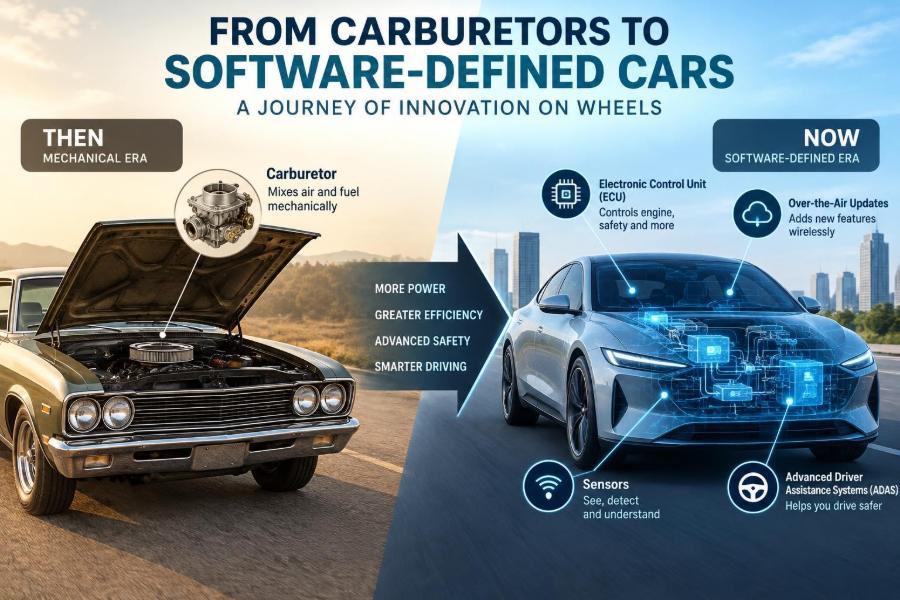

A driver of a 1970s car might have diagnosed a rough idle by listening to the engine, adjusting a carburetor screw, or replacing a set of ignition points. A driver of a current vehicle is more likely to see a warning lamp, connect a scan tool, and read a fault code from one of many electronic control units.
Both vehicles turn fuel or stored energy into motion, steer on four tires, and rely on brakes, suspension, and a human operator. Yet the way they sense conditions, make decisions, communicate faults, and receive improvements has changed dramatically.
This matters to automotive students because modern vehicles combine mechanical engineering with electronics, controls, communications, energy systems, and software. It matters to working professionals because diagnosis, repair, manufacturing, safety, and even vehicle ownership are being reshaped by that combination.
The journey from carburetors to software-defined cars is not a story of old technology becoming useless. It is a story of functions being measured more precisely, controlled more quickly, and increasingly coordinated by code.
🔧 The Carburetor Era: Metering Fuel Mechanically
A carburetor mixed air and fuel before the mixture entered a gasoline engine. Air flowing through a narrowed passage, called a venturi, created a pressure drop that drew fuel through small calibrated passages called jets.
It was an elegant mechanical solution, but it had limits. Temperature, altitude, engine wear, throttle position, and fuel quality could all affect mixture strength. A rich mixture wastes fuel and increases emissions; a lean mixture can reduce power and, in severe cases, contribute to overheating or damage.
Chokes, accelerator pumps, and multiple circuits improved drivability, but calibration remained a compromise across many operating conditions.
⚡ Electronic Ignition Removed a Major Wear Point
Early spark-ignition systems used breaker points in a distributor to switch current in the ignition coil. The points physically opened and closed, so their surfaces and adjustment changed with use.
Electronic ignition replaced this mechanical switching with sensors and semiconductor devices. It produced more consistent spark timing, reduced routine maintenance, and supported higher engine speeds more reliably.
This transition introduced a lasting pattern in automotive design: a sensor detects a physical event, an electronic circuit processes it, and an actuator performs the required action.
💉 Fuel Injection Made Mixture Control More Precise
Electronic fuel injection gradually displaced carburetors in passenger vehicles. Rather than relying mainly on airflow-induced fuel draw, injectors deliver fuel in controlled pulses.
An engine controller estimates how much fuel is needed using inputs such as intake airflow or manifold pressure, engine speed, intake-air temperature, coolant temperature, and throttle position. Injector pulse width—the time an injector is held open—becomes a key control variable.
Fuel injection does not eliminate every combustion problem, but it gives engineers much finer control over cold starts, acceleration, idle quality, fuel consumption, and exhaust emissions.
🌬️ Oxygen Sensors Closed the Control Loop
A major step was the use of the oxygen sensor in the exhaust. It tells the controller whether the exhaust indicates relatively rich or lean combustion.
With this feedback, the engine can operate in closed-loop control: it adjusts fueling, observes the result, and corrects again. This is different from open-loop control, where the system follows a programmed estimate without direct feedback from the outcome.
Near the chemically balanced air-fuel ratio for gasoline, a three-way catalytic converter can reduce several harmful exhaust constituents effectively. The sensor, controller, injector, and catalyst therefore work as one emissions system rather than as separate parts.
🧠 The ECU Became the Engine’s Decision Maker
The electronic control unit, or ECU, is a rugged embedded computer designed for the vehicle environment. It receives sensor signals, runs calibrated control logic, commands actuators, and monitors whether systems behave plausibly.
For example, it may alter spark timing to avoid knock, change idle-air control to stabilize engine speed, and operate a cooling fan according to temperature and load. Modern controllers use maps: carefully developed tables that specify suitable control values across ranges of speed, load, and other conditions.
An ECU is not “thinking” like a person. It executes defined software and responds within physical and programmed limits.
🗺️ Calibration Became as Important as Hardware
Two engines with similar mechanical architecture can behave very differently because of calibration. Fuel, spark, boost, transmission shifts, thermal management, and protective limits are all influenced by software settings.
Calibration engineers must balance competing goals. More aggressive timing may improve torque under some conditions but reduce knock margin. A faster transmission shift may feel sporty but require careful clutch pressure control to preserve durability.
This is why replacing a part with a physically compatible component is not always enough. Its software configuration and learned values may also matter.
🚨 On-Board Diagnostics Changed Fault Finding
As electronic control expanded, technicians needed a common way to identify faults. On-board diagnostics, commonly encountered through the OBD connector, allows compatible diagnostic equipment to communicate with vehicle controllers.
A diagnostic trouble code is a starting clue, not a repair instruction. A code may identify a circuit, a measured condition, or a system that has reached its correction limit; it does not automatically prove which part failed.
Good diagnosis still combines scan data with wiring checks, service information, visual inspection, and an understanding of how the system operates.
🧩 Vehicles Became Networks of Controllers
Once electronics moved beyond the engine, a vehicle gained separate controllers for brakes, airbags, body functions, steering, transmission, infotainment, and more. These controllers need to share data.
The controller area network, or CAN bus, became a widely used communication system. Instead of every module needing a separate wire for every signal, controllers can publish messages on a shared network.
For instance, the engine controller can broadcast engine speed while the instrument cluster displays it and the transmission controller uses it for shift decisions. Shared information reduces wiring complexity, but it also creates new network-diagnosis challenges.
🧵 Wiring Did Not Disappear—Its Role Changed
It is tempting to describe modern vehicles as “all software,” but every digital decision still depends on physical infrastructure. Wiring harnesses, grounds, connectors, fuses, power distribution modules, and sensors remain essential.
Water intrusion, corrosion, vibration, poor repairs, and damaged insulation can imitate module failures. A voltage drop under load may be far more revealing than a simple continuity test with the circuit unpowered.
Electrical fundamentals remain central skills: measure voltage, current, resistance where appropriate, signal quality, and circuit behavior under real operating conditions.
🛞 Anti-Lock Braking Showed the Value of Fast Control
Anti-lock braking systems, or ABS, use wheel-speed sensors to detect when a wheel is approaching lockup during braking. The controller rapidly modulates hydraulic brake pressure to help maintain tire rotation and directional control.
ABS does not repeal the laws of tire grip. It cannot create traction on ice or compensate for excessive speed. Its main advantage is that a rolling tire can usually provide more steerability than a fully locked one.
The same sensor-and-actuator foundation later supported traction control and electronic stability control.
🧭 Stability Control Coordinated Brakes, Engine, and Motion
Electronic stability control compares the driver’s intended path, estimated from steering input and vehicle speed, with the vehicle’s measured motion. Sensors can detect yaw rate, lateral acceleration, and wheel speeds.
If the vehicle begins to understeer or oversteer beyond expected behavior, the system may brake an individual wheel and, where available, request reduced engine torque. These small interventions can help restore stability.
Its effectiveness still depends on tire condition, surface grip, and available space. It is a safety layer, not permission to drive beyond the conditions.
🪂 Airbags Evolved into Occupant Protection Systems
Early supplemental restraint systems were comparatively simple. Modern systems can use crash sensors, seat-belt status, seat-position information, occupant classification, and multiple airbag stages to tailor deployment decisions.
The word supplemental matters: airbags are designed to work with seat belts, not replace them. Pretensioners can remove belt slack early in a collision sequence, while load limiters help manage belt force.
Because these systems are safety-critical, improper repairs, guessed wiring modifications, or incorrect replacement components carry serious risk. Manufacturer procedures and service precautions are essential.
📷 Cameras and Radar Expanded the Vehicle’s Awareness
Advanced driver-assistance systems, often called ADAS, use sensors such as cameras, radar, ultrasonic sensors, and sometimes lidar. Each has strengths and limitations.
| Sensor type | Useful capability | Typical limitation |
|---|---|---|
| Camera | Recognizes lane markings, signs, and visual objects | Performance can be affected by glare, dirt, darkness, or poor markings |
| Radar | Measures range and relative speed well in many conditions | Has less visual detail than a camera |
| Ultrasonic sensor | Detects nearby obstacles at low speed | Has short range and can be affected by surface shape |
Sensor fusion combines information from more than one source. It can improve confidence, but it also adds complexity in calibration, alignment, diagnostics, and validation.
👀 Driver Assistance Is Not Driver Replacement
Adaptive cruise control, lane-centering assistance, automatic emergency braking, and parking aids can reduce workload in specific circumstances. Their names can sound more capable than their operating limits.
Road geometry, weather, faded lane markings, unusual vehicles, blocked sensors, and unexpected human behavior can challenge any assistance system. Drivers must understand the owner’s manual, remain attentive, and keep responsibility for safe driving unless a system is explicitly designed and legally approved for a different role.
Clear communication about limits is an engineering and human-factors issue, not merely a marketing issue.
🔋 Hybrid Systems Added a Second Power Path
Hybrid vehicles combine an internal-combustion engine with one or more electric machines and a battery. The electric machine can propel the vehicle, assist the engine, recover energy during braking, or start the engine smoothly.
Regenerative braking converts some vehicle kinetic energy back into electrical energy instead of dissipating it entirely as heat in friction brakes. The amount recovered depends on battery state, traction, temperature, and braking demand.
Hybrid control is a coordination problem. The vehicle chooses among engine operation, electric drive, blended torque, charging, and regeneration to meet performance, efficiency, emissions, and battery-protection goals.
🔌 Battery-Electric Vehicles Simplified Some Systems
Battery-electric vehicles remove the combustion engine, fuel tank, exhaust system, and many related components. Electric motors can provide high torque from very low speed, and power electronics control that torque with precision.
However, simplification in one area shifts complexity elsewhere. The traction battery, inverter, charging system, thermal management, high-voltage safety architecture, and battery-management system become central.
Range depends on conditions such as speed, temperature, terrain, payload, cabin heating or cooling, and driving style. A single advertised figure cannot describe every real journey.
🌡️ Thermal Management Became a Cross-System Discipline
Cooling once focused mainly on keeping an engine within a suitable temperature range. Modern vehicles may manage engine coolant, transmission fluid, turbocharger heat, cabin comfort, battery cells, electric motors, inverters, and charging equipment.
Battery temperature affects performance, charging behavior, and long-term degradation. Very cold or very hot cells may require heating or cooling before they can operate or charge at their preferred rate.
Thermal systems increasingly use valves, pumps, heat exchangers, refrigerant circuits, and software strategies as an integrated network. A fault in one component can influence comfort, range, charging, or component protection.
🔄 The Inverter Is the Electric Drivetrain’s Power Translator
A traction battery supplies direct current, while common traction motors require controlled alternating current. The inverter uses high-speed semiconductor switching to create the required motor currents.
By controlling current magnitude, timing, and frequency, the inverter regulates motor torque and speed. During regeneration, energy flow reverses and the system returns electrical energy to the battery when conditions permit.
High-voltage systems should never be treated as ordinary 12-volt circuits. Safe service requires trained personnel, specified isolation procedures, appropriate protective equipment, and verification methods defined by the vehicle manufacturer.
📡 Connectivity Turned Cars into Communication Platforms
Telematics systems can connect a vehicle to mobile networks for emergency assistance, navigation data, fleet management, remote services, diagnostics, or software delivery. Connectivity can be useful long after the vehicle leaves the factory.
It also introduces questions about data collection, user consent, service continuity, and cybersecurity. Drivers and fleet operators should understand what information is transmitted, who can access it, and which features depend on an active account or network connection.
Connected capability is valuable only when it remains dependable, understandable, and appropriately protected.
🛡️ Cybersecurity Became a Vehicle Safety Concern
When a vehicle contains networked controllers, wireless interfaces, diagnostic ports, and cloud-connected services, cybersecurity becomes part of automotive engineering. The objective is to reduce the chance that unauthorized access can affect data, privacy, or vehicle functions.
Protection can include secure software design, authenticated communications, controlled diagnostic access, encryption where appropriate, monitoring, and processes for responding to vulnerabilities. No single feature solves every risk.
Cybersecurity is ongoing work because software, threats, and connected services change over the vehicle’s life.
🧱 Centralized Computing Is Replacing Some Distributed Modules
Traditional vehicles may contain many separate ECUs, each dedicated to a narrow function. Newer electrical and electronic architectures increasingly consolidate some functions into more powerful domain or central computers.
Zonal architectures are another development. They group nearby sensors and actuators through local controllers, reducing long wire runs and allowing data to move through higher-capacity networks.
Consolidation can lower weight and simplify updates, but it raises the importance of fault containment, redundancy, thermal design, and careful software integration. A powerful computer must not become an uncontrolled single point of failure.
💻 What Makes a Car Software-Defined?
A software-defined vehicle is a vehicle whose features, behavior, and improvements are increasingly determined by software that can be developed, configured, and in some cases updated after production. The concept applies beyond the infotainment screen.
Software may influence power delivery, driver displays, charging schedules, cabin functions, driver-assistance behavior, diagnostics, and service tools. Hardware still sets hard boundaries: software cannot create tire grip, battery capacity, sensor visibility, or structural strength that the vehicle does not possess.
The central change is flexibility. Instead of fixing every function permanently at the factory, engineers can refine compatible functions through controlled software releases.
⬆️ Over-the-Air Updates Offer Benefits and Constraints
Over-the-air, or OTA, updates can correct software defects, improve user interfaces, adjust calibration, or add supported functions without a workshop visit. This can be especially useful for non-safety-critical improvements and for addressing widespread software issues.
Updates also require discipline. A release must be tested across relevant hardware versions and operating conditions, downloaded securely, installed without corrupting essential systems, and recoverable if an interruption occurs.
Not every concern can be repaired by an update. Worn hardware, mechanical damage, sensor contamination, and unsuitable tires still need physical inspection and service.
🧪 Validation Now Includes Code, Data, and Edge Cases
Testing a modern vehicle involves more than durability miles and dynamometer runs. Engineers may test software in simulation, then on hardware-in-the-loop rigs, benches, proving grounds, public roads, and controlled fleets before wider deployment.
An edge case is an unusual but plausible condition that challenges assumptions: an obscured lane line, an uncommon trailer shape, conflicting sensor inputs, a low-voltage event during startup, or a network message arriving late.
Complete coverage of every real-world condition is impossible. The practical aim is systematic hazard analysis, broad testing, monitoring, conservative fallback behavior, and continuous improvement.
🧰 Diagnostics Are Moving from Parts Swapping to Systems Thinking
Modern fault finding begins with a customer concern and a reproducible condition, not with the first code displayed. A technician may need to inspect network communication, compare live data, verify power and ground, test sensors against specifications, and check for software updates or service bulletins.
Consider a parking sensor warning that appears intermittently. The cause might be a dirty sensor face, water in a connector, harness damage, a communication problem, incorrect replacement programming, or a failed sensor. Replacing the sensor first may be correct—but only after evidence supports it.
Mechanical reasoning remains just as valuable when interpreting digital evidence.
🎓 Skills Automotive Engineers and Technicians Need
The industry increasingly rewards professionals who can cross traditional boundaries. Mechanical knowledge, electrical diagnosis, data interpretation, and safe working practices reinforce one another.
- Understand vehicle dynamics, engines or electric drivetrains, brakes, steering, and thermal systems.
- Read wiring diagrams, use measuring instruments correctly, and understand network communication basics.
- Learn control concepts such as feedback, actuator limits, filtering, and fail-safe behavior.
- Develop software literacy: logic, data structures, version control concepts, and test discipline.
- Respect high-voltage and restraint-system procedures; competence includes knowing when not to proceed.
No one person must master every specialization. The key is knowing how systems connect and when to involve the right expertise.
⚖️ Progress Brings Trade-Offs, Not Just Features
Electronic control can improve efficiency, safety functions, diagnostics, and personalization. It can also increase repair complexity, dependence on specialized tools, supply-chain exposure, and the consequences of software defects.
Older vehicles are often easier to understand mechanically and may be repairable with basic tools. Newer vehicles can identify faults more specifically and manage performance more precisely, but access, programming, and parts compatibility can complicate repairs.
Good engineering does not treat complexity as a virtue by itself. It asks whether each added system delivers a clear benefit with acceptable cost, reliability, serviceability, and safety.
🏭 Manufacturing Changed Along with the Vehicle
Automotive production now integrates software configuration with physical assembly. A vehicle may be built with hardware options that require specific coding, feature activation, or calibration before delivery.
Quality control increasingly includes electronic checks: verifying module communication, sensor calibration, diagnostic status, and software versions alongside traditional measurements for torque, fit, finish, and leak testing.
This connection continues into service. Traceable configuration data can help ensure that replacement modules and safety-related calibrations match the individual vehicle.
🌍 The Lifecycle Question Extends Beyond Tailpipe Emissions
Automotive technology is often discussed only through tailpipe emissions, but the broader picture includes material extraction, manufacturing energy, maintenance, electricity or fuel source, component replacement, and end-of-life recovery.
Different powertrains have different lifecycle strengths and challenges. Battery production requires material supply chains and recycling systems; combustion vehicles require fuel production and exhaust control; all vehicles consume tires, brakes, and other materials.
Sound comparisons require defined boundaries and local context. Simple claims that one technology is always clean or always harmful usually leave out relevant conditions.
🛣️ The Core Lesson: Cars Are Integrated Systems
The path from carburetors to software-defined cars shows a consistent engineering principle: better results often come from coordinating many parts rather than optimizing one component in isolation. Fuel injection needed sensors, control logic, injectors, and exhaust aftertreatment. ADAS needs sensing, computing, braking authority, user understanding, and safe limits.
For students, this means learning fundamentals deeply while staying curious about adjacent fields. For professionals, it means resisting both extremes: assuming that every problem is mechanical, or assuming that a scan tool can replace physical diagnosis.
The best automotive decisions connect hardware capability, software behavior, human use, maintenance realities, and safety requirements into one coherent design.
Automotive technology has changed most profoundly not because cars gained computers, but because mechanical, electrical, and software systems now have to work together as one vehicle. Understanding that integration is the foundation for designing, servicing, and driving the next generation of cars responsibly. 🚗⚙️🔋