
A commuter leaves home with a fully charged battery, glides through stop-start traffic, and arrives without visiting a filling station. On the same route, another driver burns fuel while idling at lights, while a third alternates quietly between an engine and an electric motor. Which car actually uses energy most efficiently?
The answer is not as simple as comparing a dashboard range figure or the price paid at a pump. Efficiency changes with traffic, temperature, speed, vehicle size, charging source, driving style, and even how often a hybrid can recover braking energy.
For students of automobile engineering, this comparison connects thermodynamics, electric machines, battery systems, vehicle dynamics, and emissions. For drivers and fleet managers, it affects running cost, charging plans, and the suitability of a vehicle for a particular job.
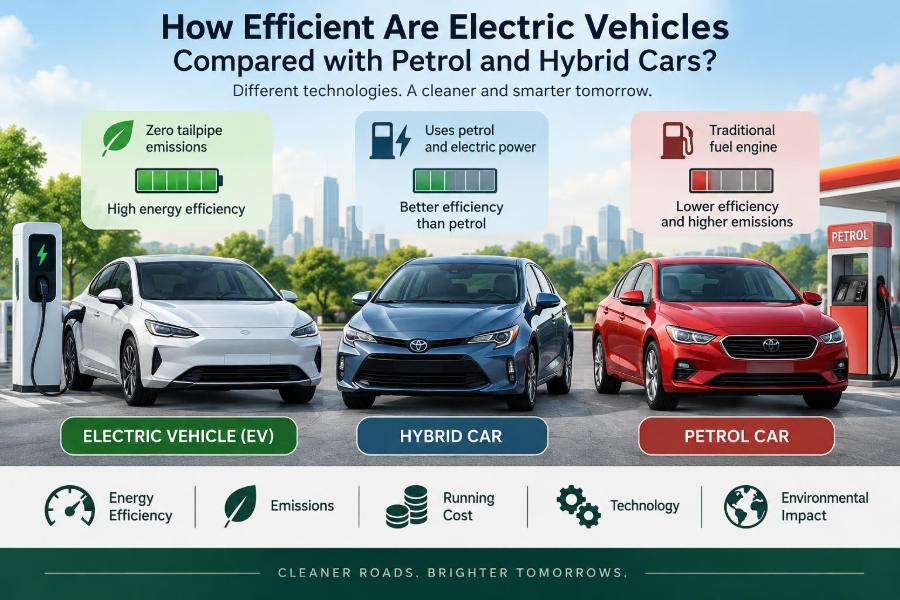
Electric vehicles usually make much better use of energy at the wheels than petrol cars. Hybrids narrow the gap by reducing the engine’s worst operating conditions, but they remain fundamentally different machines. Understanding where those differences come from is more useful than treating any powertrain as automatically best.
🔍 What “Efficiency” Means in a Car
Vehicle efficiency describes how effectively an energy source is converted into useful motion. A car also consumes energy for heating or cooling the cabin, powering electronics, overcoming tyre resistance, pushing air aside, and climbing hills.
There are two useful boundaries. Tank-to-wheel efficiency looks at energy stored in petrol or a battery and asks how much reaches the wheels. Well-to-wheel efficiency extends the question upstream to fuel production, electricity generation, transport, and charging losses.
⚙️ The Petrol Engine’s Fundamental Challenge
A petrol engine releases chemical energy by burning fuel, then turns expanding hot gases into crankshaft rotation. Much of that energy leaves as heat through the exhaust and cooling system rather than becoming wheel motion.
Its efficiency also varies sharply with load and speed. During gentle urban driving, an engine may operate far from its most efficient region because it must stay running while producing only modest power.
🔌 Why Electric Motors Use Energy So Well
An electric motor converts electrical energy into rotational torque through electromagnetic fields. There is no combustion cycle, no exhaust heat stream, and no idling fuel use in the conventional sense.
Motor, inverter, and reduction gear losses still exist, but the powertrain has fewer energy-conversion stages. This is why an EV can translate a large share of battery energy into movement, especially in conditions involving frequent acceleration and braking.
🔋 The Battery Is Not a Perfect Energy Store
A battery does not deliver every kilowatt-hour drawn from the electricity supply. Energy is lost as heat during charging, within battery cells, in cables, and in onboard charging equipment.
Likewise, battery output falls slightly through internal resistance before reaching the motor. These losses matter, but they do not remove the electric powertrain’s major advantage over combustion. They simply remind us that a wall socket reading and wheel energy are not identical.
⛽ Petrol Carries Much More Energy by Mass
Petrol has very high energy density: a small, light tank can store enough energy for a long journey. Batteries store far less energy per kilogram, so long-range EVs carry substantial battery mass.
However, stored energy is not the same as usable vehicle energy. Petrol’s advantage in storage density is partly offset by the engine’s lower conversion efficiency. Battery mass remains a genuine engineering trade-off, particularly for heavy vehicles and long-distance duty cycles.
🧭 A Simple Powertrain Comparison
| Powertrain | Main energy path | Key efficiency strength | Typical weak condition |
|---|---|---|---|
| Petrol car | Fuel → engine → gearbox → wheels | Rapid refuelling and light energy storage | Idling and low-load urban use |
| Hybrid car | Fuel/battery → engine and motor → wheels | Engine management and energy recovery | Long high-speed travel with limited electric contribution |
| Battery EV | Grid → battery → inverter/motor → wheels | High drivetrain efficiency and regeneration | Cold weather, high speed, or heavy towing |
This table simplifies real vehicles, yet it captures the design logic. An EV avoids burning fuel on board; a hybrid tries to make an engine work less wastefully; a conventional petrol vehicle depends almost entirely on engine operation.
🏙️ Why City Driving Favors EVs
Urban traffic exposes two major weaknesses of petrol cars: idling and repeated acceleration. An EV uses almost no propulsion energy while stationary, and its motor can provide strong torque immediately without holding an engine at idle.
At low speeds, aerodynamic drag is modest, so an EV’s drivetrain advantage is highly visible. A hybrid also performs well here because it can shut off the engine at stops and use its battery and motor for low-power movement.
🛣️ What Changes at Motorway Speed
At higher speed, aerodynamic drag becomes the dominant energy demand. Drag rises approximately with the square of speed, while the power needed to overcome it rises roughly with the cube. A modest speed increase can therefore have a large range penalty.
All vehicles face this physics. EVs still avoid engine conversion losses, but their range can fall noticeably at sustained motorway speed. A petrol car may show a smaller proportional change in displayed range because its fuel tank holds so much energy.
🛑 Regenerative Braking Changes the Urban Balance
When a conventional car slows down, its brakes mostly convert kinetic energy into waste heat. Regenerative braking lets an electric motor act as a generator, returning part of that energy to the battery.
Recovery is never complete. Some energy is lost in electrical conversion, tyre deformation, air drag, and braking limits. Still, regeneration can materially improve efficiency in traffic and on rolling roads, where a car repeatedly slows and accelerates.
🔄 How Full Hybrids Capture Lost Energy
A full hybrid combines an engine, electric motor, battery, and control system. It can recover braking energy, move briefly on electric power, assist the engine during acceleration, and switch off the engine when conditions allow.
The important feature is not merely the battery size. It is the control strategy: the vehicle aims to use the engine nearer its efficient operating zone and avoids wasting fuel at idle. This is why full hybrids often excel in town driving without external charging.
🔗 Mild Hybrids Are a Smaller Step
A mild hybrid usually has a small motor-generator and battery, but it generally cannot drive far—or at all—on electricity alone. It supports stop-start operation, recovers some braking energy, and assists the engine during launch or acceleration.
It can reduce fuel consumption compared with an equivalent conventional petrol car, but it should not be assumed to deliver the same efficiency gains as a full hybrid or EV. The label “hybrid” covers very different architectures.
🔌 Plug-In Hybrids Depend on Charging Habits
A plug-in hybrid electric vehicle, or PHEV, has a larger battery that can be charged externally. For short trips within its electric driving capability, it can operate much like an EV and use little or no petrol.
When it is rarely charged, however, it carries the mass and complexity of both systems while relying heavily on the engine. Its real-world efficiency is therefore unusually dependent on routine: home charging, trip length, ambient temperature, and driver behaviour.
🌡️ Cold Weather Has Different Effects
Cold conditions increase rolling resistance, thicken lubricants, and make cabin heating necessary for every vehicle. Petrol engines produce abundant waste heat, which can warm a cabin after the engine reaches temperature, although warm-up itself uses extra fuel.
An EV must often use battery energy for heating, and a cold battery may accept or deliver energy less readily. Heat pumps and battery thermal management reduce this penalty, but winter range should be planned rather than assumed from mild-weather figures.
❄️ Air Conditioning Also Uses Energy
In hot weather, air conditioning loads every powertrain. In a petrol vehicle, the compressor raises engine load; in an EV, it draws from the traction battery. At low speeds, the impact can be especially noticeable because propulsion demand is small.
The practical lesson is not to avoid comfort systems. It is to understand that auxiliary loads influence short-trip consumption more than drivers may expect, especially in compact EVs with smaller batteries.
📦 Vehicle Mass Matters, but Not Alone
A heavier vehicle needs more energy to accelerate and climb. It also increases tyre loading, which can raise rolling resistance. Battery packs add mass, while hybrid systems add an engine, electric components, and a battery.
EVs can recover some acceleration energy through regeneration, which softens the mass penalty in urban use. They cannot recover energy used to overcome air resistance, rolling losses, or long climbs. A smaller, lighter vehicle is generally efficient regardless of its power source.
🌬️ Aerodynamics Can Outweigh Powertrain Differences
At speed, a streamlined body can save more energy than many drivers expect. Frontal area, underbody design, wheel shape, mirrors, roof accessories, and ride height all influence drag.
This explains why a tall electric SUV may consume considerably more energy on a fast road than a low, aerodynamic electric hatchback. Comparing only battery capacity or engine size can hide the design factors that truly determine cruising efficiency.
🛞 Tyres Are an Overlooked Energy Consumer
Tyres flex as they roll, creating rolling resistance. Underinflation increases that resistance, while wide tyres and certain aggressive tread patterns may also raise consumption.
Low-rolling-resistance tyres can help efficiency, but engineers must balance this against wet grip, wear, noise, load capacity, and handling. For any vehicle, correct tyre pressure is one of the simplest practical habits for protecting efficiency and tyre life.
⚡ Charging Losses Belong in the Calculation
If an EV uses a stated amount of energy from its battery, the electricity drawn from the wall will be higher because charging is not perfectly efficient. Slow AC charging, onboard charging electronics, and battery temperature management each influence the difference.
For household cost calculations, use electricity measured at the charger or meter where possible. For engineering comparisons, distinguish clearly between battery-to-wheel and grid-to-wheel figures rather than mixing them.
🏭 Electricity Source Determines Upstream Impact
An EV’s operational efficiency does not automatically describe its total environmental impact. The emissions associated with charging depend on how the local grid produces electricity and when charging occurs.
Even so, using electricity in an efficient motor can reduce the energy needed at the vehicle. A careful assessment also considers battery manufacturing, fuel extraction and refining, vehicle production, and eventual recycling. These are lifecycle questions, not just tailpipe questions.
🛢️ Fuel Production Is Also Energy Intensive
Petrol reaches a car only after crude oil is extracted, transported, refined, and distributed. Those upstream processes consume energy before combustion begins inside the engine.
This is why a fair comparison should not describe petrol as if its energy simply appears at the filling station. Well-to-wheel analysis applies the same complete-system thinking to both liquid fuel and electricity.
📈 Real-World Economy Needs Careful Comparison
Petrol and hybrid vehicles are often discussed in litres per 100 kilometres or miles per gallon. EVs are commonly measured in kilowatt-hours per 100 kilometres or miles per kWh. These units describe different energy carriers.
Convert units only when the comparison has a clear purpose, such as cost, stored energy, or upstream energy use. Avoid declaring one vehicle “more efficient” from a single official test value taken under conditions that do not match the driver’s route.
🧪 Official Tests Are Useful, Not Personal Guarantees
Standardized test cycles allow vehicles to be compared under repeatable conditions. They are valuable engineering tools, but no test can reproduce every combination of weather, traffic, gradient, payload, driving style, and accessory use.
Use official figures as a baseline, then adjust expectations for your journey. A delivery vehicle on stop-start routes, for example, may reveal very different strengths from a family car used mostly for long motorway holidays.
🚚 Towing and Heavy Loads Stress Every Powertrain
Towing raises mass and often worsens aerodynamics dramatically. The extra frontal area of a trailer can be more damaging at speed than the trailer’s weight alone.
An EV can provide strong low-speed torque, which is useful for moving a load, but its range may drop substantially under sustained towing. Petrol and hybrid vehicles also consume more fuel, though rapid refuelling may be more convenient on some long towing routes.
🔧 Maintenance Is Not the Same as Energy Efficiency
EVs have no engine oil changes, spark plugs, exhaust system, or conventional multi-ratio transmission in many designs. Regenerative braking can also reduce friction-brake wear. These features may lower certain maintenance demands.
But lower maintenance complexity does not mean zero maintenance. Tyres, suspension, cooling circuits, brake condition, battery health, and software-related diagnostics still matter. Cost of ownership and energy efficiency should be considered together, but they are separate measures.
🧠 Driving Style Can Erase Some Advantages
Hard acceleration, unnecessary high speed, abrupt braking, and poor tyre pressure increase energy use in every car. An EV’s efficient motor does not make aerodynamic drag disappear, and a hybrid cannot recover all energy wasted by aggressive driving.
- Accelerate decisively but smoothly rather than repeatedly surging and braking.
- Look ahead so that coasting and regenerative braking can replace late heavy braking.
- Use route and charging planning to avoid arriving with an unnecessarily low battery.
- Remove roof boxes or carriers when they are not needed for a journey.
🏠 Matching the Vehicle to the Daily Pattern
An EV is often a strong efficiency choice for drivers with dependable charging and frequent short-to-medium journeys. Overnight charging can restore energy while the car is parked, and urban operation plays to the drivetrain’s strengths.
A full hybrid can suit drivers without easy charging who regularly face congestion. A petrol vehicle may remain practical where charging access is limited, journeys are unpredictable, or the vehicle must cover long distances with minimal stopping. Suitability is a system question, not a badge question.
⚠️ Common Comparison Mistakes
The most frequent mistake is comparing the EV’s electricity bill with only the petrol price while ignoring home charging losses, public charging prices, or different annual mileages. The reverse mistake is judging EV efficiency solely by a winter motorway range figure.
Other errors include treating every hybrid as a plug-in hybrid, assuming a PHEV is efficient without charging it, and overlooking vehicle size. Compare similar classes, similar routes, and the same definition of efficiency.
🧩 The Engineering Trade-Offs Behind Each Choice
Powertrain selection involves more than maximum efficiency. Engineers balance range, packaging, battery cost, thermal management, refuelling or charging time, durability, emissions, performance, safety, and manufacturing constraints.
A hybrid is a deliberate compromise: it retains fuel flexibility while using electrification to reduce waste. An EV simplifies the onboard propulsion path but shifts more attention to battery design and charging infrastructure. Neither approach eliminates trade-offs.
🔮 Efficiency Will Continue to Improve
Better battery chemistry, improved thermal control, more efficient inverters, heat pumps, lighter structures, and lower-drag bodies can improve EV performance. Hybrid systems can also advance through smarter controls, improved engines, and more capable electrical components.
Yet the largest gains often come from basic engineering discipline: reducing drag, avoiding unnecessary mass, selecting appropriate tyres, and matching the energy system to the use case. These principles apply whatever energy source becomes dominant.
✅ The Core Takeaway: Use the Right Boundary and Journey
At the vehicle level, battery EVs are generally the most energy-efficient of the three because electric motors and regenerative braking avoid many combustion losses. Full hybrids usually improve substantially on petrol cars, particularly in urban traffic, by recovering energy and managing engine operation more carefully.
But the best real-world choice depends on charging access, trip pattern, climate, speed, load, and electricity supply. Efficiency is not a single number on a brochure; it is the result of a powertrain, a vehicle design, and a specific journey working together.
Choose comparisons that reflect how the vehicle will actually be used, then consider energy from its source all the way to the wheels. That approach gives a clearer answer than any simple petrol-versus-electric slogan. 🚗⚡🌍