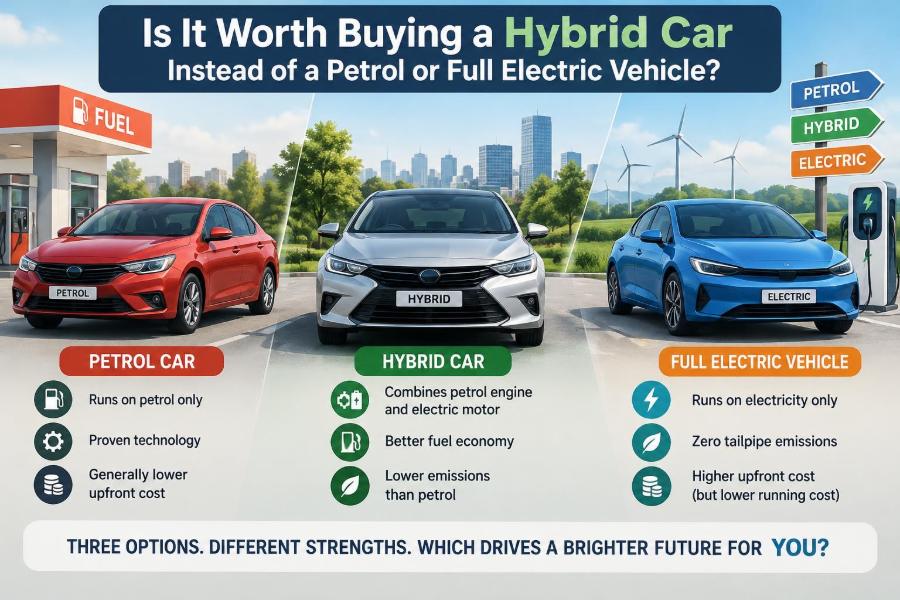

You are replacing an ageing car, and the choices seem deceptively simple. A familiar petrol model is easy to understand, an electric vehicle promises quiet driving and no tailpipe emissions, while a hybrid sits somewhere in the middle.
That middle position can be confusing. Some hybrids charge themselves, some plug into a socket, and the fuel-economy number on a brochure may have little resemblance to a particular driver’s daily results.
The right answer depends less on which technology sounds most modern and more on where, how far, and how predictably you drive. Your ability to charge at home or work can change the calculation completely.
A hybrid can be an excellent engineering compromise, but it is not automatically the best compromise for every owner. Understanding what it actually does is the first step.
🧭 Start With the Real Buying Question
The useful question is not simply, “Is a hybrid better?” It is: which powertrain wastes the least money, energy, time, and convenience in my normal use?
A commuter covering short, congested trips has different needs from a driver who regularly travels long motorway distances or a household that has reliable overnight charging. Consider your most common journeys first, then the occasional long trip.
🔧 What Makes a Hybrid Vehicle Different
A hybrid electric vehicle combines an internal-combustion engine, usually petrol, with an electric motor and a battery. The motor can assist the engine, propel the car alone for limited periods, or recover energy while slowing down.
The engine remains the main source of stored energy because the vehicle carries fuel. The electrical system reduces situations where an engine is inefficient, particularly pulling away and accelerating at low speed.
⚙️ The Main Types of Hybrid
“Hybrid” describes several quite different designs. Treating them as identical is one of the most common buying mistakes.
| Type | Battery charging method | Typical electric capability | Best fit |
|---|---|---|---|
| Mild hybrid | Engine and braking recovery | Usually cannot drive solely on electricity | Drivers wanting a small efficiency improvement |
| Full hybrid | Engine and regenerative braking | Short, low-speed electric running | Mixed and urban driving without plugging in |
| Plug-in hybrid (PHEV) | External charging plus engine and recovery | Meaningful electric-only range when charged | Frequent short journeys with reliable charging |
A range-extender vehicle is another variation: wheels are driven electrically, while a small engine may generate electricity. Its real-world character can differ from a conventional hybrid.
🔋 How Regenerative Braking Recovers Energy
When a conventional car slows down, its brakes convert the vehicle’s kinetic energy into heat. A hybrid can use its electric motor as a generator during deceleration, sending some of that energy back into the battery.
This process is called regenerative braking. It cannot recover all energy because of conversion losses, tyre resistance, and aerodynamic drag, but it is especially useful where braking happens often.
That is why hybrids generally suit stop-start traffic better than steady high-speed motorway travel.
🏙️ Why City Driving Favors Full Hybrids
Petrol engines are least efficient when cold, idling, and repeatedly accelerating a heavy car. A full hybrid can shut its engine off at some stops, launch electrically, and let the engine run nearer efficient operating conditions when it does start.
In an urban route with junctions, queues, and low speeds, those small gains occur repeatedly. The drivetrain is effectively recycling part of the energy that traffic would otherwise throw away as heat.
🛣️ Why Motorway Results Are Less Dramatic
At a sustained motorway speed, there is relatively little braking energy to capture. Aerodynamic drag rises rapidly with speed, and the petrol engine may run steadily in a reasonably efficient range.
A hybrid can still use less fuel than a comparable petrol car, but the gap is commonly smaller than in town. Buyers who spend nearly all their time on fast roads should compare realistic motorway consumption, not only the headline combined figure.
⛽ The Case for a Conventional Petrol Car
A petrol car may remain sensible where the purchase price is substantially lower, annual mileage is modest, or the buyer prioritises a particular vehicle type unavailable as a hybrid. It is mechanically familiar, and fuel stops are quick.
However, a lower sticker price is not the whole cost. Frequent urban use can make a petrol engine’s idling and low-load inefficiency more noticeable over years of ownership.
⚡ The Case for a Full Battery-Electric Vehicle
A battery-electric vehicle, or BEV, has no combustion engine. It stores grid electricity in a much larger battery and uses electric motors for propulsion, eliminating tailpipe exhaust while driving.
Electric motors are responsive from zero speed, and a BEV is mechanically simpler in several areas. For drivers who can charge conveniently and whose trips fit the vehicle’s practical range, it can be a more direct solution than carrying both engine and motor.
🔌 Home Charging Changes the PHEV Equation
A plug-in hybrid has the greatest potential when it is plugged in regularly. If a driver’s weekday return journey is within the car’s usable electric range and charging happens overnight, many routine kilometres can be completed without using petrol.
For example, a hypothetical driver with a short commute, driveway parking, and occasional longer family trips may value a PHEV’s electric weekday operation and petrol-powered flexibility at weekends.
Without routine charging, that same vehicle often becomes a heavy petrol car carrying an underused battery.
🏠 Charging Access Matters More Than Ambition
Wanting an electric vehicle does not create a convenient place to charge one. Private off-street parking, a suitable electrical installation, workplace charging, and dependable public chargers are practical factors rather than minor details.
A BEV can work very well with public charging, but it requires more planning and tolerance for charging stops. A hybrid avoids that infrastructure dependency because petrol remains its primary stored energy source.
📏 Understand Electric Range as a Variable
Published electric range is measured under defined test conditions, not a promise for every journey. Temperature, cabin heating or cooling, speed, gradients, tyre choice, payload, and driving style all affect energy use.
This matters particularly for PHEVs. Choose one whose everyday electric range has a comfortable margin over your usual route, rather than assuming the official figure will always be available.
🌡️ Cold Weather and Cabin Comfort
Low temperatures reduce battery performance and increase the energy needed for heating. Electric vehicles and PHEVs may therefore show lower electric range in winter, particularly on short trips where the cabin must warm up repeatedly.
A petrol hybrid can use engine heat, but engine warm-up also consumes fuel. Preconditioning a plugged-in vehicle while it is connected to power can reduce the burden on its traction battery and improve comfort before departure.
💨 Tailpipe Emissions Are Not the Whole Picture
A BEV has no tailpipe emissions in use. A hybrid still burns petrol and produces exhaust, although it can reduce fuel use and associated carbon dioxide compared with a similar petrol vehicle in suitable driving conditions.
Broader environmental impact also includes vehicle manufacturing, battery production, electricity generation, tyre wear, and how long the vehicle is kept in service. These factors vary by location, model, battery size, and use pattern.
For a buyer, the clearest operational distinction remains simple: a PHEV only avoids petrol on journeys actually driven electrically.
🧱 Battery Size and Vehicle Weight
Hybrid batteries are usually smaller than BEV batteries, while PHEV batteries are larger because they must provide useful electric-only travel. Added battery mass can increase energy use when the combustion engine is doing the work.
Weight is not the only design factor; aerodynamics, tyres, motor efficiency, and vehicle size matter too. Still, it explains why an uncharged PHEV may be less efficient than an ordinary full hybrid on a long journey.
🛠️ Mechanical Complexity and Reliability
A hybrid has more propulsion components than a petrol-only car: engine, fuel system, electric motor, power electronics, high-voltage battery, and control systems. A PHEV adds charging hardware and a larger battery.
Complexity does not automatically mean poor reliability. Some hybrid systems use carefully engineered transmissions and fewer conventional wear items. But repair pathways, specialist knowledge, parts availability, and warranty terms deserve investigation before purchase.
🧾 Maintenance Is Different, Not Absent
Regenerative braking can reduce use of friction brake pads and discs, but brakes still need inspection. Infrequent heavy braking can allow corrosion in damp climates, so “the brakes last longer” should not become “the brakes need no attention.”
Hybrids still require engine oil, filters, coolant checks, tyres, and scheduled servicing. BEVs avoid engine servicing but still need tyres, brakes, suspension, cabin filters, and electrical-system checks.
💷 Compare Total Cost, Not Purchase Price Alone
Total cost of ownership includes purchase price, financing, depreciation, energy or fuel, servicing, insurance, taxes or local charges, tyres, and expected resale value. These costs differ considerably by market and vehicle model.
Make a simple personal comparison using your actual annual distance. Estimate how many kilometres a PHEV will truly cover on electricity, then price the remaining petrol use. Do not assume every journey will be electric merely because the car has a plug.
📉 Depreciation and Policy Uncertainty
Vehicle values can be influenced by changing technology, new model launches, incentives, emissions rules, and local access restrictions. No buyer can predict resale value precisely, especially over a long ownership period.
A sensible approach is to avoid basing the decision on a hoped-for future policy benefit. Buy a car that works under present charging access, travel needs, and running costs, with future changes treated as a possible bonus or risk.
🚦 Local Rules Can Affect the Choice
Congestion charges, low-emission zones, parking rules, company-car taxation, and charging incentives vary by city and country. Eligibility can depend on exact emissions ratings, registration dates, or whether a PHEV meets a specific electric-range requirement.
Check official local rules for the exact vehicle before signing. Labels such as “hybrid” or “eco” are not universal legal categories, and exemptions can change.
🧪 Test Figures Versus Daily Reality
Laboratory test cycles allow cars to be compared under the same method, but real drivers face different traffic, weather, gradients, loads, and speeds. Use official figures as a comparison tool, not a personal forecast.
PHEV fuel-consumption figures require special care because the result assumes a specified share of electric driving. If your charging frequency is lower than the test assumption, petrol consumption can be much higher.
🧠 Driving Style Still Matters
Hard acceleration, high cruising speed, unnecessary cargo, underinflated tyres, and late braking raise energy use in all vehicle types. A hybrid rewards smooth anticipation because early lifting and gentle deceleration give regeneration more opportunity to work.
That does not mean driving unusually slowly. It means preserving momentum safely and avoiding turning speed into heat at every junction.
🚙 Match the Powertrain to Your Journey Pattern
Use this practical guide as a starting point:
- Mostly urban driving, no reliable charging: a full hybrid is often a strong fit.
- Short daily trips, reliable home or workplace charging: compare a PHEV with a BEV; the BEV may be simpler if range meets your needs.
- Long, frequent motorway journeys: compare efficient petrol hybrids, petrol cars, and BEVs with comfortable rapid-charging capability.
- Infrequent driving and a tight budget: a well-suited petrol car may be more rational than paying extra for unused hybrid technology.
These are patterns, not rules. Vehicle size, towing requirements, weather, and regional infrastructure can shift the answer.
🧳 Towing, Loads, and Long Trips
Heavy loads, roof boxes, trailers, steep terrain, and high speeds increase energy demand. A PHEV’s electric range can fall substantially in such conditions, while a BEV may require more frequent or longer charging stops.
Check the manufacturer’s permitted towing mass and any limits specific to the powertrain. For a driver who tows regularly, charging-route availability and usable range under load deserve more weight than an optimistic everyday range estimate.
🔍 What to Check During a Test Drive
Do not judge a hybrid only by its silent first few metres. Drive a route resembling your routine, including a hill, faster road, urban traffic, and parking manoeuvres if possible.
- Observe engine noise and transitions between electric and petrol power.
- Check rear visibility, boot space, and whether the battery affects the spare-wheel area.
- For a PHEV or BEV, inspect the charging port, cable storage, charging schedule, and navigation tools.
- Ask what happens to performance and fuel use when the battery is low.
A car that is efficient but awkward to charge or uncomfortable on your commute is unlikely to feel like a good long-term choice.
⚠️ Common Mistakes When Choosing a Hybrid
The biggest error is buying a PHEV for its official efficiency without having a regular charging routine. The second is assuming a mild hybrid will offer the same electric driving experience as a full hybrid.
Other mistakes include comparing vehicles of different size classes, ignoring insurance and tyre costs, and selecting a battery-electric vehicle based only on stated range rather than winter and motorway needs.
📋 A Simple Decision Process
Before choosing, write down your last month of driving: trip lengths, parking locations, long journeys, fuel stops, and whether charging would be genuinely convenient. This record is more useful than a vague estimate of your habits.
- Identify the journeys you make most often.
- Confirm where and how frequently you can charge.
- Compare similarly sized vehicles, including ownership costs.
- Test-drive the powertrains on familiar roads.
- Read battery, vehicle, and charging-equipment warranty conditions carefully.
This process turns a broad technology debate into a decision based on evidence from your own life.
🎯 So, Is a Hybrid Worth Buying?
A full hybrid is often worth considering for drivers who spend time in traffic, want better urban fuel economy, and cannot depend on charging. It offers a practical reduction in petrol use without changing the refuelling routine.
A PHEV is worth the extra cost and complexity only when it will be charged frequently enough to use its electric capability. For many households with dependable charging, a BEV may be the stronger option if its practical range and charging network fit their journeys.
A conventional petrol vehicle can still be the sensible purchase where budgets are constrained or hybrid benefits would rarely be used. The best powertrain is the one that matches the driver’s real energy source, daily route, and ownership plan—not the one with the most impressive label.
Choose the vehicle around your routine, then let the technology serve that routine rather than forcing your routine to serve the technology. 🚗🔋🛣️