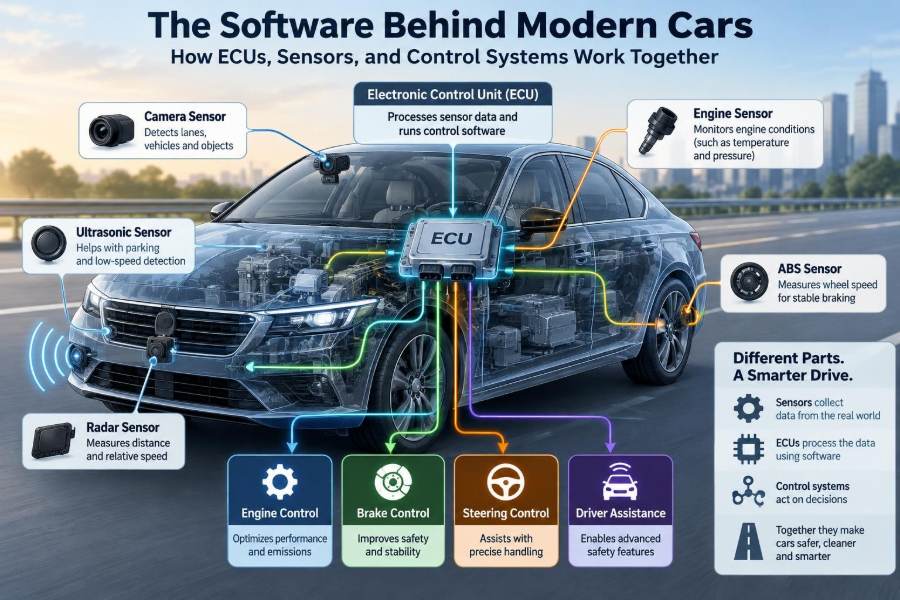

You press the start button, select drive, and pull into traffic. The engine settles into a smooth idle, the air conditioner adjusts its output, warning lights disappear from the dashboard, and the reversing camera appears as you back out. None of this is managed by one mechanical device acting alone.
Modern vehicles make hundreds of small decisions every second. They estimate wheel speed, engine load, cabin temperature, steering angle, battery condition, and the distance to obstacles. Much of that work happens silently in electronic control units, or ECUs.
For drivers, this software coordination can feel invisible until something changes: a check-engine light appears, the vehicle enters reduced-power mode, or a driver-assistance feature becomes temporarily unavailable. For engineers and technicians, understanding the chain from sensor to software to actuator is essential for designing, diagnosing, and repairing modern automobiles.
A useful way to think about the car is not as a machine with software added later, but as a physical system whose mechanical, electrical, and digital parts constantly cooperate. Here is how that cooperation works.
🧠 A Modern Vehicle Is a Distributed Computer
There is rarely one master computer that directly controls every vehicle function. Instead, a modern car contains a network of specialized ECUs. Each ECU is a rugged embedded computer designed for a particular job, such as engine management, braking, body electronics, airbag deployment, or infotainment.
This distributed arrangement keeps tasks manageable and allows critical systems to operate with appropriate speed and reliability. The engine controller does not need to render a navigation map, and the infotainment unit should not be allowed to interfere with brake-pressure control.
🔌 What an ECU Actually Contains
An ECU combines hardware and software in a sealed automotive package. Its microcontroller runs programmed instructions; memory stores calibration data and diagnostic information; input circuits interpret sensor signals; and output stages command motors, valves, relays, or warning lamps.
Unlike an office computer, an ECU must tolerate vibration, electrical noise, heat, cold, and supply-voltage changes. Its software is usually written for a narrowly defined purpose and must respond predictably within required time limits.
📥 The Basic Sense–Decide–Act Cycle
Most automotive control follows a repeating loop: sense, decide, and act. Sensors measure a condition, the ECU compares that information with its programmed strategy and calibration values, then an actuator changes something in the physical system.
Consider electronic throttle control. A pedal-position sensor reports driver demand, the engine ECU evaluates engine speed, air flow, temperature, traction-control requests, and fault status, then commands an electric throttle motor to open by a calculated amount. The resulting air flow is measured again, closing the loop.
📡 Sensors Give the Vehicle Its Inputs
A sensor converts a physical quantity into an electrical signal that an ECU can use. Common measured quantities include position, pressure, temperature, speed, acceleration, gas concentration, light level, and electrical current.
Sensors do not “understand” the world; they provide data with limited range, accuracy, and response speed. Software must account for those limits. A temperature sensor, for example, may be accurate enough for cooling control but cannot instantly represent the temperature throughout a large engine block.
🌡️ Common Sensors and Their Jobs
| Sensor | Typical measurement | Why the ECU uses it |
|---|---|---|
| Crankshaft position sensor | Engine rotational position and speed | Times fuel injection and ignition |
| Oxygen or air-fuel sensor | Oxygen content in exhaust | Helps correct air-fuel mixture |
| Wheel-speed sensor | Individual wheel rotation | Supports ABS, stability, and traction functions |
| Manifold pressure sensor | Intake pressure | Helps estimate engine air charge |
| Steering-angle sensor | Driver steering input | Supports stability control and steering assistance |
| Radar or camera | Objects, lanes, or road features | Provides inputs for driver-assistance functions |
No individual sensor is perfect. Engineers select sensor types according to the required accuracy, environmental conditions, cost, and safety consequences of an incorrect reading.
⚡ From Analogue Signal to Digital Data
Many physical sensors produce analogue voltages: continuously varying signals rather than ready-made numbers. The ECU uses an analogue-to-digital converter to sample that voltage and represent it as a digital value.
Sampling too slowly can miss rapid changes; sampling unnecessarily fast consumes processing capacity and may collect more electrical noise. Signal conditioning circuits and software filters help make the usable signal stable without hiding a genuine fast event, such as wheel deceleration during hard braking.
🧹 Why Raw Sensor Data Needs Filtering
Vehicle wiring operates near ignition systems, motors, alternators, and switching electronics, all of which can introduce electrical interference. Road vibration and sensor tolerances also create small variations that are not meaningful changes in the vehicle state.
Filtering smooths unwanted noise, but it introduces a design trade-off. Heavy filtering makes a reading calm but delayed; light filtering responds quickly but may react to noise. Brake and engine-control engineers tune filters according to how quickly a real condition must be detected.
🔍 Plausibility Checks Catch Impossible Readings
Good control software does not blindly trust one sensor. It tests whether readings are physically believable and whether related values agree. If the accelerator-pedal channels disagree beyond an allowed range, for example, the ECU can recognize a fault rather than command unintended throttle opening.
This is called a plausibility check. It may compare duplicate sensors, check whether a value changes at a realistic rate, or compare a measurement with an estimate derived from other inputs.
🧮 Control Algorithms Turn Data into Action
An algorithm is the logical method an ECU uses to transform inputs into outputs. Some automotive algorithms are straightforward lookup tables: at a given coolant temperature and engine load, use a specified fuel correction. Others continuously calculate estimates and corrections.
Calibrations are as important as the code itself. A calibration is a set of values, maps, limits, and thresholds that tailor the same basic software to a particular engine, transmission, vehicle mass, market, or emissions requirement.
🔁 Closed-Loop Control Corrects Its Own Result
In an open-loop system, the controller commands an output without checking the final result. In a closed-loop system, it measures the outcome and adjusts the command. Closed-loop operation is especially valuable when conditions vary.
Engine air-fuel control offers a familiar example. The ECU starts with an estimated fuel quantity, then uses exhaust-sensor feedback to make corrections. The correction cannot overcome every mechanical fault, but it can compensate for ordinary changes such as temperature, fuel characteristics, and component ageing.
🎛️ PID Control in Practical Terms
Many control problems use a proportional-integral-derivative, or PID, approach. The proportional part responds to present error, the integral part corrects accumulated offset, and the derivative part responds to how quickly the error is changing.
Not every ECU function uses a textbook PID controller, but the idea is widespread. A controller must be responsive without causing oscillation. A poorly tuned system can hunt around its target, much like a driver repeatedly overcorrecting the steering wheel.
🔥 Engine Management Coordinates Combustion
The engine control module uses crank position, engine speed, air measurement, temperatures, pedal demand, knock information, and exhaust feedback to control combustion. Its principal outputs include injector pulse timing, ignition timing in spark-ignition engines, throttle position, boost control where fitted, and cooling-fan operation.
The objective is not simply maximum power. The ECU balances response, fuel consumption, emissions, smoothness, component protection, and driver demand. The acceptable choice during cold start is different from the choice during steady motorway cruising.
💨 Air, Fuel, Spark, and Torque Requests
Many modern powertrains are managed around torque rather than a direct “fuel amount” request. When the driver presses the pedal, the system interprets a requested torque, then coordinates air flow, fuel delivery, ignition, transmission ratio, and sometimes electric-motor assistance to provide it.
This approach helps separate driver intent from actuator detail. It also lets stability control request reduced engine torque when wheel slip is detected, without needing to manipulate every actuator independently.
⚙️ Transmission Controllers Choose and Protect Shifts
An automatic or dual-clutch transmission controller evaluates speed, throttle demand, engine torque, gear position, fluid temperature, and sometimes road grade estimates. It commands clutches, solenoids, and hydraulic pressure to select gears and manage shift quality.
A smooth shift is a controlled transfer of torque, not merely a gear change. Excessively fast or poorly coordinated clutch application can cause harshness and wear, while overly slow application can generate heat. The controller therefore works closely with the engine ECU.
🛞 ABS Prevents Wheel Lock, Not Every Crash
The anti-lock braking system compares wheel speeds to identify a wheel approaching lock-up. It rapidly modulates brake pressure so that the tire can retain more ability to generate lateral grip while braking.
ABS is highly valuable, but it cannot create tire-road friction where little exists. On loose surfaces, stopping distance may vary compared with locked-wheel braking, and the driver must still choose an appropriate speed and following distance. The key benefit is usually preserving steerability during hard braking.
🧭 Stability Control Connects Several Systems
Electronic stability control uses information from wheel-speed sensors, steering angle, yaw rate, and lateral acceleration. It estimates whether the vehicle is responding to the driver’s steering input as expected.
If the vehicle begins to understeer or oversteer, the system may brake selected wheels and request engine-torque reduction. This is a clear example of networked control: braking, engine management, and sensor information must arrive and be interpreted quickly enough to be useful.
🛡️ Airbag Control Demands Fast, Conservative Decisions
Airbag control units monitor acceleration sensors and, depending on design, additional pressure or impact sensors. Their software must distinguish a deployment-level crash from events such as pothole strikes or minor contact.
Deployment decisions are safety-critical and time-sensitive. The system may consider impact direction, severity indicators, seat occupancy information, and restraint status. Because an airbag is a single-use device, false deployment and missed deployment are both serious outcomes that the design seeks to minimize.
💡 Body Controllers Manage Everyday Convenience
Body control modules handle functions that seem ordinary but require significant coordination: central locking, exterior and interior lighting, wipers, windows, mirrors, horn operation, and sometimes climate-control requests.
These modules often implement user-friendly logic. A short wiper-stalk movement may trigger one wipe, rain sensing may adjust intermittent timing, and lights may remain on briefly after locking. Such features are software behavior connected to relays, motors, lamps, and switches.
🔋 Battery and Energy Management Are Active Tasks
A conventional 12-volt battery is no longer just a passive energy store. The vehicle may monitor battery current, voltage, and temperature to estimate its state and manage electrical loads or alternator charging behavior.
In hybrids and electric vehicles, battery management systems take an even more central role. They monitor cell voltages and temperatures, estimate available energy, control contactors, and enforce operating limits. Exact strategies differ by vehicle, but thermal control and safe voltage limits are fundamental concerns.
🔗 Vehicle Networks Let ECUs Share Information
ECUs communicate over in-vehicle networks rather than through a separate wire for every piece of information. CAN, short for Controller Area Network, is widely used because it allows multiple modules to share messages efficiently and robustly.
Other network technologies may be used for different needs, including higher data rates or simpler local devices. A camera system, for instance, has data demands very different from a door switch. Network design considers bandwidth, latency, cost, fault behavior, and electromagnetic compatibility.
📨 Messages Have Priorities and Deadlines
On a shared network, timing matters. A wheel-speed message used by braking control may need a higher priority and more frequent update than a cabin-light status message. A message that arrives correctly but too late can still be useless for a fast control function.
Networked vehicles therefore use defined message formats, update periods, and timeout behavior. If an expected message disappears, an ECU should recognize the loss and follow a safe fallback strategy rather than continue assuming old data is valid.
🧩 Domain Controllers and Centralized Computing
Traditional architectures use many separate ECUs, but newer designs increasingly group related functions into domain controllers or more centralized vehicle computers. One controller may coordinate several body, chassis, or driver-assistance functions.
Consolidation can reduce wiring and make some software updates easier, yet it also increases the importance of partitioning. A low-priority application must not consume resources needed by a safety-relevant function. Architecture choices involve cost, development complexity, serviceability, and fault isolation.
👁️ Cameras, Radar, and Sensor Fusion
Driver-assistance systems use cameras, radar, ultrasonic sensors, and, in some vehicles, other sensing technologies. Each sees the environment differently: cameras can recognize visual patterns, radar measures range and relative speed well in many conditions, and ultrasonic sensors are useful at close parking distances.
Sensor fusion combines these inputs to form a more dependable estimate than one sensor alone might provide. It does not make perception flawless. Dirt, glare, weather, occlusion, unusual road layouts, and ambiguous objects can reduce performance, which is why drivers must understand the limits of fitted assistance systems.
🚦 Driver Assistance Is Not the Same as Vehicle Autonomy
Features such as adaptive cruise control, lane-centering assistance, automatic emergency braking, and parking aids can reduce workload in selected conditions. Their availability does not mean the vehicle can safely handle every traffic situation without human supervision.
System names can vary between manufacturers, so drivers should rely on the owner’s manual and actual operating limitations rather than the marketing label. Lane markings, camera visibility, road geometry, and sensor obstruction can all affect whether a feature operates as intended.
🚨 Warning Lights, Fault Codes, and Diagnostics
When an ECU detects an electrical, communication, or plausibility problem, it may store a diagnostic trouble code. A scan tool can retrieve codes and supporting data, sometimes including operating conditions recorded when the fault occurred.
A code is a starting point, not automatically a parts-replacement instruction. A code related to an oxygen sensor, for example, can arise from wiring faults, exhaust leaks, mixture problems, or the sensor itself. Effective diagnosis combines codes with wiring checks, live data, service information, and physical inspection.
🧰 Freeze Frames and Live Data Improve Diagnosis
Freeze-frame data captures a limited snapshot when certain faults are recorded. Engine speed, coolant temperature, load, vehicle speed, and voltage may reveal whether a problem occurs at cold start, during acceleration, or after the vehicle is fully warm.
Live data helps technicians compare what the ECU believes with what the vehicle is actually doing. A stuck thermostat, for instance, may be suggested by a coolant-temperature pattern that does not match expected warm-up behavior, but diagnosis still requires checking the complete system.
🪫 Fail-Safe and Limp-Home Strategies
When information is unreliable, a vehicle cannot always continue normal operation. ECUs may substitute a default value, disable a nonessential feature, limit engine torque, hold a transmission gear, or illuminate a warning. These are often called fail-safe or reduced-function strategies.
“Limp-home mode” is a common informal term, but its behavior differs by fault and vehicle. Reduced performance can be inconvenient; it may also be the system protecting the engine, transmission, battery, or occupants from a potentially damaging condition.
🔐 Cybersecurity Has Become an Engineering Requirement
Connected vehicles may communicate with diagnostic equipment, mobile apps, charging systems, or remote services. Each connection can offer useful functionality but also creates a path that must be protected.
Automotive cybersecurity includes secure software design, controlled access, message protection where appropriate, and processes for identifying vulnerabilities. Security work must coexist with safety and service needs: a system that is difficult to access unlawfully should still be diagnosable by authorized personnel.
🧪 Testing Happens in More Than One Place
Automotive software is tested through reviews, simulation, bench testing, hardware-in-the-loop systems, vehicle testing, and fault-injection exercises. Hardware-in-the-loop testing allows a real ECU to interact with a simulated engine, vehicle, or sensor environment before full road testing.
No single test method reveals every issue. Simulation is efficient for many repeatable scenarios, while real vehicles expose vibration, temperature changes, driver behavior, and physical interactions that models may not capture completely.
📋 Functional Safety Shapes the Design Process
Functional safety concerns hazards caused by malfunctioning electrical or electronic systems. The engineering process identifies possible hazards, assigns safety objectives, develops monitoring and fallback behavior, and verifies that the system meets its intended safety goals.
This does not mean electronics can never fail. The goal is to understand credible failure modes and reduce unreasonable risk through redundancy, diagnostics, controlled degradation, and disciplined development. The required rigor depends on what could happen if a function behaves incorrectly.
🔧 Why Modifications Can Create Unexpected Problems
Adding accessories or altering software can affect systems far beyond the visible change. An aftermarket electrical device may draw current when the vehicle is parked, introduce network communication problems, or create poor grounding. Powertrain tuning can alter temperatures, torque limits, emissions behavior, and transmission loading.
That does not mean every modification is harmful, but it should be treated as an engineering change rather than a cosmetic switch. Compatibility, installation quality, legal requirements, warranty implications, and safety effects need consideration.
🛠️ Practical Habits for Drivers and Technicians
Drivers can help electronic systems work as designed by maintaining battery health, keeping cameras and radar areas clean where applicable, responding sensibly to warning lamps, and using correct replacement parts. A weak battery can create confusing symptoms because multiple modules depend on stable voltage.
- Record when a warning occurred and what the vehicle was doing.
- Do not clear fault codes before noting them if diagnosis is needed.
- Check basic causes such as damaged connectors, corrosion, blown fuses, and low voltage.
- Use approved service information and safe procedures around high-voltage systems.
For technicians, the habit to avoid is replacing the component named in a code without validating the circuit and the system context.
🎓 Skills That Matter in Automobile Engineering
Engineers working with vehicle controls need more than programming ability. They need a working understanding of mechanics, electrical circuits, sensors, signal processing, networking, calibration, diagnostics, and human factors.
Clear communication also matters. A brake-control engineer, a software developer, a test engineer, and a service technician may view the same fault differently. Shared terminology and careful documentation connect their work across the vehicle life cycle.
🌍 Software Helps Meet Competing Vehicle Goals
Vehicle software is often where competing requirements are balanced in real time. A powertrain controller may need to deliver requested acceleration while managing emissions and protecting components. A battery controller may balance performance, charging time, cell longevity, and temperature limits.
There is no universal setting that maximizes everything. Control strategies encode priorities that change with conditions, which is why the same car can feel different when cold, fully loaded, on a steep grade, or operating with a low battery.
🏁 The Core Principle: Coordination Creates Capability
ECUs, sensors, networks, and actuators are valuable because they form feedback systems. Sensors describe conditions, ECUs interpret those conditions using software and calibrations, networks share relevant information, and actuators produce controlled physical change.
The most capable vehicles are not those with the most electronics in isolation. They are those whose components exchange reliable information, respond within the required time, detect faults intelligently, and remain understandable enough to test and repair.
Modern automotive performance, efficiency, safety, and convenience all depend on one central idea: software must work in continuous partnership with the mechanical vehicle. Understanding that partnership makes the technology behind an ordinary drive far less mysterious. 🚗⚙️🔍