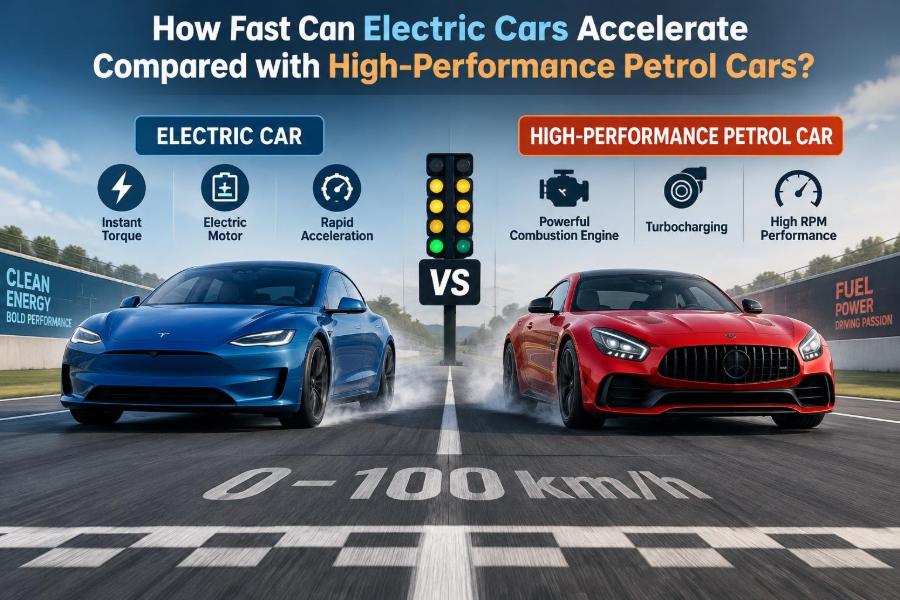

You are waiting at a junction when the lights turn green. The car beside you is silent, heavy, and apparently ordinary—until it moves ahead with a sudden, uninterrupted shove. For many drivers, that first encounter with a quick electric vehicle changes their idea of what “fast” feels like.
High-performance petrol cars still carry enormous appeal. Their engines build revs, gears snap through ratios, and exhaust sound provides a dramatic sense of effort. Yet electric cars have made astonishing straight-line acceleration available in family saloons, SUVs, and even some compact cars.
The comparison matters for more than bragging rights. Acceleration affects overtaking, joining fast traffic, tyre wear, energy use, vehicle design, and the way a driver judges speed. It also reveals fundamental differences between an electric motor and an internal-combustion engine.
So, can an electric car really out-accelerate a high-performance petrol car? Often it can over the first few metres. But the full answer depends on speed range, traction, power delivery, battery condition, gearing, heat, and what “fast” is actually being measured.
⚡ Acceleration Is More Than a 0–60 Time
Acceleration is the rate at which velocity changes. In road-car discussion, it is commonly reduced to a 0–60 mph or 0–100 km/h time, but that single number describes only one controlled test.
A vehicle can be exceptionally quick from rest and less dominant at motorway speeds. Useful comparisons also include 30–70 mph, 50–100 km/h, quarter-mile time and terminal speed, and repeated acceleration after the car has warmed up.
The question is always: fast from where, to where, and under what conditions? That framing prevents a launch-focused figure from being mistaken for total performance.
🧲 Why Electric Motors Deliver Immediate Torque
Torque is the twisting force that turns a wheel. An electric motor can produce very high torque from zero or very low rotational speed because its electromagnetic field is controlled directly by the inverter—the power electronics that convert battery DC into motor AC.
A petrol engine needs air, fuel, compression, combustion, and crankshaft rotation to create useful torque. It cannot deliver its best output at zero rpm, and it usually needs a clutch or torque converter to avoid stalling when the vehicle stops.
This does not mean every electric car has unlimited low-speed force. The battery, inverter, motor, tyre grip, and control software all set limits. But the motor’s basic torque characteristic gives EVs a major launch advantage.
🔥 How Petrol Engines Build Their Power
A petrol engine normally produces torque across a band of engine speeds, not all at once. Its power rises as torque and rpm combine, then eventually falls as breathing, friction, combustion timing, and mechanical limits take effect.
Turbocharged engines can give strong mid-range torque, but a turbocharger may take a short time to reach its most effective speed after the driver opens the throttle. Modern systems reduce this delay substantially, yet response still differs from an electric motor’s near-instant control.
Naturally aspirated performance engines often feel especially linear, but they tend to require revs before delivering their strongest acceleration. That is part of their character—and part of why an EV can feel startlingly urgent at low speed.
⚙️ The Role of Gears in Petrol-Car Acceleration
Gears multiply engine torque. A low first gear lets a petrol engine create large wheel torque even when the engine itself produces modest torque, which is why a powerful petrol car can launch extremely hard.
However, the engine must stay within an effective rpm range. During acceleration, the transmission shifts between ratios to keep the engine near its power peak. Even very fast dual-clutch and automatic gearboxes introduce changes in driveline load and, in many cases, small interruptions in thrust.
Gear ratios are therefore not merely a complication. They are a solution to the petrol engine’s narrower useful speed range.
🔁 Why Most EVs Need Only One Main Gear
Most road-going EVs use a single-speed reduction gear. The motor can operate over a much wider rpm range than a petrol engine, so one fixed ratio can cover urban driving, motorway cruising, and brisk acceleration.
Removing routine gear changes creates a distinctive sensation: the car simply keeps pulling. There is no need to wait for an upshift or for the engine to climb back into its power band.
A few electric performance vehicles use more than one ratio, usually to balance rapid launch performance with stronger high-speed acceleration or efficiency. Their existence shows that gearing can still help an EV when engineers are pursuing an extreme operating range.
🏁 Wheel Torque Is What Moves the Car
Drivers often compare headline torque figures, but motor or engine torque alone can mislead. What accelerates the vehicle is the torque available at the driven wheels, after gear reduction and driveline losses.
A modest-torque engine in a very low gear can apply greater wheel torque than a motor with a larger published torque figure in a taller overall ratio. Conversely, a powerful EV’s fixed reduction can provide enormous wheel torque immediately.
Engineers also consider tyre radius. For the same wheel torque, a smaller effective rolling radius produces greater force at the road contact patch. This is one reason raw torque numbers are poor stand-alone indicators of real acceleration.
🛞 Traction Sets the Launch Limit
At low speed, the main question is often not “How much torque can the powertrain make?” but “How much force can the tyres transmit?” If the demanded wheel force exceeds available grip, the tyres spin rather than accelerating the car efficiently.
Tyre compound, road surface, temperature, tyre load, and water all matter. A powerful rear-wheel-drive petrol car may struggle for traction on a cold road, while an all-wheel-drive EV can distribute torque across both axles with remarkable precision.
Traction control reduces wheelspin by cutting or redistributing torque. In an EV, this can happen exceptionally quickly because motor torque is electronically adjustable without waiting for combustion events or throttle airflow to change.
🧭 All-Wheel Drive Changes the Contest
Many fast EVs use one motor per axle, creating electric all-wheel drive. The control system can send positive drive torque to the axle with more available grip and can react rapidly when a wheel begins to slip.
High-performance petrol cars may also use sophisticated all-wheel-drive systems, active differentials, launch control, and torque-vectoring hardware. They can be extremely effective, especially on prepared surfaces.
The distinction is not that one layout always wins. Rather, multiple electric motors make precise axle-by-axle torque control comparatively straightforward, while a mechanical or hybrid petrol drivetrain may need clutches, shafts, differentials, and transmission decisions to achieve a similar result.
📏 Vehicle Mass Works Against Every Car
Acceleration requires force to move mass. In simplified form, Newton’s second law states that force equals mass multiplied by acceleration. For a given tractive force, a heavier vehicle accelerates less strongly.
Battery packs are heavy, so EVs often weigh more than comparable petrol cars. Their batteries are commonly mounted low in the floor, which benefits centre of gravity and handling balance, but low placement does not remove the mass penalty.
A light petrol sports car can therefore feel agile and responsive even if a heavier EV posts a better standing-start time. Mass also increases demands on tyres, brakes, suspension components, and energy consumption during repeated speed changes.
⚖️ Power-to-Weight Ratio Matters at Higher Speed
As speed rises, power becomes increasingly important. Power describes the rate at which work is done, and a vehicle with a strong power-to-weight ratio generally has better potential for sustained acceleration.
Near standstill, traction and wheel torque dominate. At higher speeds, gearing, motor or engine power, aerodynamic drag, and available electrical or fuel energy shape the result more strongly.
This is why a heavy, powerful EV can launch ahead of a lighter petrol performance car yet face a closer contest later. It is also why two cars with similar peak power can perform differently if their masses, gearing, and aerodynamic profiles differ.
🌬️ Aerodynamic Drag Grows Rapidly
Air resistance rises approximately with the square of speed, while the power needed to overcome it rises roughly with the cube of speed. In practical terms, pushing through air at very high speed demands dramatically more power than cruising at moderate speed.
EVs often have smooth underbodies, enclosed grilles, and carefully shaped wheels to reduce drag. Petrol performance cars may use larger cooling openings, spoilers, and wings that increase drag but improve engine cooling or high-speed downforce.
Downforce improves tyre loading and stability, but it costs energy. A car designed for track cornering may therefore be less efficient in a top-speed run than a body shape optimised primarily for low drag.
🚦 Why EVs Feel So Quick in Everyday Traffic
Most daily driving happens below high motorway speeds. Pulling away from lights, entering a roundabout gap, or passing a slower vehicle on a country road usually begins in the range where immediate motor torque is most noticeable.
An EV driver also does not need to select a lower gear or wait for a transmission kickdown. Pressing the accelerator requests torque almost immediately, which makes the response feel direct and effortless.
That sensation can exceed what a stopwatch alone suggests. A quick petrol car may be objectively rapid, but an EV’s uninterrupted surge and quiet cabin can make speed arrive with less mechanical warning.
🛣️ Rolling Acceleration Tells a Different Story
A rolling test, such as 50–70 mph, measures how a car accelerates while already moving. It is particularly useful for overtaking because it reduces the advantage of perfect launch traction.
An EV with ample available power can still respond strongly because it is already in its effective ratio. A petrol car can be just as competitive if its gearbox downshifts promptly and places the engine close to peak power.
Manual petrol cars introduce an additional human factor: the driver may need to choose the correct gear before overtaking. In a fast automatic or dual-clutch car, software can make that decision quickly, though not always exactly as the driver expects.
⏱️ Launch Control Is a Special Condition
Published acceleration figures are frequently obtained using launch-control modes, prepared tyres, favourable surface conditions, and procedures that are difficult to reproduce casually on public roads. They reveal capability, but not necessarily ordinary behaviour.
Petrol launch control may hold engine rpm, manage clutch engagement, regulate turbo boost, and limit wheelspin. EV launch modes may precondition the battery, set motor temperatures, coordinate both axles, and permit a carefully managed torque release.
Repeated hard launches can also trigger protective limits. The best launch may be available only when tyre grip, battery temperature, motor temperature, and state of charge are within a preferred window.
🔋 Battery State of Charge Can Affect EV Performance
An EV battery does not deliver exactly the same voltage under every condition. At a high state of charge, it can generally support stronger power delivery than when it is nearly empty, although the precise behaviour varies by vehicle and battery design.
As charge falls, the battery-management system may reduce peak power to protect cells and maintain a safe operating voltage. Drivers may see this as reduced performance bars, a power limit message, or simply less urgent response.
This is not a defect; it is part of battery protection. Anyone comparing acceleration should record battery state of charge rather than assuming a single run represents every journey.
❄️ Temperature Affects Batteries, Tyres, and Engines
Cold batteries have higher internal resistance and may accept or deliver power less readily. A cold EV may therefore limit strong acceleration until the pack warms, particularly in winter.
Cold tyres also provide less grip, weakening launches for both electric and petrol cars. On a wet, cold road, traction may matter far more than a vehicle’s brochure power rating.
Petrol engines also need appropriate oil, coolant, intake-air, and transmission temperatures for optimum output and durability. Modern control systems protect both types of vehicle, but performance testing should never ignore thermal condition.
🌡️ Heat Soak Limits Repeated Full-Throttle Runs
One impressive acceleration run does not guarantee identical results ten times in a row. Motors, inverters, batteries, engines, transmissions, intercoolers, brakes, and tyres all generate heat under hard use.
When components approach protective limits, the vehicle may reduce power. In EV discussions this is often called derating. Petrol cars can also reduce boost, retard ignition timing, or alter transmission behaviour when temperatures climb.
Cooling capacity is especially relevant on track days, long mountain climbs, and repeated drag-strip runs. A vehicle’s repeatable performance is often more useful than its single best result.
🔌 Regenerative Braking Is Not Acceleration—But It Changes the Experience
Regenerative braking uses the electric motor as a generator during deceleration, recovering some kinetic energy to the battery. It does not make a car accelerate faster, but it changes how drivers manage speed between acceleration events.
Strong regenerative braking can allow one-pedal driving, where lifting off the accelerator slows the car noticeably. This can make urban driving smoother and reduce use of friction brakes in suitable conditions.
Regeneration is limited by battery temperature, battery charge level, tyre grip, and motor capability. A nearly full or very cold battery may accept less recovered energy, so the car may provide weaker regenerative braking than usual.
🏎️ Comparing Typical Performance Categories
There is broad overlap between modern EVs and petrol cars. A modest electric hatchback is not automatically quicker than a dedicated petrol sports car, and a high-performance EV is not representative of every electric model.
| Vehicle category | Likely acceleration character | What usually limits it |
|---|---|---|
| Everyday EV | Immediate, smooth low-speed response | Motor power, battery output, front- or rear-axle traction |
| Performance EV | Very strong launch and rapid rolling response | Tyre grip, battery temperature, heat during repeated runs |
| Hot petrol hatch or saloon | Strong mid-range with gearbox involvement | Front- or rear-wheel traction, gear selection, turbo response |
| Petrol sports car | Often lighter and engaging across a broad speed range | Traction, gear changes, available engine power at current rpm |
| Exotic petrol performance car | Potentially exceptional high-speed and track performance | Aerodynamics, cooling, gearing, tyre temperature |
The table describes tendencies rather than guarantees. Specific models, tyres, road surfaces, and software settings can reverse expectations.
🎯 What Quarter-Mile Results Reveal
A quarter-mile test combines launch, traction, sustained acceleration, shifting, and high-speed power delivery. The elapsed time shows how quickly the distance is covered, while terminal speed gives a useful clue about power available near the end.
Two cars can record similar elapsed times for different reasons. An EV may gain heavily in the first half through traction and immediate torque, while a petrol car may build speed aggressively later as its engine reaches peak power.
Terminal speed should not be viewed in isolation, but it helps distinguish a hard-launching car from one that continues to accelerate strongly after the initial launch advantage fades.
🎵 Sound and Gear Changes Alter Perceived Speed
Petrol performance is communicated through vibration, rising engine note, induction noise, exhaust pulses, and gear changes. These cues make the driver aware of speed building and can create a sense of drama that many enthusiasts value.
An EV removes much of that soundtrack. Its quietness can make rapid acceleration feel surreal, but it can also reduce the sensory warning that helps a driver estimate how quickly speed is increasing.
Neither experience is objectively superior. One is mechanical and theatrical; the other is smooth, immediate, and often unexpectedly intense. Engineering performance and emotional preference do not always point to the same car.
🧠 Software Has Become Part of the Powertrain
In modern EVs, software controls inverter current, motor torque, traction intervention, thermal conditioning, pedal mapping, and the coordination of front and rear motors. The accelerator pedal is largely a torque request, interpreted within safety and component limits.
Petrol performance cars also depend heavily on software. Engine-management systems control fuel injection, ignition timing, boost pressure, throttle opening, transmission shifts, differential behaviour, and stability control.
Software can make a fast vehicle easier to use, but it cannot repeal physics. It cannot create grip on ice, eliminate heat, or make a battery deliver more energy than its safe limits allow.
🛑 Braking Capability Completes Real Performance
A car that accelerates rapidly must also brake repeatedly and predictably. Battery mass can increase kinetic energy at a given speed because kinetic energy rises with mass, so a heavy EV places serious demands on tyres and braking systems.
Regeneration can recover some energy, but friction brakes remain essential for emergency stops, high-speed braking, and situations where regenerative capacity is limited. Brake cooling and pedal consistency matter on road descents and circuits.
For everyday safety, a short, stable stop on the available road surface matters more than a dramatic acceleration figure. Performance should always be considered as a complete system.
🧰 Tyres Are the Unsung Performance Component
Tyres transmit acceleration, braking, and cornering loads through contact patches that are each only about the size of a hand. Their design strongly affects how effectively either type of powertrain reaches the road.
High-grip tyres may improve dry launches and handling, but they can wear quickly, cost more, create more road noise, and perform less well in cold or wet conditions. Some EV-specific tyres prioritise load capacity, efficiency, and low noise, with compromises in ultimate grip depending on the model.
Correct pressures, adequate tread, and suitable seasonal tyres can make more practical difference than a small increase in peak power.
💸 Fast Acceleration Has Operating Costs
Repeated full-throttle use consumes energy quickly in an EV and fuel quickly in a petrol car. The harder the car must accelerate, the more energy it needs to add to its kinetic energy, plus losses in tyres, drivetrain, and air resistance.
Hard launches can also accelerate tyre wear. A heavy, high-torque vehicle can be especially demanding on rear tyres or all four tyres, depending on its drivetrain and torque distribution.
Drivers considering a fast EV should look beyond the headline sprint time. Charging access, real-world range in their climate, tyre replacement cost, insurance, and the vehicle’s practical mass all shape ownership.
🚧 Public-Road Acceleration Needs Restraint
Rapid acceleration can close gaps far faster than other road users expect. A car may reach an unsafe speed before the driver has fully assessed a junction, bend, pedestrian crossing, or changing traffic situation.
Quiet EVs deserve particular care around cyclists and pedestrians, especially at low speed. The absence of engine noise does not make the vehicle less capable of causing harm.
Use strong acceleration where it is legal, visible, and appropriate—not as a response to another driver, a passenger’s request, or a momentary impulse. Track facilities and controlled events are the proper places to explore a vehicle’s limits.
🔍 Common Mistakes When Comparing EVs and Petrol Cars
Several shortcuts produce misleading conclusions. The most common is comparing peak torque figures without considering gearing, wheel torque, and traction.
- Assuming every EV delivers maximum output at every battery charge and temperature.
- Using one 0–60 result to predict high-speed overtaking performance.
- Ignoring vehicle mass because the EV feels quick from a traffic light.
- Comparing results measured on different surfaces, tyres, weather conditions, or test procedures.
- Treating electronic traction control as a substitute for suitable tyres and safe driving.
A fair comparison uses several measures and acknowledges the test conditions behind them.
🧪 How to Make a Fair Performance Comparison
Start by identifying the driving situation. For city use, low-speed response and 30–50 mph acceleration may matter most. For long-distance travel, rolling acceleration, energy use, high-speed stability, and repeated performance become more relevant.
- Compare similar vehicle categories, mass, and drivetrain layouts where possible.
- Check 0–60 mph or 0–100 km/h, then add rolling and quarter-mile results.
- Note tyre type, road conditions, battery charge, fuel level, and ambient temperature.
- Look for evidence of repeated runs, not only a manufacturer’s best-case figure.
- Consider braking, handling, range or fuel use, and ownership needs alongside acceleration.
This approach turns a headline contest into an engineering comparison.
🔮 Where the Technology Is Heading
Battery chemistry, cooling systems, power electronics, motor design, and control software continue to develop. Improvements that reduce heat generation or improve thermal management can help EVs sustain high output more consistently, not simply improve a single sprint.
Petrol performance is evolving too. Turbocharging, hybrid assistance, electrically driven auxiliaries, advanced transmissions, and lightweight materials allow combustion-powered cars to respond more quickly and use energy more effectively than older designs.
The future is unlikely to be defined by one universal winner. Different powertrains will remain better suited to different priorities: silent response, low mass, long-distance refuelling, track consistency, mechanical character, or packaging flexibility.
✅ The Core Principle: Match the Test to the Task
Electric cars are often extraordinarily fast because electric motors provide immediate torque, single-speed drivetrains avoid routine shift delays, and all-wheel-drive torque control can make excellent use of available grip. These strengths are most obvious in standing starts and everyday low- to medium-speed acceleration.
High-performance petrol cars remain formidable because gearing multiplies wheel torque, engines can sustain strong power at speed, and lighter sports-car designs can bring advantages in agility, thermal endurance, and driver involvement. Their performance is not made obsolete by an EV’s instant response.
The meaningful comparison is not electric versus petrol in the abstract; it is how a specific vehicle delivers safe, repeatable performance in the speed range and conditions that actually matter to its driver.
For students of automobile engineering, the lesson is clear: acceleration is a system outcome, shaped by energy source, powertrain, mass, gearing, software, tyres, aerodynamics, and temperature. A silent surge and a high-revving engine can both be impressive—provided we understand what makes each one fast. 🚗⚡🏁