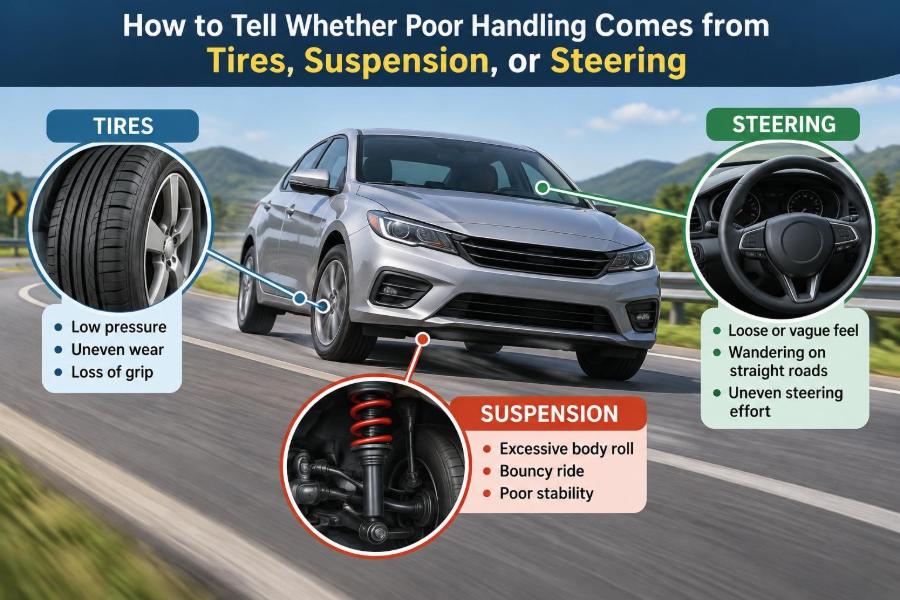

A car can feel perfectly ordinary on the commute, then become unsettling on one fast bend, one wet roundabout, or one emergency lane change. The steering may feel vague, the body may move too much, or the vehicle may pull toward a curb. Most drivers describe all of these sensations as “poor handling,” but they do not begin in the same place.
Tires, suspension, and steering work as a system. Tires create the contact with the road; suspension keeps those contact patches loaded and stable; steering gives the driver a controlled way to aim the front wheels. A fault in one area can imitate a fault in another, so replacing parts based on a single symptom is often wasteful.
Correct diagnosis matters for comfort, tire life, fuel use, and, most of all, predictable control. A vehicle that merely feels different is not automatically dangerous, but sudden changes in direction, braking stability, or steering effort deserve prompt attention.
The goal is not to turn every driver into a chassis engineer. It is to observe the vehicle methodically, separate likely causes, and know when a professional inspection is the sensible next step.
🧭 Start with What “Handling” Actually Means
Handling is the way a vehicle responds to steering, braking, acceleration, bumps, and changes in road surface. It includes straight-line stability, cornering balance, steering precision, body control, and how consistently the car behaves from one maneuver to the next.
A useful distinction is between grip and response. Grip is the tire’s ability to transmit braking, cornering, and driving forces. Response is how quickly and accurately the vehicle reacts when the driver asks for a change of direction.
🔗 See the System Before Blaming One Part
Think of the chassis as a chain. The steering wheel moves through the steering gear and linkages, the suspension positions the wheels, and the tires transmit force through four small contact patches. A loose tie-rod end, worn bushing, weak damper, or damaged tire can each create a similar “wandering” complaint.
Diagnosis therefore starts with patterns: when the symptom occurs, whether it is felt through the steering wheel or the seat, and whether weather, speed, load, or braking changes it.
⚠️ Separate Safety Symptoms from Minor Annoyances
Do not use road tests to investigate a vehicle that has a severe pull, a rapidly deflating tire, visible tire damage, major steering free play, metal-on-metal noises, or a warning light related to steering or stability control. These conditions need inspection before normal driving.
Likewise, a vibration that suddenly appears after striking a pothole can indicate wheel, tire, or suspension damage. Drive gently only as needed to reach a safe inspection location.
📝 Build a Symptom Diary
Before checking components, record the conditions. “It feels loose” is hard to diagnose; “it wanders above highway speed after fitting new rear tires” is much more useful.
- Does it occur while cruising, braking, turning, or accelerating?
- Is it worse on wet roads, grooved pavement, or rough surfaces?
- Does the steering wheel shake, or does the vibration come through the floor and seat?
- Did it begin gradually, after tire work, or after an impact?
- Does passenger or cargo load change the behavior?
🛞 Inspect Tire Pressure First
Pressure is the quickest variable to check and one of the most influential. Underinflation lets the sidewall flex more, which can make steering feel delayed and can heat the tire. Overinflation can make the ride sharper and reduce the tire’s ability to conform to uneven pavement.
Use the vehicle manufacturer’s recommended cold pressures, usually shown on the driver-door placard, rather than the maximum pressure molded into the tire sidewall. Measure when the tires have not been driven enough to warm substantially.
📏 Check Whether the Tires Actually Match
Different tires on the same axle can have different tread patterns, construction, grip characteristics, and rolling circumference. Even when sizes look similar, mixing a new tire with a heavily worn one may affect how that axle responds, particularly in rain.
On vehicles with all-wheel drive, mismatched circumference can also place unwanted stress on drivetrain components. Follow the vehicle maker’s guidance for tire matching and replacement; the acceptable difference varies by design.
🔍 Read Tread Wear Like a Diagnostic Record
Tread wear does not name the failed part by itself, but it supplies valuable clues. Check several points across each tire and compare left to right.
| Wear pattern | Common possibilities | What to verify |
|---|---|---|
| Both shoulders worn | Low pressure, hard cornering, unsuitable use | Pressure history and tread depth |
| Center worn | High pressure or prior overinflation | Cold pressure and overall pattern |
| One edge worn | Alignment geometry or worn suspension parts | Alignment after mechanical inspection |
| Cupped or scalloped patches | Damper weakness, imbalance, looseness, or tire issue | Wheel balance, dampers, joints, bearings |
Wear develops over time, so it may reflect an older problem that has already been corrected. Treat it as evidence, not a verdict.
🧱 Look for Tire Damage and Ageing
Bulges, cuts, exposed cords, deep cracks, embedded objects, and irregular raised areas require professional assessment. A bulge can indicate internal structural damage and should not be dismissed as a cosmetic defect.
Also inspect for hardened, cracked rubber on tires that have spent long periods parked or exposed to heat and sunlight. Tread depth alone does not guarantee that an aged tire will provide predictable wet grip.
🧲 Recognize Tire Pull and Radial Pull
A vehicle that drifts may not always have incorrect alignment. A tire can generate a small sideways force because of its internal construction or wear pattern, often called conicity or radial pull. This may cause a pull on a level road even when alignment readings appear reasonable.
A technician can sometimes confirm the suspicion by swapping tires side to side where the tire design and installation rules allow. If the pull changes direction, the tire becomes a strong suspect. This is not a universal DIY procedure: directional and asymmetric tires have fitment constraints.
🌧️ Notice What Changes in the Wet
When the vehicle feels acceptable in dry weather but nervous in rain, begin with tire condition, tread depth, pressure, and tire type. Water must be evacuated from the contact patch; worn or poorly suited tires lose their ability to do this before the driver necessarily notices a problem in dry conditions.
Suspension faults can worsen wet-road control, but a wet-only change in behavior often makes the tire-road interface the first place to investigate.
〰️ Understand Tramlining on Grooved Roads
Tramlining is the tendency to follow grooves, ruts, or repaired seams in the pavement. Wide tires, stiff sidewalls, aggressive tread patterns, and certain alignment settings can make it more noticeable. It is not automatically proof of a broken component.
However, a large recent increase in tramlining can point to pressure errors, uneven tire wear, altered alignment, or play in steering and suspension joints. Compare the sensation on smooth pavement before reaching conclusions.
🎡 Identify Wheel Balance and Runout Clues
A steering-wheel shake concentrated within a particular speed range often suggests front wheel or tire imbalance. A vibration felt more strongly through the seat or floor can point toward the rear, though vibration paths are not always that simple.
Bent wheels, tire runout, and internal tire defects can mimic a simple balance problem. If repeated balancing does not cure it, the shop should measure wheel and tire runout rather than repeatedly adding weights.
🧰 Know What the Suspension Is Meant to Do
The suspension supports the vehicle, allows wheel movement over bumps, controls body motion, and keeps tire contact as consistent as practical. Springs carry load; dampers, commonly called shock absorbers, control the speed of movement; links and bushings locate the wheel.
Suspension does not create grip from nothing. It helps the tire use available grip by preventing excessive bouncing, uncontrolled weight transfer, and unwanted changes in wheel alignment.
💧 Spot Worn Dampers Without Guesswork
Worn dampers may allow extra body bounce after a dip, repeated wheel hop over rough pavement, or a floaty feeling after crests. In braking, the front may dive more than expected; on uneven corners, the car may take an extra moment to settle.
The old “bounce test” can reveal a severely weak damper, but it cannot reliably assess every modern suspension design. A visual leak inspection and professional test or road assessment provide better evidence.
🪀 Distinguish Springs from Dampers
A broken or sagging spring usually changes ride height, load capacity, or corner-to-corner stance. A damper problem more often changes motion control. Confusing these parts leads to incorrect repairs because they perform different jobs.
For example, a car that sits visibly low at one corner needs spring, mount, or structural investigation. A car at normal height that continues oscillating after a bump more strongly suggests inadequate damping.
🔩 Listen for Bushings, Ball Joints, and Links
Rubber bushings isolate vibration while allowing controlled movement. As they crack, separate, or soften, the wheel can shift under braking or cornering. Ball joints and link joints provide pivoting motion; wear can create clunks, imprecision, and unsafe play.
A dull knock over small bumps may come from a stabilizer-bar link or bushing, while a clunk combined with directional instability warrants a broader inspection. Noise location can travel through the body, so hearing it on the left does not conclusively identify a left-side part.
📐 Understand Why Alignment Is a Result, Not Just a Service
Wheel alignment describes geometric angles that affect straight-line stability, tire wear, steering effort, and cornering behavior. The main terms are toe, camber, and caster. Alignment machines measure these accurately, but their readings do not repair worn or bent components.
If a control arm bushing or tie-rod end is loose, an alignment set while the vehicle is stationary may change as soon as load is applied. Mechanical condition should be checked before a final alignment.
↔️ Use Toe, Camber, and Caster as Clues
Toe is whether wheels point slightly inward or outward when viewed from above. Incorrect toe can quickly wear tires and make the car feel unstable. Camber is wheel tilt viewed from the front; excessive negative or positive camber often concentrates wear on one tread edge.
Caster is the steering-axis angle viewed from the side. It helps steering self-center and contributes to stability. A side-to-side caster difference can contribute to pulling, but road crown and tire forces must also be ruled out.
🛑 Pay Attention to Braking Behavior
A pull that appears only when braking is not automatically an alignment issue. Possible causes include a sticking brake caliper, uneven brake force, loose suspension parts that shift under load, or tire-related grip differences.
Because brake faults can overheat components and affect stopping control, a braking pull deserves timely professional inspection. Avoid testing it with hard stops on public roads.
🧭 Learn the Steering System’s Job
The steering system converts the driver’s wheel input into a precise change in road-wheel angle. Depending on the vehicle, it may use hydraulic or electric power assistance. Assistance reduces effort; it does not replace the mechanical connection, joints, rack, or column components that establish accuracy.
A steering complaint is more likely when the dominant symptom is free play, inconsistent assistance, poor self-centering, binding, or a sensation that the steering wheel and front wheels are not immediately connected.
🎯 Measure Steering Free Play Carefully
A small amount of apparent movement can come from tire sidewall deflection and power-steering system behavior. Excessive free play is different: the steering wheel moves noticeably before the vehicle begins to respond, particularly on a smooth, level road.
Possible sources include inner or outer tie-rod wear, steering rack wear, column joints, or other linkage faults. Do not place hands near moving steering or suspension components during an informal inspection; a workshop lift and proper procedures are safer.
⚡ Notice Changes in Steering Assistance
Heavy steering at all times can arise from low tire pressure, mechanical binding, or a power-assistance fault. Intermittent heaviness in an electric power steering system may be linked to electrical supply, sensors, temperature protection, or the assist unit itself.
Hydraulic systems add other possibilities, such as fluid condition, leaks, pump performance, and belt drive where applicable. These faults require diagnosis rather than assuming the steering rack is at fault.
🔄 Separate Poor Self-Centering from a Pull
After a normal turn, the steering should generally return toward center as the vehicle moves forward, though it need not snap back with force. Reluctance to self-center can result from caster settings, seized or tight suspension pivots, steering friction, or modified geometry.
A pull is a directional force that requires ongoing correction. The two can appear together, but treating them as the same symptom can obscure the cause.
🪨 Consider Impact Damage After a Pothole
A pothole, curb strike, or road debris impact can damage a tire, bend a wheel, alter alignment, or deform a suspension or steering component. The symptom may be immediate, but subtle changes can appear later as uneven tire wear develops.
After a meaningful impact, inspect tire sidewalls and wheels promptly. If the steering wheel is no longer centered, the vehicle pulls, or a new vibration begins, request a full wheel, tire, suspension, and alignment assessment.
🧳 Include Load and Vehicle Modifications
Heavy cargo, towing, and extra passengers alter ride height and weight distribution. A vehicle near its load limit may feel less composed because the suspension has less available travel. Correct tire pressures for loaded operation may differ from normal-use values, so consult the vehicle documentation.
Lowering springs, lift kits, larger wheels, and altered offsets can change alignment range, bump steer, scrub radius, and damper travel. A modification may be intentional, but its effects should be evaluated as a system rather than blamed on one new part.
🧪 Use a Safe Diagnostic Sequence
A practical sequence prevents expensive guesswork. Begin with observations that are easy to verify, then move toward measurements and professional testing.
- Check tire pressures, visible damage, size matching, and tread condition.
- Note whether the problem changes with speed, braking, weather, load, or road surface.
- Inspect for obvious fluid leaks, broken springs, abnormal ride height, and loose-looking components without going underneath an unsupported vehicle.
- Have wheel balance, tire condition, steering and suspension play, and brake operation assessed.
- Perform alignment only after worn or damaged mechanical parts have been addressed.
- Road-test after each meaningful repair so the effect is clear.
🧑🔧 Give the Technician Useful Information
A good repair order describes behavior, not a requested part. Say, for example, “the steering wheel vibrates between certain cruising speeds,” or “the car drifts right on level roads and the pull becomes stronger while braking.” Mention recent tire fitting, repairs, impacts, and modifications.
Ask what was found, what measurement supports the diagnosis, and whether a worn part caused secondary tire damage. This encourages a traceable repair plan rather than a sequence of speculative replacements.
🚫 Avoid Common Diagnosis Mistakes
Replacing shocks because the car feels vague, ordering an alignment because the steering wheel is off-center, or blaming all vibration on wheel balance can miss the actual fault. Parts can be worn simultaneously, but every repair should have a reason.
- Do not judge pull on a heavily crowned road alone.
- Do not ignore tire pressures after seasonal temperature changes.
- Do not align a vehicle with known looseness in joints or bushings.
- Do not assume a new tire is free of defects or mounting errors.
- Do not continue driving on a tire with a sidewall bulge or exposed cords.
🛠️ Match the Repair to the Cause
Tire problems call for correct inflation, repair or replacement where appropriate, balancing, and sometimes matching tires across an axle. Suspension problems may require dampers, springs, bushings, joints, mounts, or damaged arms. Steering faults may involve tie rods, rack components, column joints, or the assistance system.
Many repairs affect alignment, especially replacement of steering or suspension parts. A final alignment is often appropriate, but only after the vehicle is mechanically sound and tires are in usable condition.
📚 A Quick Symptom-to-System Reference
These are starting points, not definitive diagnoses. Several systems can contribute to one symptom, and inspection remains necessary.
| Primary observation | First area to check | Other plausible contributors |
|---|---|---|
| Vague response and low pressures | Tires | Loose steering, worn bushings |
| Repeated bounce after a dip | Dampers | Springs, load, tire condition |
| Steering-wheel shake at a speed range | Front wheel/tire balance | Runout, bent wheel, tire defect |
| Clunk plus wandering | Suspension or steering joints | Alignment, damaged tire |
| Heavy or inconsistent steering assist | Steering assistance system | Low tire pressure, binding pivots |
✅ The Core Principle: Diagnose the Pattern
The most reliable way to separate tires, suspension, and steering is to identify the pattern. Tire faults often change grip, vibration, pull, or behavior with surface and weather. Suspension faults often reveal themselves through uncontrolled body or wheel movement, noises, ride-height changes, and shifting geometry. Steering faults more directly affect effort, free play, precision, and self-centering.
There is overlap because every component influences the same contact patches. That is why the best process moves from basic tire checks to mechanical inspection, measured alignment, and targeted repair rather than guessing from one sensation.
When a vehicle no longer behaves predictably, start with the tires, inspect the supporting hardware, and treat the steering response as evidence—not just a feeling. Careful observation makes repairs more accurate and every drive more confidence-inspiring. 🚗🛞🔧