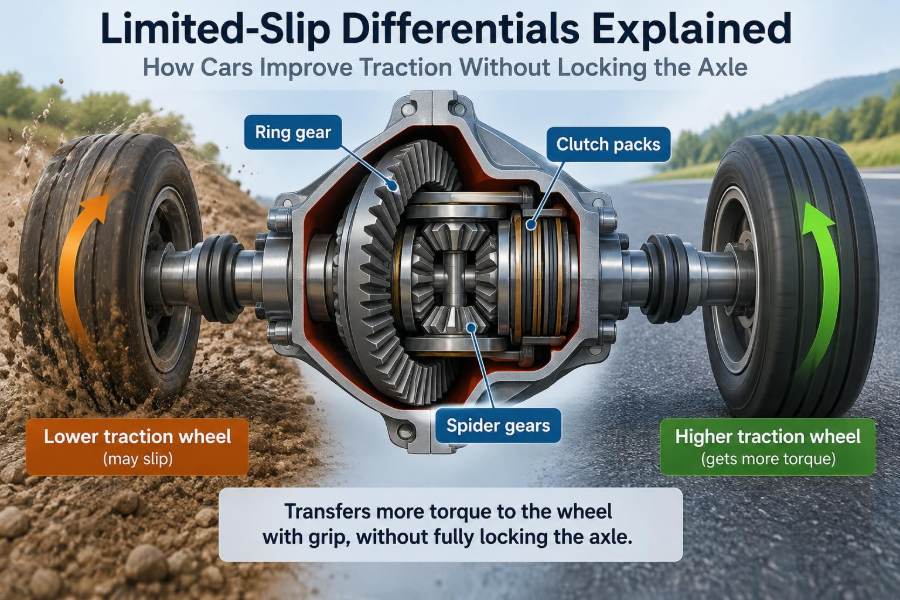

You pull away from a wet junction and one driven wheel briefly spins. Or perhaps a car exits a tight bend, applies power, and seems to push itself forward rather than wasting energy in a flare of wheelspin. The difference often comes down to a component hidden inside the axle housing: the differential.
Most road cars use an open differential because it makes cornering smooth and mechanically simple. Its weakness appears when the left and right tyres have very different amounts of grip. One tyre can spin easily while the tyre with grip receives surprisingly little useful drive torque.
A limited-slip differential, usually shortened to LSD, addresses that weakness without permanently forcing both axle shafts to rotate together. It is a traction device, but it is also a carefully managed compromise between grip, predictability, tyre wear, noise, cost, and steering behaviour.
Understanding how an LSD works helps explain why some cars feel more confident on a wet road, why performance cars can accelerate earlier out of corners, and why no differential can create grip that the tyres and road surface do not provide.
⚙️ The Differential’s Basic Job
A differential transfers torque from the propshaft or transaxle to the two driven wheels while allowing them to rotate at different speeds. This speed difference is essential whenever the car turns.
In a corner, the outside wheel travels a longer path than the inside wheel. If both wheels were compelled to turn at exactly the same speed on ordinary pavement, one or both tyres would have to scrub across the surface. That causes resistance, tyre wear, and an unsettled feel.
🔄 Why Wheels Need Different Cornering Speeds
Imagine drawing two circles with the same centre: the outer circle has a longer circumference. A car’s outer wheel follows the larger circle, so it must cover more distance during the same turn.
The differential accommodates this naturally. Its internal gears let one axle shaft rotate faster and the other slower, while maintaining the connection between the final drive and both wheels. On a steady corner, this is not a special feature; it is normal vehicle operation.
🧩 Inside an Open Differential
An open differential typically contains a carrier, side gears connected to the axle shafts, and small bevel gears often called spider gears or planet gears. The ring gear drives the carrier, and the internal gears distribute motion to the side gears.
When both tyres have similar grip, the arrangement works extremely well. During straight-line driving, the internal gears may rotate together with little relative motion. During a turn, they rotate relative to one another to permit the required wheel-speed difference.
🧊 The Open Differential Traction Problem
The problem arises when one driven wheel is on a low-grip surface. Think of a rear-wheel-drive car with one rear tyre on dry asphalt and the other on ice, wet leaves, mud, or a raised kerb with reduced load.
An open differential tends to send essentially the same torque to each side. The maximum useful torque is therefore limited by the wheel with less available grip. Once that wheel spins, the tyre on the grippy side may receive too little torque to move the car effectively.
This is why the phrase “power goes to the wheel with least resistance” is useful as a quick explanation, although it is not a complete description of the gear mechanics. The practical result is what matters: one wheel spins and forward progress is poor.
🛞 Traction Depends on More Than the Differential
A tyre produces longitudinal force through the contact patch, the small area where rubber meets the road. Available force depends on tyre compound, tread, temperature, surface condition, vertical load, suspension geometry, and the driver’s inputs.
Weight transfer also changes matters. Under acceleration, load moves rearward; in a corner, load shifts toward the outside tyres. On an uneven road or a highly loaded corner, the inside driven tyre can become lightly loaded and reach its grip limit first.
🔒 What “Limited Slip” Actually Means
A limited-slip differential allows a difference in wheel speed, but limits how freely that difference can develop when torque or speed conditions demand more traction. It sends more usable torque to the wheel that can accept it than an open differential can.
It does not mean the axle is permanently locked. The amount of limiting action varies with design, preload, applied torque, wheel-speed difference, temperature, and, in electronically managed systems, software commands.
⚖️ Limited Slip Versus a Locked Differential
A locking differential couples both axle shafts so they rotate together, either continuously or when the lock is engaged. This can be extremely effective off-road, especially when a wheel is airborne or has almost no grip.
On high-grip pavement, however, a locked axle resists the natural speed difference required in turns. A limited-slip unit provides a middle ground: it supports traction while retaining enough differentiation for normal road driving.
| Type | Wheel-speed difference | Best suited to | Typical compromise |
|---|---|---|---|
| Open differential | Allowed freely | Everyday road use | Weak when one wheel loses grip |
| Limited-slip differential | Allowed, but resisted or managed | Performance, towing, mixed-grip use | More cost and possible handling effects |
| Locking differential | Restricted when locked | Serious low-grip and off-road conditions | Unsuitable for locked use on grippy turns |
📏 Torque Bias Ratio Explained
Many LSD descriptions use a torque bias ratio, particularly for gear-type designs. This expresses how much more torque the differential can direct to the higher-traction wheel relative to the lower-traction wheel.
For example, a hypothetical 3:1 ratio means the wheel with grip can receive up to three times the torque delivered to the slipping wheel. It does not mean the unit can work when one wheel has absolutely no resistance; some designs need a small amount of reaction torque at both outputs.
🧲 Clutch-Type Limited-Slip Differentials
A clutch-type LSD uses friction plates, often called clutch packs, to resist relative rotation between the side gears and the differential case. Pressure on the plates creates coupling between the left and right axle shafts.
The unit can be tuned through plate material, ramp angles, preload, and the number of friction surfaces. This makes clutch LSDs popular in motorsport and performance applications, where engineers may want a very specific locking response.
🧱 How Clutch Packs Create Coupling
Some clutch LSDs use ramp-and-cam mechanisms. As drive or braking torque acts through the differential, the ramps push components apart and squeeze the clutch plates. More input torque can therefore produce more locking action.
Preload is the baseline clutch force present even before substantial drive torque is applied. It can improve response when one wheel suddenly unloads, but excessive preload may make low-speed turns feel tight or cause tyre chatter.
↗️ Acceleration Locking and Deceleration Locking
A differential can behave differently under power and when the driver lifts off or brakes with the engine. Ramp geometry may provide more locking on acceleration than deceleration, or similar locking in both directions.
A so-called 1-way unit predominantly locks under acceleration. A 1.5-way design adds a smaller effect on deceleration, while a 2-way design can lock strongly in both conditions. These labels describe design intent, not a universal measure of performance.
⚙️ Helical and Torsen-Type Differentials
Helical-gear LSDs use specially arranged gears to create internal thrust and friction when torque passes through them. “Torsen” is a well-known name associated with torque-sensing gear differential designs, though the broader engineering category includes several arrangements.
These units have no conventional friction clutch pack to wear in the same way. They are often valued for smooth, progressive operation and long service life when used with suitable lubricant and within their intended duty.
🪨 A Key Limitation of Gear-Type LSDs
A helical LSD usually needs some resistance at both wheels to bias torque. If one wheel is completely unloaded, such as when it lifts clear of the ground, there may be too little reaction torque for the mechanism to transfer meaningful drive to the loaded wheel.
Modern traction control can help by lightly braking the spinning wheel. That brake torque gives the differential something to work against, allowing it to send more torque across. This illustrates why mechanical and electronic traction systems are often designed as a team.
💧 Viscous Limited-Slip Differentials
A viscous LSD uses closely spaced plates immersed in a thick silicone-based fluid. When a substantial speed difference develops between the plates, fluid shear resists that difference and transfers some torque.
The response tends to be gradual rather than immediate. Because the effect depends on relative speed, a viscous unit often reacts after slip has begun. These systems have appeared in various vehicles, but their heat response and aging characteristics limit their suitability for some demanding uses.
🔩 Mechanical Lockers and Automatic Locking Designs
Some axle devices lock automatically when torque is applied and release or ratchet during certain cornering conditions. They are commonly considered separately from conventional LSDs because their coupling can be much more abrupt.
They may offer formidable traction in loose terrain, but can produce noticeable noise, changes in cornering feel, and driveline loads on pavement. Choosing one requires an honest assessment of where the vehicle is actually driven.
🧠 Electronic Limited-Slip Differentials
An electronic LSD, often called an eLSD, uses sensors and a controllable clutch mechanism. The vehicle control system can consider steering angle, wheel speeds, throttle position, yaw rate, brake pressure, selected drive mode, and other inputs.
Instead of waiting only for mechanical forces, an eLSD can anticipate or respond to a developing traction need. It may reduce locking for a tight parking manoeuvre, then increase coupling while accelerating out of a corner.
🖥️ Brake-Based Torque Vectoring
Many cars without a mechanical LSD use brake-based traction management. If one driven wheel spins, the system applies that wheel’s brake. An open differential then sees resistance at the spinning side and can transmit more torque to the other side.
This is sometimes marketed as torque vectoring, although it differs from a true active differential that transfers torque through the driveline. Brake-based systems can be effective and economical, but repeated intervention generates brake heat and may feel less seamless in sustained hard driving.
🏎️ Why LSDs Help a Car Exit Corners
As a car accelerates out of a bend, the inside driven wheel is often less heavily loaded than the outside wheel. With an open differential, the inside tyre may spin before the engine’s available torque can be used fully.
An LSD allows more of that torque to reach the outside tyre, which normally has more vertical load and greater available grip. The driver may be able to apply throttle earlier and more smoothly, improving exit speed without relying on a sudden correction after wheelspin.
🧭 The Effect on Vehicle Handling Balance
More differential locking can improve traction, but it also affects yaw behaviour: the vehicle’s tendency to rotate about its vertical axis. A rear LSD may make a rear-wheel-drive car feel more stable under power, yet aggressive locking can also encourage the rear axle to push the car straighter when power is applied.
At the front axle of a front-wheel-drive car, an LSD can reduce one-wheel spin and improve corner exit. It can also increase steering effort or tugging forces through the steering wheel under hard acceleration, a sensation often called torque steer.
🚘 Front-, Rear-, and All-Wheel-Drive Applications
In front-wheel drive, the differential shares space and duties with the steering axle, so calibration must protect steering precision. In rear-wheel drive, the LSD primarily changes how the rear tyres share propulsion and influence vehicle rotation.
All-wheel-drive vehicles may contain multiple differentials: front, rear, and sometimes a centre coupling or centre differential. An LSD at one axle solves a different problem from a centre device that controls torque distribution between the front and rear axles.
🌧️ Everyday Low-Grip Situations
An LSD is useful beyond racetracks. Consider a car pulling from a damp side road where one wheel crosses a painted line, drain cover, gravel patch, or puddle. It can reduce the tendency for the low-grip wheel to spin away the available torque.
It can also help on a snow-covered driveway or when one tyre is briefly unloaded over a rough surface. But the benefit should not be confused with extra braking ability; stopping and turning still depend principally on tyre grip and driver inputs.
🛻 Towing, Hauling, and Uneven Surfaces
A loaded vehicle can encounter uneven wheel loading on gravel access roads, boat ramps, or work sites. Limited-slip action may help maintain forward motion when one driven wheel crosses a slippery patch.
However, a conventional LSD is not automatically the best answer for severe off-road articulation. If wheels regularly lift clear of the surface, a selectable locker, carefully tuned traction control, or both may be more effective depending on the vehicle and terrain.
🌡️ Heat, Wear, and Lubrication
Clutch-type LSDs convert some speed difference into heat through friction. Hard repeated use can raise oil temperatures and gradually wear the friction material. Their performance can change as the plates, oil additives, and clearances age.
Use the lubricant specified by the vehicle or differential manufacturer. Some clutch units require a friction-modifying additive to prevent chatter; others are designed around a particular fluid formulation. The wrong oil can alter locking behaviour or damage components.
🔧 Service Signs That Deserve Attention
Noise alone does not diagnose an LSD, because tyres, wheel bearings, universal joints, and gearbox components can produce similar symptoms. Still, clunking on take-up, vibration, persistent chatter in turns, leaks, or a marked change in traction behaviour should be inspected.
For a clutch LSD, harsh low-speed binding can indicate unsuitable lubricant, worn or damaged plates, incorrect setup, or a design characteristic that has become excessive. Diagnosis should follow the manufacturer’s procedure rather than guesswork.
🧪 How Engineers Tune an LSD
Differential tuning is not simply a choice between “more” and “less” lock. Engineers consider engine torque, tyre size, axle loads, suspension behaviour, wheelbase, intended surface, cooling capacity, electronic controls, and the driver’s expected skill level.
A track-focused car may accept stronger coupling for repeatable corner exits. A commuter car may prioritise quiet, smooth turns and low maintenance. The best setting for one can be unpleasant or counterproductive for the other.
🚫 Common Misunderstandings
- “An LSD gives unlimited traction.” It only uses available grip more effectively; it cannot overcome worn tyres, ice, or excessive throttle.
- “All LSDs work the same way.” Clutch, helical, viscous, electronic, and brake-based systems behave differently.
- “More lock is always faster.” Too much coupling can impair turn-in, create understeer, or make a car difficult to balance.
- “A locker is just a stronger LSD.” The operating principle and practical consequences are meaningfully different.
🛑 Driver Technique Still Matters
An LSD rewards measured throttle application. On a slippery surface, abruptly demanding more torque than the tyres can transmit may still cause both driven tyres to lose traction. With a strongly coupled axle, that loss can be more dramatic than one-wheel spin.
Look ahead, reduce steering angle before using full power where possible, and apply throttle progressively. Stability-control systems provide a valuable safety layer, but they are not permission to exceed the road’s available grip.
🧰 Choosing an LSD for a Modified Vehicle
Before selecting an aftermarket unit, define the vehicle’s job: daily commuting, autocross, circuit work, drifting, towing, rally use, or off-road travel. Then confirm axle compatibility, gear ratios, driveshaft requirements, electronic-system interactions, lubricant needs, and installer expertise.
Also consider the rest of the package. Good tyres, correct wheel alignment, healthy dampers, and a suitable suspension setup often deliver more predictable gains than fitting an aggressively specified differential to an otherwise compromised vehicle.
✅ Questions to Ask Before Buying
- What surface and driving condition cause the current traction problem?
- Will the vehicle see mostly street use, repeated track sessions, or loose terrain?
- Does the chosen unit need periodic rebuilds or special oil?
- How will it affect steering feel, parking manoeuvres, and tyre wear?
- Will the factory traction and stability systems remain compatible?
- Can a qualified workshop set backlash, bearing preload, and gear contact pattern correctly?
🧑🔧 Installation Is Precision Work
Installing an axle differential is not normally a simple bolt-on task. Ring-and-pinion gears require precise backlash, bearing preload, and tooth-contact pattern. Errors can cause noise, overheating, rapid gear damage, or complete axle failure.
Electronic units add calibration and diagnostic requirements. A professional installation is particularly sensible when the differential is part of a safety-critical, high-torque, or competition-oriented driveline.
📌 The Core Principle: Share Torque, Preserve Turning
The limited-slip differential solves a specific engineering conflict. A vehicle needs its driven wheels to rotate at different speeds in corners, but it also needs a way to avoid losing nearly all usable drive when one wheel has less grip.
An LSD manages that conflict by resisting excessive speed difference and redirecting more torque toward the tyre that can use it. The exact method may be friction plates, gears, fluid shear, electronically controlled clutches, or brake intervention, but the goal is consistent: better use of available traction without permanently locking the axle.
A limited-slip differential does not create grip; it helps the drivetrain make better use of the grip the tyres already have. Choose the design and calibration for the vehicle’s real conditions, maintain it correctly, and combine it with sound tyres and disciplined driving. 🚗⚙️🛞