
A long downhill road, a track session, a fully loaded vehicle on a mountain pass, or even repeated emergency-style stops in city traffic can produce an unsettling change: the brake pedal feels different, the vehicle takes more distance to slow, or a sharp hot smell enters the cabin.
The brakes may have worked perfectly at the first corner or first stop. Yet after several demanding applications, the same pedal force seems to produce less deceleration. That loss of consistent braking performance is commonly called brake fade.
Brake fade matters because braking is not a one-time event. Real vehicles must convert kinetic energy into heat repeatedly, manage that heat, and retain predictable control as conditions change.
Understanding why fade happens helps drivers use brakes more intelligently, helps technicians diagnose complaints accurately, and helps engineers select components that fit a vehicle’s intended duty.
🛑 What Brake Fade Actually Means
Brake fade is a temporary reduction in braking effectiveness during or after heavy, repeated brake use. It is usually associated with excessive temperature, although the exact mechanism differs among brake systems and materials.
The key word is temporary. Once components cool, much of the original performance may return. That does not make fade harmless: reduced braking torque at the wrong moment can sharply increase stopping distance and reduce a driver’s confidence in pedal response.
Fade is not one single failure mode. Friction materials, brake fluid, rotor condition, caliper behavior, and vehicle loading can each contribute.
⚙️ The Basic Job of a Brake System
When a driver presses the pedal, hydraulic pressure pushes pistons in the calipers or wheel cylinders. In a disc brake, pads clamp a rotating disc, also called a rotor. In a drum brake, shoes press against the inside of a rotating drum.
The friction force at the wheel creates braking torque. That torque opposes wheel rotation, and tire-road friction then allows the vehicle to decelerate.
A brake system therefore depends on several linked conditions: enough pedal force, effective hydraulic pressure, adequate pad or shoe friction, sound mechanical movement, and tire grip. A loss in any one link can feel like “the brakes are fading.”
🔥 Braking Is an Energy-Conversion Problem
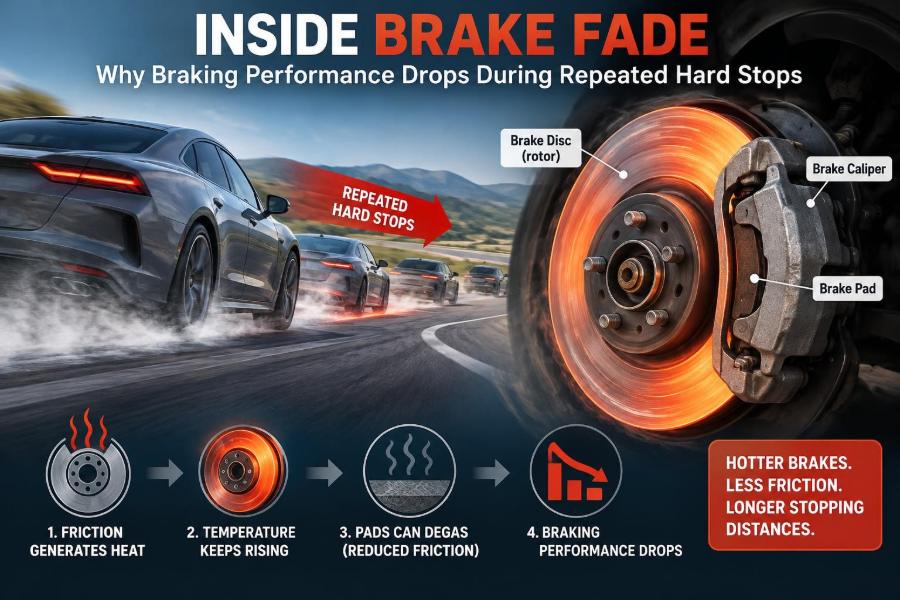
A moving vehicle carries kinetic energy. Braking does not make that energy disappear; it converts most of it into heat at the pad-rotor or shoe-drum interface.
Vehicle speed is especially significant because kinetic energy rises with the square of speed. Doubling speed means roughly four times as much kinetic energy must be managed, assuming the vehicle mass is unchanged.
On a descent, brakes may also need to absorb energy continuously as gravity pulls the vehicle downhill. This is why a modest-looking mountain road can demand more from brakes than a single high-speed stop on level ground.
🌡️ Where the Heat Goes
During a hard stop, the rotor or drum receives a large share of the heat. Pads, calipers, wheel hubs, brake fluid, and surrounding air also absorb or carry away some energy.
Heat does not spread instantly. The friction surface can become much hotter than the rotor’s internal mass, while the brake fluid behind a piston may remain cooler for a time. This temperature gradient explains why a brake can behave normally at first and then deteriorate as heat migrates through the assembly.
Cooling depends on surface area, airflow, material mass, and the time between applications. Repeated stops can add heat faster than the brake assembly can reject it.
📉 The Friction Coefficient Can Fall
The coefficient of friction describes how strongly two materials resist sliding relative to the force pressing them together. Brake-pad compounds are engineered to provide useful and reasonably stable friction across a working temperature range.
Above that range, a pad compound may produce less friction for the same clamp force. The driver must then press harder, or the car produces less deceleration. This is a classic form of friction fade.
Different compounds respond differently. A quiet, low-dust road pad may prioritize cold response and comfort, whereas a performance-oriented compound may tolerate higher temperatures but be less pleasant in ordinary commuting.
🧪 Pad Material Changes With Temperature
Brake pads are composite materials containing binders, fibers, abrasives, lubricants, and friction modifiers. Their formulation is a deliberate compromise among cold bite, hot stability, wear, noise, dust, cost, and rotor compatibility.
At excessive temperatures, binders can break down or release gases. The surface may become smoother, altered, or covered by deposits. None of these changes automatically means the pad is permanently ruined, but repeated overheating can accelerate wear and make performance less consistent.
That is why “high-performance” pads are not automatically better for every car. The useful question is whether their operating range and behavior suit the vehicle, climate, driving pattern, and braking hardware.
💨 Green Fade and Outgassing
New pads and rotors require a controlled bedding-in process. During early use, heat drives off volatile compounds from the friction material and helps establish an even transfer layer on the rotor surface.
If new pads are heavily loaded before bedding is complete, released gases can briefly interfere with solid pad-to-rotor contact. This is often called green fade. It is most relevant to fresh friction materials, rather than a general explanation for every fade complaint.
Proper bedding should follow the pad manufacturer’s instructions. The aim is progressive heating and cooling, not repeated panic stops on public roads.
🪞 Glazing Reduces Useful Contact
Overheating can leave a pad surface unusually smooth and hard, a condition commonly described as glazing. A glazed rotor may also show shiny areas or uneven friction deposits.
The result can be reduced bite, noise, vibration, or a brake that feels less responsive at normal pedal pressure. Glazing is not always visible from outside the wheel, and its presence should not be assumed without inspection.
Depending on severity, a technician may restore the system with appropriate resurfacing and new pads, or recommend replacement of worn or heat-damaged parts. The underlying overheating cause must also be addressed.
🫧 Fluid Fade Produces a Different Pedal Feel
Hydraulic brake fluid is intended to be nearly incompressible. If fluid near a hot caliper boils, it can form vapor bubbles. Unlike liquid, vapor compresses substantially when the pedal is pressed.
This condition, often called fluid fade or fluid boil, commonly produces a soft, long, or sinking pedal. The pedal may travel farther before meaningful braking force develops.
Friction fade can occur with a relatively firm pedal but weaker deceleration. Fluid boil often changes pedal travel more dramatically. The distinction is useful diagnostically, but either symptom after severe braking deserves caution and inspection.
💧 Why Old Brake Fluid Raises the Risk
Many commonly used brake fluids absorb moisture gradually from the atmosphere. Moisture lowers the fluid’s boiling resistance and can encourage internal corrosion in hydraulic components.
A vehicle that has not had its brake fluid renewed for a long period may therefore be more vulnerable to fluid boil under a demand that a well-maintained system could better tolerate. Service intervals vary by manufacturer, fluid specification, climate, and use.
Only the specified fluid type should be used. Mixing unsuitable fluids or assuming any fluid labeled “brake fluid” is interchangeable can damage seals or compromise system performance.
🧱 Disc Brakes and Drum Brakes Handle Heat Differently
Disc brakes expose the rotor to moving air and generally shed heat more effectively than drums. Vented discs add internal passages that pump air through the rotor as it rotates, increasing cooling capacity.
Drum brakes enclose their friction surfaces. They can provide strong braking force and remain common in some rear-axle applications, but their more enclosed construction makes sustained heat management more difficult.
| Feature | Disc brake | Drum brake |
|---|---|---|
| Air exposure | High, especially with vented rotors | More enclosed |
| Repeated-stop heat control | Generally better | Generally more limited |
| Common fade tendency | Pad friction loss or fluid-related issues | Heat buildup and changing shoe behavior |
| Typical use | Front axles and many all-wheel disc systems | Some rear axles where cost and packaging matter |
These are broad tendencies, not a verdict on individual designs. A well-engineered drum system may suit its intended vehicle, while an undersized disc system can still overheat.
🌀 Rotor Design Influences Cooling
Rotor diameter, thickness, mass, ventilation, vane design, and material all influence thermal behavior. A larger effective radius also gives the brake more leverage, allowing a given clamp force to generate more torque.
More thermal mass can absorb more energy before temperature rises sharply, but added mass affects cost, wheel packaging, and unsprung weight. Unsprung weight is the mass carried by the suspension below the springs; excessive amounts can affect ride and wheel control.
Slots and drilled patterns are often misunderstood. Their effects depend on the specific design and application; they are not a universal cure for fade, and some patterns may introduce trade-offs in wear or durability.
🚙 Vehicle Mass Multiplies Brake Demand
A loaded vehicle carries more kinetic energy than the same vehicle when lightly loaded. Passengers, cargo, towing equipment, and trailer mass all increase the energy that must be managed during deceleration.
For example, a vehicle descending with a trailer may be within its towing rating yet still require a braking strategy suited to the grade. A rating does not eliminate the physical heat load created by mass and elevation loss.
Trailer brakes, where fitted and correctly adjusted, can share the work. They should never be treated as a substitute for appropriate speed selection and following distance.
⛰️ Long Descents Create Continuous Heat
Repeated hard stops create short, intense heat cycles. Long descents can be more deceptive because moderate pedal use may continue for minutes, steadily increasing brake temperature.
Riding the brakes—maintaining light pressure for a long time—often gives the system little chance to cool. The driver may not notice the problem until the pedal must be pressed harder near a sharp bend.
On suitable vehicles, selecting a lower gear before the descent uses engine braking to control speed. This reduces the heat entering the friction brakes and preserves their capacity for corners or unexpected hazards.
🏁 Track Use Is a Different Thermal Environment
Track driving places repeated high-energy stops close together. Brakes may receive only seconds of cooling between braking zones, and tire grip can allow deceleration levels that load the system heavily.
A street car can complete a few fast laps without obvious trouble, then develop a longer pedal, smoke from the wheel area, vibration, or a pronounced drop in stopping confidence. This is not necessarily evidence of a defective part; it may show that the operating duty exceeds the system’s thermal design window.
Track preparation typically considers fluid condition, pad compound, rotor health, cooling airflow, tire capability, and driver technique as one system.
🦶 Pedal Feel Helps Identify the Problem
The pedal is useful feedback, although it is not a complete diagnosis. A firm pedal with disappointing deceleration points more toward reduced tire grip or friction performance. A soft or unusually long pedal suggests hydraulic issues, including possible fluid boil or air in the system.
A pedal that gradually sinks while held may indicate an internal hydraulic problem. Pulling to one side, smoke, grinding, warning lights, or a strong burning odor add urgency.
Drivers should not attempt to diagnose a serious braking symptom while continuing to drive at normal speed. Reduce speed safely, stop when possible, and arrange qualified inspection if normal braking does not return promptly.
🛞 Tires Set the Final Limit
Even perfectly functioning brakes cannot exceed the traction available between tire and road. Anti-lock braking systems, or ABS, help prevent prolonged wheel lock during hard braking, allowing steering control to be better maintained in many conditions.
ABS does not cool overheated brakes and does not create extra friction material capacity. It modulates hydraulic pressure when wheel-speed sensors detect impending lock.
Wet roads, gravel, worn tires, incorrect tire pressures, and uneven surfaces can lengthen stopping distances even when the brake hardware remains cool. Brake fade and low traction can feel similar to a driver, but their causes and remedies differ.
⚖️ Brake Bias and Weight Transfer Matter
During deceleration, weight transfers toward the front axle. Front brakes therefore handle a large portion of the work in most passenger vehicles, which explains their often larger discs and more substantial calipers.
Brake bias is the intended front-to-rear distribution of braking force. Too much rear braking can promote rear-wheel lock; too little rear braking overloads the front system and wastes available rear-tire grip.
Electronic brake-force distribution can adjust pressure according to conditions, but it cannot repeal heat limits. Repeated heavy braking still concentrates major thermal demand at the front axle.
🔧 A Sticking Caliper Can Mimic or Worsen Fade
Not every hot brake is caused by aggressive driving. A seized slide pin, corroded caliper piston, restricted flexible hose, incorrect pad fitment, or parking-brake fault can leave a pad or shoe dragging.
Drag produces heat even when the driver is not braking. The affected wheel may smell hot, pull during braking, show abnormal dust, or have visibly different wear from the opposite side.
Replacing pads alone in this situation may conceal the symptom briefly but will not solve the mechanical cause. A proper inspection includes free movement of caliper hardware and comparison across an axle.
📏 Wear and Thickness Affect Thermal Reserve
Brake rotors have a minimum service thickness specified by the vehicle or component manufacturer. As a rotor becomes thinner, it has less thermal mass and may be more prone to distortion or overheating under the same duty.
Pad thickness also matters. Very thin pads have less material to absorb and distribute heat, and worn friction material can expose backing plates, causing severe rotor damage.
Thickness alone does not reveal every issue. Rotor runout, surface condition, cracks, corrosion, and uneven deposits can also affect braking quality and should be assessed using appropriate service procedures.
🌬️ Cooling Needs Airflow and Time
Brake cooling comes from conduction into surrounding parts, radiation, and convection—the transfer of heat to passing air. Airflow through the wheel is especially valuable after a demanding stop.
Parking immediately after severe braking can trap heat around the components. On performance vehicles, a controlled cool-down period at modest speed without unnecessary brake use is often preferable when conditions permit.
Never use water to rapidly cool hot rotors. Sudden local temperature changes can stress components, and hot surfaces can produce steam dangerously. Let the system cool naturally.
🧭 Better Driving Technique Preserves Brakes
Good brake management begins before the pedal is pressed. Looking farther ahead, maintaining space, and reducing speed early decrease the need for repeated high-force applications.
- Select an appropriate lower gear before a long descent when the vehicle permits it.
- Use firm, deliberate braking to reduce speed when needed, then release the pedal rather than dragging the brakes continuously.
- Leave extra following distance when loaded, towing, descending, or traveling in hot conditions.
- Stop and allow cooling if braking response changes noticeably or a hot-brake smell becomes strong.
The best technique depends on road conditions and vehicle design. The general objective is simple: avoid adding heat continuously when speed can be controlled by planning and engine braking.
🚫 Common Responses That Do Not Solve Fade
Pumping the pedal may help a driver assess pedal response, but it does not restore a pad compound that has lost friction from overheating. Nor does it remove vapor from boiled fluid in a safe, reliable way.
Switching to a more aggressive pad without considering rotors, fluid, tires, cooling, and intended use can create new compromises, including noise, cold-performance changes, or accelerated rotor wear.
Another mistake is assuming that a brake warning symptom is normal because it occurred after “spirited driving.” Repeated fade is information: either the operating demand, system condition, or component selection needs attention.
🧰 Maintenance That Supports Consistent Braking
Routine brake service is preventive thermal management as much as replacement of worn parts. The goal is a system that applies evenly, releases fully, and retains hydraulic integrity under expected loads.
- Inspect pad and rotor condition at the recommended service intervals.
- Renew brake fluid according to the vehicle manufacturer’s schedule or earlier when use and testing justify it.
- Check caliper slides, boots, hoses, hardware, and parking-brake mechanisms for binding or corrosion.
- Use parts that match the vehicle’s specification and actual driving duty.
- Confirm wheel fasteners are tightened correctly after service, as improper installation can contribute to brake complaints.
Any repair involving brakes should be performed by someone with the proper tools, specifications, and competence. Braking systems are safety-critical.
🧩 Choosing Upgrades as a Complete System
For vehicles that genuinely exceed their factory brake duty—such as tow vehicles used on steep routes or cars used in organized track events—upgrades may be sensible. The most effective choices address the actual bottleneck.
Higher-temperature fluid can improve boiling resistance, while suitable pads can maintain friction at higher temperatures. Larger rotors, improved calipers, and brake ducts can increase thermal capacity or cooling, but may require compatible wheels, mounts, bias considerations, and careful engineering.
An upgrade should not compromise predictable cold operation or legal roadworthiness. A balanced system is more valuable than one impressive component.
🧑🔧 Diagnosing a Fade Complaint Methodically
A technician should begin with the driver’s description: when did the symptom occur, was the vehicle loaded, was it descending, did the pedal become soft, and did the issue disappear after cooling? Context separates a thermal event from a persistent mechanical fault.
Inspection may include checking friction thickness, rotor condition, fluid condition, caliper movement, leaks, tire state, and electronic fault information. Controlled testing must be performed safely and only where appropriate.
There is no reliable universal answer based solely on a hot smell or dark-looking rotor. Diagnosis should identify whether the concern is friction fade, hydraulic boil, brake drag, traction limitation, or a combination.
⚠️ When a Brake Symptom Requires Immediate Attention
Some symptoms should be treated as reasons to stop driving as soon as it is safe to do so. These include a pedal that travels abnormally far, major loss of stopping power, visible smoke, a persistent pull, grinding, fluid leakage, or a brake warning indicator.
Use hazard awareness and engine braking where appropriate to reach a safe location, but do not rely on an impaired system for normal travel. Calling for assistance is often the safer decision.
After an overheating event, do not assume that cooling alone has returned every component to serviceable condition. Heat can damage fluid, seals, friction surfaces, and nearby parts.
🧠 The Core Principle: Manage Heat Before It Manages You
Brake fade occurs when a brake system cannot maintain its intended friction and hydraulic behavior at the temperature created by the driving demand. The source may be pad chemistry, fluid boiling, a dragging component, insufficient cooling, excessive vehicle load, or several factors acting together.
Speed, mass, gradient, repeated use, and component condition determine how quickly heat accumulates. The practical response is not simply “buy stronger brakes.” It is to match driving technique, maintenance, component selection, and vehicle use to the thermal job required.
Reliable braking comes from preserving a margin: thermal margin in the hardware, hydraulic margin in fresh fluid, traction margin in the tires, and decision-making margin in the driver’s speed and following distance.
Brake fade is a reminder that braking performance depends on heat management, not just pedal pressure. Respecting that relationship makes every demanding stop more predictable and safer. 🚗🛑🌡️