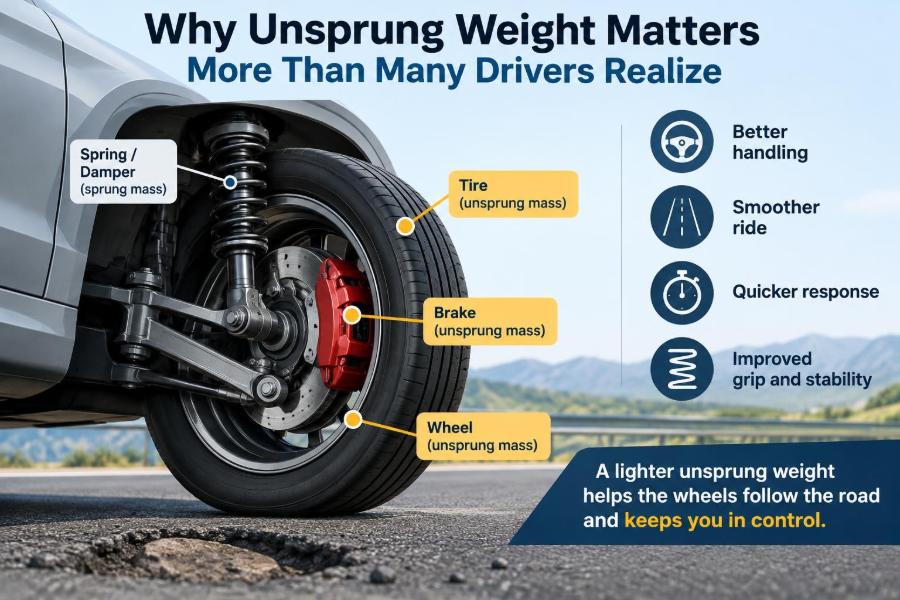

You fit a new set of wheels, perhaps because they look better, clear larger brakes, or replace a damaged original. On the drive home, the car may feel sharper over small bumps—or oddly more restless. The difference can be much larger than the scale reading alone seems to justify.
The reason is often unsprung weight: the mass that sits below the suspension springs and must follow every ripple, pothole edge, and expansion joint in the road. Wheels and tires are the most obvious examples, but they are only part of the picture.
Drivers usually think about total vehicle weight, horsepower, and tire grip. Those matter. Yet the mass at each corner of the car influences ride comfort, steering response, braking control, and the tire’s ability to stay in contact with imperfect pavement.
Understanding unsprung weight does not mean assuming lighter is always better. It means seeing why a few kilograms at the wheel can behave differently from the same kilograms placed inside the cabin—and making modifications with the whole suspension system in mind.
🚘 The Simple Meaning of Unsprung Weight
Unsprung weight is the portion of a vehicle’s mass that is not primarily supported by the suspension springs. It moves directly with the wheel assembly as the tire travels over the road surface.
At a driven road wheel, it commonly includes the tire, wheel, brake disc or drum, caliper, hub, wheel bearing components, and parts of the suspension links or axle that move with that corner. The exact boundary varies with suspension design.
The term can sound misleading because these parts are still connected to springs, dampers, and the vehicle body. The useful distinction is that they react to road inputs far more directly than the body and passengers do.
🛋️ What Counts as Sprung Weight
Sprung weight is the mass carried mainly by the springs: the body shell, powertrain, interior, occupants, and much of the suspension structure. In most passenger cars, it is the larger share of the total mass.
Imagine holding a heavy backpack while standing on a springy platform. The backpack represents sprung mass; the platform’s moving lower mechanism and its contact point with the ground resemble unsprung mass. Their motions are connected, but not identical.
A battery pack mounted low in an electric vehicle adds considerable total mass, yet it is generally sprung mass. A modestly heavier wheel affects a very different part of the vehicle’s motion.
🔩 The Parts at Each Corner
Wheel assemblies deserve attention because they often make up a major share of the unsprung mass at a corner. But a useful engineering view includes the full moving system.
- Usually unsprung: tire, wheel, valve hardware, brake rotor, caliper, hub, upright or knuckle, and portions of control arms, driveshafts, springs, and dampers.
- Usually sprung: chassis, body, engine, seats, passengers, and the inboard mounting points of suspension components.
- Design-dependent: live axles, beam axles, inboard brakes, and the position of a damper or spring can shift how mass is classified or shared.
A solid rear axle places a comparatively large structure on the unsprung side. Independent suspension can reduce the mass moving at each wheel, although its benefits depend on the complete geometry and tuning.
🌊 Why a Bump Creates Two Motions
When a tire meets a bump, the wheel must rise quickly. The suspension then manages how much of that disturbance reaches the sprung mass above it.
This creates two related motions. The wheel-and-tire assembly has a relatively fast movement often called wheel hop. The vehicle body has a slower vertical movement commonly described as body bounce or heave.
The suspension cannot make the bump disappear. Its job is to let the wheel follow the road while preventing excessive body movement, controlling oscillation, and maintaining tire contact. Lower unsprung mass generally makes the wheel easier to move in the short time available.
⚖️ Mass Is Not Just Mass at the Wheel
Adding five kilograms to luggage changes the total mass and may slightly affect acceleration or load capacity. Adding the same five kilograms at a wheel changes not only vertical motion but also rotating inertia.
Rotating parts resist changes in speed. A wheel therefore has to be accelerated in a straight line with the car and spun up around its axle. During braking, both forms of stored motion must be reduced.
This is why wheel mass is frequently described as more consequential than equal mass inside the vehicle. There is no universal conversion such as “one kilogram of wheel weight equals several kilograms in the cabin.” The effect depends on wheel diameter, where the material sits, vehicle speed, gearing, suspension characteristics, and road surface.
🎯 Rotational Inertia and Where Weight Sits
Two wheels can weigh the same but feel different dynamically. Mass concentrated near the rim has a greater effect on rotational inertia than mass positioned close to the hub.
A simple analogy is a figure skater spinning. Extending the arms makes it harder to rotate quickly; pulling them inward makes rotation easier. A larger-diameter wheel and tire package tends to place more mass farther from the axle.
This does not mean every larger wheel is unacceptable. It means diameter, tire construction, wheel design, and total assembly mass should be considered together rather than judged by appearance alone.
🛞 Tires Are Part of the Unsprung System
A tire is not merely a rubber covering on a wheel. Its sidewall, carcass, tread, and air volume form a flexible element between the road and the rim. The tire is often called the vehicle’s first spring.
A heavier tire raises unsprung mass, but tire choice also changes compliance, grip, noise, and steering behavior. A lighter tire with a stiffer sidewall is not automatically better for real roads.
Low-profile tires can sharpen steering feel and support larger wheel diameters, yet their shorter sidewalls provide less compliance over broken surfaces. The resulting ride change may be caused by both added wheel mass and reduced tire flexibility.
📉 Tire Contact Is the Main Reason It Matters
The tire can generate braking, cornering, and acceleration forces only when it is in useful contact with the road. Over a rough surface, a heavy wheel assembly can have more difficulty following rapid changes in pavement height.
If the wheel rebounds or loses normal load momentarily, available grip can drop. The driver may notice this as a skipping sensation under braking, a nervous steering response on corrugated pavement, or reduced traction over mid-corner bumps.
On smooth roads, the difference may be subtle. On uneven roads, especially at higher speeds, wheel control becomes far more relevant than a simple curb-weight comparison suggests.
🛑 Braking on Rough Pavement
Modern anti-lock braking systems can modulate brake pressure when a wheel approaches lock-up, but they cannot create grip where the tire is lightly loaded or briefly airborne. Mechanical contact remains the foundation.
More unsprung mass can make it harder for a wheel to settle quickly after an impact. That may reduce consistency when braking over a sequence of bumps, although tire compound, tread, damper condition, alignment, and brake condition can matter just as much or more.
For road safety, the practical lesson is not to chase the lightest parts possible. It is to avoid modifications that substantially worsen wheel control or compromise tire quality for the sake of wheel appearance.
🧭 Steering Feel and Accuracy
The front wheels are part of the steering system, so their mass influences what the driver feels through the steering wheel. A heavier assembly may make initial changes in wheel speed and direction feel less eager, particularly in cars with direct steering ratios.
Steering effort is also influenced by scrub radius, tire width, steering geometry, power-assistance calibration, and inflation pressure. It would be inaccurate to blame every heavy steering sensation on wheel weight.
Still, when a car receives much larger wheels and wider tires, drivers often experience a combined change: greater inertia, altered tire compliance, and sometimes altered steering geometry. The result can be more impact harshness and more kickback over potholes.
🏁 Acceleration and Gear Changes
Reducing rotating mass can help a vehicle respond more readily to engine torque, especially in lower gears where the drivetrain multiplies torque strongly. The improvement is usually more noticeable in repeated acceleration, frequent speed changes, or competition use than during steady cruising.
The magnitude is vehicle-specific. Engine output, gearing, transmission behavior, tire diameter, and the mass distribution of the new wheel all influence the outcome. A modest wheel-weight saving should not be presented as a guaranteed dramatic performance gain.
Maintaining the original rolling radius also matters. Changing tire diameter alters effective gearing and speedometer behavior, which can make an acceleration comparison misleading.
🌀 The Wheel-Hop Frequency
Every suspension has natural frequencies: rates at which its masses tend to oscillate. The unsprung assembly has a higher-frequency mode than the body because it is controlled largely by tire stiffness and the suspension’s wheel-side characteristics.
Increasing unsprung mass tends to lower that wheel-hop frequency. Changing tire stiffness, spring rate, and damper settings changes the system too. Engineers tune these interacting elements rather than treating any one number as isolated.
If the wheel mode is poorly controlled, the tire may bounce or chatter over repeated surface inputs. This is one reason a modification that feels acceptable on a smooth test drive can become tiring or less controlled on familiar rough roads.
🔧 Dampers Control Motion, Not Weight
Dampers, commonly called shock absorbers, convert motion into heat and limit repeated oscillation. They are essential for controlling both body movement and wheel movement after a disturbance.
A damper cannot erase the inertia of a heavy wheel. It can only apply a carefully calibrated resisting force as the suspension moves. Too little damping permits repeated bouncing; too much can make the wheel reluctant to move over sharp irregularities.
Replacing wheels without considering damper condition is a common oversight. Worn dampers can make a vehicle with standard wheels feel unsettled, while properly matched dampers may preserve good control with a moderately heavier assembly.
🧱 Spring Rate Changes the Trade-Off
Stiffer springs reduce body roll and body movement under some conditions, but they do not automatically improve rough-road grip. A very stiff setup can transfer more disturbance to the body and may reduce compliance on uneven pavement.
With a heavier unsprung assembly, owners sometimes install stiffer springs to counter a vague or slow-feeling response. That can alter the symptom without resolving the wheel-control problem, and it may worsen ride comfort.
Suspension tuning works best as a system: spring rate, damper forces, bump stops, tire construction, wheel mass, geometry, and intended use must be compatible.
🪨 Road Quality Changes the Answer
On a smooth circuit, a larger wheel may offer packaging space for brakes and a tire specification suited to high lateral loads. The penalty from additional unsprung mass may be less obvious than it would be on patched public roads.
On rural roads, city streets with potholes, gravel surfaces, or frost-damaged pavement, wheel compliance and contact management become more prominent. A smaller, lighter wheel with a taller sidewall can often be the more sensible all-round choice.
This is why wheel selection has no universal winner. The best setup for a show car, track-day car, long-distance commuter, off-road vehicle, and cargo-carrying truck may be very different.
🚙 SUVs, Trucks, and Solid Axles
Utility vehicles frequently use larger tires, heavier wheels, robust brakes, and components designed for high loads. These choices improve durability or capability but can raise unsprung mass.
A solid axle connects the left and right wheels through a common beam. When one wheel strikes a bump, the axle’s mass and the movement of the opposite side influence the response. This does not make solid axles inherently poor; they offer strength, simplicity, and predictable geometry in demanding applications.
However, an independent suspension can give each wheel more freedom to follow terrain. For comfort and high-speed rough-road control, reducing unsprung mass at each corner is often advantageous.
🏎️ Performance Cars and Brake Packaging
Performance vehicles may use large brake discs and calipers to manage repeated high-energy stops. Those parts sit near the wheel and add mass, even when made from carefully selected materials.
Engineers balance this cost against fade resistance, thermal capacity, stiffness, durability, and packaging. A lighter brake component that overheats or flexes excessively is not an improvement.
Inboard brakes, positioned closer to the differential rather than at the wheel, can reduce unsprung mass in some designs. They bring their own challenges, including cooling, service access, and drivetrain packaging, which explains why they are uncommon in ordinary passenger vehicles.
🧪 Why Engineers Use Quarter-Car Models
A useful teaching model is the quarter-car model. It represents one corner of a vehicle using a sprung mass, an unsprung mass, a suspension spring and damper, and a tire spring.
Although simplified, it shows why the problem cannot be solved by a single “lightest is best” rule. The model predicts how the body and wheel respond to a road input, allowing engineers to evaluate ride isolation and tire-load variation together.
Real vehicles add many complications: suspension geometry, bushing compliance, anti-roll bars, aerodynamic load, tire damping, structural flexibility, and motion at all four corners. The core lesson remains: wheel mass is part of a dynamic system.
📏 Measuring Wheel Weight Correctly
When comparing aftermarket wheels, weigh the complete assemblies if possible: wheel, tire, valve, balance weights, and any sensors. A wheel-only comparison can miss a heavy tire or a change in overall diameter.
Use the same scale and measure comparable sizes. Record front and rear assemblies separately if the vehicle uses staggered fitments. A small apparent saving may fall within ordinary scale variation, so avoid overinterpreting tiny differences.
Also check load rating, approved tire sizes, brake clearance, offset, center-bore fitment, and fastening requirements. Weight is only one specification among several safety-critical ones.
📐 Diameter, Offset, and Geometry
Wheel offset determines where the wheel sits relative to the hub mounting face. A major offset change can alter scrub radius, steering loads, bearing loads, fender clearance, and suspension clearance.
Even a light wheel can be a poor choice if its geometry creates rubbing, interferes with suspension travel, or places undesirable loads on components. Conversely, a slightly heavier wheel with correct dimensions and adequate strength may be the better engineering decision.
Always evaluate a wheel-and-tire package as a fitment system, not as an isolated style component.
⚠️ A Lighter Wheel Can Still Be the Wrong Wheel
Strength, fatigue resistance, impact resistance, and load capacity matter. A very light wheel that is unsuitable for the vehicle’s axle load or intended road conditions can bend, crack, or fail after impacts.
Manufacturing method alone does not settle the question. Forged, flow-formed, and cast wheels can all vary widely in quality and design suitability. The relevant issue is whether the specific wheel is properly engineered for its stated load and use.
For daily driving, a modest mass penalty may be worth accepting for a wheel that is durable, correctly rated, and compatible with the vehicle.
🛠️ Common Modification Mistakes
Wheel upgrades often go wrong because attention stays on diameter and appearance while the dynamic effects are ignored.
- Choosing a larger wheel without checking the complete wheel-and-tire assembly mass.
- Using an extremely low-profile tire on roads where impacts are common.
- Assuming stiffer springs will compensate for poor wheel control.
- Ignoring changes to rolling radius, offset, and brake or suspension clearance.
- Buying lightweight components with uncertain load suitability or fitment.
- Diagnosing every post-modification vibration as “normal” rather than checking balance, runout, centering, and tire condition.
None of these errors is solved merely by adding more tire pressure. Excessive pressure can reduce compliance and may make harshness worse.
🔍 Symptoms Worth Investigating
A heavier wheel package does not automatically create a fault. But if the vehicle develops a new problem after a change, investigate systematically.
Look for increased impact harshness, steering kickback, rubbing during compression or steering lock, vibration at specific speeds, reduced damping control on rough roads, or unexpected activation of traction and stability systems on uneven surfaces.
These symptoms can also come from bent wheels, incorrect balance, damaged tires, worn bushings, poor alignment, or failing dampers. A qualified technician should inspect safety-relevant concerns rather than relying on a visual guess.
🧰 Maintenance Protects Wheel Control
Good wheel control depends on more than component mass. Tire pressures should be checked cold and adjusted according to the vehicle manufacturer’s guidance for the load and tire specification being used.
Inspect tires for impact damage, uneven wear, and age-related deterioration. Check suspension joints, bushings, wheel bearings, and dampers when ride quality or handling changes. A loose joint or weak damper can overwhelm the benefit of a carefully chosen lightweight wheel.
After a significant pothole strike, inspect the tire sidewall and wheel carefully. Cosmetic damage can coexist with structural damage that is not obvious from a distance.
🧑🔧 A Sensible Selection Process
For a road car, start with the vehicle manufacturer’s recommended wheel and tire sizes. If changing them, define the actual goal: winter traction, brake clearance, appearance, track use, reduced mass, load capacity, or off-road durability.
- Choose an appropriate tire type and maintain a suitable overall rolling diameter.
- Confirm wheel load rating, diameter, width, offset, center bore, and fastening compatibility.
- Compare complete assembly weights, not wheel weights alone.
- Check clearance through full steering lock and suspension movement.
- Balance the assemblies accurately and verify alignment after major changes.
- Evaluate the result on the roads the vehicle genuinely uses.
This method keeps unsprung weight in its proper place: a meaningful criterion, but never the sole criterion.
🧠 Separating Feel From Measurable Change
Drivers are good at noticing changes, but human perception is influenced by expectation, tire noise, steering effort, and the visual impression of a larger wheel. A back-to-back comparison on the same route is more useful than a short memory-based judgment.
Where practical, compare pressure, wheel alignment, tire model, and weather conditions. Changing wheels, tires, springs, and dampers all at once makes it difficult to identify what caused the result.
Engineering decisions improve when subjective impressions are respected but tested against controlled variables.
🌱 Efficiency and Electric-Vehicle Considerations
Heavier wheels can require more energy during repeated acceleration and deceleration, while wider tires and changed aerodynamics can affect rolling resistance and range. At steady speed, tire properties and aerodynamic drag may dominate over rotating mass.
Electric vehicles also carry high vehicle mass and can deliver strong torque immediately, which places high demands on tires, wheels, and suspension. Their wheel choices often balance range, brake cooling, load rating, noise, durability, and visual design.
Aerodynamic wheel covers may improve airflow while adding some mass. This is another reminder that vehicle design involves trade-offs rather than a single ideal metric.
📊 A Practical Comparison Guide
| Change | Likely unsprung-weight effect | Other factors that may matter more |
|---|---|---|
| Larger-diameter wheel | Often increases mass and rotational inertia, especially near the rim | Tire sidewall height, assembly weight, offset, brake clearance |
| Lighter complete assembly | Can improve the wheel’s ability to follow sharp road inputs | Wheel strength, tire compliance, damper condition |
| Wider tire | May increase assembly mass | Compound, pressure, wet behavior, steering geometry |
| Larger brake hardware | Adds mass near the wheel | Thermal capacity, stiffness, repeated-stop performance |
| Stiffer suspension | Does not reduce unsprung mass | Damping match, bump travel, surface quality, grip |
🏁 The Core Principle to Remember
Unsprung weight matters because it affects how rapidly the wheel can respond to the road. Lower mass at the wheel can help the tire maintain contact and can improve the sense of precision, particularly over uneven surfaces.
But mass is only one part of the suspension equation. Tire construction, wheel diameter, geometry, spring and damper tuning, brake requirements, strength, and the roads you drive all influence the final result.
The best modification is rarely the lightest available component. It is the combination that delivers safe fitment, adequate durability, dependable tire behavior, and controlled wheel motion for the vehicle’s real task.
When choosing wheels and tires, think beyond total weight: the mass that moves with the road can shape every bump, brake application, and corner. A well-balanced setup is usually more rewarding than an extreme one. 🚗🛞⚙️