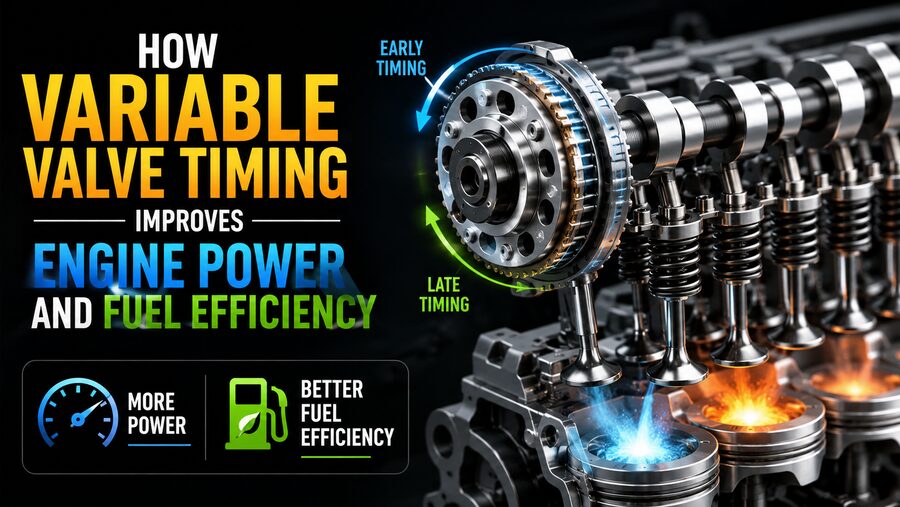

Modern car engines face a difficult engineering challenge: they need to produce strong power when the driver accelerates, remain smooth and efficient during everyday driving, and minimize fuel consumption and emissions at the same time. A traditional engine with fixed valve timing can only be optimized for a limited range of operating conditions.
That is where Variable Valve Timing, commonly abbreviated as VVT, becomes important. ⚙️
Variable valve timing allows an engine to adjust when its intake or exhaust valves open and close as engine speed and load change. More advanced systems may also alter how far the valves open or how long they remain open.
By adapting valve operation to different driving situations, VVT helps an engine breathe more effectively. The result can be better low-speed torque, stronger high-RPM power, improved fuel economy, smoother operation, and reduced emissions. 🚘💨
Understanding VVT begins with understanding what engine valves actually do.
🔧 What Do Engine Valves Do?
In a typical four-stroke gasoline engine, each cylinder contains intake and exhaust valves.
The intake valves allow fresh air—or an air-fuel mixture, depending on the fuel-injection system—to enter the cylinder. The exhaust valves allow burned combustion gases to leave.
The engine operates through four basic strokes:
- Intake – fresh air enters the cylinder.
- Compression – the piston compresses the air or air-fuel mixture.
- Power – combustion pushes the piston downward.
- Exhaust – burned gases leave the cylinder.
🔥 This sequence repeats hundreds or thousands of times per minute while the engine is running.
Opening and closing the valves at exactly the right moment is essential. If they open too early, too late, or remain open for an unsuitable amount of time, the engine may not fill or empty its cylinders efficiently.
🕒 What Is Valve Timing?
Valve timing describes when the intake and exhaust valves open and close relative to the position of the pistons and crankshaft.
The valves are operated by one or more camshafts. A camshaft contains specially shaped lobes that push against valve-train components and cause the valves to open.
In a conventional fixed-timing engine, the relationship between the camshaft and crankshaft remains essentially fixed while the engine is operating.
That creates a compromise.
Valve timing that works well at low engine speeds may restrict airflow at high speeds. Timing optimized for maximum high-RPM horsepower may reduce low-speed torque, fuel efficiency, or idle quality.
Variable valve timing reduces this compromise. ⚙️🔄
🚀 What Is Variable Valve Timing?
Variable Valve Timing is a system that changes valve operation according to engine conditions.
Depending on the design, a VVT system may adjust:
- When the intake valves open
- When the intake valves close
- When the exhaust valves open
- When the exhaust valves close
- The amount of valve overlap
- Valve lift
- Valve-opening duration
The engine control unit, or ECU, continuously monitors factors such as engine speed, throttle position, load, temperature, and sometimes many other sensor inputs.
It can then command the valve-control mechanism to use timing that better suits the current driving situation.
For example, the engine may use one timing strategy while idling at a traffic light and a very different strategy when accelerating onto a highway. 🚦➡️🛣️
⚙️ How Does a Typical VVT System Work?
Many VVT systems use a device known as a cam phaser.
The cam phaser is attached to the camshaft and can change the angular relationship between the camshaft and crankshaft.
In simple terms, it can slightly rotate the camshaft relative to the engine’s normal mechanical timing.
This allows the ECU to advance or retard valve timing.
⏩ Advancing Valve Timing
Advancing a camshaft causes certain valve events to happen earlier relative to crankshaft position.
Depending on the engine and operating conditions, this may help improve cylinder filling, torque, combustion behavior, or exhaust-gas management.
⏪ Retarding Valve Timing
Retarding the camshaft causes valve events to occur later.
This can be useful under other conditions, such as improving high-speed airflow or adjusting internal exhaust-gas recirculation.
The ideal setting changes continuously as the engine runs.
🛢️ Hydraulic Control and Engine Oil
Many VVT systems operate hydraulically using pressurized engine oil.
An electronically controlled oil-control valve directs oil pressure into different chambers of the cam phaser. This pressure rotates the phaser and changes camshaft position.
The ECU controls this process based on sensor information.
This means engine oil plays two roles:
- Lubricating engine components
- Acting as a hydraulic control fluid for the VVT mechanism
For this reason, poor oil quality, incorrect oil viscosity, sludge, low oil pressure, or clogged oil passages can interfere with some VVT systems. 🛢️
Regular oil maintenance is therefore particularly important in engines equipped with hydraulically controlled variable timing.
💪 How VVT Improves Engine Power
An internal combustion engine is essentially an air pump combined with a combustion system.
To produce more power, the engine generally needs to efficiently move more air through its cylinders while maintaining appropriate fueling and combustion.
At higher engine speeds, the time available to fill each cylinder becomes extremely short.
Fixed valve timing can restrict this process because the intake valve may close before the incoming air has finished entering the cylinder—or remain open at a time that is less beneficial.
VVT allows engineers to alter the timing so airflow takes better advantage of gas momentum and pressure changes inside the intake and exhaust systems.
This can improve volumetric efficiency, meaning the cylinder can be filled more effectively with fresh air.
More air allows the engine management system to provide an appropriate amount of fuel and generate more combustion energy.
The result is stronger performance. 🚗💨
🏎️ Why High-RPM Engines Need Different Valve Timing
Imagine an engine operating at 1,000 revolutions per minute compared with one operating at 6,000 RPM.
At high RPM, everything happens much faster.
Air flowing through an intake runner also has momentum. Even as the piston reaches the end of its intake stroke, air may still be moving rapidly toward the cylinder.
Under appropriate conditions, keeping the intake valve open slightly longer can allow this moving air to continue filling the cylinder.
At lower engine speeds, however, the same timing could allow some air to move in an undesirable direction or reduce combustion stability.
VVT allows the engine to adapt instead of relying on a single compromise. 🔄
💨 What Is Valve Overlap?
One of the most important concepts in valve timing is valve overlap.
Valve overlap occurs when the intake and exhaust valves are open at the same time near the transition between the exhaust and intake strokes.
At first, opening both valves simultaneously might sound inefficient. But carefully controlled overlap can be very useful.
At certain engine speeds, fast-moving exhaust gases can help create pressure conditions that encourage fresh intake air to enter the cylinder.
This effect can improve cylinder scavenging and breathing.
However, too much overlap during idle or low-speed operation can create unstable combustion or poor drivability.
Variable valve timing allows the engine to change overlap based on operating conditions instead of using the same overlap everywhere. ⚙️
⛽ How VVT Improves Fuel Efficiency
VVT is not only about horsepower.
One of its greatest advantages is improving engine efficiency during ordinary driving.
At low and medium loads, an engine usually does not need maximum airflow. The goal becomes producing the required torque while minimizing energy losses.
Variable valve timing can help in several ways.
🌬️ Reducing Pumping Losses
Traditional gasoline engines regulate power primarily through a throttle plate.
When the throttle is partially closed, the pistons must work against lower intake-manifold pressure while drawing air into the cylinders. This creates pumping losses.
Certain variable valve strategies can help regulate the effective amount of air trapped inside the cylinder, reducing reliance on severe throttling in some operating conditions.
Less energy wasted moving air means more of the fuel’s energy can contribute to useful work.
🔄 Changing Effective Compression
By changing when the intake valve closes, advanced engines can alter the amount of charge actually trapped in the cylinder.
Late or early intake-valve-closing strategies can effectively change the relationship between expansion and compression processes.
Some highly efficient engines use variable valve timing to help operate in ways resembling the Atkinson cycle or related modified cycles under light-load conditions.
These strategies can improve thermal efficiency, although they may reduce maximum torque in that mode.
When the driver demands more power, the engine can switch to different valve timing.
🔥 Improving Combustion Efficiency
Valve timing can also influence the amount of exhaust gas retained inside the cylinder.
Carefully retaining or reintroducing some exhaust gas can reduce pumping losses and combustion temperatures under suitable conditions.
This technique is sometimes called internal exhaust gas recirculation, or internal EGR.
Because VVT can control valve overlap and exhaust-valve timing, some engines can achieve part of this effect without relying entirely on an external EGR system.
Better combustion management can contribute to lower fuel consumption and reduced emissions. 🌱
🚦 Better Low-Speed Torque
Drivers expect engines to respond smoothly when pulling away from a stop or accelerating at low RPM.
An engine designed exclusively for high-RPM airflow may feel weak at lower speeds.
VVT can optimize intake timing to improve cylinder filling and combustion at lower RPM.
This gives the engine stronger torque without requiring extremely aggressive fixed camshaft profiles.
The result is an engine that can feel responsive in normal traffic while still delivering strong power at higher speeds. 🚘
📈 A Broader Power Band
Before advanced variable valve systems became common, engine designers often had to make significant compromises.
A mild camshaft could provide:
- Smooth idle
- Good fuel efficiency
- Strong low-speed torque
But it might limit maximum horsepower.
A more aggressive camshaft could provide:
- Better high-RPM breathing
- More peak power
But potentially at the expense of:
- Idle quality
- Low-speed response
- Fuel economy
- Emissions
Variable valve technology allows a single engine to behave somewhat like it has different camshaft characteristics under different conditions.
That creates a broader and more usable power band. 📊
🧠 Continuous VVT vs. Switching Systems
Not all variable valve systems work the same way.
Some systems continuously change camshaft timing across a range of positions.
These are often called continuously variable valve timing systems.
Others switch between distinct camshaft profiles.
🔁 Cam Profile Switching
A famous example of this general approach is the use of multiple cam profiles.
At lower engine speeds, the engine may use a relatively mild cam profile designed for smoothness and efficiency.
At higher RPM, the valve train can switch to a more aggressive profile that provides greater valve lift or duration.
This allows more air to flow through the engine when maximum performance is required.
Some modern engines combine cam phasing and variable valve lift, providing even greater control.
📏 What Is Variable Valve Lift?
Valve timing controls when the valve operates.
Valve lift controls how far it opens.
A valve opening farther can allow more air to flow through the cylinder head.
Advanced variable valve lift systems can change valve lift depending on engine load and speed.
During light-load driving, the valves may use relatively low lift.
During hard acceleration, greater lift can improve airflow and help the engine produce more power.
Some sophisticated systems can use valve lift as a major method of controlling engine airflow, further reducing pumping losses caused by the throttle. 🚀
⏱️ What Is Variable Valve Duration?
Valve duration refers to how long a valve remains open.
Longer duration can improve airflow at high engine speeds but may not be ideal at low speeds.
Systems capable of varying duration can therefore optimize another part of the engine’s breathing process.
When timing, lift, and duration can all be controlled, engineers gain enormous flexibility.
An engine can essentially alter its breathing characteristics while driving. 🫁⚙️
🖥️ The ECU Makes VVT Intelligent
Modern VVT would not be nearly as effective without sophisticated electronic engine management.
The ECU may monitor inputs including:
- Crankshaft position
- Camshaft position
- Engine RPM
- Throttle position
- Intake airflow
- Intake-manifold pressure
- Coolant temperature
- Oil temperature
- Accelerator position
- Oxygen-sensor feedback
- Engine load
Using calibration maps and control algorithms, the ECU determines the desired valve timing.
It then commands actuators or oil-control solenoids to make the adjustment.
Camshaft position sensors provide feedback so the ECU can confirm whether the requested timing has actually been achieved.
This closed-loop electronic control can make valve adjustments extremely precise. 🧠⚙️
🌱 How VVT Helps Reduce Emissions
Valve timing has a significant effect on combustion and exhaust emissions.
By controlling cylinder filling, residual exhaust gas, combustion stability, and engine load, VVT can help reduce pollutants under various operating conditions.
It can also help engines reach efficient operating states more quickly and work together with technologies such as:
- Direct fuel injection
- Turbocharging
- Exhaust gas recirculation
- Catalytic converters
- Cylinder deactivation
- Start-stop systems
- Hybrid powertrains
VVT therefore forms part of a larger strategy for making internal combustion engines cleaner and more efficient.
🌀 VVT and Turbocharged Engines
Variable valve timing can be especially useful in turbocharged engines.
A turbocharger relies on exhaust-gas energy to compress the incoming air.
Careful valve timing can influence exhaust flow, cylinder scavenging, turbocharger response, and the amount of fresh air retained inside the cylinder.
Engineers can adjust timing to improve low-speed torque, manage boost response, and reduce undesirable effects such as excessive overlap under certain boosted conditions.
Modern turbocharged engines often combine sophisticated valve timing with electronic boost control to deliver strong torque across a wide RPM range. 🏎️
⚠️ What Happens When a VVT System Fails?
Like any mechanical or hydraulic system, VVT components can develop faults.
Potential problems include:
- Dirty or degraded engine oil
- Clogged oil passages
- Faulty oil-control solenoids
- Worn cam phasers
- Camshaft-position sensor problems
- Wiring or electrical faults
- Timing-chain wear
- Low oil pressure
Symptoms may include:
- Check-engine warning light
- Rough idle
- Reduced fuel economy
- Poor acceleration
- Loss of power
- Unusual rattling noises
- Difficult starting
- Increased emissions
Because many VVT systems depend on oil pressure and clean internal passages, following the manufacturer’s recommended oil specification and maintenance interval can be particularly important. 🛢️🔧
🆚 Fixed Timing vs. Variable Valve Timing
A fixed-timing engine uses essentially the same valve-timing relationship whether it is idling, cruising, or operating near maximum RPM.
A variable-timing engine can adapt.
During idle, it can prioritize stability.
During gentle cruising, it can prioritize efficiency.
During moderate acceleration, it can improve torque.
During high-RPM operation, it can improve airflow and horsepower.
That flexibility explains why variable valve technologies have become so widespread in modern gasoline engines.
🔬 Why VVT Matters in Modern Engine Design
Modern engines are expected to deliver characteristics that once seemed contradictory.
Drivers want:
- Strong horsepower 💪
- Immediate low-speed torque 🚀
- Smooth idle 😌
- Low fuel consumption ⛽
- Reduced emissions 🌱
- Compact engine size 📦
- Good reliability 🔧
Variable valve timing helps engineers satisfy several of these goals simultaneously.
Instead of designing valve timing around one ideal operating speed, engineers can continuously adjust the engine’s breathing characteristics.
The result is an engine that is much more adaptable.
✅ Conclusion
Variable Valve Timing is one of the technologies that allows modern engines to produce impressive performance without sacrificing as much fuel efficiency as older fixed-timing designs.
By changing when valves open and close, VVT allows an engine to optimize airflow for different operating conditions. At low speeds, it can improve torque and combustion stability. During cruising, it can reduce pumping losses and improve efficiency. At higher RPM, it can increase cylinder filling and help produce greater horsepower. 🚗💨
More advanced engines go even further by combining variable timing with variable valve lift and duration, giving the engine extensive control over how it breathes.
Behind all of this is a carefully coordinated system of camshafts, phasers, actuators, engine oil, sensors, and electronic controls.
What appears to the driver as a simple press of the accelerator is actually accompanied by rapid adjustments inside the engine. ⚙️🧠
Variable valve timing demonstrates an important principle of modern automotive engineering: rather than forcing an engine to operate with one permanent compromise, engineers can make its mechanical behavior adapt to the situation.
That adaptability is what helps today’s engines provide stronger performance, better fuel economy, smoother operation, and cleaner emissions—all from the same engine. 🚘⚡🌱