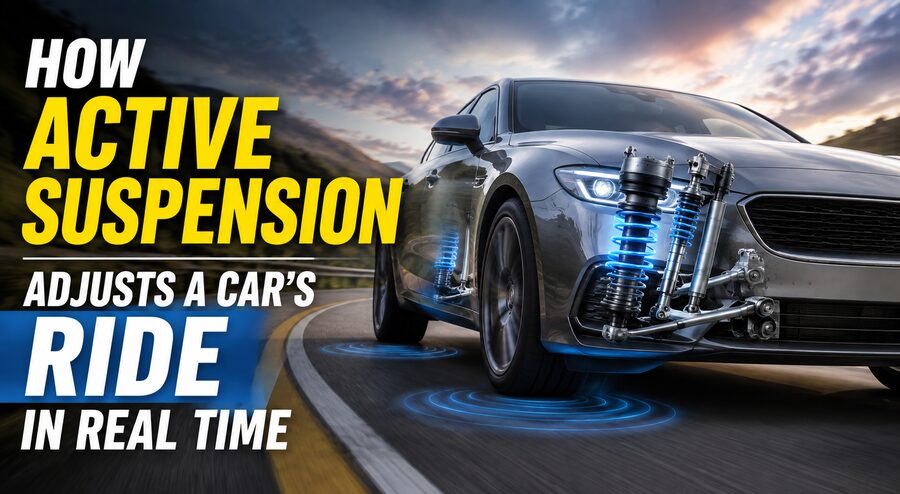

Modern cars are filled with technologies designed to make driving safer, smoother, and more comfortable. One of the most impressive is active suspension, a system capable of adjusting how a vehicle responds to bumps, corners, acceleration, and braking almost instantly. 🚘⚙️
Traditional suspension systems depend mainly on springs, shock absorbers, and mechanical components with largely fixed characteristics. Active suspension takes things much further. Using sensors, electronic control units, and electronically or hydraulically controlled actuators, the vehicle can continuously change suspension behavior while driving.
That means the car can soften the ride on a rough road, stiffen the suspension during aggressive cornering, reduce body roll, and help keep the vehicle more stable—all within fractions of a second.
Here is how this remarkable technology works. 👇
🛞 What Is a Car Suspension System?
Before understanding active suspension, it helps to know what suspension does.
A vehicle’s suspension connects the wheels to the body or chassis. Its main components usually include:
- Springs
- Dampers or shock absorbers
- Control arms
- Bushings
- Anti-roll bars
- Steering and wheel-linkage components
The suspension has two major responsibilities.
First, it helps keep the tires in contact with the road, which is essential for steering, braking, and acceleration.
Second, it isolates passengers and the vehicle body from bumps, potholes, and other road imperfections. 🛣️
These goals can conflict with each other.
A very soft suspension provides excellent comfort but may allow excessive body movement during cornering. A very stiff suspension improves handling but can make the ride uncomfortable.
Active suspension helps solve this compromise by changing its behavior according to the situation.
⚙️ What Is Active Suspension?
An active suspension system uses electronically controlled components to actively manage the movement of the vehicle’s body and wheels.
Instead of relying only on fixed spring rates and passive shock absorbers, active systems can apply or modify forces at individual wheels.
The system continuously monitors what the vehicle is doing and responds in real time.
For example:
➡️ A wheel hits a bump.
➡️ Sensors detect rapid suspension movement.
➡️ The control computer calculates the required response.
➡️ The suspension adjusts damping or applies corrective force.
➡️ Less of the bump reaches the vehicle cabin.
This entire process can occur extremely quickly. ⚡
🧠 The Electronic Brain Behind Active Suspension
The heart of an active suspension system is its electronic control unit, often called an ECU.
The ECU receives information from sensors positioned throughout the vehicle.
Depending on the system, these sensors may monitor:
- 🚗 Vehicle speed
- 🛞 Wheel movement
- 📐 Steering angle
- ↔️ Lateral acceleration
- ⬆️ Vertical acceleration
- 🛑 Brake pressure
- ⚡ Accelerator position
- 🔄 Yaw rate
- 📏 Vehicle body height
- 🛣️ Road conditions
The computer processes this information many times per second.
It then decides how much force or damping should be applied at each corner of the vehicle.
This constant feedback loop allows the suspension to respond to changing driving conditions almost immediately.
🔄 How Active Suspension Reacts to a Bump
Imagine driving over a speed bump.
In a conventional suspension system, the wheel moves upward and compresses the spring. The shock absorber controls how quickly the wheel and body move afterward.
An active system can react more intelligently.
When sensors detect the wheel beginning to move upward, the suspension controller can reduce or adjust the damping force so the wheel moves more freely over the bump.
At the same time, the system may control body movement to prevent the passenger compartment from being thrown upward.
The result can be a noticeably smoother ride. 😌
Some sophisticated vehicles even use forward-looking cameras or road-scanning sensors to identify bumps before the wheels reach them.
The suspension can then prepare itself in advance.
📷 Road-Scanning Suspension Technology
One of the most advanced forms of active suspension uses cameras, radar, or other sensors to examine the road ahead.
A forward-facing camera may detect:
- Potholes
- Speed bumps
- Uneven pavement
- Road depressions
- Surface changes
The computer analyzes the upcoming road profile and determines when each wheel is likely to encounter the irregularity.
It can then adjust the suspension before impact. 🛣️👀
Instead of merely reacting to a bump, the car effectively anticipates it.
This predictive approach can significantly improve passenger comfort.
🏎️ How Active Suspension Helps During Cornering
When a conventional car enters a corner at speed, centrifugal effects cause the vehicle body to lean toward the outside of the turn.
This movement is called body roll.
For example, during a left-hand turn, the body tends to lean toward the right.
Excessive body roll can make a vehicle feel less stable and can alter how weight is distributed across the tires.
Active suspension can counteract this movement.
Sensors detect steering input and lateral acceleration. The control unit calculates the expected body roll and adjusts suspension forces accordingly.
The outside suspension may become firmer or generate an opposing force, while the inside suspension may be adjusted differently.
The vehicle remains flatter through the corner. 🏁
Benefits may include:
- Improved stability
- More predictable handling
- Better tire contact
- Increased passenger comfort
- Reduced body movement
This allows engineers to provide both a comfortable ride and sporty handling without relying entirely on extremely stiff springs.
🛑 Reducing Nose Dive Under Braking
When a vehicle brakes hard, its weight shifts toward the front.
The front suspension compresses while the rear suspension becomes lighter.
This creates a motion known as brake dive or nose dive.
Active suspension can detect rapid braking and respond almost immediately.
The system can increase support at the front of the vehicle, helping keep the body more level. 🛑
This does not eliminate weight transfer—the laws of physics still apply—but it can reduce visible and uncomfortable body movement.
Keeping the vehicle flatter may also improve driver confidence during emergency braking.
⚡ Controlling Squat During Acceleration
The opposite happens during hard acceleration.
Weight transfers toward the rear of the vehicle, causing the rear suspension to compress and the front to rise.
This movement is called squat.
Active suspension can counteract squat by adjusting suspension forces as acceleration increases.
As a result, the vehicle stays closer to level even during rapid acceleration. 🚀
This is particularly useful in powerful sports cars, luxury sedans, and high-performance electric vehicles.
🔧 Active vs. Adaptive Suspension
The terms active suspension and adaptive suspension are sometimes used interchangeably, but technically they can refer to different systems.
🔹 Adaptive Suspension
Adaptive suspension mainly changes the characteristics of the shock absorbers.
For example, electronically controlled dampers can switch between softer and firmer settings.
A comfort mode may provide softer damping, while a sport mode may increase stiffness.
🔹 Fully Active Suspension
A fully active system can actively generate forces that influence wheel or body movement.
It may use:
- Hydraulic actuators
- Electric motors
- Electromechanical devices
- High-pressure pumps
Fully active systems can potentially control body movement much more aggressively than conventional adaptive dampers.
However, they are usually more complicated, expensive, and energy-intensive.
🧲 Magnetorheological Dampers
One fascinating form of electronically adjustable suspension uses magnetorheological fluid.
This specialized fluid contains tiny magnetic particles.
Under normal conditions, the fluid flows relatively easily.
When an electromagnetic field is applied, the particles align, changing the fluid’s resistance almost instantly. 🧲
By controlling the magnetic field, the vehicle can adjust the damping force extremely quickly.
The result is a shock absorber that can shift from relatively soft to significantly firmer operation in a very short time.
Such systems are often used in performance and luxury vehicles.
💧 Hydraulic Active Suspension
Some active suspension designs use hydraulic pressure to generate corrective forces.
Hydraulic actuators can raise, lower, or support individual corners of the vehicle.
A pump supplies pressurized hydraulic fluid, while electronically controlled valves regulate how the system responds.
Hydraulic active suspension can produce powerful forces and excellent body control.
However, it can also add:
- Weight
- Complexity
- Energy consumption
- Maintenance requirements
For this reason, engineers must carefully balance performance benefits against cost and efficiency.
⚡ Electric Active Suspension
Modern electric vehicles have encouraged the development of increasingly sophisticated electromechanical suspension systems.
Instead of relying entirely on hydraulic pumps, these systems may use electric motors or electrically powered actuators.
Electric systems can potentially react very quickly and provide precise control.
Some designs can even recover a portion of the energy generated by suspension movement, although implementation varies.
As vehicles become more electronically controlled, electric active suspension is likely to become increasingly important. 🔋
🚙 Automatic Ride-Height Adjustment
Some advanced suspension systems can also change the vehicle’s height.
At highway speeds, the suspension may lower the body slightly.
This can:
- Reduce aerodynamic drag
- Improve efficiency
- Lower the center of gravity
- Improve high-speed stability
When driving over rough terrain, the vehicle may raise itself to increase ground clearance. 🏔️
This feature is especially useful in luxury SUVs and off-road vehicles.
Different driving modes may automatically select different ride heights.
🌊 How Active Suspension Improves Comfort
Passenger comfort depends heavily on controlling vertical and side-to-side motion.
Without good suspension control, passengers may experience:
- Bouncing
- Pitching
- Rolling
- Vibrations
- Harsh impacts
Active suspension attempts to isolate the cabin from these movements.
Some highly advanced systems can control individual wheels independently, allowing the wheels to follow road imperfections while keeping the body relatively stable.
The sensation can feel as though the car is floating over uneven pavement. ☁️🚘
🛡️ Does Active Suspension Improve Safety?
Active suspension can contribute to vehicle stability and control, although it does not replace systems such as electronic stability control, anti-lock braking, or traction control.
Maintaining better tire contact with the road can help support:
- Steering response
- Braking performance
- Cornering stability
- Vehicle balance
Because modern cars share information across multiple electronic systems, suspension controllers can also work alongside braking, steering, and stability systems.
For example, if stability-control sensors detect that the car is entering a turn aggressively, the suspension may adjust simultaneously to improve body control.
🖥️ Drive Modes and Suspension Settings
Many modern vehicles allow drivers to select modes such as:
Comfort 🛋️ – Softer suspension response for everyday driving.
Sport 🏎️ – Firmer suspension for faster steering response and reduced body roll.
Eco 🌱 – May adjust ride height or suspension behavior to improve efficiency.
Off-Road 🏔️ – Can raise ride height and allow greater wheel movement.
Individual ⚙️ – Allows the driver to customize suspension settings independently from the engine or steering response.
In vehicles with advanced active suspension, these modes do more than change a single fixed setting. The suspension may continue making adjustments continuously within the selected mode.
⚠️ Challenges of Active Suspension
Active suspension offers impressive advantages, but it also introduces challenges.
The systems contain additional electronics, sensors, actuators, pumps, and control software.
This can make them:
- More expensive to manufacture
- More complicated to repair
- Heavier than simple suspension systems
- More dependent on electronics
- Potentially expensive to replace as the vehicle ages
Engineers therefore try to design systems that provide meaningful improvements without unnecessary complexity.
🤖 Active Suspension and Autonomous Vehicles
Active suspension could become even more important as autonomous vehicles develop.
Passengers in a self-driving car may spend less time watching the road and more time reading, working, or using digital displays.
That can make unwanted body movement more noticeable and may even increase motion sickness. 🤢
A predictive suspension system could use maps, cameras, lidar, and other sensors to anticipate curves and bumps.
The car could then adjust the suspension before the movement occurs.
Future vehicles may therefore coordinate autonomous driving and suspension control as one integrated system.
🔮 The Future of Real-Time Suspension Technology
Suspension systems are increasingly becoming software-controlled.
Future cars may combine:
- Artificial intelligence 🧠
- Road-scanning cameras 📷
- High-definition maps 🗺️
- Vehicle-to-vehicle communication 📡
- Electric suspension actuators ⚡
- Predictive algorithms 💻
Imagine a car receiving information from another vehicle about a pothole several hundred meters ahead.
The suspension could prepare itself before reaching the damaged road.
Systems may also learn a driver’s habits and automatically tailor suspension settings to their preferences.
🚗 Final Thoughts
Active suspension transforms a traditionally mechanical system into an intelligent, continuously adjusting part of the vehicle.
By using sensors to monitor wheel movement, steering, acceleration, braking, vehicle speed, and road conditions, the system can modify damping or apply corrective suspension forces in real time. ⚙️
When the road becomes rough, it can prioritize comfort. When the driver enters a fast corner, it can reduce body roll. During hard braking, it can fight nose dive. Under acceleration, it can reduce squat. Some systems can even scan the road ahead and prepare for bumps before they arrive.
The real achievement of active suspension is its ability to reduce the traditional compromise between comfort and handling.
Instead of forcing engineers to choose between a soft luxury ride and firm performance-oriented handling, active suspension allows the vehicle to provide both depending on the situation.
As sensors, electric actuators, software, and artificial intelligence continue to improve, suspension systems are likely to become even more predictive and intelligent. The result could be cars that not only react to the road beneath them but actively prepare for what lies ahead. 🚘🛣️✨