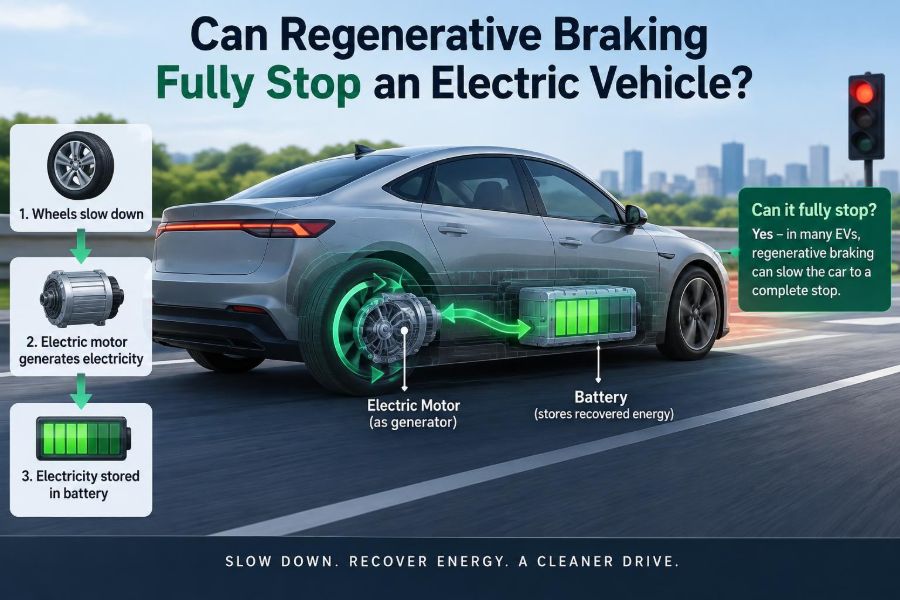

A driver approaches a red light in an electric car, eases off the accelerator, and feels the vehicle begin to slow. No brake pedal has been pressed, yet energy that would normally become heat at the wheels is being sent back to the battery.
That experience makes an obvious question feel more complicated: if the motor can slow the car and recharge the battery, why does the vehicle still need ordinary friction brakes? In some driving modes, the answer appears to be: only rarely.
But a vehicle has to stop safely in every condition, not only during a gentle urban deceleration with a warm battery and plenty of grip. It must also hold still on a slope, stop on a slippery road, and respond predictably in an emergency.
Understanding where regenerative braking works, where it fades away, and how it cooperates with hydraulic brakes is essential for anyone studying modern automobile engineering. 🚙
⚡ 1. The Short Answer
Regenerative braking can bring an electric vehicle close to a stop and, in some designs, all the way to zero speed under suitable conditions. It cannot, however, replace friction braking as the sole braking system of a road vehicle.
Regeneration depends on the electric motor, inverter, battery, tyre-road grip, and operating conditions. Friction brakes remain necessary for low-speed stopping, emergency braking, parking, stability control, backup capability, and situations in which the battery cannot accept energy.
The practical arrangement is therefore a blended braking system. Control software decides how much requested deceleration comes from the motor and how much comes from hydraulic wheel brakes.
🔄 2. What Regenerative Braking Actually Does
During propulsion, electrical energy flows from the battery through the inverter to the traction motor. The motor produces torque at the driven wheels, converting electrical energy into mechanical motion.
During regeneration, the energy flow reverses. The rotating wheels drive the motor, which acts as a generator; the inverter manages the electrical output, and the battery receives charge.
This generator action creates a torque that opposes wheel rotation. That opposing torque is the braking effect the driver feels.
- Vehicle kinetic energy is reduced.
- Some of that energy becomes electrical energy.
- The battery stores a portion of the recovered energy.
- Unavoidable losses still occur in tyres, gears, electronics, and the battery.
🧲 3. Why a Motor Can Produce Braking Torque
An electric machine does not need to be “turned off” to stop producing useful torque. By controlling magnetic fields and current, the drive system can command negative torque rather than positive propulsion torque.
For a simplified rotating system, mechanical power is related to torque and rotational speed: P = T × ω. In regenerative operation, the torque opposes the rotational direction, so mechanical energy is extracted from the wheels.
The available regenerative force is therefore linked to motor speed. As speed drops, the machine has less rotational power available to convert, even if the control system is requesting strong deceleration.
🚦 4. Lift-Off Deceleration and Brake-Pedal Braking
Many EVs begin regeneration when the driver simply lifts off the accelerator. This is often called lift-off regeneration and can create a pronounced one-pedal driving experience.
Pressing the brake pedal usually asks for more deceleration. The vehicle controller then blends regenerative torque with friction braking as needed to meet the driver’s request.
These are separate driver inputs, but both may use regeneration. A well-calibrated vehicle makes the transition feel natural, so the pedal does not suddenly feel different when hydraulic braking begins.
🏙️ 5. Why City Driving Favors Energy Recovery
Urban driving includes frequent slowing from moderate speeds, repeated stops, and relatively low aerodynamic losses. Those conditions create many opportunities to recover kinetic energy.
On a long steady highway journey, less energy is available from braking because the vehicle spends more time maintaining speed. When a highway vehicle does slow, a larger share of its lost energy may also be associated with aerodynamic drag rather than recoverable wheel energy.
Regeneration is most valuable when the driver anticipates traffic, lifts off early, and allows controlled deceleration instead of repeatedly converting speed into friction-brake heat.
📉 6. Why Regenerative Braking Weakens Near Zero Speed
The central limitation is simple: at very low wheel speed, the motor generates little useful electrical power. Since P = T × ω, reducing angular speed ω reduces power for a given torque.
Motor-control methods can maintain braking torque over a useful low-speed range, but they cannot make a stationary wheel continuously generate electrical energy. Once the vehicle is stopped, there is no rotational kinetic energy left to recover.
For this reason, many vehicles smoothly add friction braking as speed falls. The driver may not notice the handover, but the hydraulic system commonly performs the final part of the stop.
🛑 7. Can an EV Reach Zero Speed on Regeneration?
Some EVs can use regeneration to decelerate to a complete standstill in a one-pedal mode. That does not mean regeneration alone supplies every part of the stop.
Near zero speed, the system may apply the friction brakes automatically to finish the stop and hold the vehicle. From the driver’s perspective, the car stops without brake-pedal input; from an engineering perspective, braking functions have been coordinated.
The distinction matters. One-pedal driving is a driver-interface feature, not proof that friction brakes are unnecessary.
🔋 8. The Battery Must Be Able to Accept Charge
Recovered electrical energy has somewhere to go only if the battery can accept charging power. Battery management systems limit regenerative braking when charge acceptance is restricted.
A battery near a high state of charge may have limited room for additional energy. The system then reduces regenerative torque and relies more heavily on friction brakes for the same requested deceleration.
Battery temperature also matters. Cold cells, very hot cells, and batteries being actively protected by their management system may accept less charging power than under favorable conditions.
❄️ 9. Cold Weather Changes the Braking Blend
At low temperatures, battery electrochemical behavior changes and charging acceptance can be reduced. An EV may consequently offer weaker regeneration shortly after a cold start.
This can alter lift-off deceleration and change how much friction braking is required. A driver who expects a certain one-pedal response may notice that the vehicle coasts more than usual or uses a different brake feel.
Good control systems communicate limitations clearly and preserve consistent, safe braking response. The priority is predictable deceleration, not maximum energy recovery. ❄️
🏔️ 10. Long Descents Reveal Another Limit
On a sustained downhill route, gravity continually adds energy to the vehicle. Regeneration can help control speed while returning part of that energy to the battery.
However, if the battery reaches its permitted charge limit during the descent, regeneration must be reduced or stopped. The friction brakes then assume more of the speed-control task.
This is one reason a complete braking system cannot depend solely on battery charging. A safe vehicle must still manage a long descent when storage capacity is unavailable.
🛞 11. Tyre Grip Sets the Ultimate Braking Limit
Neither regenerative nor friction braking can exceed the tyre-road friction available at each wheel. Excessive braking torque causes wheel slip, which can reduce directional control and lengthen a stop.
On dry pavement, the vehicle may be able to use considerable regenerative torque. On wet, icy, loose, or uneven surfaces, the allowable torque may fall sharply.
The braking system must therefore regulate torque according to grip, wheel speed, vehicle motion, and driver demand. Recovering energy is valuable only while the tyres remain under control.
🧠 12. ABS and Stability Control Still Matter
Anti-lock braking systems monitor for wheel lock tendencies and reduce braking force to help preserve steerability. In an EV, this regulation must coordinate both hydraulic pressure and regenerative motor torque.
Electronic stability control may request braking at selected wheels to counter understeer, oversteer, or yaw disturbances. A single traction motor cannot independently brake every wheel, so friction brakes remain especially important for these interventions.
Regeneration may be reduced quickly when wheel-slip control activates. Fast, stable handling of the vehicle is more important than recovering a little more energy.
⚙️ 13. Driven Wheels Limit Where Regeneration Acts
A motor can regenerate only through the wheels mechanically connected to it. A front-wheel-drive EV normally regenerates through the front axle, while a rear-wheel-drive EV normally regenerates through the rear axle.
An all-wheel-drive EV with motors on both axles has greater flexibility. It can distribute regenerative torque across the vehicle, subject to motor capability, battery acceptance, grip, and stability requirements.
Friction brakes are fitted at all wheels because braking distribution must remain safe even when a drive motor is unavailable or a particular axle has limited traction.
⚖️ 14. Brake Balance Is Not Fixed
During deceleration, load transfers toward the front axle. The front tyres can generally support more braking force while the rear tyres become easier to lock.
A braking controller adjusts front-rear force distribution to reflect this changing vertical load. It also considers vehicle speed, road gradient, cornering, drive configuration, and available regenerative torque.
Using a fixed regeneration level would be inefficient and can be unstable. Modern brake blending is a continuously changing control problem, not a simple on-off generator function.
🦶 15. Brake Pedal Feel Must Stay Consistent
Drivers judge braking partly by pedal travel, force, response time, and deceleration. They should not have to identify the exact moment when the vehicle moves from motor braking to friction braking.
In a blended system, software calculates a target deceleration from pedal input. It first uses regeneration within safe limits and then commands hydraulic pressure for the remaining braking demand.
Pedal-feel systems and brake actuators are designed so that changing energy recovery does not create an unsettling change in response. This is a major integration challenge in EV brake engineering.
🧩 16. Comparing Regeneration and Friction Braking
| Feature | Regenerative braking | Friction braking |
|---|---|---|
| Primary energy outcome | Returns part of kinetic energy to the battery | Converts kinetic energy mainly to heat |
| Useful near standstill | Limited by very low motor speed | Effective down to zero speed |
| Dependent on battery acceptance | Yes | No |
| Independent wheel control | Limited by motor and driveline layout | Available through wheel brake circuits and control systems |
| Parking and holding | Not a dependable long-term solution by itself | Used through service and parking brake functions |
The two systems are not rivals. Their strengths are complementary, which is exactly why production EVs combine them.
🔥 17. Friction Brakes Still Need Thermal Capacity
Even in an EV, disc brakes and other friction components must withstand demanding use. Emergency stops, mountain descents with limited regeneration, repeated high-energy stops, and fault conditions can generate substantial heat.
Regeneration can reduce normal brake wear and reduce heat during routine deceleration. It does not eliminate the need for robust rotors, pads, calipers, fluid, and cooling considerations.
Engineers size friction brakes for safety-critical duty, not merely for the average amount of braking left after energy recovery.
🅿️ 18. Stopping Is Different From Holding Still
Bringing a moving vehicle to zero speed is one task. Keeping it stationary on a hill, at a traffic signal, or while parked is another.
A motor can create holding torque for a limited operating situation, but relying on continuous electrical control alone is not the preferred parking safety strategy. Electrical energy use, system faults, and thermal limits must be considered.
Vehicles therefore use hydraulic hold functions, mechanical parking brakes, or electronically applied parking brakes. These provide a secure stationary condition independent of regenerative energy capture.
🚨 19. Emergency Braking Prioritizes Deceleration
In a panic stop, the braking system must achieve the requested deceleration as rapidly and controllably as available grip permits. It cannot wait for ideal regenerative conditions.
Regeneration may contribute, but friction braking provides immediate additional capacity whenever motor torque, battery acceptance, or driven-wheel traction is insufficient. ABS and stability functions may continuously change the contribution from each source.
Energy recovery is always subordinate to stopping performance and vehicle control. This hierarchy is fundamental to brake-system design.
🛡️ 20. Redundancy Is a Safety Requirement
Road vehicles need braking capability even if an electrical component, high-voltage system, control pathway, or traction machine develops a fault. Hydraulic friction brakes provide an essential independent means of slowing the vehicle.
Brake systems also include monitoring, diagnostics, warning strategies, and fallback operating modes. The exact architecture differs by vehicle, but the design goal remains clear: a single failure should not leave the driver without adequate braking control.
Regenerative braking adds capability and efficiency; it should not create a single point of failure for basic stopping.
🔌 21. What Happens When the High-Voltage System Is Unavailable?
If the traction battery is disconnected or the inverter cannot command regenerative torque, the motor cannot provide normal energy recovery. The vehicle must still be capable of being slowed through its friction brakes.
This situation illustrates why calling regeneration the “main brake” can be misleading. It may perform much of the routine deceleration, but the friction system remains a necessary safety foundation.
The driver may notice reduced energy recovery or a changed pedal response, but safe brake-system design aims to retain usable, predictable conventional braking.
📐 22. Braking Energy Depends Strongly on Speed
Vehicle kinetic energy is approximated by Ek = ½mv². Although this expression is simplified, it reveals an important point: kinetic energy rises with the square of speed.
Doubling speed increases kinetic energy by roughly four times for the same mass. This means higher-speed braking events contain more energy, but they also place greater demands on motor power, battery charging acceptance, tyre grip, and friction-brake capacity.
Not all of this energy can be recovered. Some is lost to aerodynamic drag, rolling resistance, electrical conversion losses, and battery charging losses.
🎛️ 23. Driver-Selectable Regeneration Modes
Many EVs offer selectable regeneration levels. A lighter setting allows more coasting, while a stronger setting produces more lift-off deceleration.
These settings affect driving feel and can help drivers adapt to traffic, gradients, or personal preference. They do not bypass physical limits imposed by the battery, motor, tyres, or low-speed operation.
A strong mode may still reduce its braking effect when the battery is cold or nearly full. The vehicle controller must retain authority to protect components and maintain stability.
🚗 24. Hybrid Vehicles Use the Same Principle
Hybrid and plug-in hybrid vehicles also recover energy by operating an electric machine as a generator. Their braking systems similarly blend electrical regeneration with friction braking.
The details can differ because hybrids may have multiple machines, engine-connected transmissions, and smaller battery packs. Nevertheless, the low-speed, battery-acceptance, grip, thermal, and safety limitations remain relevant.
Studying EV regenerative braking therefore provides a useful foundation for understanding electrified powertrains across many vehicle types.
🔧 25. Maintenance Changes, but It Does Not Disappear
Because regeneration handles a meaningful share of routine deceleration, friction pads and discs may be used less often than in a comparable conventional vehicle. That can reduce wear in normal service.
Less frequent use does not mean the components can be ignored. Corrosion, contamination, seized sliding parts, aged brake fluid, and uneven pad movement can still affect braking performance.
Periodic inspection and use of the friction brakes remain important. A component reserved for emergencies must still work correctly when that emergency arrives.
🧪 26. How Engineers Validate Brake Blending
Engineers test braking across changing speeds, loads, road surfaces, battery states, temperatures, gradients, and drive modes. They evaluate both measured deceleration and the driver’s perception of pedal response.
They also assess transitions: regeneration increasing, regeneration fading at low speed, ABS intervention, stability-control intervention, and fallback operation after an electrical fault. Smooth transitions are important, but repeatable safe performance is more important.
Calibration is therefore multidisciplinary. It connects electric-machine control, power electronics, battery management, chassis dynamics, hydraulic braking, software, and human factors.
🧭 27. The Core Principle: Recover What You Can, Brake With What You Need
Regenerative braking is an efficient way to convert part of a vehicle’s kinetic energy back into stored electrical energy. It is especially useful during frequent deceleration, where it can improve overall efficiency and reduce routine reliance on friction brakes.
Yet regeneration is constrained by speed, motor capability, battery charge acceptance, available grip, axle layout, and safety-control demands. It cannot recover energy from a stopped vehicle, and it cannot be the only trusted method for every braking scenario.
Electric vehicles stop best by blending regenerative braking for efficiency with friction braking for complete, reliable control in all conditions. ⚡🛑🚙