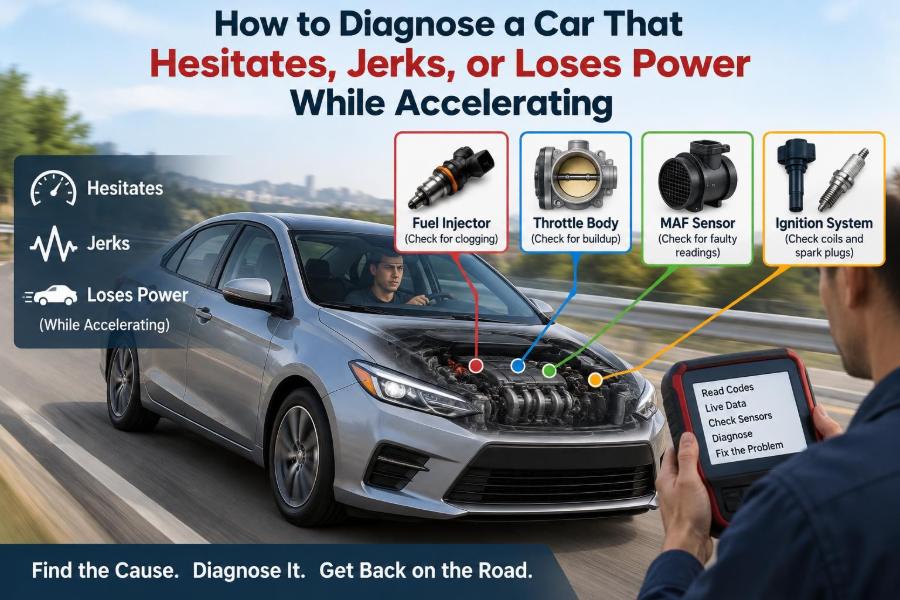

You press the accelerator to join fast-moving traffic, climb a hill, or pull away from a junction—and the car pauses, surges, jerks, or feels strangely weak. The engine may recover after a moment, or the problem may appear only under hard acceleration.
These symptoms are frustrating because they are not one fault. A hesitation can come from fuel delivery, airflow measurement, ignition, exhaust restriction, transmission behavior, or even a dragging brake.
Good diagnosis is therefore less about replacing the most common part and more about observing when, where, and how the fault occurs. The exact driving conditions provide clues that a random parts swap cannot.
This guide explains a logical diagnostic path for conventional petrol and diesel vehicles, with notes where turbocharged, hybrid, and modern electronically controlled cars need special care.
🚦 Start by Defining the Symptom Precisely
“Loses power” can describe several very different experiences. A misfire feels like sharp individual jolts; fuel starvation often feels like a smooth but severe flattening of acceleration; transmission slip may raise engine speed without a matching increase in road speed.
Record the conditions in which the problem happens. Note engine temperature, fuel level, gear, vehicle speed, throttle position, road gradient, warning lights, weather, and whether the engine is cold or warm.
- Hesitation: a brief delay after throttle input.
- Jerking or bucking: repeated, abrupt changes in torque.
- Power loss: reduced ability to accelerate, often sustained.
- Surging: power rises and falls while throttle position is steady.
🛑 Put Safety Before Fault-Finding
A vehicle that loses power unpredictably can be dangerous during overtaking, merging, or crossing traffic. Avoid testing it aggressively on public roads, especially if the check-engine light is flashing, the engine stalls, or there is a fuel smell.
Stop and arrange professional help if you see smoke, hear severe knocking, find a fuel leak, observe overheating, or have a red oil-pressure warning. Those conditions can indicate risks beyond an ordinary drivability fault.
🔍 Separate Engine Problems from Driveline Problems
Watch the tachometer, if fitted. If engine rpm drops, stumbles, or fluctuates with the jerk, the fault is likely in engine operation or its controls. If rpm rises sharply but the vehicle does not accelerate proportionally, investigate the clutch, automatic transmission, torque converter, or CVT.
A vibration that changes mainly with road speed rather than engine speed may instead come from a wheel, driveshaft, or drivetrain mount. This distinction prevents a great deal of wasted work.
💡 Read the Warning Lights Correctly
A steady check-engine light generally means the control module has stored a fault code related to emissions or engine management. The vehicle may still run normally, poorly, or in a reduced-power strategy.
A flashing check-engine light commonly indicates an active misfire severe enough that unburned fuel could overheat and damage the catalytic converter. Reduce load immediately and do not continue hard acceleration.
Other lights matter too. A traction-control light can appear because the system is intervening or because it has detected an engine-management issue. A transmission warning requires a different diagnostic route from an engine fault code.
🧰 Scan Codes, but Do Not Let Them Diagnose the Car
An OBD scan tool is an efficient starting point, not a verdict. Codes may identify a circuit, a sensor range, or a cylinder with detected misfires, but they do not always identify the failed component.
For example, a lean-mixture code can result from low fuel pressure, an intake air leak, a biased airflow sensor, an exhaust leak ahead of an oxygen sensor, or incorrect injector delivery. Clear codes only after recording them, including freeze-frame data captured when the code set.
📊 Use Live Data to See What the ECU Sees
Live scan data can turn a vague complaint into a testable hypothesis. Useful parameters include engine coolant temperature, intake-air temperature, throttle angle, calculated load, mass airflow, manifold pressure, commanded versus actual boost, fuel trims, oxygen-sensor activity, and misfire counts.
Values must be interpreted for the particular engine. A reading that seems unusual is not automatically defective; compare it with service information, a known-good vehicle where possible, and the operating condition.
🔥 Recognize a True Misfire
A misfire occurs when one or more cylinders fail to produce normal combustion. Under acceleration, cylinder pressure rises, making it harder for the ignition system to fire the spark plug gap. That is why weak ignition components often fail first under load.
Typical signs include a shaking engine, sharp jerks, popping from the exhaust, a fuel smell, and a flashing check-engine light. A petrol engine may idle acceptably but stumble badly in a high gear at low rpm when the throttle is opened.
⚡ Inspect Spark Plugs Before Blaming Electronics
Correct spark plugs must have the specified heat range, type, and gap. Worn electrodes increase the voltage needed to jump the gap, while an incorrect gap can create poor ignition performance under load.
Plug appearance also provides evidence. Oil deposits may point to an engine mechanical issue, dry black soot can suggest rich running or weak spark, and one plug that differs markedly from the others may identify the affected cylinder. Do not diagnose solely by colour; modern fuel additives and driving patterns can mislead.
🔌 Test Coils, Leads, and Electrical Connections
Coil-on-plug ignition coils can develop insulation breakdown that appears only when hot or under heavy load. On engines with plug leads, aged leads, poor routing, or damaged insulation may allow high voltage to leak to ground.
If scan data identifies one cylinder, a controlled component swap can be useful: move its ignition coil to another cylinder, then see whether the misfire follows. Follow manufacturer procedures and avoid disconnecting ignition components with the engine running.
⛽ Consider Fuel Quality and Fuel Level First
Badly contaminated fuel, water in fuel, or the wrong fuel type can cause rough running and poor acceleration soon after refuelling. The timing matters: if the symptom began immediately after filling up, retain the receipt and avoid assuming an unrelated part failed.
Low fuel level can expose a weak fuel pump or allow fuel pickup problems during cornering or climbing. This is a clue, not proof. Repeatedly driving near empty also makes diagnosis less consistent.
🛢️ Check Fuel Delivery Under Load
An engine needs much more fuel at wide-open throttle than at idle. A restricted fuel filter, weak electric pump, damaged pump wiring, blocked pickup strainer, failing pressure regulator, or restricted fuel line may therefore cause power loss mainly during acceleration.
Fuel pressure should be tested with the correct equipment and procedure. Some modern direct-injection systems operate at very high pressure, so their high-pressure circuits should be tested only with suitable tools and training.
💉 Understand Injector-Related Faults
Injectors meter fuel into individual cylinders. Deposits, electrical faults, leaks, or poor spray patterns can create hesitation, roughness, hard starting, and cylinder-specific misfires.
A fuel additive may help light deposit-related symptoms in some cases, but it cannot repair a failed injector coil, damaged wiring, severe contamination, or an injector that mechanically sticks. Balance tests and waveform analysis are more conclusive professional methods.
🌬️ Look for Unmetered Air Leaks
Most petrol engines calculate fuel quantity from measured airflow and sensor inputs. A split intake hose, loose clamp, cracked vacuum line, leaking intake gasket, or faulty positive-crankcase-ventilation system can let in air that the system did not measure.
The mixture then becomes lean, particularly at idle or light throttle. A smoke test is often the safest and clearest way to locate intake leaks; spraying flammable liquids around a running engine is not a sensible home diagnostic method.
📡 Evaluate the Mass Airflow and MAP Sensors
The mass airflow (MAF) sensor measures incoming air mass on many engines. A manifold absolute pressure (MAP) sensor measures pressure in the intake manifold; some engines use both. Incorrect information from either sensor can make commanded fueling and boost control unsuitable for the actual airflow.
Inspect connectors, wiring, air ducts, and contamination before replacing a sensor. An oiled aftermarket air filter, for instance, can contaminate certain MAF sensing elements. Use only sensor-safe cleaner when the manufacturer permits cleaning.
🦋 Check the Throttle Body and Pedal Signals
Electronic throttle systems use sensors in both the accelerator pedal and throttle body. The engine control unit compares redundant signals for safety and may limit power when values disagree.
Carbon around a throttle plate can affect idle control and small throttle transitions on some engines. However, a reduced-power warning, throttle-related code, or inconsistent pedal response requires methodical electrical diagnosis rather than merely cleaning parts.
🌡️ Do Not Ignore Engine Temperature Inputs
Coolant-temperature data influences cold enrichment, ignition timing, idle speed, cooling-fan operation, and sometimes transmission strategy. A sensor reporting an implausibly cold or hot engine can produce poor drivability without an obvious overheating symptom.
Compare scan-tool temperature to a cold engine and to actual operating conditions. A large discrepancy may involve the sensor, connector, wiring, or control module interpretation.
🧪 Let Fuel Trims Guide the Search
Fuel trims show how much correction the control unit is adding or subtracting to achieve its target mixture. Positive correction generally means the system is adding fuel because it perceives a lean condition; negative correction means it is removing fuel.
The pattern is especially useful. A lean correction mainly at idle often suggests an intake leak, while a lean correction that worsens at higher load can point toward inadequate fuel delivery. These are diagnostic patterns, not absolute rules.
🧯 Consider Exhaust Restriction
A damaged or melted catalytic converter, collapsed muffler internals, or blocked diesel particulate filter can restrict exhaust flow. The engine may start and idle reasonably well but become increasingly breathless as rpm and load rise.
Signs can include excessive heat, a sulfur-like smell, weak high-speed acceleration, and unusually high backpressure. Restriction testing should follow manufacturer guidance because drilling or removing exhaust components can create safety, emissions, and legal problems.
🌪️ Diagnose Turbo and Boost-System Faults
Turbocharged engines depend on pressurized intake air. A split charge-air hose, loose intercooler connection, sticking wastegate, failed boost-control solenoid, vacuum leak, or sensor error can reduce boost and cause a pronounced loss of power.
Listen for a new rushing or whooshing noise under acceleration, but do not treat sound alone as proof. Compare requested boost with measured boost on a scan tool and inspect hoses for oil traces, splits, and loose clamps.
🛢️ Account for Diesel-Specific Issues
Diesel engines can hesitate because of restricted fuel filters, air entering the low-pressure fuel side, injector faults, boost leaks, exhaust-gas-recirculation problems, or particulate-filter loading. Their control strategies differ substantially from petrol engines.
A diesel particulate filter may trigger reduced power when soot loading becomes excessive or when its pressure-sensing system reports implausible values. Forced regeneration and related repairs should be performed correctly; repeated short journeys may be part of the operating context but are not the only possible cause.
♻️ Check EGR and Intake Deposits with Context
The exhaust-gas-recirculation (EGR) system returns a controlled amount of exhaust gas to the intake under certain conditions. If an EGR valve sticks open when it should close, acceleration can feel flat or rough because the intake charge contains too much inert exhaust gas.
Carbon deposits in intake passages can also affect airflow, especially on some direct-injection engines. Diagnosis should distinguish a confirmed restriction or sticking valve from a merely dirty-looking component.
🧠 Understand Reduced-Power or Limp-Home Mode
When the ECU detects a fault that could harm the engine, emissions equipment, or driveline, it may limit throttle opening, boost, rpm, or available torque. Drivers often describe this as the car “suddenly having no power.”
Switching the ignition off may temporarily restore normal response, but this does not fix the cause. Record codes before clearing them and avoid repeated full-throttle attempts, which may turn an intermittent clue into a more expensive failure.
⚙️ Rule Out Clutch and Transmission Slip
In a manual vehicle, a worn clutch can slip most noticeably in a high gear under acceleration. Engine speed rises disproportionately, sometimes accompanied by a hot friction smell, while vehicle speed lags behind.
Automatic transmissions can hesitate, flare between gears, shudder, or enter a protective mode because of fluid condition, hydraulic control, sensor faults, solenoid issues, or internal wear. Transmission diagnosis needs its own codes, fluid specifications, and road-test procedure.
🛞 Remember Brakes, Bearings, and Mechanical Drag
Not every apparent power loss comes from the engine. A seized brake caliper, parking brake that fails to release, or severely damaged wheel bearing can make the vehicle feel reluctant to accelerate.
After a short drive, a wheel that is dramatically hotter than the others may indicate drag, but do not touch hot wheels or brake components. A workshop can safely inspect temperatures and brake operation.
🔧 Check Basic Mechanical Health
Low compression, incorrect camshaft timing, valve-train faults, or a timing-chain problem can cause persistent low power and rough running. These faults may also produce unusual mechanical noise, difficult starting, or codes related to cam/crank correlation.
Compression and leak-down tests help distinguish sealing problems involving valves, piston rings, head gasket, or cylinder damage. They should be performed and interpreted alongside timing verification rather than used as isolated pass/fail numbers.
🧭 Use a Logical Diagnostic Sequence
Start with observations that are inexpensive, safe, and likely to change the next decision. Then move from external inspection and electronic evidence to pressure tests, mechanical tests, and component replacement.
- Confirm the symptom and duplicate it safely, if possible.
- Check warning lights, fluid levels, obvious leaks, intake hoses, and wiring damage.
- Scan all relevant modules and save codes and freeze-frame data.
- Review live data and identify whether the issue follows load, temperature, speed, or a specific cylinder.
- Test the most plausible system with an appropriate method.
- Repair, verify the symptom is gone, and rescan for returning codes.
❌ Avoid the Parts-Cannon Approach
Replacing spark plugs, coils, sensors, filters, and fuel pumps one after another may eventually cure some faults, but it is expensive and can introduce new problems. Cheap pattern sensors are particularly capable of creating confusing readings or new codes.
Do not assume that a code naming a sensor means that sensor failed. The ECU may be reporting a signal outside its expected range because of a vacuum leak, poor ground, wiring fault, exhaust leak, or genuine mechanical condition.
📋 Keep a Symptom and Repair Record
Write down the date, mileage, fuel purchase, weather, fault codes, live-data observations, repairs, and whether the problem changed. Intermittent faults are easier to solve when patterns are documented rather than remembered.
This record is also useful when handing the car to a technician. “It jerks sometimes” is less actionable than “after ten minutes of driving, it misfires only above moderate load in third gear, with a flashing engine light.”
👨🔧 Know When Professional Testing Is Necessary
A competent technician can use smoke machines, fuel-pressure equipment, oscilloscopes, scan-tool bidirectional controls, exhaust backpressure tools, and manufacturer wiring information. These tools test systems under conditions that a basic code reader cannot reproduce.
Seek professional diagnosis promptly for high-pressure fuel systems, hybrid or electric high-voltage systems, active misfires, turbocharger control faults, transmission symptoms, overheating, and any symptom that affects safe merging or overtaking.
✅ The Core Principle: Diagnose the Condition, Not the Part
Acceleration depends on the engine receiving the correct air, fuel, spark or injection event, timing, exhaust flow, and control inputs—while the transmission and brakes allow torque to reach the road. A defect in any link can feel broadly similar from the driver’s seat.
The fastest reliable route is to connect the symptom to its conditions, collect evidence, and test a hypothesis. That approach respects the complexity of modern vehicles while keeping simple faults, such as split hoses and worn plugs, from being overlooked.
A car that hesitates, jerks, or loses power is giving diagnostic clues; careful observation and measured testing turn those clues into the right repair. 🚗🔧📈