
Picture a trip that is only a few kilometres long: a visit to family, a delivery across town, or a commute to work. Today, the choice often feels routine—walk, take a bus, call a taxi, cycle, or drive. In the nineteenth century, that same trip depended heavily on walking, animal power, rail timetables, and roads that could turn difficult in wet weather.
The automobile did not suddenly solve every transport problem. Its earliest forms were noisy, slow, mechanically fragile, and viewed with suspicion. Yet one machine showed that a compact engine could carry people independently of a horse or a railway line.
That shift mattered because it connected engineering choices—combustion, steering, power transmission, braking, and materials—to everyday mobility. It also began a long chain of changes in manufacturing, cities, energy systems, safety, and the environment.
The story of the first practical automobile is therefore more than a history lesson. It is a useful case study in how an engineering prototype becomes a working transportation system.
🧭 What “First Practical Automobile” Really Means
Calling one vehicle the “first automobile” requires care. Earlier self-propelled road vehicles existed, including steam-powered machines, and several inventors developed internal-combustion engines and carriage-like vehicles in the nineteenth century.
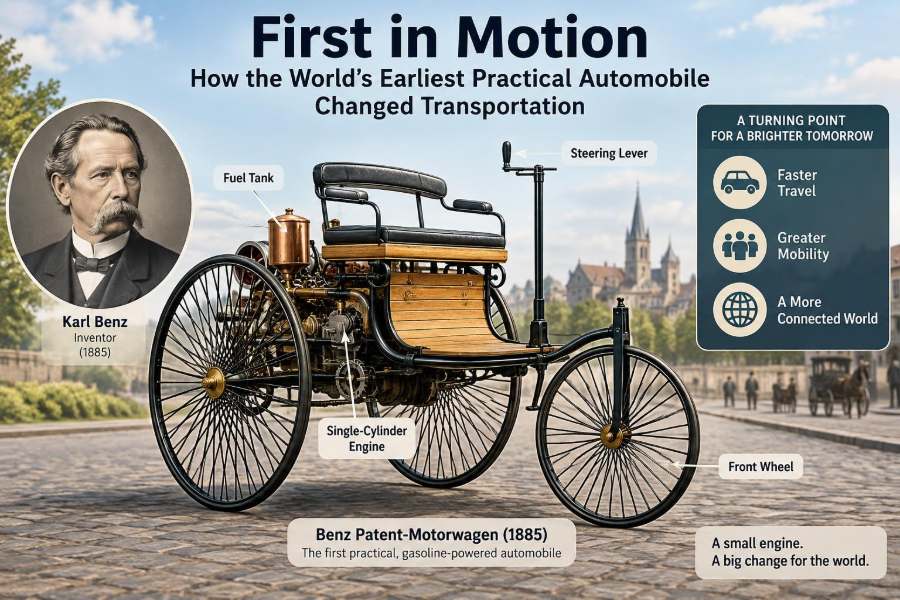
Most historians identify Karl Benz’s 1885 Patent-Motorwagen—patented in January 1886—as the first practical automobile powered by an internal-combustion engine and designed as an integrated vehicle rather than as a converted horse carriage. “Practical” does not mean convenient by modern standards. It means the machine combined a workable engine, chassis, controls, fuel supply, and road capability into a usable design.
🛞 Transportation Before the Motor Car
Before automobiles, road travel was dominated by feet, horses, carts, coaches, and bicycles. These systems could be highly effective, but animal-drawn travel required feeding, housing, rest, and constant care for the animal.
Railways transformed long-distance travel by moving many people and heavy freight efficiently along fixed routes. Their strength was also their limitation: passengers and goods still needed a way to travel between the station and the final destination.
The early motor car introduced a new possibility: powered point-to-point travel on ordinary roads, without tracks and without a living animal as the source of traction.
🔥 Why Internal Combustion Was a Turning Point
An internal-combustion engine releases fuel energy inside a cylinder. Combustion raises gas pressure, which pushes a piston; the piston’s reciprocating, or back-and-forth, motion is converted into rotary motion at the crankshaft.
Compared with a steam road vehicle, a gasoline engine could be comparatively compact and did not require a boiler, water supply, and time to raise steam. It still demanded reliable ignition, cooling, lubrication, and fuel metering—challenges that made early designs far from simple.
Its advantage was power density: useful power from a relatively small and light machine. That characteristic made personal road vehicles more feasible.
👨🔧 Karl Benz and the Integrated Design Approach
Karl Benz was not merely attaching an engine to an existing carriage. His Motorwagen was conceived around its power unit and drivetrain. That distinction matters because the loads, vibration, steering needs, and balance of a powered vehicle differ from those of a horse-drawn one.
The vehicle used a lightweight tubular steel frame and three wheels. A three-wheel layout avoided the difficult steering geometry required for a four-wheeled vehicle, while still providing a stable enough platform for its intended modest speed.
This integration is a lasting engineering lesson: a successful product often emerges when the system is designed as a whole, rather than when one new component is added to an unsuitable old system.
⚙️ The Motorwagen’s Single-Cylinder Engine
The Patent-Motorwagen used a single-cylinder, four-stroke gasoline engine mounted at the rear. In the four-stroke cycle, the engine draws in a charge, compresses it, produces power after ignition, and expels exhaust gases.
Its output was very small by current automotive standards, but low vehicle mass meant it could propel the machine at roughly walking-to-cycling speeds on favourable roads. Early performance depended strongly on gradients, surface condition, mechanical adjustment, and passenger load.
A large flywheel helped smooth the intermittent pulses from the single cylinder. This is a basic engine principle: because combustion does not occur continuously, rotating mass stores energy between power strokes.
🧪 Fuel Was an Engineering Problem Too
Early motorists could not pull into a purpose-built filling station. Benz’s engine ran on ligroin, a light petroleum solvent then available from chemists and pharmacies. Fuel availability therefore constrained where a journey could realistically begin and end.
Fuel quality and delivery also affected operation. A combustion engine needs an ignitable mixture of fuel vapour and air; too rich or too lean a mixture can reduce power, cause poor running, or prevent starting.
The lesson remains familiar to engineers: an invention is only useful when its supporting system—fuel, maintenance, parts, knowledge, and access—develops around it.
🔌 Ignition and Combustion Control
For the fuel-air charge to release energy at the right moment, the engine requires ignition. The Motorwagen used an electrical ignition arrangement, a significant feature when dependable small-scale electrical systems were still developing.
Ignition timing affects efficiency and drivability. If combustion begins too early, pressure can oppose the rising piston; too late, the expanding gases cannot transfer their energy as effectively. Modern electronic controls manage this continuously, but the underlying requirement was already clear.
Early ignition reliability mattered especially because a roadside failure could leave an owner with few repair facilities and no replacement vehicle.
🌡️ Keeping a Small Engine Cool
Combustion produces far more heat than can be converted into mechanical work. Without heat removal, engine parts expand, lubricant degrades, and damage can occur. The Motorwagen used an evaporative water-cooling arrangement rather than the pressurised, pump-driven cooling systems familiar today.
This worked at low power, but it required attention to water level and limited sustained operation. Cooling is often overlooked in simplified accounts of engines, yet it is one reason a running demonstration and a dependable vehicle are not the same achievement.
Every powertrain is a heat-management system as well as a motion-producing system.
🔗 From Crankshaft to Road Wheels
Making an engine rotate is only the beginning. The rotation must reach the driven wheel at an appropriate speed and torque. Torque is the twisting effect that helps a wheel push against the road; it becomes particularly important when starting or climbing.
The Motorwagen transmitted power through belts, chains, and gears to the rear wheels. This arrangement illustrates the essential drivetrain path: engine, speed-reduction components, final drive, and tyres or wheels that create tractive force at the road surface.
Losses from friction, belt slip, and poorly aligned components could quickly reduce the limited power available. Mechanical efficiency was therefore crucial.
🧩 Why the Vehicle Used Three Wheels
A four-wheel vehicle must turn its front wheels through different angles so that each wheel follows a suitable path around a corner. If this relationship is poorly controlled, tyres scrub sideways and steering becomes heavy or unstable.
The three-wheeled Motorwagen used a single front wheel for steering, avoiding this problem. Its configuration was a reasonable response to the engineering knowledge and manufacturing capability available at the time.
Three wheels also brought trade-offs. Lateral stability, load placement, and braking behaviour need close attention because the vehicle can be more sensitive to sharp turns and uneven ground than a well-designed four-wheel car.
🕹️ Steering Was More Than Choosing a Direction
The Motorwagen’s steering used a rack-and-pinion-style mechanism connected to the front wheel. A steering system must do more than rotate a wheel: it must give the driver leverage, resist unwanted movement from road shocks, and allow controlled correction.
At low speed, a single steered wheel made the task manageable. At higher speed, steering stability becomes increasingly important. Small disturbances can grow if geometry, tyre behaviour, weight distribution, and driver input do not work together.
Modern steering systems have become more sophisticated, but they still answer the same question: how can a driver place the vehicle accurately and safely on an imperfect road?
🛑 Braking and the Limits of Early Control
Early braking was basic. The Motorwagen used a hand-operated brake acting on the rear wheels. Braking converts the vehicle’s kinetic energy—the energy of motion—mainly into heat through friction.
At low speeds this could be adequate, but braking distance rises rapidly as speed rises because kinetic energy increases with the square of speed. Doubling speed means roughly four times the kinetic energy must be managed.
This relationship explains why brakes, tyre grip, driver awareness, and road conditions became central safety concerns as cars became faster. Power without controllability is not practical transportation.
🛣️ Roads Shaped the Automobile’s Early Use
The first automobiles inherited roads created for pedestrians, wagons, horses, and cycles. Surfaces were often uneven, dusty, muddy, narrow, or steep. A vehicle’s capability on paper could be very different from its capability on a rutted hill.
Road conditions affected traction, vibration, cooling demand, steering effort, and component life. Pneumatic tyres and stronger suspension would later improve comfort and control, but early motorists had to work around infrastructure that had not been designed for them.
This is a recurring transport pattern: vehicles influence infrastructure, and infrastructure determines which vehicle designs can succeed.
👩✈️ Bertha Benz Proved Usefulness on the Road
In 1888, Bertha Benz undertook a famous journey from Mannheim to Pforzheim with her sons in a Motorwagen, travelling about 100 kilometres. The trip was not simply a publicity event; it demonstrated that the vehicle could undertake purposeful road travel beyond a short local test.
She dealt with practical problems along the way, including fuel acquisition and mechanical attention. Accounts of the journey describe improvised responses that underline a reality of early engineering: users often discover weaknesses that workshop testing does not reveal.
Her journey helped make the automobile visible as a useful machine rather than an unfamiliar technical curiosity.
🧰 Real-World Testing Revealed Design Gaps
A prototype may run correctly in a controlled setting and still fail under real use. Hills expose inadequate torque or gearing. Rough roads expose loose fasteners and weak structures. Repeated stops expose brake limitations.
Bertha Benz’s trip highlighted the need for improvements such as lower gearing for climbing and stronger braking materials. Such feedback is not a failure of invention; it is the process through which an invention becomes a product.
- Test across realistic loads, gradients, weather, and surfaces.
- Record failures rather than treating them as isolated annoyances.
- Turn repeated user workarounds into formal design requirements.
🏭 From Workshop Machine to Manufactured Product
The Patent-Motorwagen was produced in small numbers, not on a modern assembly line. Parts required skilled fabrication, adjustment, and repair. This limited output and kept ownership beyond the reach of most households.
Still, it established a product category. Once an automobile could be sold, maintained, demonstrated, and improved, other companies could compete on reliability, power, price, body design, and ease of operation.
Manufacturing changed the automobile as much as the engine did. Interchangeable parts, specialised tooling, standardised materials, and later moving assembly methods made vehicles more consistent and more affordable.
📈 Why Mass Production Changed the Scale
Mass production did not create the automobile, but it changed who could use one. Repetitive manufacturing reduced unit cost when enough demand existed, while standard designs made training, parts supply, and repair more manageable.
There were trade-offs. Standardisation can restrict variety, and large-scale production requires substantial investment and supply coordination. Yet it made personal motor transport a social force rather than a niche experiment.
The automobile’s spread was therefore not caused by one inventor alone. It depended on a growing network of manufacturers, fuel suppliers, road builders, mechanics, regulators, and drivers.
🏙️ Cities Began to Reorganise Around Cars
As automobile ownership expanded, towns and cities adjusted. Streets gained traffic rules, signs, parking arrangements, service stations, and eventually road hierarchies designed for larger traffic volumes.
Cars increased personal travel range and supported dispersed development in many places. They also consumed public space, introduced congestion, and changed the experience of walking and cycling. These outcomes vary by city design, public transport quality, and policy choices.
The early car did not predetermine every later urban outcome, but it introduced a form of flexibility that planners and households increasingly incorporated into daily decisions.
📦 Freight and Service Work Found New Uses
Automobile engineering quickly extended beyond private passenger travel. Light commercial vehicles allowed tradespeople, doctors, delivery services, and small businesses to carry tools or goods directly to customers.
For a business, the value was not only speed. A motor vehicle could reduce dependence on animal care, operate on flexible routes, and connect places that lacked rail sidings. However, it also introduced fuel costs, breakdown risk, and the need for trained drivers and mechanics.
This balance between operational freedom and operating cost still shapes fleet decisions today.
🌍 Energy Dependence Became a Transport Issue
Internal-combustion automobiles tied road mobility closely to refined petroleum fuels. This created a highly energy-dense, portable fuel system, but it also made transport sensitive to fuel extraction, refining, distribution, price changes, and geopolitical disruption.
Combusting gasoline produces exhaust pollutants and carbon dioxide. The scale of these effects grew as vehicle numbers increased, which is why emissions control, fuel efficiency, alternative fuels, and electrification became major engineering priorities.
The earliest Motorwagen could not have created these global effects alone. Its importance lies in helping establish the technology pathway that later reached enormous scale.
🌫️ The Environmental Trade-Offs Must Be Seen Clearly
Automobiles can provide valuable access where walking, cycling, and public transport are impractical or unavailable. They can support emergency response, rural travel, and the movement of goods. Those benefits are real, but they do not erase the costs of emissions, noise, land use, tyre wear, and collisions.
Good transport engineering evaluates the full system rather than declaring one mode universally best. A compact electric vehicle, a bus, a freight rail service, and a bicycle each fit different trip patterns and infrastructure conditions.
Understanding the first practical automobile helps explain why current transport choices involve both technical and social trade-offs.
🦺 Safety Had to Catch Up With Capability
Early automobiles lacked most safety features now taken for granted: enclosed crash structures, seat belts, airbags, advanced lighting, electronic stability control, and regulated crash testing. Their low speeds reduced some risks, but mechanical unreliability and poor roads created others.
Vehicle safety later evolved through a combination of engineering, driver behaviour, road design, emergency care, and regulation. No single layer is sufficient. A safer brake helps, but so do visible intersections, predictable traffic rules, sober driving, and appropriate speed.
This is known as a systems approach to safety: prevent errors where possible and reduce harm when errors occur.
🔧 Reliability Is a Design Requirement, Not a Luxury
The difference between a demonstration vehicle and a transport tool is reliability. A practical car must start consistently, maintain its temperature, transmit power without frequent adjustment, stop predictably, and survive vibration over time.
Engineers pursue reliability through material selection, tolerances, lubrication, sealing, testing, service intervals, and designs that tolerate normal variation. A component can be clever yet unsuitable if it demands constant expert attention.
For students, the Motorwagen is a reminder to ask not only “Does it work?” but also “How long, under what conditions, and with what maintenance?”
📐 The Power-to-Weight Lesson
The Motorwagen achieved motion with limited engine output partly because it was light. Vehicle mass affects acceleration, hill climbing, braking loads, tyre forces, and energy consumption.
Reducing weight is not automatically beneficial. Structures must still resist fatigue and protect occupants, while components must endure real loads. The design challenge is to use material where it contributes meaningful strength, stiffness, durability, or safety.
This same balancing act appears in modern electric vehicles, where battery mass and structural requirements influence range, handling, and efficiency.
🧠 Early Cars Taught Drivers New Skills
Horse-drawn transport required animal-handling knowledge. Motoring added mechanical tasks: managing fuel, monitoring heat, making adjustments, understanding braking limits, and responding to breakdowns.
Early drivers were often operators and mechanics at the same time. As automobiles became more reliable, controls became simpler and driver training became more formal, but the driver’s role remained vital.
Even now, a driver benefits from understanding tyre pressure, warning indicators, basic maintenance, and how weather changes stopping distance. Technology can reduce workload; it cannot remove the need for responsible operation.
🧱 Common Myths About the “First Car”
History is often compressed into a single-name story. That can hide useful distinctions. Benz’s achievement was foundational, but it came after decades of work on engines, steam vehicles, cycles, materials, and machinery.
| Oversimplified claim | More accurate view |
|---|---|
| Benz made the first self-propelled road vehicle. | Steam road vehicles existed earlier; Benz is widely credited with the first practical gasoline automobile. |
| The Motorwagen was a modern car in miniature. | It established key principles but lacked the performance, controls, safety, and infrastructure of later cars. |
| One invention transformed transport overnight. | Adoption required manufacturing, roads, fuel supply, repair services, and public acceptance. |
🔍 A Useful Engineering Method: Follow the System Boundary
When assessing any transport innovation, begin with the vehicle but do not stop there. Identify the energy source, supply chain, road or charging infrastructure, user skills, maintenance needs, regulations, and end-of-life impacts.
For example, judging an electric vehicle only by tailpipe emissions misses electricity generation and battery production. Judging the Motorwagen only by its engine misses the pharmacy fuel network, road quality, and repair knowledge that made a journey possible.
System boundaries shape conclusions. Stating them clearly is a mark of careful engineering analysis.
🔋 From Benz’s Engine to Today’s Powertrains
Modern vehicles use refined versions of familiar functions: energy storage, energy conversion, torque delivery, steering, braking, cooling, and control. Internal-combustion cars have advanced greatly, while hybrid and battery-electric vehicles replace or combine the engine with electric machines and power electronics.
The details differ. An electric motor produces useful torque from very low speed, and a battery stores energy electrochemically rather than as liquid fuel. Yet the vehicle still needs structure, thermal management, tyres, brakes, safe controls, and an energy-refilling system.
Historical understanding helps engineers see both continuity and genuine change.
🎓 What Students Can Learn From the Motorwagen
The Motorwagen is an excellent engineering case because no single subsystem explains its significance. Its engine mattered, but so did its frame, cooling, transmission, steering, brakes, fuel arrangement, and real-world test journey.
- Define the problem precisely: independent road travel, not simply engine operation.
- Design around constraints: limited materials, manufacturing methods, energy, and roads.
- Test with users: field experience exposes requirements missed in the workshop.
- Expect iteration: practical products improve through evidence, not first attempts alone.
These principles apply equally to autonomous vehicles, bicycles, agricultural machines, and future mobility systems.
🚦 The Core Legacy: Mobility Is a Whole System
The Patent-Motorwagen changed transportation because it demonstrated a credible new relationship between a person, a machine, and the road. It gave individual travellers more route freedom than fixed-track transport, while creating new dependencies on fuel, maintenance, roads, and rules.
Its legacy is not that gasoline cars are the final answer to mobility. Rather, it shows how a carefully integrated machine can unlock new behaviour—and how widespread adoption brings consequences that engineers and society must manage together.
The enduring principle is simple: transportation advances when vehicle design, human needs, and supporting infrastructure develop as one connected system.
The first practical automobile mattered not because it ended the transport story, but because it proved that engineering can turn independent motion into a system that reshapes everyday life. 🚗⚙️🌍