
Picture a long weekend drive in an electric car: the navigation system is estimating the next charging stop, passengers are watching the battery percentage, and the driver is deciding whether a short break will be enough. For many people, that planning is still part of EV ownership.
Electric vehicles have already become far more capable, yet their battery packs remain a central engineering constraint. They influence range, charging time, vehicle mass, cabin packaging, cost, safety systems, and even how quickly a manufacturer can build cars.
Solid-state batteries are often presented as the next major answer. The phrase sounds simple, but it describes a difficult redesign of the electrochemical system inside every battery cell—not just a better version of the same pack.
Understanding what changes, what does not, and why commercialization is taking time helps students and professionals separate genuine engineering potential from optimistic headlines.
🔋 The Battery Behind an Electric Vehicle
An EV battery pack is made from many individual cells, arranged into modules or directly into a structural pack. Each cell stores energy through reversible chemical reactions and delivers electrical power to the motor through the vehicle’s high-voltage system.
Today, most road-going EVs use lithium-ion cells with a liquid or gel-like electrolyte. The electrolyte is the material through which lithium ions travel between the two electrodes during charging and discharging.
🧪 What Makes a Battery “Solid-State”
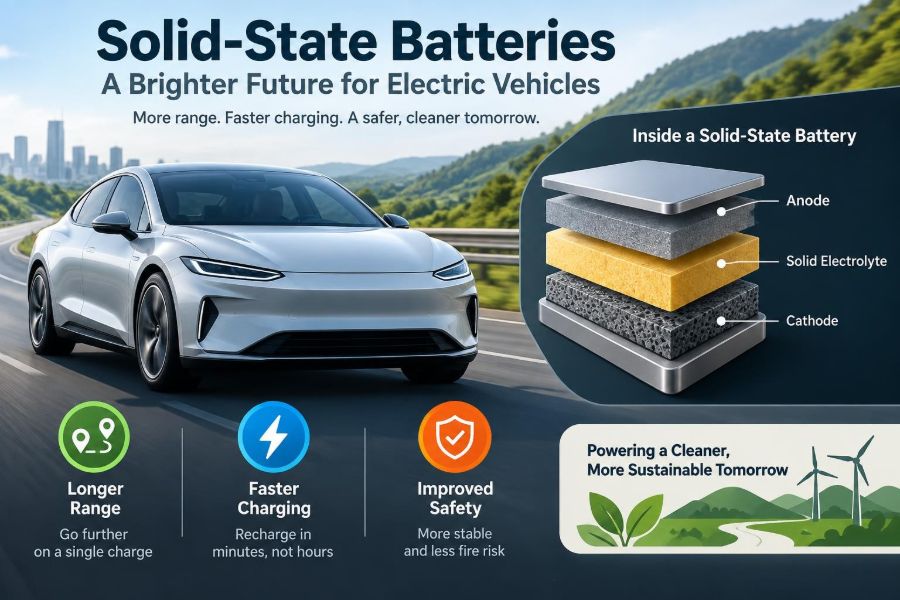
A solid-state battery replaces the conventional liquid electrolyte with a solid electrolyte. Depending on the design, this may be a ceramic, glass-like material, sulfide-based compound, polymer, or composite material.
Electrons still move through the external circuit to power the vehicle. Inside the cell, lithium ions move through the solid electrolyte. The basic purpose is familiar, but the materials, interfaces, manufacturing methods, and failure modes can be very different.
🧭 A Simple Cell-Level Comparison
| Feature | Conventional lithium-ion cell | Solid-state cell |
|---|---|---|
| Electrolyte | Liquid or gel electrolyte | Solid ion-conducting material |
| Potential anode | Usually graphite or graphite-silicon blend | May enable lithium-metal anode |
| Key challenge | Thermal management and liquid-electrolyte safety | Stable interfaces, pressure, and scalable production |
| Potential benefit | Mature, widely manufactured technology | Higher energy density and improved safety potential |
The comparison is not a verdict that one chemistry is universally better. Battery engineering involves trade-offs, and a solid electrolyte alone does not guarantee a superior vehicle battery.
⚡ Why Energy Density Matters for Range
Energy density describes how much energy a battery can store for a given mass or volume. Gravimetric energy density is measured relative to weight, while volumetric energy density is measured relative to space.
Higher cell energy density can support more driving range without making the pack heavier. Alternatively, an automaker can hold range roughly constant while reducing battery mass, freeing capacity for passengers, cargo, safety structure, or improved efficiency.
🪶 The Promise of Lithium-Metal Anodes
One major reason solid-state batteries attract attention is their potential compatibility with lithium-metal anodes. In a conventional lithium-ion cell, graphite commonly hosts lithium ions during charging. Lithium metal could store more lithium in less material.
That potential is significant, but lithium metal is not an automatic upgrade. It creates difficult interface and durability challenges, especially when cells are repeatedly charged, discharged, expanded, and compressed over years of driving.
🚙 More Range Is Not Just a Bigger Number
Extra range can change vehicle design choices. A compact vehicle might use a smaller battery while retaining practical trip capability, lowering mass and potentially reducing demand for cell materials. A larger vehicle might prioritize range for towing, cold weather, or high-speed travel.
Real-world range still depends on aerodynamics, tires, driving speed, elevation, cabin heating or cooling, wind, payload, and battery temperature. A higher-energy cell improves the starting point; it does not cancel the physics of moving a vehicle.
⏱️ What Actually Limits Charging Speed
Fast charging is limited by more than the charger’s advertised power. The cell must accept lithium ions quickly without excessive heating, damaging chemical reactions, lithium plating, or uneven current distribution.
Charging performance also depends on state of charge. A battery generally accepts energy more readily at lower charge levels, then slows near full charge to protect the cell. This controlled reduction is called the charging curve or charge taper.
🏎️ Could Solid-State Cells Charge Faster?
Some solid-state concepts aim for faster charging because certain solid electrolytes can conduct lithium ions efficiently and may support different electrode designs. In principle, stable materials and thin layers could reduce internal resistance.
In practice, fast charging puts severe stress on interfaces. A cell that performs well in a small laboratory sample must also work evenly across much larger electrode areas, through thousands of thermal and mechanical cycles. Fast-charge claims must therefore be assessed at pack-relevant scale and realistic temperatures.
🧱 The Interface Problem
Every battery contains boundaries where different materials touch. In solid-state cells, the contact between electrolyte and electrode is especially important. Even tiny gaps, cracks, contamination, or chemical reactions can raise resistance and reduce usable capacity.
Imagine trying to pass water through two pipes held close together but not properly joined. The material may be excellent on its own, yet the connection becomes the bottleneck. Much of solid-state battery development focuses on making and preserving these connections.
🌡️ Temperature Changes the Chemistry
Battery reactions slow in cold conditions. Many solid electrolytes also have temperature-dependent ionic conductivity, meaning their performance can change substantially as conditions shift.
A practical automotive battery must operate through winter starts, summer parking, repeated rapid charging, and heat generated by hard acceleration. Cell-level results measured under tightly controlled conditions cannot simply be assumed to represent all-weather vehicle use.
🛡️ Safety Benefits Need Careful Context
Liquid electrolytes in many lithium-ion cells are flammable, so conventional battery packs require robust separators, cooling systems, housings, electrical protection, and software monitoring. Replacing flammable liquid with a solid material could reduce certain fire-related risks.
However, solid-state does not mean risk-free. A high-energy battery still contains reactive materials and substantial stored energy. Internal shorts, manufacturing defects, crash damage, overheating, and poor electrical isolation remain serious engineering concerns.
🌲 Dendrites Are a Critical Challenge
Lithium can sometimes grow into needle-like structures called dendrites. If growth reaches across the separator or electrolyte, it may create an internal short circuit.
A dense solid electrolyte may resist dendrite penetration better than a liquid system in some designs, but defects, stress concentrations, and local current hotspots complicate the picture. Preventing harmful growth requires material selection, uniform pressure, controlled charging, and reliable manufacturing.
📏 Thin Layers Bring Benefits and Difficulties
A solid electrolyte needs to be thin enough that ions can move through it with low resistance. Yet it must also remain mechanically strong, defect-free, and electrically insulating between the electrodes.
Making a material thin, large-area, and flawless is hard. A tiny flaw that is insignificant in a small test coupon can become important in an automotive cell with much larger active surfaces.
🗜️ Why Stack Pressure Appears in Designs
Some solid-state cell architectures work best under controlled compression. Pressure helps maintain close contact between layers as the electrodes expand and contract during cycling.
That creates a vehicle-level question: how is pressure maintained for years despite vibration, crash loads, temperature swings, and aging? Springs, frames, pack structure, and cell format all become part of the electrochemical solution.
🏭 Scaling from Lab Cell to Factory Cell
A laboratory cell can demonstrate a useful mechanism without proving that the design is ready for production. Automotive manufacturing demands repeatable quality across very large volumes, low defect rates, traceable materials, and economically viable equipment.
Processes may involve dry coating, sintering, pressing, controlled-atmosphere handling, precise stacking, or new sealing techniques. Each step must be fast enough, reliable enough, and safe enough for a factory environment.
🔍 Quality Control Becomes Even More Important
Battery manufacturing already relies on inspection because hidden defects can affect performance and safety. Solid-state architectures may require additional attention to layer uniformity, microcracks, moisture sensitivity, interfacial contamination, and pressure distribution.
Non-destructive inspection methods, process data, and end-of-line testing will matter as much as the headline cell chemistry. A promising battery is only useful when a manufacturer can consistently make it.
💰 Cost Will Decide Adoption Speed
Vehicles compete on affordability as well as technical capability. New electrolyte materials, specialized equipment, yield losses, protective packaging, and controlled production environments can initially make solid-state cells expensive.
Cost may fall with manufacturing scale and design simplification, but it should not be assumed that every solid-state approach will reach mass-market prices. The best early applications may be vehicles where compactness, performance, or premium range justify a higher battery cost.
🔌 The Charging Network Still Matters
Even a battery capable of accepting high power needs compatible charging infrastructure. Station availability, charger reliability, grid connection capacity, payment systems, cable cooling, and site design all shape the real charging experience.
A faster cell can shorten a stop only if the vehicle, charger, and battery thermal system work together. Charging progress is therefore a system problem, not solely a cell-chemistry problem.
🧊 Thermal Management Will Not Disappear
It is a common mistake to assume that solid-state batteries eliminate cooling needs. Cells still generate heat through internal resistance, especially during high-power charging and acceleration.
Battery thermal management keeps cells within a suitable operating range and reduces temperature differences across the pack. Depending on the chemistry, future packs may need different cooling strategies, but they will still need deliberate thermal engineering.
🔧 Pack Design Could Change Substantially
If cells become more energy-dense, engineers may reconsider module layouts, cooling plates, crash structures, electrical connections, and enclosure dimensions. A thinner or lighter pack could improve cabin floor height, ground clearance, or overall vehicle proportions.
These gains are not guaranteed because some solid-state cells may require extra compression hardware or protective barriers. The relevant measure is pack-level performance, not only an impressive cell-level number.
♻️ Recycling Must Evolve Alongside Chemistry
Battery recycling is easier when materials are identified, safely transported, discharged, dismantled, and processed in known streams. New solid electrolytes and electrode combinations may require adapted recovery methods.
Designers should consider disassembly, material labeling, and second-life assessment early. A chemistry that improves vehicle performance but is difficult to recover responsibly creates another engineering challenge rather than a complete solution.
📊 How to Evaluate a Battery Announcement
When reading about a new solid-state battery, ask what exactly has been demonstrated. A single coin cell, a prototype vehicle, and a production-qualified automotive pack represent very different levels of maturity.
- Is the reported result from a full-size cell or a small research cell?
- At what temperature, charging rate, and pressure was it measured?
- Does the claim refer to cell energy density or complete pack energy density?
- How many charge-discharge cycles were achieved under relevant conditions?
- Has manufacturing at useful scale been addressed?
These questions do not dismiss innovation. They help place a result in its proper engineering context.
🧠 Common Misunderstandings to Avoid
“Solid-state” is not one single battery chemistry. Different companies and research groups can use very different electrolytes, cathodes, anodes, separators, cell shapes, and manufacturing routes under the same broad label.
Another misconception is that every future EV will switch at once. Conventional lithium-ion batteries continue to improve, and several chemistries may coexist because city cars, commercial fleets, performance vehicles, and heavy-duty applications have different needs.
🔄 Conventional Lithium-Ion Is Still Advancing
Current lithium-ion technology is not standing still. Improvements in electrode materials, cell formats, battery management, structural integration, manufacturing efficiency, and charging control continue to raise practical performance.
This matters because solid-state batteries must outperform a moving target. Their success will depend not merely on being technically possible, but on offering a compelling advantage over refined conventional alternatives.
🚚 Different Vehicles Need Different Priorities
A delivery van may value long cycle life and predictable charging more than maximum range. A luxury sedan may prioritize quiet long-distance travel, while a sports car may value high power output and low mass.
For that reason, early solid-state adoption may not look the same across every segment. The most suitable first use could be where its particular combination of energy density, packaging, safety potential, or performance offsets its added complexity.
👩🔧 Skills Engineers Will Need
Solid-state batteries sit at the intersection of electrochemistry, materials science, mechanical design, thermal engineering, manufacturing, controls, and safety validation. Engineers need to understand how choices in one discipline affect the others.
For students, useful foundations include ion transport, electrode kinetics, heat transfer, fracture mechanics, quality engineering, and battery management systems. For working professionals, cross-functional communication becomes especially valuable when materials decisions influence pack structure and production equipment.
🧪 Testing Beyond the Ideal Cycle
A credible automotive validation program must examine more than capacity retention in a steady laboratory cycle. Engineers assess vibration, shock, crush behavior, thermal exposure, humidity, electrical abuse, storage, fast charging, cold operation, and manufacturing variation.
The aim is not to make development seem slow for its own sake. It is to ensure that a battery behaves predictably when driven, parked, charged, serviced, and aged in conditions that are less controlled than a laboratory bench.
🛣️ What a Realistic Rollout May Look Like
New battery technologies commonly move through research cells, larger prototypes, pilot production, limited vehicle applications, and wider deployment. At every stage, developers learn about reliability, cost, supply chains, and customer use patterns.
Timelines can change because a single issue—such as cycle life, moisture handling, or production yield—can require substantial redesign. Cautious engineering progress is more valuable than a rushed launch of an unproven high-voltage system.
🎯 The Core Takeaway for EV Development
Solid-state batteries could reshape EV design by enabling higher energy density, potentially safer electrolyte systems, and new approaches to charging and packaging. Their most compelling opportunity comes from combining those benefits at the vehicle level rather than optimizing one laboratory metric.
The hard work is equally clear: durable interfaces, dendrite control, temperature performance, pressure management, manufacturing yield, cost, recycling, and rigorous safety validation. A breakthrough cell becomes a breakthrough vehicle only when all of these pieces work together.
Solid-state batteries are a promising path toward better electric vehicles, but their real transformation will come from disciplined system engineering, not from the word “solid” alone. 🚗🔋⚙️