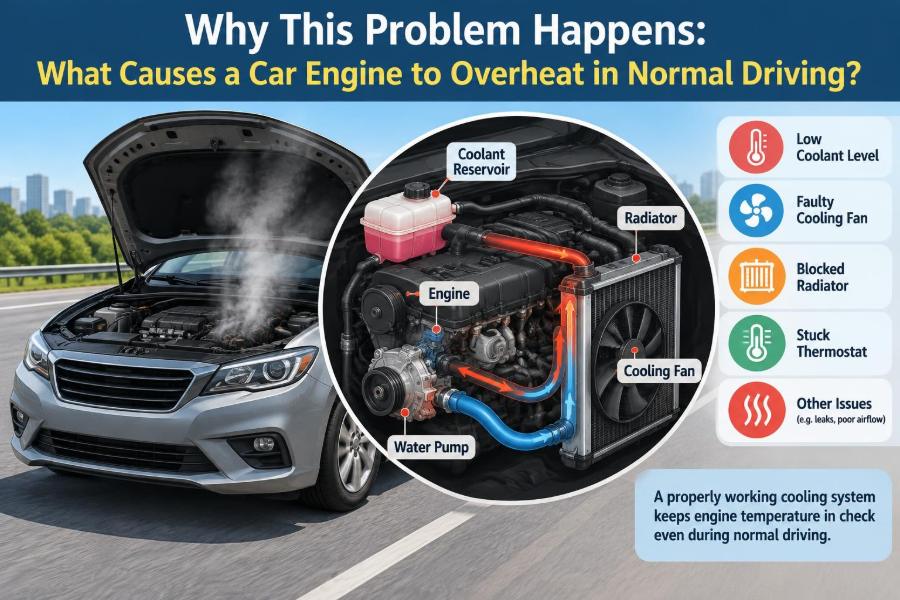

The temperature gauge begins to climb while you are waiting at a traffic light. Perhaps the heater suddenly blows cool air, a warning message appears, or steam drifts from beneath the bonnet after a routine commute. None of these moments feels routine, even when the car had seemed perfectly normal a few minutes earlier.
An engine can overheat during ordinary driving because it produces a great deal of heat whenever fuel is burned. The cooling system must continuously move that heat away, transfer it to the air, and keep the engine within a controlled operating range.
Overheating is not one fault with one universal repair. It is a symptom that can result from low coolant, poor circulation, restricted airflow, combustion-gas leakage, incorrect maintenance, or an operating condition that exposes a weak component.
Understanding the chain of events helps drivers react safely and helps engineering students diagnose problems logically rather than replacing parts at random.
🌡️ What “Overheating” Actually Means
An engine is designed to operate hot, but not uncontrollably hot. Combustion temperatures inside the cylinders are extremely high, while the metal around the combustion chambers must remain at a much lower, managed temperature to retain its strength, clearances, and lubrication conditions.
Overheating occurs when heat is being generated faster than the engine and cooling system can reject it. The dashboard gauge is only an indication from a sensor location, so a normal-looking reading does not always prove that every part of the engine is at a safe temperature.
🔥 Why Normal Driving Produces So Much Heat
A petrol or diesel engine converts only part of the fuel’s chemical energy into useful movement. A large share becomes heat, leaving through the exhaust, engine oil, coolant, and surrounding air.
At steady road speed, airflow through the radiator is usually strong. In slow traffic, uphill driving, towing, hot weather, or air-conditioning use, the margin becomes smaller. A cooling system in good condition handles these demands; a weakened system may reveal its problem there.
🧊 The Cooling System’s Basic Heat Journey
Coolant absorbs heat from passages in the engine block and cylinder head called water jackets. The water pump circulates this hot coolant to the radiator, where thin tubes and fins release heat to air passing through them.
The cooled fluid returns to the engine and the cycle continues. The thermostat regulates when coolant is sent through the radiator, while the pressure cap raises the coolant’s boiling point by maintaining pressure in the sealed system.
🧩 Why One Weak Link Can Cause a Big Temperature Rise
The cooling system behaves like a chain. It needs adequate coolant quantity, the correct mixture, sealed passages, pump circulation, thermostat control, radiator heat transfer, and sufficient airflow.
A small restriction can be tolerable on a cool motorway journey but become critical on a warm urban trip. This is why drivers sometimes say a car “only overheats in traffic” or “only overheats on hills.” The driving condition has exposed a limited cooling capacity.
💧 Low Coolant Level and Lost Heat Capacity
Low coolant is among the most common underlying reasons for overheating. With less liquid in the system, there is less material available to carry heat away from hot metal surfaces.
As the level falls, air pockets may form in high parts of the cylinder head, heater circuit, or thermostat housing. Air transfers heat far less effectively than liquid coolant, so local hot spots can develop even before the temperature gauge gives a clear warning.
🔎 External Coolant Leaks
External leaks can occur at hoses, hose clamps, radiator seams, the water pump, thermostat housing, heater hoses, expansion tank, or drain fittings. A leak may leave coloured residue, white staining, dampness, or a sweet smell, depending on the coolant type and location.
Not every leak makes a puddle. Coolant can land on hot exhaust components and evaporate, or it may escape only when the system becomes hot and pressurised. A pressure test is often more useful than a visual check alone.
🫧 Internal Coolant Leaks
Coolant can also escape into the combustion chambers, engine oil, or transmission fluid cooler on vehicles where those circuits share a heat exchanger. These faults require careful diagnosis because the visible evidence can be subtle.
Persistent white exhaust vapour after full warm-up, unexplained coolant loss, misfiring at start-up, oil contamination, or pressurisation of the cooling system can be warning signs. However, no single sign confirms one specific fault; proper testing is needed.
🔒 The Pressure Cap Is a Working Component
The radiator cap or expansion-tank cap is not merely a cover. It seals the system and controls pressure. Higher pressure raises the boiling temperature of the coolant, allowing it to carry heat without forming vapour under normal conditions.
A weak cap may open too early, allowing coolant to escape into an overflow reservoir or out of the system. A cap that does not seal properly can also admit air as the engine cools. It is inexpensive, but it should be tested or replaced with the correct specification rather than guessed.
🚰 Water Pump Problems and Poor Coolant Circulation
The water pump creates the flow that carries heat from the engine to the radiator. Many pumps are belt-driven; some modern vehicles use electric pumps controlled by the engine management system.
A worn bearing, leaking seal, damaged impeller, slipped drive belt, or electrical fault can reduce circulation. Some impellers can corrode or crack without obvious external leakage. The engine may then overheat under load because heat is not being moved away quickly enough.
🛞 Drive Belts Can Affect More Than One System
On engines with a mechanically driven water pump, a loose, glazed, damaged, or broken auxiliary belt can stop or slow coolant circulation. The same belt may also drive the alternator, so a battery warning light combined with rising temperature deserves immediate attention.
Timing-belt-driven pumps are different. Their condition cannot always be inspected externally, which is one reason manufacturers specify replacement intervals for belt-driven timing systems and associated components.
🚦 A Stuck Thermostat Changes the Flow Path
The thermostat is a temperature-sensitive valve. When an engine is cold, it restricts flow to the radiator so the engine warms up promptly. As coolant reaches its designed operating range, it opens and permits greater radiator flow.
A thermostat stuck closed or partly closed can sharply restrict heat rejection. A thermostat stuck open usually causes slow warm-up and poor heater performance rather than classic overheating, though the exact behaviour depends on the vehicle’s cooling-system design.
🌬️ Radiator Airflow Matters at Low Speed
The radiator cannot reject heat if air does not pass through its fins. At road speed, vehicle motion supplies much of that airflow. In stationary traffic, the electric cooling fan or engine-driven fan becomes essential.
A car that stays cool on an open road but overheats while idling often has an airflow problem. Likely causes include an inoperative fan motor, failed relay, blown fuse, damaged wiring, faulty temperature input, or a problem in the fan-control module.
🌀 Cooling Fan Faults Are Not Always Simple
Many vehicles use multiple fan speeds or two fan motors. One speed may work while another fails, creating an intermittent or condition-specific overheating complaint.
Fan operation can also be commanded by the air-conditioning system. If switching on the air conditioning normally triggers fan activity but it does not, that observation can help a technician narrow the diagnostic path. It is a clue, not a final diagnosis.
🍂 Blocked Radiator Fins Reduce Heat Transfer
Leaves, insects, mud, road debris, and bent fins can obstruct the front of a radiator. On many cars, the air-conditioning condenser sits ahead of it, so debris can become trapped between the two heat exchangers.
External blockage reduces the area exposed to airflow. Cleaning must be done carefully: aggressive pressure washing or brushing can flatten delicate fins and make the restriction worse. Access and cleaning methods vary considerably by vehicle.
🧱 Internal Radiator Restriction
Inside the radiator, deposits, corrosion products, old sealants, or incompatible coolant mixtures can narrow the small tubes that carry coolant. The radiator may look clean outside while its internal flow capacity is poor.
An infrared temperature check can sometimes reveal unusually cool sections that suggest restricted flow, but interpretation requires experience. Replacing a severely blocked radiator is often more reliable than attempting an aggressive chemical flush on an ageing system.
🧪 Coolant Quality, Mixture, and Corrosion Protection
Coolant is not simply coloured water. The correct formulation contains corrosion inhibitors and is designed to work with particular metals, seals, and cooling-system materials. Its concentration also affects boiling protection and freeze protection.
Using plain water for a short emergency top-up may be unavoidable, but it should not become the permanent fill. Mixing coolant types solely because they look similar can create compatibility problems. Use the manufacturer-specified fluid and mixing guidance whenever possible.
🫧 Air Locks After Repairs or Coolant Loss
After a hose replacement, thermostat job, radiator change, or significant coolant loss, air can remain trapped in the system. This is commonly called an air lock.
Some vehicles need a specific bleeding procedure, bleed screws, a vacuum-fill tool, or an electronically commanded pump routine. Simply filling the expansion tank and driving away may leave a trapped air pocket that prevents stable temperature control or causes the cabin heater to blow cold.
🏠 The Heater Core Can Provide a Useful Clue
The cabin heater core is a small radiator that uses hot engine coolant. If the engine is overheating while the heater blows cold, coolant may be low, circulation may be poor, or air may be trapped in the heater circuit.
This symptom is not universal: climate-control settings, blend doors, and electrical faults can also affect cabin heat. Still, changes in heater output are valuable observations to report during diagnosis.
⛽ Combustion Gas Entering the Cooling System
A damaged head gasket, cracked cylinder head, or cracked engine block can allow high-pressure combustion gases to enter the cooling system. This adds pressure, displaces coolant, and can form gas pockets that reduce circulation.
Drivers may notice repeated coolant expulsion, persistent bubbling in the expansion tank, overheating soon after a cold start, or unexplained coolant loss. These symptoms should be assessed with appropriate tests, because disassembly based on appearance alone can be costly and unnecessary.
🧱 Why Overheating Can Damage a Head Gasket
Overheating can be both a cause and a consequence of gasket trouble. If a cooling fault allows metal temperatures to rise too high, the cylinder head and engine block expand at different rates. This can distort sealing surfaces and compromise the gasket.
Continuing to drive while severely overheated increases the risk of warped components, oil breakdown, piston damage, and permanent engine damage. The safest decision is usually to stop before a warning becomes a major repair.
🛢️ Engine Oil Has a Cooling Role Too
Engine oil primarily lubricates moving parts, but it also carries heat away from bearings, pistons, and valvetrain components. Low oil level, incorrect oil grade, or degraded oil can increase thermal stress in heavily loaded areas.
Oil faults do not replace the usual cooling-system causes, but they can worsen an engine’s ability to cope with heat. A separate oil cooler, where fitted, introduces additional hoses and seals that may require inspection.
🏔️ Heavy Loads, Steep Hills, and High Ambient Temperature
Towing, carrying heavy loads, climbing long grades, driving at high altitude, and operating in very hot weather all increase the demand on the cooling system. The engine produces more heat, while hot outside air provides less temperature difference for the radiator to use.
These conditions do not normally make a healthy vehicle overheat. They can, however, expose a partly blocked radiator, weak fan, low coolant level, or ageing water pump that was not obvious in easier driving.
🚗 Stop-Start Traffic Versus Motorway Overheating
The driving pattern provides a useful diagnostic clue. Consider the contrast below, while remembering that several faults can exist at the same time.
| Observed pattern | Systems worth checking first |
|---|---|
| Overheats mainly while idling or in queues | Cooling fan operation, fan control, airflow blockage, coolant level |
| Overheats mainly at sustained speed or under hill load | Coolant level, radiator restriction, thermostat, water pump, combustion-gas leakage |
| Temperature rises and falls unpredictably | Air locks, low coolant, sensor issues, intermittent pump or fan control |
| Coolant disappears with no obvious puddle | Pressure leaks, internal leakage, cap function, heater circuit |
Patterns guide efficient testing; they should not be used as a substitute for it.
📟 Temperature Sensors, Gauges, and Misleading Readings
A faulty coolant-temperature sensor, damaged connector, instrument-cluster problem, or software fault can create an incorrect warning or gauge reading. Conversely, some modern gauges are deliberately damped, meaning they remain near the middle through a range of normal temperatures.
Never assume a warning is false merely because the engine seems to run normally. A technician can compare scan-tool data, measured temperatures, fan commands, and system pressure to determine whether the problem is actual overheating or an inaccurate indication.
🚨 What to Do When the Temperature Rises
If the temperature warning appears or the gauge moves into an unsafe zone, reduce engine load promptly. Turn off the air conditioning, avoid hard acceleration, and find a safe place to stop as soon as conditions allow.
- Stop the vehicle safely and switch off the engine if the warning persists.
- Do not remove a radiator or expansion-tank cap from a hot system.
- Keep clear of steam and escaping coolant, which can cause serious burns.
- Allow the engine to cool fully before inspecting the coolant reservoir.
- Arrange recovery or professional assessment if coolant is low, steam is present, or the cause is unknown.
Running the cabin heater at maximum can sometimes remove a small amount of heat while moving to safety, but it is not a repair and should never justify continuing a dangerous journey.
🧯 Why Adding Cold Water to a Hot Engine Is Risky
Pouring cold water into an overheated engine or radiator can create a rapid temperature change across hot metal components. In severe cases, thermal shock can contribute to cracking or distortion.
More immediately, opening a pressurised system can release boiling coolant violently. Wait until the system is cool enough to inspect safely, then use the correct coolant where possible and investigate why the level became low.
🔧 A Sensible Diagnostic Sequence
Effective diagnosis starts with evidence, not assumptions. A workshop may inspect the coolant level and condition, check for leaks, pressure-test the system and cap, confirm fan operation, observe live temperature data, and assess thermostat and pump behaviour.
Further checks may include combustion-gas testing, cylinder leak-down testing, radiator flow assessment, and inspection of belts or electric pump controls. The goal is to find the reason heat cannot leave the engine, not merely to reset a warning light.
🧠 Common Diagnosis Mistakes to Avoid
Replacing the thermostat first is common because it is a familiar overheating suspect. Sometimes it is correct; sometimes it wastes time because the actual fault is a fan relay, a leaking cap, trapped air, or low coolant from an unseen leak.
- Do not diagnose from coolant colour alone.
- Do not mix fluids without confirming compatibility.
- Do not rely on a single dashboard gauge reading.
- Do not keep driving repeatedly after topping up coolant.
- Do not use stop-leak products casually; they can obstruct small passages.
A repeated need to add coolant is evidence of a fault, not normal maintenance.
🧰 Preventive Maintenance That Preserves Cooling Capacity
Follow the manufacturer’s service schedule for coolant replacement, belts, water-pump-related timing work, and inspections. Check the expansion tank level only when the engine is cold, and investigate changes rather than repeatedly topping up.
Keeping the radiator area free of debris, using specified coolant, fixing minor leaks early, and paying attention to new fan noise or coolant smells all preserve the system’s safety margin. Prevention is especially valuable before hot-weather travel or towing.
⚙️ Modern Engines Have Smaller Margins for Neglect
Modern engines often use compact cooling passages, plastic housings, electronically controlled thermostats, turbochargers, and tightly managed emissions systems. These designs can improve efficiency and warm-up control, but they also make correct fluid, bleeding procedures, and diagnostic data more significant.
This does not mean modern cars are inherently unreliable. It means a casual repair method that worked on an older vehicle may not suit a newer cooling system with electronic controls and specific service procedures.
📚 The Core Engineering Principle
An overheating engine is fundamentally a heat-balance problem. Heat enters the engine through combustion and friction; heat leaves through the coolant, oil, exhaust, and surrounding air. Overheating begins when the rate of heat removal falls below the rate of heat generation for long enough.
That principle explains why the same car may behave differently in traffic, on a hill, with air conditioning running, or after a coolant repair. The fault may be small, but the operating condition changes the amount of reserve capacity available.
✅ Bringing the Causes Together
The most useful question is not simply, “What part causes overheating?” Ask instead: is coolant missing, is flow restricted, is airflow insufficient, is pressure control failing, or is combustion heat entering the cooling system where it should not?
A safe response and methodical diagnosis protect both the vehicle and its occupants. Early investigation of a warning, a coolant smell, a falling level, or an unusual temperature pattern is far less disruptive than waiting for a severe overheat.
A car engine overheats in normal driving when its cooling system can no longer remove heat as quickly and reliably as the engine produces it. Treat the warning as a system problem to be understood, not a nuisance to be ignored. 🚗🌡️🔧