
A car can feel perfectly normal on a familiar commute, yet its tires may be wearing away in places nobody sees. The first clue might be a steering wheel that sits slightly off-center, a faint pull on a level road, or a tire edge that feels sharper and more worn than the rest of the tread.
It is tempting to treat these signs as small inconveniences. After all, the vehicle still turns, brakes, and gets from one place to another. But the angles at which the wheels meet the road affect how every tire carries load, generates grip, and responds to steering input.
Wheel alignment is therefore not merely a workshop adjustment performed during tire replacement. It is a geometric condition that connects suspension design, tire wear, straight-line stability, cornering behavior, fuel use, and driver confidence.
Understanding what alignment does also makes maintenance decisions easier. Instead of waiting for a tire to become visibly damaged, drivers and technicians can recognize early symptoms, investigate the real cause, and protect both the tires and the vehicle’s handling.
🧭 What Wheel Alignment Actually Means
Wheel alignment is the adjustment or verification of the angles and directions of the wheels relative to the vehicle and the road. The goal is not to make every wheel visually parallel in every situation; it is to place the wheels within the manufacturer’s specified geometry.
Those specifications account for the suspension design, vehicle height, steering system, and intended handling characteristics. A correctly aligned vehicle should track predictably while allowing the tires to roll with minimal unnecessary scrub.
📐 The Three Core Alignment Angles
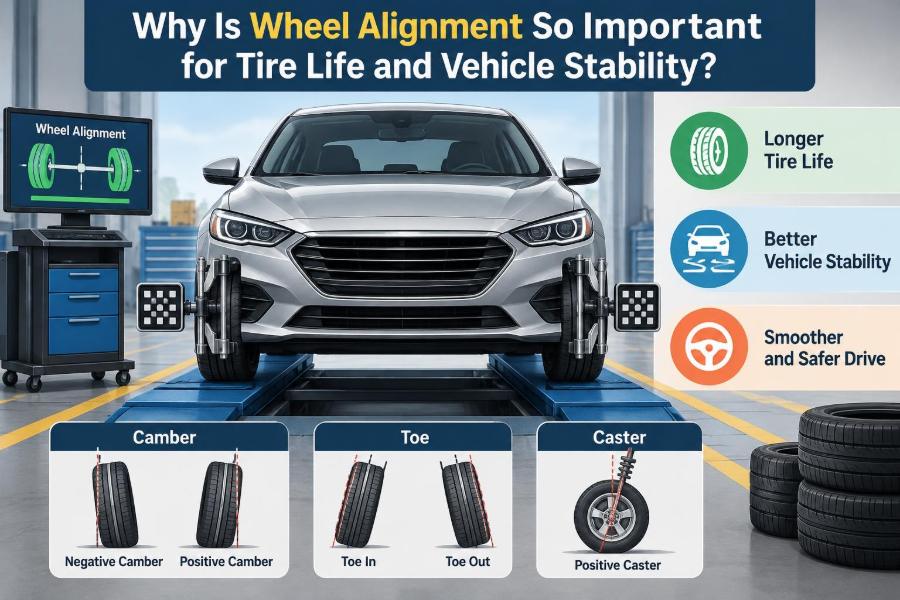
Most alignment discussions begin with toe, camber, and caster. They describe different views of the wheel and steering axis, and each influences tire behavior in a different way.
| Angle | Simple view | Main influence |
|---|---|---|
| Toe | Wheel direction viewed from above | Tire scrub, straight tracking, steering response |
| Camber | Wheel lean viewed from the front | Tread load distribution and cornering behavior |
| Caster | Steering-axis tilt viewed from the side | Self-centering, directional stability, steering feel |
These angles interact. A diagnosis based on one number alone can miss the reason a vehicle pulls, wanders, or destroys a tire shoulder.
➡️ Toe: The Fastest Way to Wear Tires
Toe describes whether a pair of wheels point slightly toward each other or slightly away from each other when viewed from above. Wheels pointing inward have toe-in; wheels pointing outward have toe-out.
Even a small toe error can force a tire to slide sideways as it rolls. This is called scrub, and it can wear the tread rapidly because the rubber is being dragged across the road rather than rolling cleanly.
Toe is commonly adjustable at the steering tie rods on the front axle. On many modern vehicles, rear toe is also adjustable, which matters because rear-wheel direction strongly affects how the whole vehicle tracks.
🪞 Camber: How the Wheel Leans
Camber is the inward or outward tilt of a wheel viewed from the front of the vehicle. If the top of the wheel leans inward, it has negative camber; if it leans outward, it has positive camber.
A carefully chosen amount of negative camber can help a tire remain better loaded during cornering as the body rolls. Too much negative camber, however, concentrates load toward the inner shoulder. Excessive positive camber tends to load the outer shoulder.
Camber wear is often most obvious when the tire is inspected from the inside, where it can be missed during a casual walk-around.
🧲 Caster: The Angle Behind Straight-Line Stability
Caster is the fore-and-aft tilt of the steering axis when viewed from the side. Positive caster generally helps the steering return toward center after a turn, much like the swiveling wheels on a shopping trolley tend to trail behind their pivot.
Caster usually has less direct effect on tread wear than toe or camber, but it matters greatly for directional stability and steering feel. A significant side-to-side caster difference can contribute to a pull, particularly on a reasonably level road.
🎯 Thrust Angle and Rear-Wheel Direction
The thrust angle is the direction the rear wheels effectively push the vehicle compared with its centerline. If the rear axle points slightly to one side, the vehicle may travel straight while the steering wheel is held off-center.
This condition is sometimes described as dog-tracking or crab-walking. Correcting only the front toe may straighten the steering wheel temporarily without addressing the rear geometry that is directing the vehicle incorrectly.
🛞 Why Tires Need an Even Contact Patch
The contact patch is the small area where each tire touches the road. It is where acceleration, braking, steering, and cornering forces are transferred, despite being much smaller than the tire itself.
Alignment helps distribute the vehicle’s load across that patch as intended. When an angle is out of range, one edge or a series of tread blocks may do disproportionate work, producing localized heat and wear.
A tire can still have substantial tread in its center while being unsafe or uneconomical to keep because one shoulder has worn down first.
🔥 How Misalignment Turns Rolling Into Scrubbing
A properly directed wheel rolls forward with little lateral slip. A wheel with incorrect toe, by contrast, tries to travel in a direction that does not match the vehicle’s path. The road resists that mismatch.
The result is repeated microscopic sliding at the tread surface. Over thousands of rotations, that sliding can create feathered tread blocks, where one side of each block feels sharp and the other feels rounded.
This is why tire wear caused by alignment is not always smooth or symmetrical. Its texture often tells a useful story about the force acting on the tire.
🔍 Reading Tire Wear Patterns
Tire inspection is a practical first step, although it cannot replace measurement on alignment equipment. Run a hand gently across the tread and inspect both inner and outer shoulders with the wheels turned if necessary.
- Feathering across the tread: often associated with incorrect toe.
- Wear on one inner or outer shoulder: can indicate camber error, though other causes are possible.
- Cupping or scalloped dips: often points toward worn dampers, imbalance, looseness, or multiple faults rather than alignment alone.
- Wear near the center: is more commonly related to excessive inflation than alignment.
Patterns are clues, not verdicts. Tire pressure, rotation history, driving roads, load, and suspension condition must be considered together.
🧱 The Hidden Cost of Uneven Tire Wear
Uneven wear shortens the useful life of a tire because the most damaged area determines when replacement is necessary. The remaining healthy rubber cannot compensate for a shoulder that has reached an unacceptable condition.
It can also reduce wet-road performance. Grooves and sipes need adequate depth and an even footprint to move water effectively, so an irregularly worn tire may lose its intended grip characteristics before the whole tread looks worn out.
🛣️ Vehicle Stability Begins at the Tire
Stability means more than driving without a dramatic pull. It includes the vehicle’s ability to hold a chosen line, respond consistently to corrections, and remain composed when road conditions or loads change.
When all four tires point and load correctly, the driver receives predictable feedback through the steering system. Misalignment can make the vehicle feel reluctant to settle, especially during highway travel, lane changes, or crosswinds.
↔️ Why a Car May Pull to One Side
A pull is not automatically proof of an alignment problem. Road crown, wind, tire pressure differences, tire construction variation, brake drag, and tire conicity can all cause a vehicle to drift.
Tire conicity occurs when a tire’s construction or shape causes it to behave slightly like a cone, generating a side force as it rolls. A technician may swap front tires side to side as part of diagnosis, where appropriate, to see whether the direction of the pull changes.
The useful point is to investigate rather than assume. Aligning a car with an underlying brake or tire fault may not solve the complaint.
🧭 An Off-Center Steering Wheel Is a Useful Clue
On a level road, a steering wheel that is consistently tilted while the car travels straight often suggests that front and rear wheel directions are not properly coordinated. It can be irritating, but it also provides valuable diagnostic information.
The steering wheel should be centered during alignment procedures before final front-toe adjustment. Simply repositioning the wheel without correcting the geometry does not resolve the forces acting on the tires.
🌬️ Highway Wandering and Driver Fatigue
A vehicle that needs frequent small steering corrections can be tiring to drive. Alignment is one possible contributor, particularly when caster, toe, or rear thrust angle is outside specification.
Worn steering joints, damaged suspension bushes, loose wheel bearings, poor tires, and incorrect pressures can create similar sensations. Because stability is a system property, a competent inspection should include these parts rather than treating alignment as an isolated number.
⚖️ Braking Behavior and Alignment
Alignment does not create braking force; the braking system and tire-road grip do that. Yet uneven tire contact and a vehicle that is already pulling can make braking behavior feel less consistent, especially when grip is limited.
A strong pull during braking deserves prompt inspection because a sticking brake, damaged suspension part, or unequal tire condition may be involved. It should not be dismissed as a routine alignment symptom.
🌧️ Wet Roads Make Geometry More Noticeable
On dry pavement, a driver may tolerate mild wandering or uneven tread wear for a long time. Rain reduces the available grip margin, so differences in tire condition and contact pressure become easier to feel.
Correct alignment cannot overcome worn tires or deep standing water. It does, however, help the tire use its designed tread area more evenly, supporting predictable behavior when surface grip is already reduced.
🛠️ What Changes Wheel Alignment
Alignment angles can change gradually as rubber bushes compress, springs settle, and joints wear. They can also change suddenly after a pothole strike, curb contact, collision, or impact with road debris.
- Worn ball joints, tie-rod ends, control-arm bushes, or wheel bearings
- Bent suspension arms, steering links, struts, or axle components
- Damaged wheels or tires
- Changes in ride height from weak springs, added load, or modified suspension
- Incorrect installation after suspension or steering repairs
Adjustment alone cannot correct a bent or loose component. The faulty part must be repaired first, then the geometry measured again.
🕳️ Potholes and Curbs Are More Than a Rough Ride
A sharp impact can bend a wheel, deform a tire, shift an adjustment point, or damage a suspension component. The vehicle may continue to drive, but the resulting geometry can be outside its intended range.
After a significant impact, watch for vibration, a new pull, steering-wheel offset, noises, or a visible tire bulge. A bulge is a tire-structure concern, not an alignment issue, and needs professional assessment.
🔧 Alignment Is Not the Same as Wheel Balancing
These services are often requested together, but they solve different problems. Wheel balancing distributes mass around the wheel-and-tire assembly to reduce vibration as it rotates. Alignment sets wheel angles and directions.
A vibration that rises within a certain speed range often suggests balance, wheel, or tire issues. Feathered wear and a pull are more suggestive of geometry, although real-world faults can overlap.
📏 What Happens During a Professional Alignment
A proper alignment begins with inspection. The technician checks tire condition and pressures, looks for looseness or damage, and ensures the vehicle is at an appropriate ride height before relying on electronic measurements.
Sensors or targets attached to the wheels allow an alignment machine to calculate angles relative to the vehicle. The technician then adjusts available points, commonly toe and sometimes camber or caster, according to the manufacturer’s procedure.
Many vehicles do not provide factory adjustment for every angle. If a non-adjustable angle is out of range, the reason may be worn, bent, damaged, or incorrectly positioned hardware rather than a missed adjustment.
📄 Why the Alignment Printout Matters
A before-and-after report can show measured angles, specification ranges, and final values. It is useful for discussing what was corrected and whether any angle remained out of range because of a mechanical limitation.
Numbers should be interpreted in context. A value barely inside a broad range is not automatically ideal, and a reading outside range may reveal a part problem rather than a need for repeated adjustment.
🚙 Front-Wheel, Rear-Wheel, and All-Wheel Alignment
Older or simpler vehicles may have limited rear adjustment, while many modern independent rear suspensions allow rear toe and camber adjustment. A four-wheel alignment evaluates the relationship between both axles.
This matters even on front-wheel-drive vehicles. The rear wheels guide the path the chassis follows, so rear geometry can affect steering-wheel position, tracking, and tire life.
🏎️ Factory Specifications Are Not Universal Preferences
Alignment targets are developed for a particular vehicle configuration and intended use. A family sedan, a loaded pickup, and a performance coupe may use different geometry to balance stability, comfort, tire wear, steering effort, and cornering response.
Enthusiasts sometimes choose nonstandard settings for track use or a specific handling goal. Such changes can involve trade-offs, including faster tire wear, poorer straight-line behavior, or undesirable behavior on ordinary roads. They should not be copied casually from another vehicle.
📦 Load, Ride Height, and Modified Suspension
Suspension geometry changes as the vehicle moves through its travel. Carrying heavy equipment, towing, installing lowering springs, lifting a truck, or fitting altered suspension components can therefore affect camber, toe, and caster relationships.
Some manufacturers specify alignment conditions such as fuel level or ballast. For modified vehicles, usable settings depend on the hardware, intended load, tire size, and suspension travel—not just a generic “performance” alignment label.
🔄 Tire Rotation Cannot Cure Misalignment
Rotation moves tires to different positions so wear can be shared more evenly over time, following the pattern suitable for the tire and vehicle. It cannot remove the damage already caused by excessive toe or incorrect camber.
In fact, rotating a badly worn tire may spread a handling problem to another axle. Correct the underlying geometry and inspect the existing tires before expecting rotation to restore normal behavior.
💨 Tire Pressure Still Matters
Alignment and inflation pressure both shape the contact patch, but they are separate maintenance issues. Underinflation commonly increases shoulder loading and heat, while overinflation can concentrate wear nearer the center of the tread.
Check pressures when tires are cold and use the vehicle manufacturer’s placard recommendation unless a specific approved operating condition requires otherwise. An alignment check performed with obviously incorrect pressures begins with incomplete information.
🧰 When an Alignment Check Is Sensible
There is no single interval that fits every vehicle and road environment. A check is sensible after a hard impact, after replacing steering or suspension parts, when fitting new tires, or when symptoms appear.
It can also be worthwhile as preventive maintenance for vehicles that travel frequently on rough roads. The aim is not to purchase an adjustment unnecessarily; it is to detect geometry or component problems before they consume expensive tires.
👀 A Driver’s Simple Inspection Routine
Drivers cannot measure alignment accurately by eye, but a brief routine catches many warning signs early. Inspect tires in good light and pay attention to changes in how the vehicle feels.
- Check pressures regularly and before long trips.
- Look across the full tread width, including the inner shoulder.
- Notice new pulling, wandering, vibration, or steering-wheel offset.
- Listen for clunks after a pothole or curb impact.
- Ask for tire and suspension condition to be checked during routine service.
Early observation is valuable because a small abnormal wear pattern is easier to investigate than a tire that has already reached replacement condition.
🚫 Common Alignment Misconceptions
One misconception is that a vehicle must pull dramatically before alignment matters. In reality, toe-related wear can develop while the driver feels little more than a subtle change in steering feel.
Another is that new tires automatically solve the problem. Fresh tires fitted to unresolved geometry may wear unevenly from their first miles. Finally, an alignment machine cannot compensate for loose joints, broken springs, distorted wheels, or unsuitable tire pressures.
🧑🔧 Choosing a Useful Repair Conversation
When booking an alignment inspection, describe the symptom precisely: which direction the car pulls, when vibration occurs, whether the steering wheel is off-center, and whether an impact happened recently. These details help separate tire, brake, wheel, and suspension possibilities.
Ask whether worn or damaged parts were found before adjustment, and request an explanation of any angle that could not be brought within specification. Clear information is more useful than a vague assurance that the vehicle was “aligned.”
🧠 The Core Principle: Let Tires Roll as Designed
Wheel alignment matters because tires deliver every control force a vehicle has. Their rubber must brake, steer, accelerate, and resist lateral forces while carrying the vehicle’s weight, all through a limited contact patch.
Correct geometry helps that contact patch work evenly and predictably. It reduces avoidable scrub, preserves usable tread, supports stable tracking, and gives the driver a better chance of noticing genuine faults before they become larger problems.
The best approach is balanced: inspect tires and pressures regularly, respond to new symptoms, repair damaged components before adjustment, and use manufacturer specifications as the normal road-going baseline.
Wheel alignment is not just about a straight steering wheel; it is about allowing every tire to share the road load correctly so the vehicle remains stable, predictable, and economical to maintain. 🚗🛞🧭