
A child runs toward the road. A vehicle ahead brakes unexpectedly. Or rain turns a familiar bend into a surface with far less grip than the driver expects. In moments like these, a car can become unstable before the driver has time to think through the physics.
Modern vehicles are designed to help in these situations. Anti-lock braking, electronic stability control, traction control, steering assistance, and advanced driver-assistance systems can all influence what the car does when its tires approach their limits.
But these systems are not created by one person working in isolation. They are the result of coordinated work by engineers who understand vehicle motion, software, sensors, brakes, tires, human behavior, manufacturing, and safety regulation.
The people behind this work are usually called vehicle dynamics engineers, chassis engineers, control-systems engineers, and functional safety engineers. Their common task is demanding: help the vehicle remain controllable without pretending that electronics can repeal the laws of physics.
🚘 Stability Is More Than Staying Upright
For a road vehicle, stability means the vehicle responds predictably to the driver and maintains a controllable path. It includes resisting excessive skidding, spinning, plowing straight ahead in a turn, or locking wheels under hard braking.
A stable car is not necessarily a car that never slides. On a low-grip surface, some tire slip may be unavoidable. The engineering objective is to keep the motion within a range where the driver can still steer, brake, and recover.
🧑🔧 The Core Professionals Behind Vehicle Stability
Vehicle stability is a multidisciplinary engineering problem. Different specialists own different parts of the system, then integrate their work into one behavior that feels coherent to the driver.
- Vehicle dynamics engineers study how mass, tires, suspension, steering, and aerodynamics affect motion.
- Chassis engineers develop physical hardware such as brakes, steering gear, suspension components, and wheel-end systems.
- Controls engineers create the algorithms that decide when and how the car should intervene.
- Embedded software engineers implement those algorithms reliably on vehicle electronic control units.
- Functional safety engineers examine faults and ensure safety-related functions behave appropriately when problems occur.
📐 Vehicle Dynamics Engineers Define the Motion Problem
Vehicle dynamics engineers begin with the question: what should this vehicle do when the driver steers, brakes, accelerates, or combines all three? They use mathematical models, simulation, instrumented testing, and professional driving evaluations to answer it.
They pay close attention to yaw, which is rotation around the vehicle’s vertical axis. If the rear of a car rotates too quickly in a corner, the car may oversteer. If the front tires lose grip first and the car runs wide, it understeers.
🛞 Tires Set the Ultimate Limit
No stability system can create unlimited grip. The tire-road contact patch is small, and its available friction depends on tire condition, temperature, load, road texture, water, snow, ice, and contamination.
Engineers often describe the available grip with a “friction circle” or friction ellipse. A tire used heavily for braking has less remaining capacity for cornering, and a tire transmitting high drive torque has less capacity for lateral force. This is why braking hard while turning can be so demanding.
⚖️ Weight Transfer Changes Every Emergency Maneuver
When a driver brakes, load transfers toward the front axle. When accelerating, load shifts rearward. During a turn, load moves toward the outside wheels. The total vehicle weight does not change, but the force carried by each tire does.
This matters because tires do not gain grip in perfect proportion to added load. Suspension geometry, springs, dampers, anti-roll bars, and ride height all influence how load transfer affects cornering balance.
🧭 Understeer and Oversteer Need Different Responses
Understeer occurs when the front tires cannot generate enough lateral force to follow the intended curve. The car turns less than the driver commands. Excessive speed on corner entry is a common trigger.
Oversteer occurs when the rear tires lose lateral grip and the rear of the vehicle rotates outward. It can arise from sudden lift-off, excessive power, abrupt steering, low rear-tire grip, or surface changes.
Neither behavior is corrected simply by “adding more electronics.” Engineers first tune the vehicle’s mechanical balance, then calibrate stability control to recognize and manage developing instability.
🧠 Electronic Stability Control Makes Fast Decisions
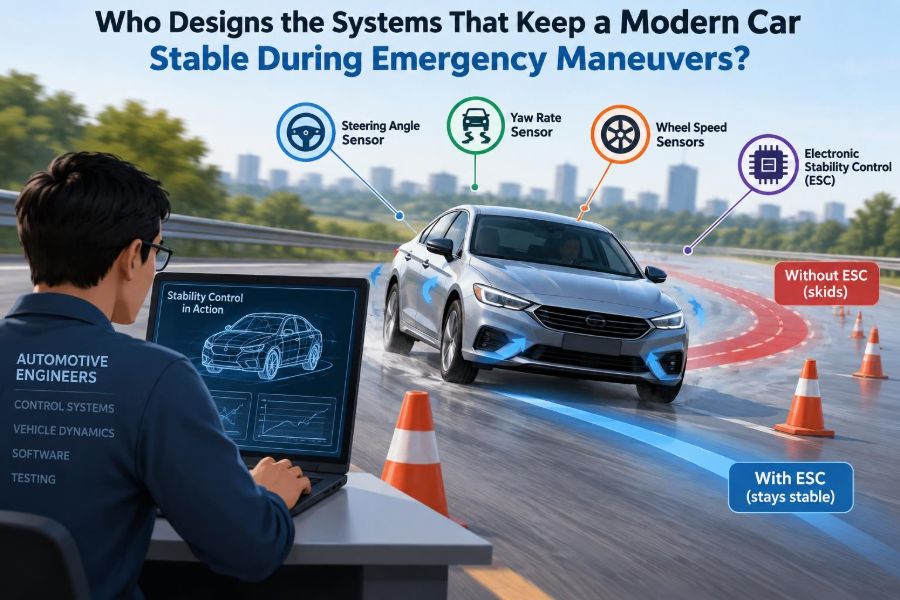
Electronic stability control, commonly shortened to ESC, compares the driver’s apparent intended path with the vehicle’s actual motion. It uses sensor data to detect when yaw behavior or side-slip behavior is moving beyond the expected range.
If intervention is needed, ESC can apply braking force to one or more individual wheels and may request reduced engine or motor torque. Braking a selected wheel produces a corrective yaw moment, helping the car rotate more or less depending on the situation.
🔍 The Sensors That Tell the Car What Is Happening
A stability controller cannot directly observe every useful quantity. Instead, it estimates vehicle state from several measurements taken many times per second.
- Wheel-speed sensors indicate whether individual wheels are slowing, spinning, or locking relative to others.
- A steering-angle sensor indicates the driver’s steering input.
- A yaw-rate sensor measures how quickly the vehicle rotates.
- A lateral-acceleration sensor measures sideways acceleration.
- Brake-pressure and pedal-position signals help identify driver demand.
Sensor data is never perfectly clean. Controls engineers must account for noise, offsets, delays, wheel-speed differences in turns, and unusual surfaces.
🧮 Estimation Fills in What Sensors Cannot Measure Directly
One key variable is vehicle side slip: the difference between the direction the vehicle is pointing and the direction it is actually traveling. Directly measuring it accurately in an ordinary production car is not straightforward.
Instead, the controller estimates it from a vehicle model and sensor inputs. These estimates work well only within assumptions, so calibration teams test across different speeds, loads, tire conditions, and friction levels.
🛑 ABS Preserves Steering During Heavy Braking
Anti-lock braking systems, or ABS, prevent sustained wheel lock during braking. A locked tire generally has very little ability to generate lateral force, meaning a driver may be unable to steer around an obstacle.
ABS modulates brake pressure near the point where each tire can produce strong braking force while continuing to rotate. Pedal pulsation during a hard ABS event is usually normal feedback from the system’s rapid pressure control.
⚡ Traction Control Manages Drive-Wheel Slip
Traction control addresses excessive wheel spin during acceleration. On a wet road, ice, gravel, or a surface with uneven grip from side to side, one driven wheel can spin faster than the vehicle is actually moving.
The system may reduce engine or motor torque, apply a brake at the spinning wheel, or combine both approaches. In electric vehicles, rapid motor-torque adjustment can be especially useful, but the tire’s grip remains the governing constraint.
🔧 Brake Engineers Make Intervention Possible
Stability algorithms need an actuator capable of creating accurate wheel-by-wheel braking forces. Brake engineers develop calipers, discs, hydraulic circuits, valves, pumps, electronic brake boosters, and brake-control modules that can do this repeatedly.
The challenge includes pedal feel, response speed, heat management, durability, corrosion resistance, manufacturing variation, and serviceability. A clever control strategy is of little use if the physical brake system cannot deliver its requested pressure reliably.
🛠️ Steering and Suspension Engineers Shape the Baseline
Electronic systems are strongest when the vehicle is fundamentally well behaved. Suspension and steering engineers determine the baseline response through geometry, compliance, spring and damper tuning, steering ratio, roll stiffness distribution, and alignment targets.
For example, bushing compliance can alter wheel alignment as cornering forces rise. That may help stability in one condition but reduce steering precision in another. Engineers balance these characteristics rather than optimize one measurement in isolation.
💻 Control Algorithms Turn Physics Into Commands
A control algorithm is a set of rules and calculations that converts sensor inputs into actuator commands. In stability control, the controller predicts a reasonable yaw response from vehicle speed and steering input, compares that prediction with actual motion, and calculates a correction when needed.
The design must avoid both late intervention and overreaction. Acting too late allows instability to grow. Acting too aggressively can surprise the driver, slow the vehicle unnecessarily, or make the response feel artificial.
🎛️ Calibration Gives the System Its Character
Calibration is the detailed adjustment of thresholds, gains, filters, intervention rates, and operating conditions. Two vehicles using similar hardware can feel very different because their calibration targets differ.
A family SUV, a sports car, a pickup, and a battery-electric sedan have different mass distributions, tire sizes, center-of-gravity heights, intended uses, and driver expectations. Their stability systems should not simply share one generic tune.
🌧️ Split-Friction Roads Are a Difficult Test Case
Imagine a hypothetical emergency stop with the left wheels on wet pavement and the right wheels on ice. The wheels on pavement can generate much more braking force, creating a strong tendency for the vehicle to rotate.
ABS and ESC must manage individual wheel pressures to help maintain a controllable direction. This example shows why four-wheel sensing and individual brake control matter; treating all wheels as if they have equal grip would be unsafe and inaccurate.
🏔️ Different Surfaces Demand Different Assumptions
Dry asphalt, rain-soaked roads, loose gravel, snow, and ice produce very different tire behavior. A controller cannot know friction perfectly before the tires interact with the surface, so it infers available grip from wheel and vehicle responses.
Some vehicles offer selectable drive modes for snow, gravel, sport driving, or off-road use. These modes may alter accelerator response, torque distribution, shift behavior, and the intervention threshold, but they do not eliminate the need for a safe speed.
🔋 Electrification Adds New Stability-Control Tools
Electric motors can change torque quickly and precisely. With more than one motor, a vehicle may distribute drive torque between axles or sides, a practice often called torque vectoring when it deliberately supports turning behavior.
This can improve response, but engineers must coordinate motor control with friction braking, regenerative braking, and battery limits. Regenerative braking can vary with battery temperature, state of charge, and traction conditions, so the vehicle must blend braking smoothly and predictably.
🧩 Brake-by-Wire Requires Careful Coordination
In an electronically controlled brake system, the pedal may request deceleration while software determines how hydraulic friction braking and regenerative braking are shared. Drivers should still experience a consistent, confidence-inspiring pedal response.
Engineers must consider fault conditions, transition quality, and what happens when a component becomes unavailable. The system cannot assume that every actuator will always deliver its ideal response.
🧯 Functional Safety Engineers Ask “What If It Fails?”
Functional safety concerns unreasonable risk caused by malfunctioning electrical or electronic systems. Engineers analyze what could happen if a sensor reports incorrect data, a communication message is missing, power voltage drops, or a control unit resets.
Possible protections include diagnostic checks, redundant sensing where justified, plausibility tests that compare signals, degraded operating modes, warnings, and carefully defined safe states. The appropriate design depends on the function and the hazards associated with failure.
🔐 Cybersecurity Has Become Part of Vehicle Safety
As vehicles gain connected features and many networked control units, cybersecurity supports safety. Unauthorized or corrupted commands must not be allowed to influence propulsion, steering, braking, or safety-related controller behavior.
Cybersecurity engineers work alongside software and systems teams on secure communication, controlled software updates, access management, and threat analysis. It is not a replacement for functional safety; the disciplines address different failure paths that can overlap in practice.
🧪 Simulation Finds Problems Before Road Testing
Engineers use simulation to evaluate thousands of situations that would be slow, expensive, or risky to reproduce first on a proving ground. Models may include vehicle mass properties, tire behavior, suspension movement, brakes, sensors, software logic, and road friction.
Simulation is valuable for early design choices and regression testing after software changes. Yet a model is only an approximation, especially for tires and varied surfaces, so simulation cannot replace physical validation.
🏁 Proving Grounds Reveal Real-World Interactions
Controlled test tracks allow engineers to repeat emergency lane changes, cornering, braking, split-friction stops, rough-road events, and low-grip maneuvers with instrumentation and trained drivers.
Testing also examines less obvious conditions: a fully loaded vehicle, a roof load where permitted, different tire variants, worn tires within legal service limits, hot brakes, crosswinds, and uneven roads. A system that works in one clean test condition may reveal weaknesses when variables combine.
👩💻 Software Validation Is Not Just a Final Step
Automotive control software is tested at several levels. Engineers may test individual functions, then software integrated with simulated electronics, then a real controller connected to a simulated vehicle, and finally the complete vehicle.
This staged approach helps catch logic errors before they reach road testing. It also makes later updates safer to assess, because teams can repeat known scenarios and check that a correction in one area did not disrupt another function.
📋 Regulations and Standards Set Minimum Expectations
Vehicle safety regulations differ by market and may specify requirements for functions such as braking, stability control, warning indicators, and diagnostics. Standards and internal engineering processes also guide development, but compliance is not the same thing as exceptional real-world behavior.
Manufacturers must interpret requirements for their vehicle architecture and intended markets. Engineers then document requirements, tests, results, and changes so that safety-critical decisions can be reviewed and traced.
🤝 Human Factors Keep the Driver in the Loop
The driver is part of the control system. Warning lights, pedal feedback, steering feel, audible alerts, displays, and intervention timing affect whether a person understands what the vehicle is doing.
A stability system should assist rather than encourage overconfidence. If an intervention is too invisible, drivers may not recognize poor conditions. If it is abrupt or confusing, they may react in ways that conflict with the correction.
🚫 Common Misunderstandings About Stability Systems
A frequent mistake is treating ESC, ABS, and all-wheel drive as interchangeable. They address different problems: ABS supports steering during braking, ESC manages developing directional instability, and all-wheel drive can improve traction when accelerating but does not create extra braking or cornering grip.
Another misunderstanding is that a warning light means the system is “working harder.” A flashing stability-control indicator often means intervention is occurring, while a continuously illuminated warning can indicate a fault or disabled function. The owner’s manual and qualified service advice are the appropriate references for a specific vehicle.
🧰 Maintenance Protects the Engineers’ Work
Stability systems depend on the mechanical condition of the vehicle. Worn or mismatched tires, incorrect tire pressures, damaged wheel-speed sensors, poor alignment, weak brakes, or unsuitable replacement parts can change how the car behaves and how accurately the controller estimates motion.
- Fit tires of the specified size and compatible type for the vehicle.
- Maintain recommended pressures and inspect tread condition regularly.
- Address brake, steering, suspension, and warning-light problems promptly.
- After certain repairs or alignments, ensure required sensor calibrations are completed.
🎓 Skills Needed for a Career in Vehicle Stability
Students interested in this field benefit from a foundation in mechanics, dynamics, control theory, electronics, programming, data analysis, and experimental methods. Familiarity with MATLAB-like modeling environments, embedded C or similar languages, and test-data tools is often useful.
Equally valuable are communication and disciplined documentation. A brake engineer, software developer, test driver, and safety analyst need to explain assumptions clearly, challenge one another constructively, and make decisions that can be traced later.
🔄 Why Team Integration Is the Hard Part
A modern car is a system of systems. A change in tire specification can affect ESC calibration; a revised suspension bushing can affect yaw response; a new motor-control strategy can alter traction behavior; and a software update can influence warning logic.
Systems engineers coordinate interfaces, requirements, dependencies, and verification plans. Their work prevents each technical team from optimizing its own component while accidentally making the whole vehicle less predictable.
🛡️ The Core Principle Behind Emergency Stability
The systems that help a modern car stay stable are designed by an interconnected engineering team, not by a single “stability designer.” Their work combines sound mechanical design with sensors, fast actuators, carefully verified software, and safety processes.
The most responsible design philosophy is also the most realistic: assist the driver near the limit, preserve controllability where possible, communicate clearly, and acknowledge that low grip, excessive speed, or poor maintenance can exceed any system’s capability.
Modern vehicle stability is the product of physics, software, testing, and human judgment working together—not a substitute for attentive driving and suitable tires. Understanding that distinction helps drivers use these systems wisely and gives future engineers a clearer picture of the responsibility behind every intervention. 🚗🛞🛡️