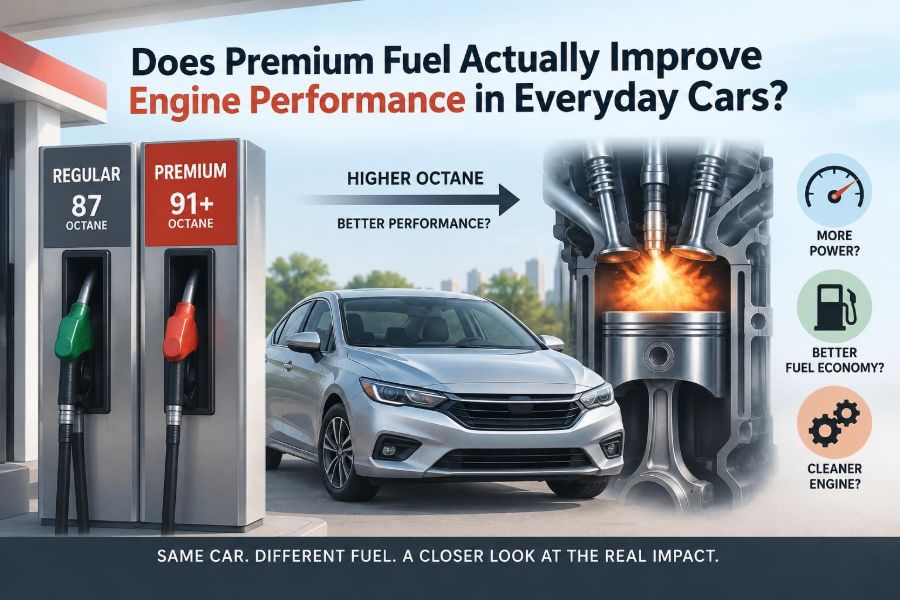

You pull up to the fuel pump and see several choices: regular, mid-grade, premium, perhaps a detergent-branded option. Premium costs more, and its label suggests a more refined product. It is natural to wonder whether that extra cost will make an ordinary car quicker, smoother, cleaner, or more efficient.
Sometimes a driver also notices a change after filling up. The engine may seem quieter, throttle response may feel sharper, or a long trip may return slightly better fuel economy. Those observations can be real, but the reason is not always the octane number printed on the pump.
The key question is not whether premium gasoline is “better” in an absolute sense. It is whether its properties match what a particular engine was designed, calibrated, and maintained to use.
Understanding that match helps drivers spend intelligently, avoid fuel-related myths, and recognize when an apparent fuel problem is actually a mechanical or maintenance issue.
⛽ Start with the Meaning of “Premium”
At most fuel stations, “premium” primarily means gasoline with a higher octane rating than regular grade. It does not automatically mean the fuel contains more energy, is cleaner, or will produce more power in every engine.
Fuel grades vary by market, but regular, mid-grade, and premium are usually separated by octane number. The owner’s manual—not the most expensive pump label—is the reliable starting point for choosing among them.
🔢 Octane Is a Measure of Knock Resistance
Octane rating describes how well gasoline resists abnormal combustion, commonly called knock or detonation. A higher-octane fuel can tolerate greater heat and pressure in the cylinder before it auto-ignites.
It is not a direct rating of fuel quality or power content. Think of octane as a fuel’s resistance to igniting at the wrong moment, rather than its ability to make a bigger explosion.
🔥 Normal Combustion Happens on a Controlled Schedule
In a spark-ignition petrol engine, the piston compresses an air-fuel mixture. Near the end of compression, the spark plug fires, creating a flame front that travels across the combustion chamber in a controlled way.
The timing is carefully managed so cylinder pressure peaks at a useful point after the piston has started moving downward. This controlled pressure rise is what converts combustion energy into crankshaft torque.
💥 What Engine Knock Actually Is
Knock occurs when part of the unburned mixture ahead of the normal flame front ignites unexpectedly. Instead of one orderly burn, the chamber experiences rapid pressure waves that can create the familiar metallic pinging sound in some conditions.
Modern cars often prevent audible knock, but knock control is still active behind the scenes. Persistent severe knock is undesirable because it can increase heat and mechanical stress within the engine.
🧪 Why Higher Compression Raises Octane Demand
Compression ratio compares cylinder volume when the piston is low with its volume when the piston is near the top. Compressing the mixture raises its temperature and pressure, which improves potential efficiency but also makes unintended ignition more likely.
Turbocharging and supercharging create a related challenge by forcing more air into the cylinders. More air allows more fuel to be burned and can increase torque, but it also raises the combustion pressures that make knock more likely.
📘 The Fuel Requirement in Your Owner’s Manual
Manufacturers commonly use two different phrases: “required” and “recommended.” The difference matters more than advertising claims at the pump.
- Premium required: The engine is intended to operate on that minimum octane. Using lower octane may cause reduced performance, protective intervention, or in some cases operating concerns.
- Premium recommended: The engine can generally run on regular fuel, but it may deliver its published performance or best response with premium.
- Regular specified: The engine was calibrated to achieve its intended operation on regular gasoline. Premium is usually unnecessary.
Always check the exact wording for the specific model year and engine. Two trims of the same vehicle can have different fuel requirements.
🧠 The Knock Sensor Changes the Equation
Most modern engines use one or more knock sensors, which detect the vibration patterns associated with knock. When the engine control unit identifies a risk, it can adjust operating conditions—often by retarding ignition timing.
Retarding timing means firing the spark later. This reduces knock tendency, but it may also reduce torque and efficiency because peak cylinder pressure occurs less advantageously in the power stroke.
⚙️ When Premium Can Restore Available Performance
An engine designed to take advantage of premium fuel can sometimes run closer to its preferred ignition timing when high-octane gasoline is used. Under demanding conditions, this may preserve acceleration, especially in turbocharged engines or vehicles carrying heavy loads.
This does not mean premium adds power like an aftermarket modification. Rather, it can allow an engine that is already capable of a certain output to avoid backing away from that output because of knock protection.
🚙 Why a Regular-Fuel Engine Usually Gains Nothing
If an engine is calibrated for regular gasoline and does not encounter knock on that fuel, switching to premium gives the control unit no useful combustion limitation to remove. Timing, boost, and fuel delivery may remain essentially unchanged.
In that situation, the driver has purchased greater knock resistance than the engine needs. The vehicle may run normally, but normal operation is exactly what it was already designed to do on regular fuel.
🏁 Wide-Open Throttle Is Different from Gentle Cruising
Octane demand rises when cylinder pressure and temperature rise. Hard acceleration, steep climbs, hot weather, high loads, and towing are therefore more likely to reveal a difference in an engine that can benefit from premium.
At a steady, light-throttle highway cruise, the engine is often under much less stress. Even a premium-recommended vehicle may show little practical difference during that part of a journey.
🌡️ Heat, Altitude, and Weather Affect the Result
High intake-air temperatures, a hot engine bay, and sustained load can narrow an engine’s knock margin. Under these conditions, high-octane fuel may be more useful where the manufacturer permits or recommends it.
Altitude changes air density and therefore engine load, while modern electronic controls adapt in several ways. The result is not simple enough to reduce to “premium is always needed in the mountains” or any similar rule. Follow the vehicle’s stated requirement and local fuel guidance.
🌀 Turbocharged Engines Need Careful Reading
Many everyday cars now use small turbocharged engines. Their boost pressure lets a compact engine produce strong low- and mid-range torque, but the calibration must actively manage combustion temperature, pressure, and knock.
Some turbo engines require premium; others are engineered to use regular. The presence of a turbocharger alone is not a fuel-grade instruction. The manual and fuel-filler label remain decisive.
📈 Horsepower Claims May Depend on Fuel Grade
Manufacturers sometimes state maximum horsepower and torque with a particular premium fuel grade. When this is the case, lower octane may still be permitted, but the engine may not reach the published peak output in all conditions.
This distinction is most relevant to drivers who frequently accelerate hard, tow, climb grades, or use a vehicle in hot conditions. For routine commuting, the difference may be difficult to notice even if it exists at full load.
🛞 Naturally Aspirated Engines Can Benefit Too—Sometimes
A naturally aspirated engine has no turbocharger or supercharger, but it can still have a high compression ratio or aggressive ignition calibration. Such engines may be designed for premium fuel to control knock and retain efficiency.
Conversely, many naturally aspirated engines are deliberately optimized for regular fuel. Engine aspiration is only one design feature; it cannot predict the correct gasoline grade by itself.
🔋 Premium Fuel Does Not Contain Automatically More Energy
A common belief is that premium fuel must produce more energy per litre or gallon. In practical pump-fuel use, octane rating and energy content are not the same property, and a higher octane number does not guarantee better fuel economy.
Fuel formulation can vary by supplier, season, and region. Any small mileage difference between tanks can also be influenced by traffic, route, weather, tyre pressure, vehicle load, driving style, and how completely the tank was filled.
📊 A Simple Decision Guide
| Vehicle guidance | Best default choice | What premium may change |
|---|---|---|
| Regular fuel specified | Use the specified regular grade | Usually no measurable performance advantage |
| Premium recommended | Choose based on driving conditions and value | May preserve response, power, or efficiency under load |
| Premium required | Use at least the stated premium grade | Supports intended operation and knock control margin |
| Older vehicle with audible pinging | Investigate the cause; follow manual guidance | May temporarily reduce symptoms, but is not a diagnosis |
The table is a decision framework, not a substitute for manufacturer instructions. Regional octane scales and fuel labels differ, so compare the number using the rating system specified for the vehicle’s market.
💰 Calculate Value, Not Just Pump Price
For a premium-recommended car, the relevant question is whether any improvement in economy or performance is worth the extra fuel cost for your actual use. A small change in kilometres per tank is not automatically a saving if the higher-grade fuel costs substantially more.
A practical method is to record several comparable tanks, including distance traveled and fuel purchased, while keeping route and driving habits as consistent as possible. One short trip or a single fill-up is too noisy a test to support a confident conclusion.
🧭 Avoid the “Seat-of-the-Pants” Test Trap
Drivers often expect premium to feel better after paying more for it. That expectation can genuinely affect perception, especially because throttle response and road conditions vary from one journey to the next.
If you test permitted fuels, use repeatable conditions. Compare fuel economy over enough distance, note outside temperature and driving mix, and do not treat a single enthusiastic acceleration run as proof of a broad engine change.
🧼 Octane and Detergent Additives Are Separate Issues
Gasoline contains additive packages that help control deposits in fuel-system and intake components. The exact package can differ between fuel brands and grades, but premium does not automatically mean superior cleaning.
Some suppliers may include a stronger detergent package in certain grades, while others may use similar detergent standards across their range. If deposit control is your concern, inspect the fuel retailer’s product information and follow maintenance recommendations rather than assuming octane solves it.
🧹 Premium Will Not Repair Existing Carbon Deposits
Deposit buildup can affect airflow, injector spray patterns, combustion behavior, or valve operation depending on the engine design. A tank of higher-octane fuel is not a reliable repair for a significant mechanical or deposit-related problem.
Direct-injection engines deserve particular nuance: fuel is injected directly into the cylinder, so gasoline does not wash over the intake valves in the way it does in conventional port-injected systems. Fuel choice cannot address every deposit location.
🔧 An Engine Problem Can Mimic a Fuel Problem
If a car hesitates, pings, loses power, idles roughly, or triggers a warning light, premium fuel may seem like an easy solution. It can sometimes mask a knock-related symptom, but it does not identify why the symptom occurred.
Potential causes include incorrect spark plugs, carbon buildup, intake leaks, poor sensor readings, cooling-system problems, ignition faults, or fuel-delivery issues. A persistent symptom should be assessed by a qualified technician rather than repeatedly treated with more expensive fuel.
🚨 Do Not Ignore Audible Pinging
Some older vehicles make audible pinging under acceleration when octane is inadequate or an engine condition has changed. Newer cars may reduce the chance of audible noise through electronic knock control, so silence is not always proof that the fuel choice is ideal.
If pinging occurs with the fuel grade the manufacturer specifies, avoid prolonged heavy loading and arrange inspection. The correct response is not to assume that a higher grade permanently resolves the underlying cause.
🕰️ Older Engines Have Different Sensitivities
Older engines may lack modern knock sensors and adaptive control, making the correct fuel grade especially significant. Their original compression ratio, ignition timing, carbon deposits, cooling condition, and prior modifications can all influence octane demand.
Classic or modified vehicles should be evaluated according to their actual engine specification, not merely their age. A rebuilt high-compression engine, for example, may need a different fuel strategy than it did when new.
🧰 Modifications Can Change the Required Fuel
Changes such as increased boost, advanced ignition timing, a higher-compression build, performance software, or aggressive towing calibration can reduce knock margin. A tuner may specify premium fuel because the revised calibration expects its resistance to knock.
Using regular fuel with a tune that requires premium can be risky even if the car appears to drive normally. The original manual applies to the factory configuration; modifications can create a new fuel requirement.
🚚 Towing and Heavy Loads Put Fuel Choice in Context
Pulling a trailer, carrying a full load, or climbing long grades at speed raises engine demand. For a vehicle whose manual recommends premium for maximum performance, these are the situations where premium may be most likely to help the engine avoid protective timing reduction.
For a vehicle specified for regular fuel, regular remains the correct baseline even when towing, unless the manufacturer gives a separate instruction. Good cooling-system health, correct transmission operation, and sensible driving speed matter just as much.
🧾 Mid-Grade Is Not Always a Special Formula
At some stations, mid-grade gasoline is created by blending regular and premium at the dispenser. That does not make it inferior when the station equipment is working properly, but it means it may not be a distinct refinery product with a unique benefit.
Mid-grade can make sense when a manufacturer specifies an octane level between the regular and premium options available locally. It is not automatically the ideal compromise for every premium-recommended vehicle.
🧪 Ethanol Blends Add Another Variable
Many petrol fuels contain ethanol. Ethanol has a relatively high octane rating, but it has lower energy content per unit volume than pure gasoline, so blend composition can affect fuel economy.
Only use blends approved for the vehicle. A fuel’s octane rating does not override material compatibility, emissions-system calibration, storage limits, or the manufacturer’s maximum permitted ethanol content.
🧑🔧 Follow the Fuel Label, Not Internet Folklore
Advice such as “all luxury cars need premium,” “all engines run better on premium,” or “use premium once a month to clean the system” is too broad to be dependable. Vehicle engineering is more specific than those rules.
- Read the fuel-filler label and owner’s manual.
- Use the minimum grade marked as required.
- For premium-recommended vehicles, match the choice to your priorities and operating conditions.
- Investigate ongoing driveability problems instead of changing grades repeatedly.
🔍 A Practical Fill-Up Routine
For most drivers, the routine can be simple: use the manufacturer-approved octane grade from a reputable station, secure the fuel cap correctly, and keep records if you are testing a permitted alternative.
Do not top off the tank after the pump clicks off. Overfilling can create problems in the evaporative-emissions system. Also avoid using fuel stored in unsuitable containers or gasoline that has been sitting for a long period without appropriate storage precautions.
🎯 The Core Principle: Match Fuel to Engine Design
Premium gasoline is valuable when an engine needs its higher knock resistance or can use it to maintain a more favorable calibration. It is not a universal performance upgrade, a guaranteed mileage enhancer, or a cure for mechanical faults.
For everyday cars built for regular fuel, regular is usually the rational choice. For premium-required cars, premium is part of operating the vehicle as engineered. For premium-recommended cars, the best answer depends on how the vehicle is driven and whether the real-world benefit justifies the added cost.
The smartest fuel choice is not the most expensive one—it is the octane grade your engine is designed and calibrated to use. A manual, a fuel-filler label, and careful attention to persistent symptoms will tell you far more than the pump’s marketing language. 🚗⛽🔧