
A driver approaches an intersection on a wet evening. A pedestrian steps from behind a parked van, a cyclist moves into the lane, and the traffic light changes. In a few seconds, the driver must notice, predict, decide, and act.
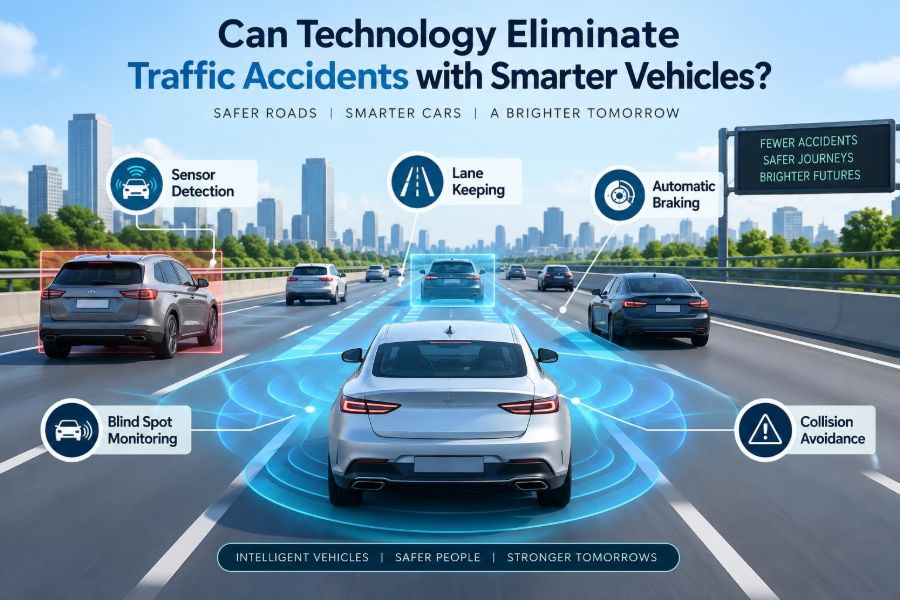
Modern vehicles can now warn about that pedestrian, apply the brakes if a collision appears likely, keep a car from drifting out of its lane, and call for help after a severe crash. These capabilities make a compelling promise: perhaps smarter vehicles can make roads dramatically safer.
But traffic crashes are not caused by one failure alone. They emerge from human choices, road design, weather, vehicle condition, visibility, and the unpredictable movement of other road users. Technology can reduce some risks very effectively while leaving others largely untouched.
The better question is not whether a single invention can end every accident. It is how vehicles, drivers, infrastructure, and safety policy can work together to prevent the largest possible share of harmful mistakes.
🛣️ What “Eliminate Traffic Accidents” Really Means
Eliminating every traffic accident is an extremely high standard. A safe road system must account for distracted drivers, mechanical failures, loose cargo, animals, severe weather, damaged markings, and people who behave unexpectedly.
Technology can lower both crash frequency and crash severity. Preventing a low-speed impact is useful, but reducing the force of an unavoidable impact through airbags, seat belts, and crumple zones is also a major safety achievement.
Therefore, safer vehicles should be judged by specific questions: Which crashes can they prevent? Under what conditions do they work? What happens when their sensors or assumptions are wrong?
📉 Why Road Safety Is a Systems Problem
A road crash rarely has one clean cause. A driver may be tired, the road may be slippery, the sign may be obscured, and the following vehicle may be too close. Each factor changes the margin available for recovery.
This is why automobile engineering increasingly treats safety as a system. The vehicle must be designed for normal operation, foreseeable misuse, and faults that occur during service. Roads, regulations, maintenance, and driver behaviour are part of the same system.
A highly capable car cannot fully compensate for a dangerous junction or a driver who deliberately takes extreme risks. Yet a well-designed system can make an ordinary human error less likely to become a fatal event.
🧠 The Human Error Technology Tries to Catch
Human drivers make errors in perception, judgment, and control. They may fail to see a motorcycle, misjudge an oncoming vehicle’s speed, brake too late, or press the accelerator more sharply than intended.
Driver-assistance technology is most useful when it catches routine lapses before they grow. A forward collision warning can direct attention back to a closing gap. Electronic stability control can help when a driver enters a wet bend too quickly and the vehicle begins to skid.
These systems do not make people flawless. They add a second opportunity to notice danger or stabilize the vehicle when the first opportunity has been missed.
👀 Sensing the Road Beyond Human Vision
Smart vehicles depend first on sensing. Cameras identify lane boundaries, signs, traffic lights, and object shapes. Radar measures distance and relative speed, often working well through darkness and light rain. Ultrasonic sensors are commonly used at low speed for parking.
Some vehicles also use lidar, which measures distance using reflected laser light and can create a detailed three-dimensional picture of nearby objects. Each sensor type has strengths and weaknesses, so combining them can improve confidence.
This combination is called sensor fusion. Instead of trusting a single camera or radar reading, software compares multiple inputs and estimates what is happening around the vehicle.
🌧️ Why Sensors Do Not See Perfectly
A sensor is not an all-knowing observer. Cameras can be impaired by glare, darkness, dirt, fog, heavy rain, or a low sun. Radar may detect an object strongly but provide less detail about its exact shape. Snow, road spray, and a blocked sensor housing can degrade performance.
Recognition is also difficult in unusual scenes. A pedestrian carrying a large object, a partly hidden bicycle, temporary construction markings, or a vehicle at an unusual angle can challenge classification software.
Drivers should treat sensor-related warnings as assistance, not proof that every hazard has been detected. Keeping windscreens, cameras, radar covers, and lights clean is a small maintenance task with real safety value.
⚙️ From Detection to a Driving Decision
Seeing an object is only the first stage. The vehicle must estimate whether the object is relevant, predict its path, calculate risk, and decide whether to warn, brake, steer, or do nothing.
Consider a parked car beside the road. Braking for every parked car would make a vehicle unpleasant and potentially unsafe in traffic. The system must distinguish it from a vehicle moving into the lane, a pedestrian emerging from behind it, or a harmless roadside feature.
This decision problem explains why safe automation is difficult. The road is not a controlled factory floor; it is a changing environment filled with incomplete information.
🛑 Automatic Emergency Braking and Its Limits
Automatic emergency braking, often shortened to AEB, detects an imminent collision and can apply the brakes when the driver does not react in time. It is especially valuable in common situations such as approaching a slower vehicle or a stopped queue.
Its effectiveness depends on vehicle speed, grip, sensor visibility, object type, and the available stopping distance. If a child runs into the road very close to the vehicle, physics may leave too little time to avoid contact even when the system responds correctly.
AEB should never be used as permission to follow closely. It is a last protective layer, not a replacement for scanning ahead and maintaining a safe gap.
↔️ Lane Support Can Prevent a Familiar Crash
Lane departure warning alerts the driver when a vehicle drifts across a marked lane boundary. Lane-keeping assistance may apply gentle steering torque to help keep the vehicle centered, while lane-centering systems continuously assist with position control.
These functions can reduce risk from fatigue, momentary distraction, or monotonous motorway driving. They are less dependable where markings are faded, covered, absent, confusing, or altered by roadworks.
They also cannot settle the question of intent by themselves. A driver changing lanes to avoid debris, passing a cyclist, or making room for an emergency vehicle must remain responsible for checking surroundings and steering appropriately.
🌀 Stability Control Works With Vehicle Physics
Electronic stability control compares the driver’s intended direction, inferred from steering input, with the vehicle’s actual motion. If it detects understeer or oversteer, it can reduce engine torque and brake individual wheels to help restore stability.
Understeer occurs when the front tyres lose grip and the vehicle turns less than commanded. Oversteer occurs when the rear tyres lose grip and the rear of the vehicle begins to swing outward. Both can lead to loss of control.
Stability control cannot create unlimited grip. Worn tyres, excessive speed, standing water, ice, and poor loading still reduce what the vehicle can do. Good tyres remain a foundational safety technology.
🚦 Adaptive Cruise Control Is Not Autonomous Driving
Adaptive cruise control uses sensors to maintain a selected following distance behind traffic. In suitable conditions, it can reduce the effort of managing speed on highways and help avoid creeping too close to the vehicle ahead.
However, following a lead vehicle is much simpler than handling the full driving task. A system may have difficulty with stationary objects, sharp curves, cut-ins, intersections, or vehicles moving across its path, depending on its design.
A common mistake is to confuse convenience with autonomy. If the system requires driver supervision, the driver must continue looking ahead, keeping hands ready where required, and taking control when conditions exceed its capability.
🧭 The Difference Between Assistance and Automation
Driver assistance supports a human who remains responsible for monitoring the environment. Automated driving performs some or all of the dynamic driving task within defined conditions, often called its operational design domain.
That domain may limit operation to certain roads, speeds, weather conditions, mapped areas, or traffic situations. A system that works reliably on a divided highway may not be designed for busy urban streets with cyclists, delivery vehicles, and unprotected turns.
Clear communication matters. A feature name that sounds more capable than it is can encourage overtrust, which creates a new route to danger.
🧑✈️ Driver Monitoring Addresses the Attention Gap
As vehicles take over more routine control, the human role changes. A person who is merely watching automation for a long period can become less alert and slower to respond when intervention is suddenly needed.
Driver-monitoring systems may use an inward-facing camera or steering-wheel interaction to estimate whether the driver is looking at the road and able to respond. Their purpose is not to blame the driver; it is to detect when the safety fallback is weak.
Monitoring must be designed carefully, with clear privacy practices and sensible warnings. It should identify meaningful disengagement rather than repeatedly nagging an attentive driver.
📱 Distraction Cannot Be Solved by a Dashboard Screen
Infotainment systems, navigation screens, messages, and app-based functions can compete for attention. A smart vehicle that adds visual complexity may undermine the safety benefits of its assistance features.
Good interface design reduces unnecessary steps for common tasks, uses clear alerts, and avoids demanding visual attention when the road requires it. Voice control can help in limited cases, but spoken menus can also distract if they are lengthy or unreliable.
The safest approach remains simple: set navigation and media before moving, keep the phone out of hand, and stop safely for tasks that require concentration.
😴 Fatigue Detection Has an Important Role
Drowsiness reduces attention, reaction time, and judgment. Some vehicles infer fatigue from steering patterns, lane position, driving duration, or driver-facing cameras, then recommend a break.
Such systems can identify possible warning signs, but they cannot measure a person’s true readiness with perfect certainty. A calm driver may make small steering corrections, while a tired driver may temporarily appear controlled.
No alert can substitute for rest. If a driver is struggling to stay awake, the appropriate action is to stop in a safe place rather than relying on lane support, caffeine, or repeated warnings.
🧪 Software Must Be Tested for Rare Events
Most driving is ordinary: vehicles follow lanes, stop at signals, and share predictable road space. Safety-critical systems must also handle rare, difficult events, such as a temporary sign falling into the lane or a pedestrian crossing between vehicles at night.
Engineers use simulations, closed-course testing, component tests, road trials, and structured safety analysis. Simulation enables many variations of a situation, but it cannot perfectly reproduce every sensor artifact, human behaviour, or road condition.
The central challenge is not only making a system work in typical situations. It is understanding where it may fail and ensuring that failure does not produce an unacceptable hazard.
🔒 Cybersecurity Is Now a Road-Safety Issue
Connected vehicles exchange information with phones, service tools, cloud systems, and sometimes roadside infrastructure. This connectivity can support updates, diagnostics, emergency response, and useful services, but it also expands the attack surface.
A safety-oriented design separates critical control systems from less trusted functions where possible. It also requires secure software development, access control, monitoring, and a plan for responding to discovered vulnerabilities.
Owners contribute too: use reputable service providers, apply legitimate updates, and avoid unofficial modifications that interfere with braking, steering, airbag, or sensor systems.
🔧 Reliability and Maintenance Still Matter
Smart safety features rely on ordinary mechanical systems. A vehicle cannot brake effectively if tyres are bald, brake components are neglected, or suspension faults affect stability. Nor can a camera-based system work well through a damaged or heavily soiled windscreen.
Maintenance should include both traditional checks and technology-specific inspection. After a collision, windscreen replacement, bumper repair, wheel alignment work, or suspension repair, sensors may require calibration according to the manufacturer’s procedure.
Ignoring calibration is risky because a system can appear normal while its view or reference position is inaccurate. Professional repair quality has become part of digital safety.
🚑 Crash Survival Technology Remains Essential
Even the best prevention tools cannot avoid every crash. Passive safety systems protect occupants once an impact has begun: seat belts, airbags, head restraints, reinforced passenger compartments, and energy-absorbing structures all play different roles.
Modern restraint systems may adjust deployment according to crash conditions and occupant information, but no airbag replaces a correctly worn seat belt. The belt positions the occupant and reduces movement before the airbag provides additional cushioning.
Vehicle safety must therefore include both active safety, which seeks to prevent a crash, and passive safety, which seeks to reduce injury when prevention fails.
🚶 Protecting Pedestrians and Cyclists Requires More Than Detection
Vulnerable road users are difficult to protect because they are small, exposed, and often move unpredictably through complex environments. A pedestrian may be hidden by a van; a cyclist may be travelling faster than expected beside slow traffic.
Detection systems can help, but safer street design also matters: lower speeds where people walk, clear crossing points, protected cycle routes, better lighting, and sight lines that reduce concealment.
Vehicle design contributes through energy-absorbing front structures and emergency braking, but the greatest protection is often preventing a high-speed conflict from developing in the first place.
📡 Vehicle-to-Everything Communication Adds Foresight
Vehicle-to-everything, or V2X, communication refers to sharing selected information between vehicles, roadside equipment, and sometimes other road users’ devices. A signal could communicate its phase timing, or a vehicle could warn others that it is braking hard ahead.
This may extend awareness beyond line of sight. For example, a vehicle approaching an obstructed junction could receive a warning about traffic that its cameras cannot yet see.
Its value depends on reliable deployment, common technical rules, cybersecurity, and broad participation. A safety feature that only works when a few nearby vehicles are equipped has limited reach.
🏙️ Smart Roads Can Support Smarter Vehicles
Well-maintained markings, readable signs, consistent intersection design, drainage, lighting, and clear work-zone management make life easier for both humans and automated systems. In this sense, infrastructure quality reduces the burden placed on vehicle intelligence.
Roadside sensors and dynamic signs can provide useful local information, such as hazardous weather, congestion, or a lane closure. But smart infrastructure should support safety even when a connection fails or a vehicle lacks advanced equipment.
Basic engineering remains powerful: a forgiving roadside, a protected turn phase, or a lower-speed street can prevent harm without requiring every road user to own a new car.
⚖️ Ethical Decisions Are Usually Design Decisions
Discussions of automated vehicles often focus on dramatic moral dilemmas. In practical engineering, many ethical questions arise earlier and more often: What level of uncertainty should trigger braking? How should a system behave when lane markings conflict? How should it communicate its limitations?
These choices affect who bears risk. A system tuned to brake aggressively may reduce one danger while increasing the possibility of a rear-end collision. A system tuned to avoid false alarms may respond too late in some real threats.
Responsible design makes such trade-offs explicit, tests them thoroughly, and does not conceal limitations behind reassuring marketing language.
⚠️ Overtrust and Misuse Can Cancel Safety Gains
Automation can produce behavioural adaptation: people may take greater risks because they believe a system will protect them. A driver may look away more often, follow more closely, or assume that every hazard will trigger an intervention.
This is particularly dangerous when a feature works well most of the time. Reliable operation in easy conditions can create confidence precisely when the system is approaching a difficult situation.
Training, clear manuals, sensible alerts, and honest feature names help. The practical rule is straightforward: know what the feature is designed to do, and know what it is not designed to do.
🧾 Data Can Improve Safety but Raises Questions
Vehicles can record diagnostic information, system status, and in some cases data associated with a crash or near-crash event. This information can help engineers identify faults, improve designs, and reconstruct technical events.
However, data collection also raises legitimate concerns about privacy, consent, access, retention, and cybersecurity. Safety benefits do not remove the need for transparent rules about what is collected and why.
Users should be able to understand relevant data settings, while investigators and manufacturers need appropriate processes for safety-critical information. Trust is easier to build when the boundaries are clear.
💰 Access and Fleet Age Shape Real-World Benefits
Advanced driver-assistance systems reach the road gradually because vehicles remain in service for many years. A new safety feature may be common in newer models while many drivers continue using vehicles with fewer protections.
Cost also matters. Repairs involving sensors, cameras, radar units, and calibration can be more expensive or harder to access than conventional repairs. If safety technology is too difficult to maintain, its benefits may not persist over a vehicle’s life.
Broad safety improvement requires durable designs, repair information, trained technicians, affordable maintenance, and policies that do not leave older vehicles or lower-income road users behind.
🧰 What Drivers Can Do With Current Technology
Drivers get the most from safety features when they learn their vehicle rather than assuming all systems behave alike. Read the relevant manual sections, practice controls in a low-risk setting, and understand warning symbols before a stressful journey.
- Adjust mirrors, seating position, and head restraint before driving.
- Keep tyres correctly maintained and use tyres suited to local conditions.
- Clean cameras, lights, radar covers, and windscreens regularly.
- Leave generous following distance, especially in rain, darkness, or heavy traffic.
- Respond to warnings early instead of waiting for automatic intervention.
- Schedule proper inspection and calibration after relevant repairs.
Technology works best when it reinforces attentive, patient driving habits rather than compensating for their absence.
👩🔧 What Engineers Must Design For
Automobile engineers must design for real users, not an idealized driver on a perfect road. That means considering misuse, maintenance variation, sensor contamination, confusing environments, component aging, and failures in communication or power supply.
Safety engineering often uses redundancy and graceful degradation. If one input becomes unreliable, the system should identify the problem, limit unsafe functions where necessary, warn the driver clearly, and retain safe basic vehicle control.
Human factors are equally vital. An alert that is too subtle may be missed; one that is too frequent may be ignored. Technical capability and understandable interaction must be developed together.
🏛️ Regulation and Standards Set a Safety Floor
Testing requirements, vehicle standards, inspection rules, and crash-investigation processes help establish minimum expectations across manufacturers. They can encourage proven safety features while requiring evidence that new systems behave predictably enough for public roads.
Regulation must keep pace with software-defined vehicles, remote updates, cybersecurity, and automated functions. At the same time, rules should avoid assuming that a feature is safe in every location simply because it performs well in one test scenario.
A strong framework combines pre-market assessment, transparent reporting of serious faults, recall or repair mechanisms, and continued monitoring as technology is used in diverse conditions.
🔮 The Most Realistic Path Forward
The near-term path to fewer crashes is likely to be incremental rather than magical. Better braking support, improved occupant protection, safer road layouts, lower conflict speeds, driver monitoring, reliable maintenance, and clearer vehicle interfaces can reinforce one another.
Fully automated driving may eventually handle some environments well, especially where routes and conditions are tightly defined. But broad deployment across all roads and weather will require progress not only in artificial intelligence, but also in validation, infrastructure, law, public understanding, and repair practices.
The goal should be measurable risk reduction, not an unrealistic claim that a vehicle can remove every consequence of human life on shared roads.
✅ The Core Principle: Layered Safety Beats a Single Solution
Smarter vehicles can prevent many crashes and reduce harm in others. Their greatest value comes from combining independent layers: alert drivers, capable brakes, stable vehicle dynamics, effective restraints, readable roads, safe street design, and responsible operation.
Each layer has limits. A camera may miss a hazard, a driver may be tired, and a road may be poorly marked. When several layers overlap, one failure does not automatically become a tragedy.
Technology will not eliminate every traffic accident, but carefully engineered vehicles working within a safer transport system can make serious crashes far less likely and less harmful.
That is the practical promise of smarter vehicles: not perfection, but a road network that anticipates mistakes, preserves safety margins, and protects people when the unexpected happens. 🚗🛣️🛡️