
It is a cold morning, the windscreen is misted, and the familiar advice arrives before the key even turns: “Let the engine idle for ten minutes.” Later, at the fuel station, another driver recommends premium petrol for every car because it will “clean everything out.”
Much of this advice began with older vehicles, incomplete observations, or one unusual fault that became a rule for everybody. Modern engines, fuels, lubricants, and diagnostic systems have changed, but many workshop myths have remained remarkably durable.
These misunderstandings are not always harmless. They can waste fuel, increase emissions, hide an emerging mechanical problem, or lead an owner to spend money on maintenance that the vehicle does not need.
The better approach is not to follow slogans. It is to understand what the engine, transmission, tyres, fluids, and control systems are actually doing under real driving conditions.
🧭 Why Vehicle Myths Persist
Cars are complex systems, but their behaviour is visible in simple everyday moments: a noisy cold start, a fuel gauge that falls quickly in traffic, or a warning light that disappears after restarting. It is natural to form a quick explanation from one experience.
The problem is that several causes can produce the same symptom. Poor fuel economy may come from short trips, low tyre pressure, a dragging brake, winter fuel blends, heavy traffic, or an engine fault. A single explanation is rarely enough.
Good maintenance decisions begin by separating a useful principle from a universal claim.
❄️ Myth: Every Engine Needs a Long Idle Warm-Up
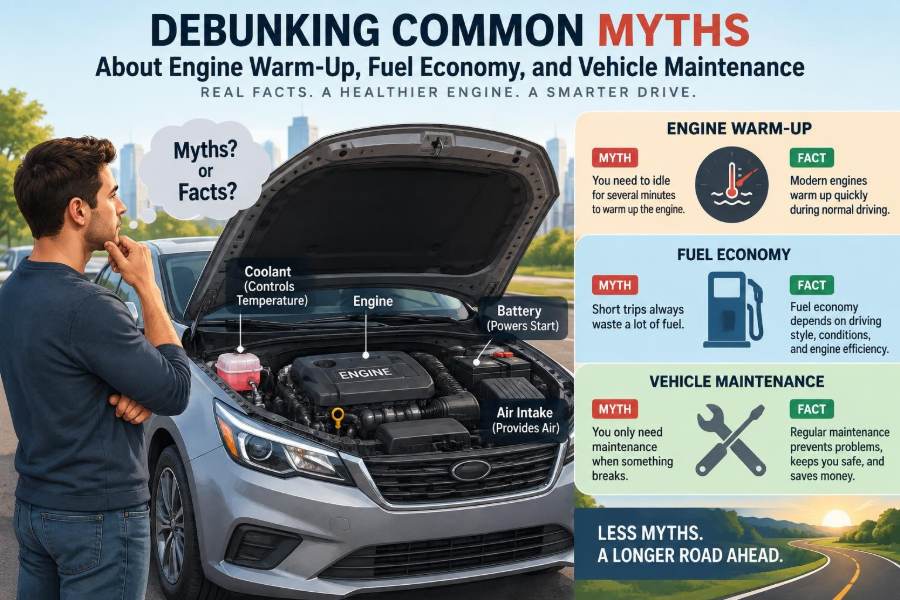
For most modern passenger vehicles, extended idling is not the best way to warm the engine. After starting, a brief pause to stabilize idle speed and ensure clear visibility is usually sufficient; gentle driving then warms the engine and drivetrain more effectively.
At idle, the engine produces relatively little power and heat. It may take a long time for the coolant, engine oil, transmission fluid, wheel bearings, and tyres to approach their normal operating conditions.
Older carburetted engines often did need more warm-up attention because fuel metering was less precise. Electronic fuel injection can enrich the mixture automatically during cold operation, reducing the need for long stationary idling.
🌡️ What “Warm” Actually Means
Engine warm-up is not a single event. Coolant temperature may rise first, while engine oil remains thicker than normal and components farther from the combustion chambers remain cooler.
The dashboard temperature gauge is therefore useful but incomplete. It usually represents coolant temperature, not the condition of every lubricated component. In automatic vehicles, transmission fluid may take longer to warm, especially in cold weather.
A car can feel comfortable inside and still benefit from restrained driving for the first several minutes.
🚙 Gentle Driving Is the Practical Warm-Up Method
Gentle driving means using moderate throttle, avoiding high engine speed, and postponing heavy loads until the vehicle has had time to heat through. It does not mean creeping along so slowly that traffic flow is disrupted.
Combustion under light road load creates more useful heat than idling, while airflow and circulation bring the whole vehicle toward normal operating condition. This is why a calm drive away is generally preferable to warming the engine for many minutes on the driveway.
- Start the engine normally.
- Wait briefly if needed for a stable idle, demisting, or safety checks.
- Drive smoothly and avoid full-throttle acceleration.
- Delay very high revs, towing, or steep-load driving until temperatures have stabilized.
🛢️ Cold Oil Is Not “Bad” Oil
Oil becomes more resistant to flow as temperature falls. This is why multigrade oils use ratings such as 0W-20 or 5W-30: the number before the W describes low-temperature flow behaviour, while the second number relates to viscosity at operating temperature.
A manufacturer specifies an oil grade that balances cold-start flow, film strength, fuel economy, emissions-system compatibility, and engine design. The right oil helps protect the engine immediately after start-up.
Cold oil is not automatically damaging. The concern is demanding high power before the lubricant has circulated fully and reached a suitable viscosity. Using the specified grade matters more than trying to compensate with a long idle.
⚙️ Why Hard Acceleration Should Wait
High engine load increases cylinder pressure, bearing load, turbocharger speed where fitted, and heat generation. When the engine is cold, clearances and lubricant behaviour have not yet reached their intended operating state.
This does not mean a cold engine will fail after one firm acceleration. Rather, repeated heavy use before warm-up creates unnecessary stress. The sensible habit is simply to reserve maximum performance for later in the journey.
The same principle applies to high-revving engines, turbocharged engines, and vehicles carrying heavy loads.
🔥 Myth: Idling Is the Best Way to Defrost a Car
Idling does create cabin heat eventually, but it is often slow. A cold engine at idle produces limited waste heat, and the cabin heater cannot deliver heat that the cooling system has not yet absorbed.
Clear glass is a safety requirement, so do not drive until vision is adequate. Use the front and rear demisters, air conditioning if the vehicle uses it for dehumidification, and appropriate external ice removal.
Once visibility is safe, driving gently usually brings faster heat than remaining parked. Never run an engine in a garage or enclosed space because exhaust gases, including carbon monoxide, can accumulate dangerously.
🏁 Myth: Warming Up Means Revving the Engine
Repeatedly revving a cold engine does not warm the complete vehicle in a controlled way. It raises engine speed while oil, bearings, transmission components, and tyres may still be cold.
A brief increase in rpm may occur naturally when a cold-start control system manages emissions and stability. That is different from manually blipping the throttle to “wake up” the engine.
Steady, low-to-moderate-load driving is the more balanced warm-up strategy.
⛽ Myth: Premium Fuel Improves Every Engine
Premium petrol commonly has a higher octane rating. Octane rating indicates resistance to knock, which is uncontrolled combustion that can occur when pressure and temperature become high in a spark-ignition engine.
It does not automatically mean that the fuel contains more energy, produces more power, or improves economy in every engine. If an engine is calibrated for regular unleaded fuel, a higher-octane fuel may provide little or no noticeable benefit.
Always use at least the fuel grade required by the manufacturer. If the handbook says premium is recommended rather than required, the vehicle may adjust its operation under some conditions, but benefits vary with engine design and driving conditions.
💥 Understanding Knock Without the Drama
Normal combustion begins at the spark plug and progresses smoothly across the mixture. Knock occurs when part of the unburned mixture auto-ignites in an uncontrolled manner, creating sharp pressure waves.
Modern engines use knock sensors to detect this tendency and may reduce ignition advance to protect the engine. Higher-octane fuel can allow some engines to maintain more optimal timing under heavy load.
That is a design-specific response, not proof that premium fuel is a universal upgrade. Persistent audible knocking or pinging deserves professional diagnosis, especially if the correct fuel is already being used.
🧪 Myth: Fuel Additives Solve Every Running Problem
Some approved additives can be useful in particular circumstances, such as addressing water contamination risks in suitable fuel systems or providing detergency where a manufacturer permits it. They are not a substitute for repair.
A misfire, rough idle, hard start, warning light, or loss of power can result from ignition faults, air leaks, fuel-pressure problems, sensor errors, mechanical wear, or emissions-control issues. Pouring a cleaner into the tank may delay proper diagnosis.
Use additives only when compatible with the vehicle and when there is a clear reason. Avoid mixing several products or exceeding their instructions.
📉 Myth: Fuel Economy Is Determined Only by Engine Size
Engine displacement affects potential fuel use, but it is only one part of the picture. Vehicle mass, gearing, aerodynamic drag, tyre rolling resistance, traffic conditions, trip length, driving style, and auxiliary loads all influence real-world consumption.
A small turbocharged engine can use substantial fuel when worked hard. A larger engine can perform reasonably efficiently at steady road speed if the vehicle’s gearing and load are favourable.
Fuel economy is best understood as the energy needed to move a particular vehicle through a particular journey.
🌬️ Aerodynamic Drag Rises Quickly at Speed
Air resistance increases sharply as vehicle speed rises. This is why a small increase in motorway speed can require noticeably more engine power, even when the road is level.
Roof boxes, open windows at higher speeds, external accessories, and poorly fitted undertrays can all add drag. Their effect may be minor around town but more apparent during sustained high-speed travel.
There is no need to remove useful equipment for every journey. The practical lesson is to avoid carrying large external items when they are no longer needed.
🛞 Tyre Pressure Is an Everyday Economy Factor
Underinflated tyres flex more as they roll, converting more energy into heat. This raises rolling resistance and can reduce fuel economy while also affecting steering response, tread wear, and tyre temperature.
Check pressures when tyres are cold, using the vehicle manufacturer’s recommended values for the actual load condition. The number moulded on a tyre sidewall is generally a maximum rating, not the vehicle’s target pressure.
A slow pressure loss may indicate a puncture, valve issue, wheel-rim leak, or tyre damage. Repeatedly adding air without investigating the cause is not a long-term solution.
🚦 Short Trips Can Distort Fuel-Economy Expectations
On a short trip, the engine spends a larger proportion of time cold. It may use a richer mixture during warm-up, while cabin heating, demisting, electrical loads, and stop-start traffic consume energy before the vehicle settles into efficient operation.
For example, a car used for several two-kilometre errands may show much poorer consumption than the same car on a continuous thirty-kilometre journey. This does not necessarily indicate a fault.
Where practical, combine errands into one journey. It can reduce cold starts and unnecessary distance, although convenience and safety should remain the priority.
📊 Reading the Trip Computer Carefully
Instantaneous consumption displays change rapidly with throttle position, road gradient, and gear selection. They are useful for learning smooth driving habits, but they can be misleading if treated as a laboratory measurement.
Average consumption becomes more meaningful over several full journeys or fuel tanks. Consistently tracking distance travelled and fuel added can reveal a change that deserves attention.
Allow for normal variation caused by weather, traffic, seasonal fuel changes, towing, or a different route before assuming the engine has developed a fault.
🦶 Smooth Inputs Usually Save More Than Extreme Techniques
Progressive acceleration, anticipating traffic flow, and maintaining sensible spacing reduce unnecessary braking and re-acceleration. The engine then spends less time delivering energy that the brakes immediately turn into heat.
However, “hypermiling” techniques can become unsafe when they encourage coasting in neutral, following too closely, or travelling below a safe traffic speed. Efficient driving must remain legal, predictable, and fully controlled.
Use the vehicle’s normal gear selection and retain engine braking when it is appropriate.
🔧 Myth: Oil Must Always Be Changed at One Fixed Distance
Oil-change intervals depend on the engine, oil specification, operating environment, and manufacturer maintenance schedule. Some vehicles use fixed intervals, while others calculate service needs from time, distance, temperature, starts, and driving conditions.
Short trips, dusty use, towing, repeated cold operation, and extended idling can be severe service. They may justify earlier maintenance where the manufacturer provides a severe-duty schedule.
Changing oil far earlier than required is not automatically better; it creates cost and waste. Extending intervals beyond the specified limit, on the other hand, risks degraded lubrication and deposit formation.
📘 The Oil Specification Matters as Much as the Grade
Two oils can share the same viscosity grade and still differ substantially in additive package and approval. Modern engines may require an oil compatible with turbochargers, particulate filters, timing chains, variable valve systems, or long-drain service intervals.
For this reason, “any 5W-30” is not reliable maintenance advice. Consult the handbook or an official service specification and choose oil that meets the stated requirement.
Incorrect oil may not create an immediate failure, but it can compromise performance or long-term durability in systems designed around a specific lubricant.
🧰 Myth: Dark Engine Oil Automatically Means It Has Failed
Engine oil often darkens as it suspends combustion by-products and contaminants. In diesel engines especially, dark oil can appear soon after a change. Colour alone is not a dependable test of remaining service life.
More concerning signs include a milky appearance that may suggest moisture contamination, metallic particles, an unexpected fuel smell, or a rapid unexplained level change. These observations need context and, where appropriate, inspection.
Follow the service interval and check the level correctly rather than judging oil only by its colour.
🧯 Myth: Coolant Never Needs Attention
Coolant does more than prevent freezing. It transfers heat, protects metal surfaces against corrosion, lubricates some water pumps, and helps control boiling within the cooling system.
Coolant formulations are not universally interchangeable. Mixing incompatible types can reduce corrosion protection or create deposits, even where the colours look similar. Colour is not a reliable specification.
Check level only when the engine is cool and follow the manufacturer’s approved fluid specification. Never remove a pressurized coolant cap from a hot engine.
🛑 Brake Fluid Is a Safety Service Item
Brake fluid is hygroscopic, meaning it can absorb moisture over time. Water content can lower its boiling point and contribute to internal corrosion in brake components.
During repeated hard braking, fluid temperature rises. If contaminated fluid boils, vapour can compress more easily than liquid, potentially producing a soft pedal and reduced braking effectiveness.
Use the specified fluid type and replacement interval. A brake warning light, fluid leak, changed pedal feel, or reduced braking performance requires prompt professional attention.
🔋 Myth: A Battery Is Fine Until the Car Will Not Start
A starting battery can lose capacity gradually while still starting the engine in mild weather. Cold temperatures increase the power needed to crank an engine and reduce the battery’s available output, exposing a weak battery quickly.
Frequent short trips may not fully replace the energy used for starting, especially with heated screens, lights, fans, and infotainment operating. Corroded terminals and poor connections can produce similar symptoms.
Battery health should be assessed with suitable testing rather than guessed from age alone. Start-stop vehicles often require a battery type designed for their charging and cycling demands.
🧠 Warning Lights Are Messages, Not Maintenance Plans
A warning light indicates that the vehicle has detected a condition outside an expected range. It does not always identify the failed part. For example, an engine fault light may relate to air measurement, ignition, fuelling, exhaust after-treatment, or sensor wiring.
Clearing a code without finding the cause may turn the light off temporarily while the underlying fault remains. Diagnostic trouble codes guide the investigation; they are not automatically a parts-shopping list.
A flashing engine warning light, a red oil-pressure warning, overheating indication, or brake-system warning can require immediate action. Follow the handbook’s guidance and stop safely when necessary.
🧑🔧 Myth: Dealer Service Is the Only Proper Service
A competent independent workshop can service and repair many vehicles well, provided it has appropriate training, information, diagnostic equipment, parts, and procedures. The quality of work matters more than the sign above the door.
Some jobs may be better suited to a specialist or authorized network, particularly where software programming, warranty conditions, recalls, high-voltage systems, or model-specific tools are involved.
Ask what work is proposed, which parts and fluid specifications will be used, and whether service records will be updated. Clear documentation protects both the vehicle and its resale history.
🧾 Maintenance Records Are Mechanical Evidence
A service record is more useful than a collection of stamps. It should show dates, mileage, work completed, fluid specifications, parts used, and recommendations for future attention.
Good records help a technician distinguish a recurring problem from a new one. They also help an owner verify that time-based items such as brake fluid, coolant, belts, and filters have not been overlooked.
Keep invoices, digital records, and notes about unusual symptoms. A brief description such as “noise occurs only on cold left turns” is often more valuable than “car sounds strange.”
⏱️ Myth: If It Drives Normally, Nothing Needs Checking
Many wear items deteriorate gradually. Tyres can age, brake pads can approach their limit, suspension joints can develop play, and fluid levels can fall without dramatically changing how the vehicle feels.
Routine inspections identify issues before they become expensive or safety-critical. They do not eliminate unexpected failures, but they reduce the chance that obvious warning signs go unnoticed.
- Check tyre condition, tread, and pressure regularly.
- Monitor engine-oil and coolant levels as directed by the handbook.
- Listen for new noises and notice changes in steering, braking, or vibration.
- Follow time-based as well as distance-based maintenance requirements.
🔩 Belts, Chains, and the Danger of Assumptions
Timing belts and timing chains both synchronize vital engine components, but they have different inspection and replacement needs. A belt may have a scheduled replacement interval; a chain is not necessarily maintenance-free or guaranteed to last indefinitely.
Chain wear, tensioner faults, poor lubrication, and incorrect oil can contribute to problems. Likewise, a belt can fail early if contaminated by oil, fitted incorrectly, or used beyond its age or mileage limit.
Know which system your engine uses, then follow the manufacturer’s specific guidance rather than relying on broad claims about belts or chains.
🚿 Washing an Engine Bay Is Not Routine Maintenance
A clean engine bay can make leaks easier to spot, but high-pressure water can force moisture into electrical connectors, sensors, intake components, and insulation. Modern engine bays contain many electronic parts that do not benefit from casual soaking.
If cleaning is necessary, use methods appropriate to the vehicle and avoid sensitive components. In many cases, a careful wipe-down and targeted degreasing by a professional is safer than pressure washing.
Cleaning should never conceal an active oil, fuel, coolant, or brake-fluid leak. Find and repair the source first.
🧊 Seasonal Changes Alter What Your Car Needs
Winter raises demands on batteries, tyres, demisting systems, and coolant protection. Summer heat increases cooling-system load, tyre temperature, and air-conditioning use. Rain and low light raise the importance of tyres, wipers, lights, and washer fluid.
Seasonal preparation is not a separate kind of maintenance; it is an adjustment to operating conditions. The appropriate checks depend on climate, parking conditions, journey length, and local regulations.
Before a long trip, inspect the basics rather than assuming a recent service covers every immediate need.
📚 Read the Handbook Before Following Internet Advice
The owner’s handbook is specific to the vehicle’s engine, transmission, brakes, fluids, warning lights, tyre sizes, and operating features. General advice is valuable only when it does not contradict this primary information.
This is especially relevant for hybrids, plug-in hybrids, diesels with particulate filters, turbocharged engines, and vehicles with start-stop systems. Their operating strategies can differ significantly from older conventional cars.
When advice conflicts, the vehicle manufacturer’s instructions and a qualified technician’s diagnosis should carry more weight than a popular online rule.
✅ The Core Principle: Maintain by Evidence, Not Tradition
Most myths contain a small fragment of truth. Engines do need a period of gentle use when cold. Premium fuel does help engines designed to use its knock resistance. Early oil changes may be sensible under severe operating conditions.
The mistake is turning that fragment into a rule for every vehicle, climate, and driving pattern. Sound ownership combines the correct specification, the recommended maintenance schedule, careful observation, and prompt investigation of meaningful changes.
Think of maintenance as risk management rather than ritual. The goal is not to perform the most tasks, but to perform the right tasks at the right time for the vehicle you actually own.
Reliable vehicle care comes from understanding the machine, following its specifications, and responding to evidence instead of repeating old motoring myths. That approach saves fuel, supports safety, and makes every journey a little more predictable. 🚗🔧🌿