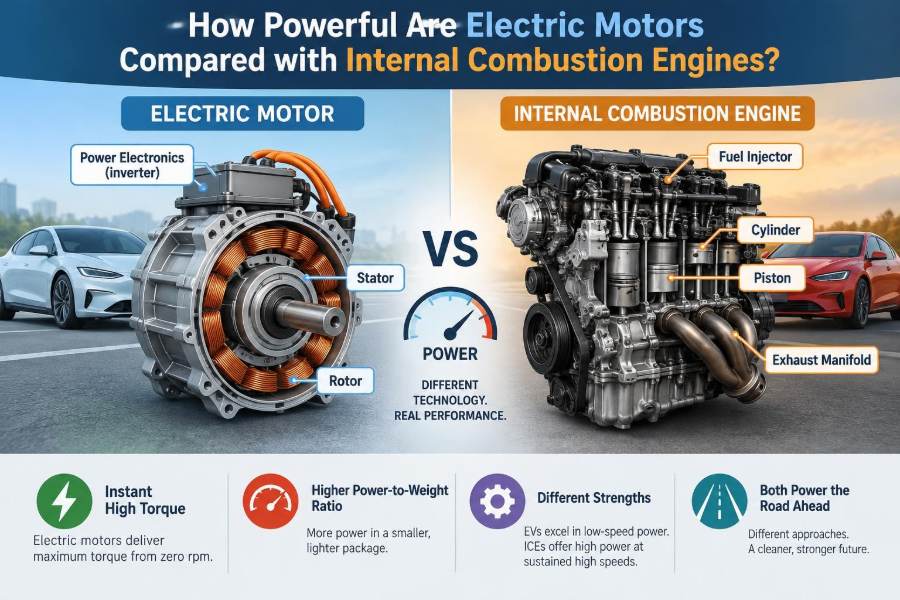

Press the accelerator in an electric car and the response can feel almost surprising: no gear hunting, no rise in engine note, and no pause before the vehicle moves. A modest-looking electric hatchback may feel quicker around town than a larger petrol car.
That sensation leads to a reasonable question. Is the electric motor actually more powerful, or does it simply deliver its power in a more useful way?
The answer matters well beyond acceleration figures. It affects towing, highway passing, battery sizing, thermal design, gearing, vehicle cost, and the way engineers describe performance. It also explains why a power number alone rarely tells the whole story.
Electric motors and internal combustion engines can produce similar peak outputs, but they create and deliver that output by very different mechanisms. Understanding those differences makes vehicle specifications much easier to interpret.
⚡ Power Is Not the Same as Torque
Power is the rate at which work is done. In a vehicle, it strongly influences how quickly speed can continue increasing, especially at higher road speeds. It is commonly expressed in kilowatts (kW), horsepower (hp), or brake horsepower.
Torque is a twisting force. At the wheels, torque is what pushes the contact patches against the road and starts the vehicle moving. It is usually expressed in newton-metres (N·m) or pound-feet (lb-ft).
The relationship is simple in principle: power depends on both torque and rotational speed. An engine or motor can have high torque at low speed without high power if it is barely rotating.
🔄 Why Rotational Speed Changes the Comparison
A combustion engine generally develops useful torque over a middle band of its rpm range, then makes its greatest power nearer the upper part of that range. Because torque is multiplied by rpm to produce power, an engine may reach peak power well after peak torque.
An electric traction motor often provides near-maximum torque from zero rpm up to a designed transition speed. Beyond that point, it usually reduces torque while maintaining roughly constant power for a period.
This difference is why an electric vehicle can feel immediately forceful from a traffic light even when its quoted peak power is not extraordinary.
🏁 The Meaning of “Powerful” Depends on the Job
There is no single complete answer to whether one powertrain is more powerful. For a standing start, available wheel torque and tyre grip matter greatly. For overtaking at motorway speed, sustained power matters more.
For climbing a long grade with passengers and luggage, continuous power and cooling capacity become critical. For a racing lap, mass, traction, gearing, energy storage, aerodynamics, and thermal limits all influence the result.
A specification sheet is a starting point, not a complete performance prediction.
🧲 How an Electric Traction Motor Produces Torque
An electric traction motor uses magnetic fields. The inverter converts the battery’s direct current into carefully controlled alternating current, energising windings in the motor and producing a rotating magnetic field.
That field interacts with the rotor, generating torque. The exact design varies: permanent-magnet synchronous motors, induction motors, and electrically excited synchronous motors each have different trade-offs in cost, efficiency, material use, and control.
Crucially, the control system can command substantial torque at standstill. The motor does not need to idle, draw in air, inject fuel, ignite a mixture, and build rpm before it can act.
🔥 How an Internal Combustion Engine Produces Torque
In a petrol or diesel engine, fuel releases energy through combustion inside cylinders. Expanding gases push pistons, which turn the crankshaft and create torque.
The process depends on airflow, fuel delivery, combustion timing, cylinder pressure, exhaust flow, and crankshaft speed. A naturally aspirated engine relies mainly on atmospheric pressure for intake air; a turbocharged engine uses an exhaust-driven turbine to compress more air into the cylinders.
This is a remarkably capable system, but it has mechanical and gas-flow delays that are largely absent from a directly controlled electric motor.
🚦 Instant Torque Is Real, but It Needs Context
“Instant torque” is useful shorthand, but it can be misunderstood. An electric motor does not create unlimited force instantly. It produces torque promptly within limits set by the inverter, battery, motor, temperature, and traction.
The tyres must also transmit that torque. On wet asphalt, gravel, or ice, a vehicle can only use as much wheel force as the available grip allows. Traction control deliberately reduces motor torque when wheelspin is detected.
So the practical advantage is rapidly controllable low-speed torque, not magic acceleration on every surface.
⚙️ Gear Ratios Multiply Torque
Neither motor torque nor engine torque reaches the road unchanged. Gear reduction multiplies torque at the driven wheels while reducing their rotational speed relative to the power source.
A conventional engine needs several ratios because it operates efficiently and powerfully within a relatively narrow rpm range. A battery-electric vehicle commonly uses one fixed reduction ratio because its motor works effectively over a much wider speed range.
A lower motor-torque figure can therefore still create strong wheel torque if paired with suitable reduction gearing. Comparing crankshaft torque directly with motor-shaft torque can be misleading.
📊 A Better Way to Read the Numbers
| Specification | What it helps indicate | What it cannot tell you alone |
|---|---|---|
| Peak power | Potential high-speed acceleration and maximum sustained output | How quickly power arrives or how long it can be held |
| Peak torque | Potential low-speed drive force before gearing and traction limits | Wheel torque, traction, or acceleration by itself |
| Vehicle mass | How much inertia must be accelerated | Motor response, tyres, or aerodynamic drag |
| 0–100 km/h time | Combined launch and acceleration capability in stated conditions | High-speed passing, repeatability, or towing behaviour |
| Power curve | How output changes with speed | Whole-vehicle performance without gearing and mass data |
When comparing vehicles, look for the context around each number. A power curve, kerb mass, tyre specification, and independent performance testing often reveal more than a headline torque value.
📈 The Typical Electric Motor Power Curve
From zero rpm to a base speed, an electric motor is commonly controlled in a constant-torque region. As motor speed rises, power increases because torque is being applied at a higher rotational speed.
Above base speed, voltage limits become more significant. The controller may use field weakening, a control method that reduces effective magnetic flux so the motor can rotate faster. Torque declines, while power can remain approximately constant over a range.
Eventually, available power also falls as motor speed, voltage, and thermal constraints take over. The exact curve is specific to the motor and inverter design.
📉 The Typical Combustion Engine Power Curve
A combustion engine’s torque rises as cylinder filling and combustion improve, reaches a peak, and later falls as airflow and friction constraints grow. Its power curve continues rising while rpm increases enough to overcome the falling torque.
Turbocharging can make a broad torque plateau possible, particularly in modern road engines. Yet turbo response, emissions controls, heat, and gearbox ratio selection still shape the driving experience.
The engine’s useful operating zone is narrower, which is why transmission calibration is such an important part of combustion-vehicle performance.
🚗 Why EVs Often Feel Quicker in City Driving
Urban driving repeatedly asks for low- and medium-speed acceleration: pulling into traffic, clearing a junction, merging, or moving from 30 to 60 km/h. These are conditions where electric drive’s immediate torque delivery is especially noticeable.
There is usually no conventional downshift delay, and the motor controller can adjust torque extremely quickly. The quietness of electric drive can make the acceleration seem even more abrupt because there is less sound and vibration announcing the effort.
That feeling does not automatically mean the EV has more peak power than every comparable engine vehicle. It means more of its useful response is available immediately.
🛣️ High-Speed Performance Favors Sustained Power
As speed rises, aerodynamic drag rises rapidly. The power needed to push air aside becomes a dominant demand, which is why a vehicle’s ability to keep accelerating at high speed depends heavily on delivered power.
At these speeds, a well-geared combustion engine operating near peak power can be very effective. An EV also needs sufficient motor and battery power, plus cooling that permits the requested output to continue.
This is one reason a strong launch time should not be treated as a complete measure of motorway performance.
🔋 The Battery Is Part of the Powertrain
In an EV, the battery is not merely a fuel tank. It is an electrochemical power source with limits on how quickly it can supply and accept current.
Battery temperature, state of charge, cell chemistry, internal resistance, and management strategy can affect available power. A low or very high state of charge may reduce the vehicle’s ability to deliver its maximum advertised output.
Engine vehicles have their own supply constraints—fuel delivery, intake temperature, lubrication, and cooling—but the battery’s electrical behaviour is particularly central to EV performance.
🌡️ Heat Limits Repeated Maximum Acceleration
Any powertrain converts some energy into unwanted heat. Electric motors, inverters, cables, batteries, engines, transmissions, exhaust systems, and brakes all require thermal management.
A short maximum-power burst is easier to provide than repeated acceleration, towing on a steep road, or track use in hot conditions. If temperatures rise beyond preferred limits, the control system may reduce output to protect components. This is often called derating.
Manufacturers do not all define peak and continuous ratings in the same way, so direct comparisons require care.
❄️ Cold Weather Changes Available Output
Cold batteries can accept and deliver energy less readily than batteries at their preferred operating temperature. An EV may warm or condition its battery before offering full performance, depending on design and conditions.
Combustion engines also behave differently when cold. Oil is more viscous, warm-up enrichment may be used, and cabin heating draws from engine heat that is not yet available.
Neither system should be judged from a single cold start. The relevant question is how the vehicle manages temperature during the journey it is asked to complete.
🧮 Peak Power Versus Continuous Power
Peak power is the highest output available for a limited time under suitable conditions. Continuous power is the output a system can sustain without exceeding thermal or electrical limits.
This distinction is especially relevant for heavy vehicles, long climbs, towing, industrial machines, and performance driving. A vehicle that feels exceptionally strong for a brief acceleration may not maintain that exact output indefinitely.
For everyday commuting, peak response may be more noticeable. For engineering design, continuous capability often tells the harder and more valuable story.
🛞 Tyres Decide How Much Power Reaches the Road
At low speed, a powerful vehicle may be traction-limited rather than power-limited. More motor torque simply produces wheelspin unless the control system manages it or the tyres have enough grip.
All-wheel drive can improve launch performance by sharing drive force among more contact patches. It does not create unlimited traction, and it adds components, mass, complexity, and sometimes energy consumption.
Tyre compound, road texture, load transfer, weather, and tyre temperature can change real acceleration far more than many drivers expect.
🧠 Software Is a Major Performance Component
Modern electric vehicles rely on software to coordinate motor current, inverter switching, traction control, regenerative braking, battery protection, and thermal conditioning. The driver’s pedal request is interpreted, not simply passed directly to the motor.
Combustion vehicles also use sophisticated engine and transmission control, but an EV’s torque can be adjusted with exceptional speed and precision. This helps smoothness, stability, and efficiency as well as acceleration.
It also means two vehicles with similar hardware can feel different because their control strategies differ.
🔌 Regenerative Braking Shows the Motor’s Other Role
When slowing down, an EV motor can operate as a generator. Vehicle kinetic energy turns the motor, which sends electrical energy back toward the battery instead of wasting all of it as brake heat.
Regeneration is limited by battery condition, motor capability, tyre grip, and stability requirements. Friction brakes remain essential for strong stops, low-speed stopping, emergencies, and situations where regeneration is restricted.
This ability does not make the motor more powerful in acceleration, but it highlights its flexibility as both propulsion unit and controlled generator.
⛽ Energy Efficiency Is Different from Power
An electric drivetrain generally converts a larger share of stored energy into wheel motion than a combustion drivetrain, which loses substantial energy as heat through combustion and exhaust. That efficiency can reduce energy use in many driving conditions.
However, efficiency does not define maximum power. A highly efficient small motor can still have modest output, while a large high-performance electric system can consume energy rapidly when driven hard.
Keep the terms separate: power describes rate of energy use or delivery; efficiency describes how much input energy becomes useful output.
🏋️ Vehicle Mass Can Offset a Power Advantage
Battery packs add substantial mass, even though they are usually mounted low in the vehicle. A heavier EV may need more force to achieve the same acceleration as a lighter combustion vehicle.
Low battery placement can improve the centre of gravity and help handling stability, but mass still affects tyres, brakes, suspension loads, and energy use during acceleration.
This is why the power-to-weight ratio is a useful comparison. It relates available power to the mass that must be moved, though it still does not account for traction or power delivery shape.
🚚 Towing and Load Carrying Need a Broader View
Electric motors provide helpful low-speed control for pulling away with a trailer, and their immediate torque can make starts feel confident. Yet towing increases aerodynamic drag, rolling resistance, and energy demand substantially.
Long uphill towing also tests continuous power and cooling. The additional load can reduce range, while battery state of charge and temperature may influence performance margins.
For a working vehicle, examine rated towing capacity, axle limits, cooling design, available range under realistic load, and the duration of demanding use—not only peak motor torque.
🏎️ Multi-Motor Systems Add More Than Power
Many electric vehicles use separate motors on different axles or even individual wheels. Adding motors can raise total power, but it also enables precise distribution of drive force.
Torque vectoring uses that control to influence how a vehicle turns and remains stable. A system may send more or less torque to an axle or side of the vehicle according to grip, steering, and driver demand.
The benefits depend on calibration and conditions. More motors also mean more cost, mass, cooling demands, and potential energy use when high output is requested.
🧰 Hybrids Combine Complementary Strengths
Hybrid powertrains use electric machines and combustion engines together. The electric motor can fill in low-rpm torque, recover braking energy, start the engine smoothly, or assist during high demand.
In a performance hybrid, the combined system can provide strong response across a broad speed range. But “combined power” is not always the simple arithmetic sum of the engine’s peak figure and the motor’s peak figure, because their peaks may occur at different speeds or operating conditions.
Hybrid systems demonstrate that the comparison is not always electric versus combustion; engineers can use both where each is most useful.
📏 Ratings Are Not Always Published the Same Way
Vehicle makers may quote motor peak power, system power, engine power, wheel power estimates, or outputs measured under different test conventions. Marketing terminology can obscure those distinctions.
A motor may have one rating for a short burst and another for continuous operation. A multi-motor EV may quote the total available system output, while a hybrid may be limited by its battery, inverter, or transmission at a given moment.
Compare like with like whenever possible, and read the manufacturer’s technical documentation rather than relying only on a headline badge.
⚠️ Common Comparison Mistakes
- Comparing motor torque directly with engine torque while ignoring gear ratios.
- Assuming instant torque means unlimited traction or identical performance in rain and snow.
- Treating peak output as output that can be sustained during every drive.
- Using one acceleration time to judge all speeds, loads, and temperatures.
- Confusing efficiency with maximum power.
- Ignoring mass, tyre specification, aerodynamic drag, and battery state of charge.
Each mistake comes from reducing a whole vehicle system to one attractive number. Engineering comparisons improve when the operating condition is stated clearly.
🔍 A Practical Method for Comparing Two Vehicles
- Start with peak power and vehicle mass to get a first impression of high-speed potential.
- Check torque curves or credible descriptions of torque delivery, not just one peak torque figure.
- Look at acceleration ranges relevant to your use, such as urban merging or motorway overtaking.
- Consider drivetrain layout, tyres, traction control, and whether all-wheel drive is fitted.
- Ask how temperature, battery charge, payload, and repeated use may change the result.
- For towing or commercial work, prioritise continuous power, cooling, and realistic energy use.
This approach is slower than comparing badges, but it produces a much more honest answer.
🔮 Where Electric Motor Performance Is Heading
Motor, inverter, battery, and cooling development continues to improve the options available to vehicle engineers. Higher-voltage architectures can reduce current for a given power level, while advances in thermal design can support demanding operation more effectively.
At the same time, engineering always involves trade-offs. More peak output can require larger motors, stronger inverters, higher-current batteries, added cooling, and tyres capable of handling the resulting forces.
The meaningful goal is not maximum output in isolation. It is dependable, controllable performance that fits the vehicle’s purpose and operating environment.
🎯 The Core Principle: Useful Power at the Wheels
Electric motors can be at least as powerful as internal combustion engines, and electric powertrains can deliver exceptional vehicle performance. Their defining advantage is often not an automatically higher peak number, but the way torque is made available quickly, smoothly, and precisely.
Combustion engines remain capable of high sustained output, broad operating range through multi-ratio transmissions, and effective performance when correctly matched to their vehicle. Electric systems bring immediate response, simple gearing, regenerative capability, and high drivetrain efficiency.
The fairest comparison asks: how much usable power and wheel force does the complete vehicle provide for this speed, load, road surface, temperature, and duration?
Electric motors are not universally “more powerful” than engines; they are powerful in a different, often more immediately accessible way, and the complete vehicle determines what the driver finally feels. 🚗⚡🔧