
You press the brake pedal on a wet road, and the car stays controllable rather than allowing the wheels to lock. You set the cabin temperature, and the airflow changes without constant adjustment. A warning appears when a door is not fully closed, and the engine starts cleanly on a cold morning.
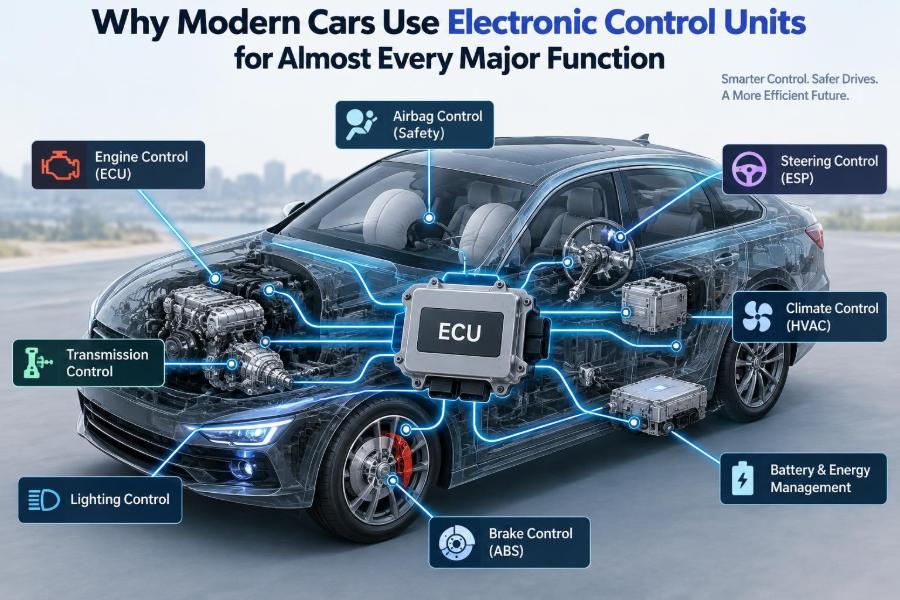
These ordinary moments feel mechanical, but most depend on small computers called electronic control units, or ECUs. A modern vehicle may contain dozens of them, each making rapid decisions from sensor information.
This does not mean cars have become “computers on wheels” in a simplistic sense. They still rely on engines, motors, gears, hydraulics, bearings, tyres, and carefully engineered structures. ECUs make these physical systems responsive, coordinated, efficient, and safer under changing conditions.
Understanding why they are used almost everywhere helps students diagnose vehicles more logically and helps working professionals see the link between electrical, mechanical, software, and safety engineering.
🧠 What an ECU Actually Is
An ECU is a rugged embedded computer designed for vehicle use. It receives electrical signals from sensors, applies programmed logic and calibration data, then commands actuators such as injectors, valves, motors, relays, pumps, lamps, or displays.
Unlike a general-purpose laptop, an ECU is built for heat, vibration, electrical noise, moisture risk, and predictable timing. Many tasks must be completed in milliseconds, repeatedly, while the vehicle is operating.
⚙️ The Basic Sense-Decide-Act Cycle
Most automotive electronic control follows a simple loop: sense, decide, act, and verify. A sensor measures a condition; the ECU compares that input with its programmed strategy; an actuator changes the system; and feedback helps determine whether the result is plausible.
For example, an engine controller can read intake-air temperature, crankshaft position, throttle position, and oxygen-sensor signals. It then calculates injection and ignition commands suitable for that operating moment.
📏 Why Mechanical Controls Alone Reach Limits
Mechanical governors, cables, springs, and hydraulic valves remain useful, especially where simplicity and direct force are needed. However, they cannot easily account for many conditions at once or change their response precisely from moment to moment.
A purely mechanical fuel system cannot readily combine cold-start needs, altitude, exhaust feedback, rapid load changes, emission constraints, and driver demand with the flexibility of electronic fuel injection. ECUs became widespread because the required control problem became too complex for fixed mechanical relationships alone.
🌡️ Engines Need Continuous Adjustment
An internal-combustion engine does not operate under one steady condition. Ambient temperature, air density, fuel quality, engine temperature, throttle demand, load, and speed constantly change.
The engine control module, often called the ECM or PCM, adjusts fuel delivery, ignition timing, idle control, boost control where fitted, cooling-fan operation, and other functions. Its aim is not simply maximum power; it must balance drivability, fuel consumption, emissions, protection, and smoothness.
🫁 Emissions Control Depends on Precise Feedback
Modern emissions systems need accurate control of combustion and exhaust after-treatment. Oxygen or air-fuel-ratio sensors allow closed-loop fuel control, meaning the ECU can correct fueling based on exhaust feedback rather than relying only on a fixed map.
Other electronically managed systems may include exhaust-gas recirculation, evaporative-emissions control, diesel particulate filter regeneration, and selective catalytic reduction dosing. Their exact arrangements differ by engine and market, but their operation requires sensing, timing, and fault monitoring that mechanical controls cannot deliver as effectively.
🔋 Electrified Powertrains Add Another Layer
Hybrid and electric vehicles depend even more directly on electronic control. A traction motor needs an inverter to convert battery direct current into controlled alternating current, and the inverter must respond accurately to torque requests.
The vehicle control system coordinates motor torque, regenerative braking, battery temperature, charging, cabin heating, and power limits. In a hybrid, it also decides how the engine and electric machine share work. These decisions occur continuously and cannot be managed by a conventional mechanical linkage.
🛞 Anti-Lock Braking Is a Fast Control Problem
During hard braking, a wheel can slow toward lock-up faster than a driver can recognize and correct it. The anti-lock braking system uses wheel-speed sensors and an ECU to detect when a wheel is approaching excessive slip.
It modulates brake pressure through hydraulic valves so the tyre can continue producing useful braking and steering forces. ABS does not defeat the laws of tyre grip; poor tyres, excessive speed, and loose surfaces still matter. It improves control by managing available grip more effectively.
🧭 Stability Control Coordinates Several Systems
Electronic stability control compares the driver’s intended path, inferred from steering input, with the vehicle’s actual motion, measured through wheel speeds, yaw rate, and lateral-acceleration sensors. If the vehicle begins to understeer or oversteer, it can reduce drive torque and brake selected wheels.
This is a good example of why distributed ECUs are valuable. Braking, steering information, powertrain torque, and sensor data must work together quickly rather than as isolated mechanical subsystems.
🧲 Steering Assistance Can Be Smarter Than a Pump
Electric power steering uses an electric motor and a control unit to provide assistance. Sensors measure steering torque and often steering angle, allowing assistance to vary with vehicle speed and operating condition.
At parking speeds, higher assistance reduces effort. At highway speed, lower assistance can help preserve a more stable steering feel. The system can also provide the controlled steering torque required by certain driver-assistance features, subject to vehicle design and safety limits.
🛑 Brake-by-Wire Does Not Mean Brakes Are Optional
Some vehicles use electronic brake control to blend regenerative and friction braking, manage brake-force distribution, or support automated emergency braking. The phrase “brake-by-wire” can describe different architectures, so it should not be treated as one universal design.
Safety-critical braking systems are engineered with monitoring, fallback strategies, and carefully designed hydraulic or electrical redundancies appropriate to the architecture. The key principle is that electronics can manage brake force more precisely, but system safety must not depend on a single unmonitored command.
🪟 Body Functions Have Become Convenient and Coordinated
Door locks, windows, mirrors, wipers, exterior lighting, seat adjustment, tailgates, and interior lamps are commonly managed by body control modules. Grouping these functions reduces the need for separate stand-alone relays and allows useful coordination.
For instance, a body controller can delay interior-light fade-out, prevent a window from closing on an obstruction when equipped with anti-pinch sensing, or activate headlights according to ambient light and driver settings.
🌧️ Wipers and Lights Respond to Conditions
A rain sensor can estimate water on the windscreen and allow automatic wiper operation. An ambient-light sensor can request headlamp activation when daylight falls or the vehicle enters a tunnel.
These features are convenience systems, not substitutes for driver judgment. Rain sensors can be affected by contamination or unusual conditions, and automatic lights may not always select the best mode for fog, heavy spray, or local road rules.
❄️ Climate Control Is More Than a Fan Switch
Automatic climate control considers cabin temperature, outside temperature, solar load, evaporator conditions, coolant temperature, and user settings. The climate ECU can adjust blower speed, air-mix doors, compressor command, and air distribution to approach a selected comfort target.
Without electronic control, the driver would manually balance these variables. The ECU does not create cooling or heat; it regulates the physical HVAC system efficiently and consistently.
🪑 Seats, Restraints, and Occupant Detection
Seat modules may control position memory, heating, ventilation, and lumbar support. Restraint control modules use accelerometers and, depending on the vehicle, occupant-sensing inputs to determine whether airbag and pretensioner deployment criteria are met in a collision.
These are safety-critical systems. Diagnosis and repair require approved procedures because improper handling of connectors, wiring, or replacement parts can create serious risk. A warning lamp must never be dismissed as merely an electrical annoyance.
📡 Vehicle Networks Reduce Wiring Complexity
If every switch and sensor required its own wire to every related actuator, a vehicle harness would become extremely large and difficult to assemble. Networks allow ECUs to share messages over a smaller set of communication wires.
CAN is widely used for robust vehicle communication. Other network technologies may be used where bandwidth, timing, cost, or subsystem requirements differ. The important idea is that modules exchange standardized messages rather than acting as entirely separate islands.
🗣️ A Simple Example of ECU Communication
When a driver presses the accelerator in a modern vehicle, the pedal sensors report a request to the powertrain controller. That controller determines allowable torque after considering traction control, transmission state, battery limits in an electrified vehicle, engine protection, and other relevant messages.
The instrument cluster may then display information derived from the same network. There is no simple cable directly “opening the throttle” in many designs; the request is interpreted as part of a wider control strategy.
🧩 Why Cars Use Many ECUs Instead of One Giant Computer
Different functions have different timing, safety, packaging, and supplier requirements. A braking controller must react predictably to wheel dynamics, while an infotainment unit handles displays, audio, and user interfaces with very different priorities.
Distributed modules also localize wiring and allow manufacturers to reuse proven subsystem designs across vehicle platforms. At the same time, the industry is increasingly adopting domain controllers and central computing units to consolidate some functions. The balance is evolving rather than fixed.
⏱️ Real-Time Response Matters
Vehicle control often has deadlines. If an ECU computes an ABS valve command too late, the answer may be technically correct but no longer useful. This is why automotive software uses real-time scheduling and carefully defined task priorities.
Timing also matters for ignition, injection, motor control, airbag sensing, and communication. Reliable timing is one reason automotive software development requires disciplined testing beyond ordinary application programming.
🛡️ Functional Safety Shapes the Design
Failures can arise from sensors, wiring, power supplies, software, actuators, or the ECU itself. Functional safety engineering asks what could fail, what harm could follow, and how the system can detect faults or move to a safer state.
Depending on the function, measures can include plausibility checks, redundant sensor tracks, watchdog circuits that monitor processor operation, fault codes, degraded modes, and independent fallback paths. Redundancy does not always mean duplicating every component; it means addressing hazards systematically.
🔎 Diagnostics Are Built Into Modern Vehicles
ECUs monitor many circuits and signals for open circuits, short circuits, implausible values, communication loss, and performance conditions outside expected limits. When a relevant fault is detected, the module can store a diagnostic trouble code and sometimes illuminate a warning indicator.
A code is a starting point, not an automatic instruction to replace a component. “Circuit low” may result from a damaged wire, poor ground, connector corrosion, a failed sensor, or a module issue. Good diagnosis combines scan-tool data, wiring diagrams, measurements, and system understanding.
🔧 Calibration Is Different From Hardware Design
Hardware determines what the ECU can measure and control. Calibration is the collection of values, maps, thresholds, and strategies that tune behaviour for a particular vehicle, engine, battery, transmission, and market requirement.
For example, a fuel map relates operating conditions to fuel commands, while protective logic may reduce torque when temperatures become excessive. A sound calibration must provide acceptable behaviour across a wide range of real driving conditions, not merely perform well in one ideal test.
📈 Software Updates Can Improve or Correct Behaviour
Some vehicles can receive software updates remotely, while others require a workshop programming procedure. Updates may address bugs, refine compatibility, modify user-interface behaviour, or update control strategies where permitted and validated.
Programming is not routine battery maintenance. Voltage stability, correct software selection, secure procedures, and manufacturer information matter because interrupted or incorrect programming can leave a module inoperative.
🔐 Connectivity Introduces Cybersecurity Duties
Connected services, wireless interfaces, diagnostic ports, and mobile applications create useful features but also increase the number of paths through which a vehicle system might be accessed. Cybersecurity aims to prevent unauthorized commands, data access, and software modification.
Protection can involve authenticated communication, secure software updates, network separation, and monitoring. This is an ongoing engineering responsibility because threats and vehicle capabilities both change over time.
⚡ Power Supply Quality Is Crucial
ECUs do not receive perfectly smooth laboratory power. Starting the engine, switching motors, charging systems, weak batteries, poor grounds, and wiring faults can create voltage disturbances. Automotive electronics must tolerate expected disturbances and recognize conditions where reliable operation is not possible.
For technicians, this explains why a low battery or corroded earth connection can generate several unrelated warning messages. Before condemning multiple modules, check basic power, ground, and charging-system health.
🧰 Common Repair Mistakes to Avoid
Electronic faults can tempt people into quick parts replacement. That approach wastes money and can hide the original fault.
- Do not assume a stored code proves that the named part has failed.
- Do not probe airbag or high-voltage systems without correct training and procedures.
- Do not fit modules casually; many require matching, coding, configuration, or programming.
- Do not ignore water ingress, damaged connectors, poor grounds, or rodent-damaged harnesses.
- Do not disconnect the battery as a universal “reset,” especially when fault memory and learned values are diagnostically useful.
🧪 A Better Diagnostic Workflow
Start by confirming the customer complaint and checking for basic conditions: battery state, fuses, grounds, visible damage, and relevant service information. Then scan all applicable modules, not just the one that displayed a warning.
- Record codes, freeze-frame data, and symptoms before clearing anything.
- Use wiring diagrams to identify power, ground, signal, and network paths.
- Test the circuit and component under appropriate conditions.
- Repair the proven cause, clear codes when appropriate, and verify operation.
This process is slower than guessing at the beginning but usually faster than repeated replacement of good parts.
💰 Complexity Brings Real Trade-Offs
ECUs provide capability, but they add cost, software dependency, diagnostic requirements, and potential obsolescence concerns. A simple mechanical system can sometimes be easier to understand and repair in remote or low-resource settings.
There are also ownership questions around access to diagnostic information, repair tools, and software functions. Good engineering is not about adding electronics everywhere for its own sake; it is about using electronic control where its precision, adaptability, monitoring, or coordination genuinely improves the vehicle.
🎓 Skills Automobile Engineers Need
Modern automotive work increasingly crosses traditional boundaries. Mechanical knowledge remains essential, but it must connect with electronics, control theory, data communication, software, and safety practice.
- Read sensor signals and actuator circuits.
- Understand feedback control and calibration concepts.
- Interpret network communication and diagnostic data.
- Respect high-voltage and restraint-system safety procedures.
- Think in systems: a fault in one module can affect another system’s behaviour.
🔮 The Direction of Vehicle Architecture
Vehicles are moving toward more integrated computing, faster data networks, centralized software platforms, and greater coordination between powertrain, chassis, body, and driver-assistance functions. Electrification and advanced driver assistance are major reasons for this shift.
Yet decentralized controllers will remain practical in many locations, especially where sensors and actuators need local control. Future architectures are likely to combine central computing with intelligent local modules rather than replace every ECU with one box.
🏁 The Core Reason ECUs Are Everywhere
Modern cars use ECUs for almost every major function because a vehicle must respond to changing conditions faster, more precisely, and with more coordination than purely mechanical controls can usually provide. They turn sensor data into controlled physical action across engines, motors, brakes, steering, climate systems, lighting, restraints, and connectivity.
The central lesson is not that electronics have replaced engineering fundamentals. ECUs extend those fundamentals by making complex mechanical and electrical systems measurable, adaptable, diagnosable, and coordinated. Their benefits depend on sound hardware, robust software, correct calibration, safe design, and skilled maintenance.
Modern vehicle performance and safety increasingly come from the partnership between physical machinery and intelligent electronic control—not from either one alone. Understanding that partnership is essential for anyone working with automobiles now and in the years ahead. 🚗⚙️🔌