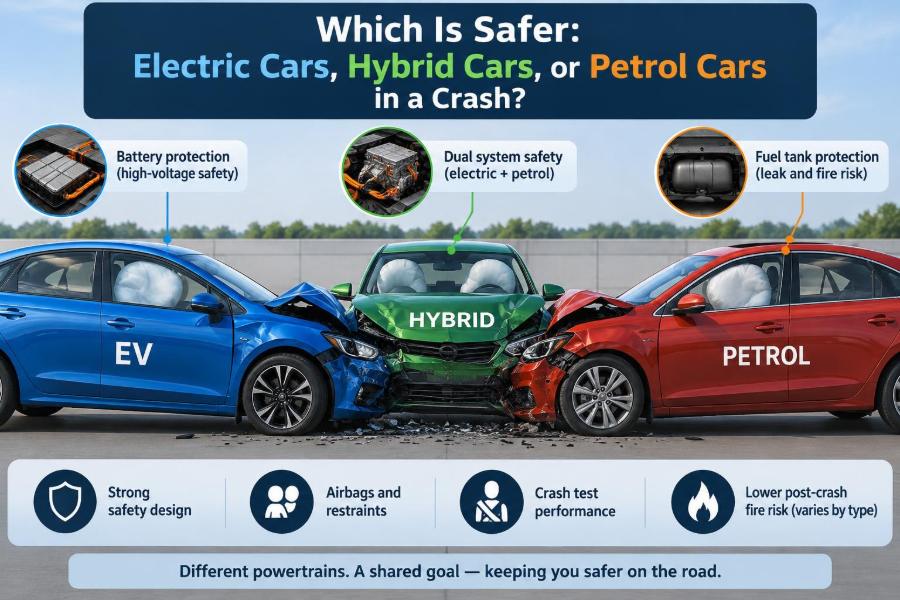

A family is choosing its next car. One person worries about an electric vehicle’s battery after seeing dramatic crash videos. Another assumes a familiar petrol car must be safer because it has no high-voltage cables. A third suggests a hybrid as the sensible middle ground.
Those reactions are understandable, but they mix together several different safety questions. Surviving the initial impact, avoiding fire, protecting rescue crews, and remaining safe after a crash are related—but they are not the same thing.
The useful question is not whether electric, hybrid, or petrol cars are automatically safest. It is whether a particular vehicle has been engineered, tested, maintained, and used in a way that manages the hazards of its powertrain.
Modern vehicle safety is a systems problem. The body structure, restraint systems, battery or fuel protection, crash sensors, software, and emergency procedures all work together in the few seconds before and after a collision.
🧭 The short answer: there is no automatic winner
A well-designed electric car can be extremely safe in a crash. So can a well-designed hybrid or petrol car. Power source alone does not determine occupant protection.
For a buyer comparing modern vehicles in the same class, independent crash-test results and the specific vehicle’s safety equipment matter more than whether it uses electricity or petrol. The designs do, however, create different hazards that engineers must manage.
🧱 Start with crashworthiness, not the engine type
Crashworthiness means how well a vehicle protects its occupants during an impact. It includes the strength and shape of the passenger compartment, the way the front and rear structures deform, airbags, seat belts, head restraints, and child-seat provisions.
In a frontal collision, the car should sacrifice carefully designed areas outside the cabin. These crumple zones absorb energy over a longer distance, reducing the violent deceleration transferred to people inside.
💥 Kinetic energy is the common problem
Every moving vehicle carries kinetic energy. In a crash, that energy has to go somewhere: into vehicle deformation, movement of the other vehicle or barrier, heat, sound, and—if protection fails—injury to occupants.
A battery pack does not change this basic physics. Vehicle mass, speed, impact direction, stiffness mismatch between vehicles, restraint use, and the available crush space remain decisive factors.
⚖️ Vehicle mass changes the collision picture
Many electric cars are heavier than comparable petrol cars because traction batteries are substantial. In a collision with a lighter vehicle, the heavier vehicle may experience less change in speed, which can benefit its own occupants.
That does not make extra mass universally safer. A heavier vehicle can transfer more demand to the lighter road user, increase tyre and brake demands, and worsen consequences for pedestrians, cyclists, or smaller vehicles. Engineers and regulators must consider the whole crash system, not only one car’s occupants.
🔩 Why a low battery can help structural design
In many battery-electric vehicles, the battery pack is mounted low in the floor. This can lower the centre of gravity, helping reduce rollover tendency in some manoeuvres.
The pack may also form part of a stiff underfloor structure. But stiffness must be balanced carefully: the vehicle still needs controlled crush zones, and the passenger cell must remain intact without sending damaging loads into the battery enclosure.
🔋 Battery packs are protected like critical structures
A traction battery is not simply a large version of a household battery. It is a sealed assembly containing many cells, electrical connections, cooling components, sensors, and a protective enclosure.
Manufacturers commonly position the pack within the wheelbase and beneath the cabin, away from the most exposed front and rear crush zones. Reinforced side sills, cross-members, shields, and mounting structures help prevent intrusion from kerbs, debris, and side impacts.
⚡ High voltage is managed by isolation and shutdown
Electric and hybrid vehicles use high-voltage systems to drive the motor. Under normal conditions, cables, connectors, and battery components are insulated and enclosed.
When crash sensors detect a serious impact, the vehicle is designed to disconnect or isolate high-voltage circuits using contactors and other protective devices. This reduces the chance that damaged external components remain energised. It is a vital layer of protection, though severe damage still requires trained assessment.
🔥 Battery fire risk needs a precise explanation
Lithium-ion batteries can be damaged by severe crushing, puncture, overheating, manufacturing defects, or electrical faults. In some circumstances, damage can trigger thermal runaway: a self-heating chain reaction within cells that may release flammable gases and generate intense heat.
That possibility deserves respect, not exaggeration. A crash involving a battery does not automatically cause a fire, and an undamaged battery does not become dangerous merely because a vehicle has been in a minor collision. The risk depends strongly on the damage and condition of the pack.
🕰️ Why battery incidents can be delayed
Unlike a fuel leak that may be immediately visible or smelled, internal battery damage can sometimes develop over time. A pack may require monitoring after a serious underbody strike, flood exposure, or collision even when the car initially appears quiet and intact.
This is why recovery guidance can include isolation, separation from other vehicles or buildings, and observation. Owners should follow the manufacturer’s instructions and tell the insurer, repairer, and recovery operator that the vehicle is electric or hybrid.
⛽ Petrol brings a different post-crash hazard
Petrol vehicles carry liquid fuel and fuel vapour. A collision can damage the tank, filler neck, fuel lines, or engine-bay components. Modern fuel systems use protected tank locations, robust lines, valves, and automatic fuel-pump shutoff strategies to reduce these risks.
Petrol is volatile, and leaked fuel near an ignition source can burn rapidly. This is not an argument that petrol cars are inherently unsafe; it is a reminder that conventional vehicles also require specialised crash engineering.
🔄 Hybrids combine both sets of considerations
A hybrid contains a petrol fuel system and an electrical propulsion system. Depending on the design, it may use a relatively small battery, a high-voltage battery, or—in plug-in hybrids—a larger rechargeable pack.
That means hybrid crash safety includes fuel containment, high-voltage isolation, battery protection, and conventional engine-bay protection. A hybrid is not automatically a compromise in safety; it is a vehicle with a more complex set of systems to protect.
📊 Comparing the main crash-related hazards
| Vehicle type | Primary energy-storage concern | Typical engineering response | Post-crash attention |
|---|---|---|---|
| Electric | High-voltage battery damage and delayed thermal events | Protected pack, isolation, cooling and crash sensing | Inspect pack, avoid charging if damaged, monitor as advised |
| Hybrid | Both fuel-system and high-voltage hazards | Fuel protection plus battery enclosure and isolation | Identify vehicle type clearly for recovery and repair |
| Petrol | Fuel leakage, vapour and ignition | Protected tank, shutoff systems and controlled fuel routing | Check for leaks, fumes and engine-bay damage |
The table describes hazards, not a ranking. In all three cases, the vehicle’s crash structure and condition after the impact determine the practical level of risk.
🛡️ The passenger cell remains the first line of defence
The strongest safety concept in a modern car is the survival space around occupants. High-strength steel, aluminium, adhesives, tailored sections, and carefully designed load paths help preserve that space.
Powertrain components must be kept out of it. In a petrol car, the engine and transmission need controlled movement. In an electric car, the battery enclosure must resist deformation. In a hybrid, both challenges exist.
🎈 Airbags and seat belts still decide many outcomes
Advanced powertrains do not replace basic restraint systems. Seat belts position occupants and manage loads; pretensioners remove slack early in a crash; load limiters help control chest forces; airbags add cushioning for specific impact directions.
Even the safest vehicle design cannot fully protect an unbelted occupant. Correct belt use, appropriate child restraints, and proper seating position remain among the most effective actions available to vehicle users.
↔️ Side impacts are especially demanding
There is less space between an occupant and the striking object in a side collision than in a frontal crash. This makes strong doors, side sills, centre structures, curtain airbags, and seat-mounted airbags especially valuable.
For an electric vehicle, side-impact design must protect both the people and the battery beneath or beside the cabin. Engineers use barriers, load paths, and enclosure reinforcement to limit intrusion and prevent cell damage.
🔃 Rollover protection goes beyond centre of gravity
A lower centre of gravity can help reduce the likelihood of rollover, but it does not eliminate it. Kerb strikes, soft ground, aggressive steering, a collision with another vehicle, and vehicle shape all influence rollover risk.
Roof strength, curtain airbags, belt effectiveness, and electronic stability control matter once a rollover begins. A low battery is one helpful design feature, not a substitute for careful driving.
🌊 Floodwater creates special electrical concerns
Any vehicle exposed to deep floodwater needs careful inspection. Water can contaminate interiors, brakes, electronics, lubrication, and fuel systems. Electric and hybrid vehicles add the need to assess high-voltage components and battery condition.
Do not assume a vehicle is safe to start or charge after flood exposure. Recovery and inspection procedures vary by manufacturer and by the depth and duration of immersion.
🧰 Repairs matter as much as original engineering
A vehicle only remains as safe as its repaired structure and safety systems allow. Poorly repaired crash rails, missing fasteners, incorrect adhesives, damaged undertrays, or improperly reinstalled sensors can undermine protection in a later crash.
Electric and hybrid repairs may require trained technicians, insulated tools, isolation procedures, and checks of the battery enclosure. Petrol vehicles also require competent repair of fuel lines, tanks, and crash sensors.
🚫 Never judge damage by the bumper alone
A scraped bumper may be cosmetic, but a low-speed impact can also damage radar sensors, cooling components, brackets, wiring, or underbody shields. In an EV, a hard strike underneath—such as hitting road debris—deserves particular attention even if the body panels look fine.
After any meaningful impact, watch for warning lights, fluid leaks, unusual smells, smoke, hissing sounds, loss of power, or charging faults. These are reasons to stop using the vehicle and seek professional advice.
🚒 Rescue crews need to identify the vehicle
Emergency responders use vehicle-specific information to locate airbags, reinforced cutting zones, high-voltage cables, fuel tanks, and shutoff points. Modern rescue guidance is designed around the fact that different vehicles hide different hazards.
Occupants can help by telling responders what they are driving if they are able. In a serious crash, do not attempt to disconnect damaged high-voltage components or investigate a leaking fuel system yourself.
📍 What to do immediately after a crash
Your first priorities are people, traffic, and fire risk—not diagnosing the powertrain. Move to a safe location only if the vehicle remains movable and doing so is safe.
- Switch off the vehicle if possible, follow its emergency instructions, and call emergency services for injuries, smoke, fire, or a hazardous location.
- Move occupants away from traffic and away from the vehicle when there is smoke, fire, a fuel smell, damaged battery area, or uncertainty about its condition.
- Do not touch exposed orange cables, damaged battery casing, spilled fluids, or metal parts near visible electrical damage.
- Do not charge an electric or plug-in hybrid vehicle after a significant crash until it has been assessed.
🏠 Storage after a serious impact requires caution
A damaged vehicle should not simply be parked in a closed garage because it still drives. This is especially relevant if an EV or plug-in hybrid has underbody damage, battery warnings, heat, smoke, or an impact near the pack.
Recovery professionals and manufacturers may recommend a separated outdoor location while inspection is arranged. The right approach depends on the damage, so the vehicle maker’s emergency guidance and local responder instructions should take priority.
🧪 Crash tests are useful—but have limits
Independent crash assessment programmes and regulatory tests provide valuable comparisons of occupant protection, child protection, vulnerable-road-user protection, and crash-avoidance technology. They are a sensible place to begin when comparing models.
However, no test reproduces every real crash. Real-world outcomes vary with speed, angle, vehicle mismatch, seat position, road conditions, maintenance, and whether occupants wear belts. A strong rating is meaningful evidence, not a promise of injury-free travel.
🧾 Compare the exact model, not the badge
Safety can differ substantially between a small city car, an SUV, a premium saloon, and a pickup—even when they use the same fuel. It can also change between model years as structures and standard equipment evolve.
When shopping, compare the exact variant where possible. Check its crash-test assessment, standard airbags, stability control, automatic emergency braking, lane-support features, rear-seat protection, tyre specification, and any battery or fuel-system recall history.
🧠 Driver-assistance systems prevent crashes before they start
The safest crash is the one that never occurs. Automatic emergency braking, electronic stability control, blind-spot monitoring, rear cross-traffic alerts, driver-attention systems, and well-designed headlights can reduce exposure to common collision scenarios.
These features are not exclusive to EVs, hybrids, or petrol cars. Their availability often depends more on model age, trim level, and market than on powertrain.
🛞 Tyres, brakes, and maintenance are safety equipment
Tyres are the only parts that contact the road. Worn tread, incorrect pressures, damaged sidewalls, or poor-quality replacements can lengthen stopping distances and reduce wet grip regardless of how sophisticated the vehicle is.
EVs may wear tyres differently because of weight and strong low-speed torque; hybrids and petrol cars have their own maintenance needs. Regular inspections, correct tyres, functioning brakes, and prompt repair of warning lights matter more than broad assumptions about fuel type.
👥 Consider safety beyond the people inside
A responsible comparison includes pedestrians, cyclists, motorcyclists, occupants of smaller cars, and emergency workers. Front-end shape, visibility, vehicle mass, active safety systems, and post-crash hazards all influence their safety.
For example, the quiet operation of an EV at low speed can make pedestrian warning systems relevant, while the mass of any large vehicle can affect compatibility in a collision with a smaller one. Safety is wider than the driver’s seat.
❌ Common myths that distort the choice
- “Electric cars always catch fire after crashes.” Severe battery damage can create a fire risk, but it is not an inevitable outcome.
- “Petrol cars have no electrical danger.” All modern cars contain electrical systems, and petrol adds flammable fuel and vapour considerations.
- “Hybrids are twice as dangerous because they have both systems.” They have two categories of hazards, but they are engineered with protective measures for both.
- “A heavy car is always safest.” Mass can affect occupant outcomes, but it also affects crash compatibility, handling, braking demands, and others outside the vehicle.
🧩 A practical buying checklist
Choose the vehicle that best combines strong crash performance with the way you actually travel. A safe design cannot compensate for a car that is poorly maintained, badly fitted to your family, or difficult for you to see out of and control.
- Review independent crash information for the exact model and year.
- Confirm essential safety equipment is standard, not merely optional.
- Check rear-seat and child-seat suitability if relevant.
- Inspect recall records and ensure safety-related repairs are complete.
- For EVs and hybrids, understand charging, recovery, and post-impact instructions.
- Test visibility, seating position, controls, and driver-assistance behaviour before purchase.
🎯 The core principle: safety comes from the whole design
Electric cars must protect a high-voltage battery; hybrids must manage both battery and fuel systems; petrol cars must contain fuel and protect conventional powertrain components. These are real engineering differences.
But the occupant’s safety in a crash is shaped most directly by a sound passenger cell, effective restraint systems, controlled energy absorption, reliable sensors, good tyres, crash avoidance technology, and correct use. The safer choice is usually the specific vehicle with stronger demonstrated crash protection and safety features—not a powertrain category chosen by assumption.
Choose the best-engineered, best-tested vehicle you can, maintain it properly, buckle up on every trip, and treat post-crash damage seriously whatever powers it. 🚗🔋🛡️