
You are accelerating onto a motorway, the engine is pulling hard, and the tachometer approaches the top of its useful range. In many cars, a gear change creates a brief pause: engine speed drops, the car hesitates slightly, then the next ratio takes over.
A dual-clutch transmission, usually shortened to DCT, is designed to make that interruption far less noticeable. The next gear is prepared before the current one is released, so torque can be handed from one path to another in a remarkably short interval.
That smooth, quick response is why DCTs appear in performance cars, everyday hatchbacks, crossovers, motorcycles, and some hybrid powertrains. But the same hardware that makes rapid shifts possible also explains their distinctive low-speed behavior, heat sensitivity, and maintenance requirements.
Understanding what happens inside a DCT turns a mysterious badge on a gear selector into a useful engineering case study: a transmission that combines the efficiency principles of a manual gearbox with computer-controlled clutch operation.
⚙️ What a Dual-Clutch Transmission Actually Is
A dual-clutch transmission is an automated gearbox with two separately controlled clutches. It uses mechanical gear sets much like those in a manual transmission, but it does not need a driver-operated clutch pedal.
One clutch drives one group of gears, while the other clutch drives the alternate group. An electronic controller decides when to engage, disengage, and preselect ratios based on vehicle speed, throttle position, engine load, temperature, and the selected driving mode.
Despite sometimes being called an “automatic,” a DCT is not built around the same basic architecture as a conventional torque-converter automatic. That distinction matters when comparing efficiency, shift feel, service needs, and low-speed operation.
🚦 The Driving Problem It Was Built to Solve
A conventional manual shift requires several separate actions. The driver releases the accelerator, disengages the clutch, selects another gear, re-engages the clutch, and reapplies power. Even a skilled driver creates a moment when engine torque is not reaching the driven wheels.
Early automated manual transmissions could perform these tasks with actuators, but they often retained a noticeable pause between gears. The transmission had to release one gear before mechanically selecting the next one.
A DCT addresses this by preparing the next likely ratio in advance. Instead of waiting to select it after the shift begins, the system needs mainly to transfer clutch torque from one input shaft to the other.
🧩 The Two-Path Layout
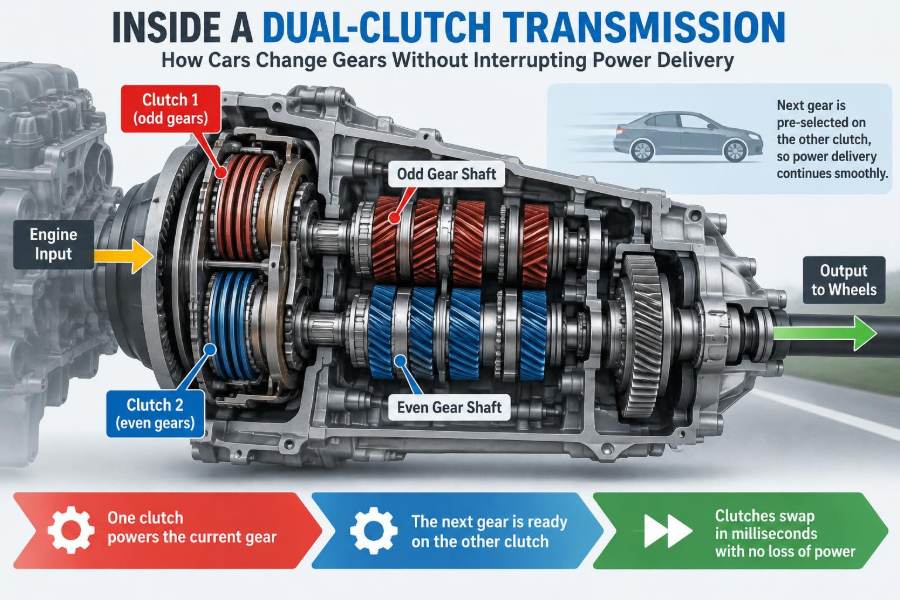
Inside a typical DCT are two input shafts arranged concentrically or alongside one another. Each shaft connects to a different clutch and carries a different family of gears.
Commonly, one shaft handles odd-numbered forward gears such as first, third, fifth, and seventh. The other handles even-numbered gears such as second, fourth, sixth, and often reverse. The exact arrangement varies by design, but the alternating principle is central.
Imagine two runners in a relay race. One runner is already moving with the baton, while the next runner is positioned and ready. The handover still must be controlled carefully, but the next stage is not starting from rest.
🔩 Why Odd and Even Gears Are Separated
Separating alternating gears makes the usual upshift sequence predictable. If first gear is transmitting power through one clutch, second gear can be engaged mechanically on the other shaft without yet transmitting torque.
When the controller requests an upshift, it gradually opens the first clutch while closing the second. Second gear is already selected, so the transmission avoids the time normally required to move a selector mechanism into that ratio.
The same logic applies to a downshift. While fourth gear is active, the system may prepare third gear. This arrangement is particularly effective when the driver is accelerating or braking in a conventional, sequential pattern.
🧠 The Transmission Control Unit Makes the Decisions
The mechanical components cannot deliver smooth shifts without a control system. The transmission control unit, or TCU, continuously interprets sensor data and commands actuators that operate clutches, shift forks, and sometimes hydraulic valves.
It considers more than road speed. A light throttle request may call for an early upshift to reduce engine speed, while a deep accelerator input may hold a lower gear or immediately prepare a downshift.
The TCU also communicates with the engine controller. During a shift, the engine may briefly reduce torque or adjust ignition and fuel delivery so clutch transfer occurs without a harsh jolt.
📡 Inputs That Shape Every Shift
Shift quality depends on accurate information. Important inputs can include engine speed, input-shaft speed, output-shaft speed, wheel speed, accelerator position, brake use, gear-selector position, transmission-fluid temperature, and clutch temperature.
- Speed sensors reveal whether the target gear will match vehicle speed.
- Throttle and torque signals indicate how much driving force the driver expects.
- Temperature sensors help prevent clutch or fluid overheating.
- Brake and gradient information, where available, can influence downshift and engine-braking choices.
If a sensor value is implausible, the transmission may enter a reduced-function mode. That is not necessarily proof of a major mechanical failure, but it does require correct diagnosis rather than guesswork.
🔄 Preselection: Preparing the Next Ratio
Preselection means engaging the next probable gear on the currently unloaded shaft. The selected gear is mechanically ready, but its clutch remains open, so it does not drive the wheels.
For example, while a car accelerates in third gear, fourth may be preselected. If the driver continues accelerating, the expected upshift can happen quickly. If the driver suddenly lifts off or requests strong acceleration, the controller may abandon that choice and prepare a different ratio.
Preselection is a prediction, not a guarantee. Real driving is irregular: a driver may brake, overtake, enter a corner, or change modes just as the system expected an upshift. The calibration must manage these changing intentions smoothly.
🏁 What Happens During an Upshift
Consider a shift from third to fourth. Third gear is transmitting torque through its assigned clutch, while fourth gear has already been selected on the other shaft.
- The TCU confirms that vehicle and engine conditions allow the shift.
- Engine torque may be reduced briefly to control the handover.
- The clutch serving third gear starts to release.
- At nearly the same time, the clutch serving fourth gear begins to engage.
- The controller matches rotational speeds and restores requested engine torque.
There is often a very brief overlap or carefully managed gap depending on the design and operating condition. The aim is not simply the fastest possible clutch movement; it is a controlled transfer that avoids flare, shudder, excessive heat, or driveline shock.
⬇️ Why Downshifts Need More Coordination
Downshifting requires the engine to rotate faster in the lower gear at the same road speed. If the system engaged the lower gear without matching speed, the wheels could abruptly force the engine to accelerate, producing a harsh shift.
A DCT can command an electronic throttle “blip” or use other torque-management strategies to raise engine speed before the lower-ratio clutch fully engages. Drivers often hear this as a crisp rise in engine note during sportier downshifts.
The result can be rapid engine braking and immediate response when exiting a corner or preparing to overtake. Yet the same process must be softened during gentle commuting, where a dramatic downshift would feel unnecessary.
🎯 Torque Handover, Not Magic
The phrase “without interrupting power delivery” describes the goal, but it should not be taken as a literal promise of perfectly constant torque in every situation. During a shift, torque is being redistributed between clutches and managed by the engine controller.
At high load, a well-calibrated DCT can make the transition feel extremely continuous. At very low speed, during a sudden driver input, or when heat protection is active, the handover may be more perceptible.
The key engineering advantage is that the target ratio is ready before it must carry load. That reduces the time and coordination required compared with a gearbox that has only one input path.
🛢️ Wet Clutches and Their Cooling Advantage
Many DCTs use wet clutches, meaning the clutch packs operate in transmission fluid. The fluid helps remove heat and can support high torque capacity, which is useful in heavier vehicles and high-output applications.
Wet systems generally need pumps, valves, fluid passages, and filtration. Their fluid is a working component, not just a lubricant: it can influence cooling, hydraulic actuation, and clutch behavior.
The trade-off is additional complexity and parasitic losses from moving fluid. Service intervals and fluid specifications are therefore especially significant; using an incorrect fluid can affect clutch friction characteristics and hydraulic operation.
🌡️ Dry Clutches and Their Different Compromises
A dry-clutch DCT uses clutch assemblies that are not immersed in cooling fluid, similar in broad principle to the friction clutch in a manual-transmission vehicle. This can reduce pumping losses and simplify parts of the design.
However, dry clutches have less ability to shed heat during repeated slipping. Slow traffic, frequent hill starts, parking maneuvers, and creeping can demand prolonged partial engagement, which is precisely when heat builds.
Neither layout is automatically better. The suitable choice depends on vehicle mass, expected torque, duty cycle, packaging, cooling capacity, and the manufacturer’s calibration priorities.
📊 DCT, Torque Converter, CVT, and Manual Compared
| Transmission type | Core method | Typical strength | Typical compromise |
|---|---|---|---|
| Dual-clutch transmission | Two clutches and preselected gears | Fast, direct ratio changes | Can feel less natural at crawl speed |
| Torque-converter automatic | Fluid coupling with planetary gears | Smooth launch and creeping | Shift response and efficiency depend greatly on design |
| CVT | Continuously variable ratio system | Can hold the engine near an efficient speed | Often has a different, less stepped driving feel |
| Manual transmission | Driver-operated clutch and gears | Direct driver control and mechanical simplicity | Driver must manage every clutch operation |
Modern versions of all four types can be effective. The best choice depends less on labels than on the vehicle’s intended use, calibration quality, maintenance history, and driver expectations.
🚗 Why Low-Speed Driving Feels Different
A torque converter naturally allows some slip through fluid coupling, which makes gentle creeping in traffic feel smooth. A DCT must create a similar effect by deliberately slipping a friction clutch.
That is a controlled but heat-generating process. The controller may alternately engage and release the clutch at very low speed, especially when a driver repeatedly moves a short distance and stops again.
This is why some DCT-equipped cars can feel hesitant, grabby, or slightly delayed during parking and congestion even when they shift sharply at higher speeds. It is often a characteristic of the operating principle, though excessive shudder or warning messages should not be dismissed as normal.
🅿️ Parking, Creeping, and Hill Starts
When parking, use deliberate brake inputs and allow the vehicle to move only as needed. Constantly feathering the accelerator to inch forward can hold the clutch in a heat-producing slip condition for longer than necessary.
On a hill, avoid trying to hold the car stationary with the accelerator. Use the brake pedal, parking brake, or an auto-hold function if fitted. The transmission can then engage the clutch for departure rather than fighting gravity continuously.
These habits are useful for any clutch-based drivetrain. They are especially relevant to DCTs because the system, not the driver’s left foot, is controlling the clutch engagement.
🔥 Heat Is the Main Enemy of Clutch Life
Every friction clutch converts some energy into heat while slipping. Brief slip is normal during launch and gear changes; excessive or prolonged slip raises component temperatures and can accelerate wear.
Heavy stop-start traffic, steep ramps, towing beyond a vehicle’s rating, repeated launch-control use, and aggressive maneuvering can all increase thermal load. Wet-clutch systems can manage more heat in many applications, but they are not immune to overheating.
If a vehicle displays a transmission-temperature warning, follow the owner’s manual and allow the system to cool as directed. Continuing to demand power can turn a protective warning into a more expensive mechanical problem.
🧪 The Role of Mechatronics
Many DCTs package electronic controls, hydraulic circuits, solenoids, sensors, and sometimes actuators into a unit often called a mechatronic module. It is the bridge between software decisions and physical clutch or gear movements.
In an electrohydraulic design, solenoids route pressurized fluid to operate clutch pistons and shift mechanisms. In other designs, electric motors or electromechanical actuators carry out more of the work.
This integration improves response and packaging, but diagnosis becomes more specialized. A fault may involve wiring, a sensor, hydraulic pressure, valve behavior, software adaptation, or internal mechanical wear; identical symptoms do not always have identical causes.
🧷 Synchronizers, Dog Engagement, and Gear Selection
Road-car DCTs commonly use synchronizers, which help match the speed of a gear and shaft before engagement. This reduces clash and allows refined operation under ordinary driving conditions.
Some high-performance or racing-oriented transmissions use dog engagement mechanisms that can permit extremely fast shifts but may be less forgiving or less smooth. These systems serve different priorities and should not be assumed to behave like a commuter-car DCT.
The important point is that preselecting a gear still requires accurate mechanical engagement. The clutch handover may be quick, but the target gear must be securely selected and speed-matched first.
🛞 How Gear Ratios Multiply Engine Torque
A transmission does not create energy, but it changes the relationship between engine speed and wheel speed. A lower gear ratio multiplies torque more strongly at the wheels, helping the vehicle launch, climb, or accelerate.
As speed rises, higher gears reduce engine revolutions for a given road speed. This can lower noise and fuel consumption when the engine is operating efficiently.
A DCT’s rapid ratio changes let the engine remain near a useful part of its speed range during acceleration. That is one reason performance-focused vehicles value them: the engine spends less time falling away from its productive operating range between shifts.
🎮 Drive Modes Change the Software Strategy
Normal, Eco, Sport, and manual-select modes often use the same gears and clutches, but they apply different control maps. A mode changes the system’s interpretation of the driver’s likely priorities.
- Economy-oriented calibration tends to upshift earlier and may favor higher gears.
- Sport calibration may hold lower gears, downshift sooner, and engage clutches more decisively.
- Manual-select mode usually gives the driver more shift timing authority, while retaining safeguards against damaging engine speed.
These modes cannot repeal thermal limits or mechanical constraints. A requested downshift may be delayed or refused if it would over-rev the engine or conflict with protection logic.
🧍 What Paddle Shifters Really Control
Paddle shifters send an electronic request to the transmission controller; they do not directly move a shift fork through a cable. The TCU evaluates whether the requested ratio is appropriate.
If you request a downshift at too high a road speed, the controller may wait until engine speed is safe. If you request an upshift during hard acceleration, it may act immediately or protect the engine according to the vehicle’s programming.
This arrangement provides driver involvement without requiring the driver to coordinate two clutches, engine torque, shaft speed, and gear engagement in fractions of a second.
🔧 Fluid Service and Adaptation Procedures
For wet-clutch DCTs, specified fluid and filter service can be essential. Fluid degrades with heat and use, while contamination can affect valves, pumps, and clutch control. Always use the manufacturer’s specified procedure, fluid grade, fill level, and temperature conditions.
Some transmissions also need an adaptation, relearn, or calibration procedure after certain repairs, software updates, clutch work, or component replacement. This lets the controller establish clutch kiss points and other operating values.
Skipping a required procedure can lead to poor shift quality even if new parts have been installed correctly. Conversely, a relearn is not a universal cure for worn clutches or faulty hydraulic hardware.
🛠️ Symptoms That Deserve Investigation
Drivers should distinguish an unfamiliar characteristic from a developing fault. A small pause during a parking maneuver may be expected in some models; persistent harshness, slipping, or warnings merit inspection.
- Repeated shuddering during normal takeoff
- Unexpected neutral selection or refusal to engage drive or reverse
- Engine speed rising without matching vehicle acceleration
- Repeated transmission-temperature warnings
- Harsh impacts during ordinary shifts
- Fluid leaks, burning smells, or a malfunction indicator
These symptoms can have several causes. Reading fault codes is only the beginning; proper diagnosis should include service history, fluid condition where applicable, live data, and model-specific technical procedures.
🚫 Common Habits That Increase Wear
Drivers sometimes treat a DCT exactly like a torque-converter automatic because both have two pedals and a selector. The interface is similar, but the clutch physics are not.
Avoid prolonged accelerator feathering in queues, holding on slopes with throttle, and repeated full-throttle launches unless the vehicle is designed and operated for them. Do not shift between drive and reverse until the vehicle has stopped unless the manufacturer specifically permits a particular maneuver.
Also avoid assuming that a rough low-speed feel will disappear if ignored. Early attention to abnormal behavior may prevent secondary damage, especially where overheating or a hydraulic fault is involved.
🏎️ Why Performance Cars Adopted DCTs
Performance driving rewards fast shifts because acceleration is reduced whenever the engine is unloaded or falls far below its effective speed range. A DCT can execute repeatable shifts more rapidly than most human-operated manual shifts while maintaining stable vehicle balance.
During cornering, a quick downshift can also provide predictable engine braking before the driver returns to power. The transmission controller can coordinate this with stability systems and engine torque management.
That does not mean every enthusiast prefers a DCT. A manual gearbox offers direct mechanical participation that some drivers value more than outright shift speed. The preference is experiential as well as technical.
🔋 DCTs in Hybrid and Electrified Powertrains
Hybrid layouts can place an electric motor within or alongside a DCT assembly. The motor may fill torque during shifts, assist launch, recover energy during braking, or allow limited electric driving depending on the architecture.
Electric torque can help mask a torque dip while a clutch transfer occurs. However, hybrid integration adds control complexity because the system must coordinate engine starts, motor torque, battery limits, clutches, and gear selection.
Battery-electric vehicles often do not need a multi-speed DCT because electric motors deliver useful torque over a broad speed range. Still, some specialized electric applications use multi-speed gearboxes where performance or operating efficiency justifies added complexity.
⚖️ Efficiency, Smoothness, and Durability Are Trade-Offs
Transmission design is an exercise in competing goals. Fast shifts may require firmer clutch engagement; very soft engagement can create more slip and heat. Aggressive shift logic can feel responsive, while relaxed logic may be smoother and more efficient.
Manufacturers tune hardware and software around the vehicle’s purpose. A compact commuter, a heavy crossover, and a track-focused coupe may all use DCT technology but feel completely different because their clutches, cooling systems, ratios, and calibrations differ.
Judging a transmission solely by one moment—such as a cold parking maneuver or a wide-open-throttle upshift—misses the broader engineering compromise.
🧑🔧 A Sensible Ownership Approach
Read the vehicle-specific manual rather than relying on general internet advice. It will state approved fluids, towing restrictions, warning responses, shift-mode functions, and any special instructions for traffic, gradients, or launch features.
Follow the prescribed service schedule, keep software updates in mind when a manufacturer identifies a calibration issue, and report repeatable symptoms clearly. Useful descriptions include whether the fault occurs cold or hot, in drive or reverse, on hills, and under light or heavy throttle.
For technicians, a structured approach matters: verify the complaint, inspect for leaks and correct fluid condition where relevant, scan all related modules, review live data, and only then decide whether adaptation, electrical repair, hydraulic testing, or mechanical work is justified.
🧠 The Core Principle Behind Seamless Shifts
The defining idea of a dual-clutch transmission is simple: one gear path delivers torque while the other prepares the next ratio. The controller then transfers clutch engagement between those paths while coordinating engine torque and rotational speed.
That architecture explains both sides of DCT behavior. It can produce rapid, direct shifts because the next gear is preselected; it can also require careful thermal management because low-speed motion still depends on controlled clutch slip.
For students, the DCT is a valuable example of mechanical design and control engineering working together. Gears, shafts, friction materials, fluid circuits, sensors, software, and driver behavior all influence the final result at the wheels.
A dual-clutch transmission changes gears quickly not by eliminating clutch work, but by preparing the next gear and transferring torque between two independently controlled clutches with precise timing. When its operating limits and service needs are respected, that principle delivers an engaging blend of efficiency, response, and engineering sophistication. 🚗⚙️🔧