
You may have noticed it most clearly in a manual car: pull away in a high gear, accelerate from low engine speed, or switch off the engine, and the cabin can shudder. In older vehicles, some vibration was simply accepted as part of driving.
Modern drivers expect something different. They want strong low-speed pulling power, quiet cruising, smooth gear changes, and little vibration through the pedals, seat, or steering wheel. Those expectations are challenging when an engine still produces its power in separate combustion pulses rather than as a perfectly continuous flow.
A major component helping engineers meet that challenge is the dual-mass flywheel, usually abbreviated to DMF. It sits between the engine and transmission, where it absorbs and reshapes torsional vibration before that vibration reaches the drivetrain and cabin.
It is a clever solution, but not a maintenance-free one. Understanding why it exists also explains why certain noises, clutch symptoms, and repair decisions deserve careful attention.
⚙️ The Basic Job of Any Flywheel
A flywheel is a rotating mass attached to the engine’s crankshaft. Its stored rotational energy helps the crankshaft continue turning between combustion events, making engine rotation more even.
In a manual-transmission vehicle, the flywheel also provides the friction surface against which the clutch disc grips. In many automatic or automated transmissions, a related flywheel-like component performs the same inertia and mounting role.
A conventional single-mass flywheel is largely one solid piece of metal. It is durable and simple, but it cannot do much to isolate vibration traveling from the engine into the gearbox.
🔥 Why Engines Do Not Deliver Perfectly Smooth Torque
Each cylinder produces useful torque only during part of its four-stroke cycle. Combustion pushes the piston down, then the crankshaft must carry the engine through intake, compression, and exhaust strokes until another firing event occurs.
This creates changing torque at the crankshaft. Even a well-balanced engine produces small speed fluctuations within every rotation. These fluctuations are called torsional vibrations: tiny accelerations and decelerations in twisting motion.
More cylinders and higher engine speed generally make the pulses feel smoother. Fewer cylinders, large cylinder pressures, and low engine speed make individual firing pulses more noticeable.
🌀 Understanding Torsional Vibration
Torsional vibration is different from the whole engine physically rocking on its mounts. Imagine twisting one end of a long ruler back and forth: the motion is rotational and elastic, not simply a side-to-side movement.
The crankshaft, flywheel, clutch, gearbox shafts, and gears all have some elasticity. When combustion pulses excite this rotating system, parts can twist slightly, recover, and oscillate.
Without adequate damping, the oscillation can cause gear rattle, driveline boom, harshness during load changes, and vibration felt by occupants. The vehicle may still drive, but refinement suffers.
🔊 Why Gearboxes Can Rattle at Low Engine Speed
Manual gearbox gears need small clearances so they can be manufactured, lubricated, and operate reliably. Torque fluctuations can repeatedly reverse or vary the load on gear teeth across those clearances.
The resulting noise is often called gear rattle. It can be especially noticeable at idle, during low-rpm acceleration, or when a high gear is selected too early.
Transmission design, oil viscosity, engine calibration, and cabin insulation all affect what a driver hears. Yet reducing vibration before it enters the gearbox is often the most effective route, which is where the DMF becomes valuable.
🧩 What Makes a Flywheel “Dual-Mass”
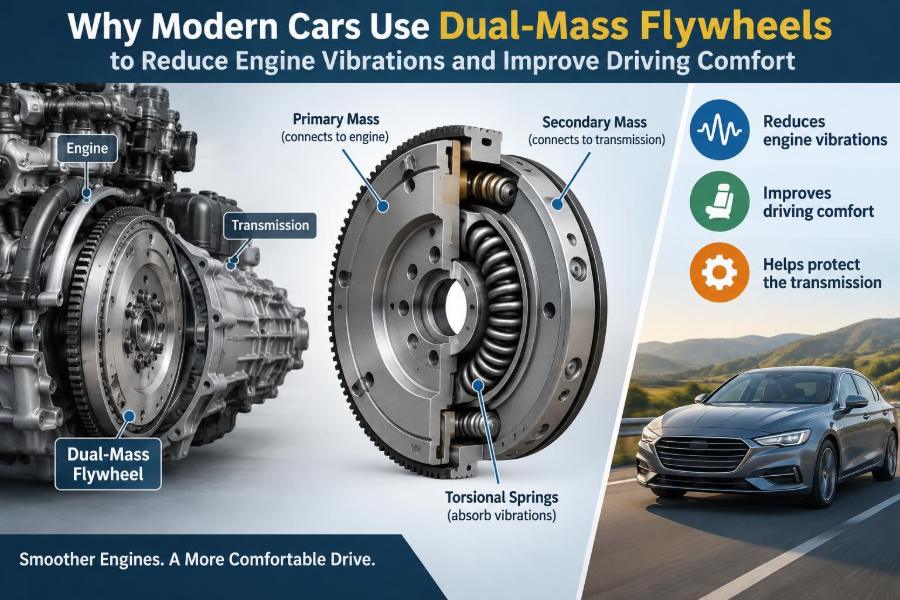
A dual-mass flywheel divides the rotating mass into two main sections. The primary mass attaches to the engine crankshaft, while the secondary mass connects to the clutch and transmission side.
These masses are not rigidly locked together. An internal damping system allows controlled relative rotation between them. Instead of sending every sharp torque pulse directly into the gearbox, the DMF filters much of it.
The arrangement is compact because it combines flywheel inertia and torsional damping in the same assembly. That packaging matters in vehicles where space around the clutch housing is limited.
🪀 The Spring-and-Damper Principle
Inside a typical DMF are carefully arranged arc springs, friction elements, guides, and sometimes additional damping stages. When the engine delivers a torque pulse, the two masses rotate slightly relative to each other and the springs compress.
The springs temporarily store energy, then release it more gradually. Friction and other damping features prevent the system from bouncing back and forth excessively.
A useful analogy is a door closer. If a door were connected directly to a stiff spring, it could slam and rebound. A controlled spring-and-damper system lets it move while preventing an abrupt, noisy reaction.
📉 Moving Resonance Away from Everyday Driving
Every rotating system has natural frequencies at which vibration can grow significantly. This condition is called resonance. In a drivetrain, resonance can make a normally minor vibration suddenly obvious at certain engine speeds.
The DMF changes the effective stiffness and inertia seen by the engine and gearbox. Its design aims to place troublesome resonant behavior outside the engine-speed range most often used in normal driving, or reduce its severity there.
This is why a DMF is not merely a heavier flywheel. Its spring rates, travel, damping, and mass distribution are tuned for a particular engine and transmission combination.
🚦 Why Low-Speed Torque Makes the DMF Valuable
Modern engines are often calibrated to provide useful torque at relatively low rpm. Turbocharging, direct fuel injection, improved combustion control, and taller gearing can all encourage drivers to use low engine speeds.
That improves relaxed cruising and can reduce fuel consumption in suitable conditions. However, a low-rpm engine receives fewer combustion events per second, so each torque pulse is more distinct.
A DMF helps make low-speed operation acceptable without exposing the gearbox to the full roughness of those pulses. It does not make severe lugging harmless, but it expands the smooth operating range.
🛢️ Why Diesel Engines Commonly Use Them
Diesel engines often produce strong torque at low rpm and high cylinder pressure during combustion. Historically, their torque pulses were especially challenging for driveline refinement, although modern gasoline engines can also benefit greatly from DMFs.
Diesels are frequently paired with long gearing to exploit their low-speed torque. That combination can place the transmission in a range where torsional vibration is more likely to be noticeable.
For these reasons, dual-mass flywheels became closely associated with passenger-car diesels. Their use is not limited to diesel vehicles, though; many turbocharged gasoline cars and hybrids use related torsional-damping strategies.
⛽ Why Modern Gasoline Engines Need Them Too
Small turbocharged gasoline engines often deliver much more low-rpm torque than older naturally aspirated engines of similar size. Three-cylinder and some four-cylinder designs also have pulse characteristics that require careful vibration control.
Engineers can address the issue through balance shafts, engine mounts, software, gearing, clutch design, and transmission calibration. A DMF is one useful part of that broader refinement strategy.
Its presence should not be interpreted as proof that an engine is poorly designed. It is often a deliberate response to efficiency targets, compact packaging, and the desire for a quieter, more flexible car.
🚗 What the Driver Feels in Daily Use
When working correctly, a dual-mass flywheel can make pulling away smoother and reduce driveline shunt during gentle throttle changes. The driver may notice less vibration through the clutch pedal and less booming in the cabin.
It can also reduce noise while idling in neutral, particularly in manual cars. During steady highway cruising, its effect is less obvious because the system is quietly preventing disturbance rather than creating a dramatic sensation.
The benefit becomes clearest when compared with a poorly damped drivetrain: fewer rattles, fewer harsh responses, and a more polished connection between engine and transmission.
🔄 The Relationship Between the DMF and Clutch
In a conventional manual layout, the clutch disc is clamped between the flywheel and pressure plate. Older clutch discs often contained substantial torsion springs of their own to soften drivetrain shock.
With a DMF, much of the torsional damping can be moved into the flywheel assembly. This can allow a simpler clutch disc design while providing greater damping travel and more carefully controlled behavior.
The clutch and DMF must be treated as a system. Installing an incompatible clutch disc, pressure plate, or flywheel can change engagement quality, vibration behavior, and component life.
🕹️ Manual, Automated, and Dual-Clutch Applications
Manual transmissions are the most familiar DMF application, but the concept is also used with automated manual transmissions and many dual-clutch transmissions. These layouts still need to manage engine torque pulses before they reach gears and clutches.
Different transmission types package the damping components differently. Some automatic transmissions use torque converters that provide their own smoothing effects, although torsional vibration control remains relevant elsewhere in the system.
Therefore, “automatic” does not automatically mean “no flywheel damping concern.” The exact arrangement depends on the powertrain architecture, not just the selector lever in the cabin.
🏗️ Internal Construction Is More Complex Than It Looks
From outside, a DMF can resemble a thick metal disc. Internally, it may contain springs operating in curved channels, friction washers, bearings, stops, and a sealed grease supply.
The springs often work through several stages of compression. A softer initial response can deal with small vibrations, while a stiffer response handles larger torque changes without allowing excessive angular movement.
This complexity is the source of both its refinement and its cost. A solid flywheel has fewer moving parts; a DMF has more opportunities for wear if subjected to heat, overload, or repeated shock.
🌡️ Heat Is a Major Enemy
Clutch slip generates heat at the flywheel face. Repeated hard launches, towing beyond a vehicle’s intended capability, holding the vehicle on a hill with the clutch, or prolonged slipping in traffic can raise temperatures significantly.
Excessive heat can damage the flywheel’s friction surface and may affect internal grease and damping components. Blue discoloration, heat checking, or cracking can be warning signs, though proper diagnosis requires inspection by a qualified technician.
A DMF is designed for normal clutch operation. It is not designed to absorb repeated abuse that turns the clutch into a substitute for the brake pedal.
⚠️ Symptoms of a Worn or Damaged DMF
A failing DMF may produce a clunk, rattle, or knocking sound during engine start-up or shut-down. It may also contribute to vibration at idle, rough clutch engagement, or a judder when moving away.
These symptoms are not unique to the DMF. Engine mounts, clutch components, gearbox bearings, exhaust contact, injection faults, and accessory drives can create similar sensations or noises.
- Rattling that changes when the clutch pedal is pressed can suggest a clutch or transmission-area issue.
- A pronounced bang at switch-off may indicate excessive rotational play, but engine running quality should also be checked.
- Judder during take-off can arise from clutch contamination, warped friction surfaces, mount movement, or flywheel problems.
Diagnosis should consider the complete vehicle rather than replacing an expensive part based on one sound alone.
🩺 Why Accurate Diagnosis Matters
Technicians may assess starting and shut-down behavior, listen at idle, inspect clutch operation, read fault codes, and evaluate engine smoothness. Once the transmission is removed, the flywheel can be checked for surface condition, free play, rocking movement, and signs of overheating.
Manufacturer procedures matter because acceptable movement is design-specific. A small amount of rotational motion is normal in a functioning DMF; it is the very motion that enables damping.
Guessing from a video or treating all rattle as “a bad flywheel” can lead to unnecessary cost. A professional diagnosis should identify whether the DMF is the cause, a victim of another fault, or still serviceable.
🧰 Replacement Usually Happens with Clutch Work
Accessing the flywheel usually requires removing the transmission, which is labor-intensive. For that reason, when a clutch is worn and the DMF shows damage or excessive wear, replacing both at the same time is often practical.
The reverse can also apply: if the DMF has failed, fitting a new clutch kit may be sensible because the major labor has already been incurred. The correct decision depends on inspection, mileage history, operating conditions, and component condition.
New fasteners and specified tightening procedures are commonly required. Flywheel bolts are safety-critical and may be torque-to-yield on some designs, meaning they are intended for one-time use.
🔧 Resurfacing Is Not Always Appropriate
A solid flywheel can sometimes be machined to restore a damaged clutch face, provided its dimensions and condition remain within specification. A DMF is different because its friction face is part of a precisely engineered, moving assembly.
Machining can alter surface height, heat behavior, balance, and the relationship between components. Some DMFs are explicitly not intended to be resurfaced; others may have limited approved service options.
The safe rule is simple: follow the vehicle manufacturer’s procedure and the replacement-part supplier’s instructions. Do not assume a method suitable for a single-mass flywheel is suitable for a DMF.
🔁 Single-Mass Flywheel Conversion Kits
After a DMF failure, some owners consider a single-mass flywheel conversion. These kits replace the two-part flywheel with a solid unit and usually use a clutch disc with torsion springs to restore some damping.
The approach can reduce component complexity and may suit certain commercial, off-road, or competition-focused applications. Availability, cost, driving style, and the vehicle’s intended use all influence the choice.
However, a conversion can increase gearbox rattle, vibration, and harshness, particularly at idle or low rpm. It may also change clutch feel and driveline behavior, so it should not be presented as a universal upgrade.
⚖️ Dual-Mass and Single-Mass Compared
| Feature | Dual-mass flywheel | Single-mass flywheel |
|---|---|---|
| Vibration isolation | High, with tuned internal damping | Limited; relies more on clutch-disc springs and other systems |
| Mechanical complexity | Higher | Lower |
| Low-rpm refinement | Usually better | Can produce more rattle or harshness |
| Response to abuse and heat | Can be vulnerable internally | Often more robust in simple heavy-duty use |
| Best selection principle | Original-equipment refinement and intended calibration | Specific use case, with accepted comfort compromises |
Neither design is automatically superior. The right choice is the one that matches the engine, gearbox, load cycle, legal requirements, and the driver’s tolerance for noise and vibration.
🚫 Driving Habits That Shorten Service Life
Many DMF problems are connected not to one dramatic event but to repeated thermal and torsional stress. Good driving habits reduce that stress without requiring any special technique.
- Do not hold the car stationary on an incline using clutch slip; use the brake or parking brake.
- Avoid aggressive launches and repeated wheelspin unless the vehicle and operating situation genuinely demand it.
- Downshift rather than applying heavy throttle at very low rpm in a high gear.
- Do not rest a foot on the clutch pedal, which can encourage partial disengagement or release-bearing wear.
- Address engine misfires, poor idle quality, and broken mounts promptly, because they can increase driveline disturbance.
📈 Lugging the Engine Is Not Efficient Driving
Lugging means asking an engine for substantial torque at an rpm too low for smooth operation. The car may accelerate, but the drivetrain can feel coarse, hesitant, or booming.
Drivers sometimes choose a high gear early in pursuit of economy. In reality, excessive low-speed load can increase vibration and may require more throttle than a slightly lower gear would need.
A practical approach is to listen and feel. If the engine shudders, drones, or responds reluctantly, downshift. The DMF can reduce torsional vibration, but it cannot repeal the limits of combustion timing and engine speed.
🧪 Engine Faults Can Mimic or Damage a DMF
An uneven-running engine sends irregular torque pulses into the flywheel. Misfires, injector problems, ignition faults, air leaks, poor combustion, and some sensor issues can therefore resemble a drivetrain vibration fault.
If a new flywheel is installed without correcting the underlying engine issue, the replacement may be exposed to the same abnormal loading. This is particularly relevant when the complaint includes rough idle, warning lights, smoke, poor starting, or reduced power.
Good repair practice checks the engine’s condition before blaming the component designed to absorb its vibration.
🧱 Engine Mounts and the Wider NVH System
Vehicle refinement is an NVH problem: noise, vibration, and harshness are managed by many interacting parts. Engine mounts isolate powertrain movement, subframes control structural paths, exhaust hangers prevent contact, and cabin insulation reduces transmitted sound.
A DMF works mainly on torsional vibration in the rotating drivetrain. It cannot correct a collapsed engine mount that allows the powertrain to move excessively, nor can it silence an exhaust system touching the body.
This system view is useful for students and technicians alike. A vibration complaint is rarely solved reliably by focusing on only the most visible or most expensive part.
🏭 Why Manufacturers Keep Choosing DMFs
Manufacturers must balance fuel economy, emissions performance, engine responsiveness, cost, durability, packaging, and customer expectations. Taller gearing and efficient low-speed torque can benefit real-world driving, but they also challenge driveline smoothness.
A dual-mass flywheel allows engineers to pair engines and transmissions in ways that would otherwise create more audible gear noise or objectionable vibration. It supports refinement without necessarily making the powertrain larger or heavier in other areas.
Its adoption reflects a system-level compromise, not a simple attempt to add complexity. Like many automotive components, it exists because competing engineering goals must be met at once.
🧭 Selecting Parts and Repair Information Carefully
When replacement is needed, part selection should be based on the vehicle identification details, engine code, transmission type, and original equipment specification. Similar-looking flywheels can have different damping characteristics, clutch diameters, sensors, or mounting arrangements.
Quality matters because the component operates under repeated heat, torque, and high rotational speed. A trusted repairer should use correct alignment tools, cleanliness procedures, bolt specifications, and clutch-release setup.
Owners should ask what caused the failure, whether the clutch and release bearing were inspected, and whether engine or mount issues were ruled out. Those questions are more useful than choosing solely by the lowest component price.
🎓 A Useful Engineering Lesson in Compromise
The DMF illustrates a central automotive engineering idea: a vehicle is a connected system, and improvements in one area can create demands elsewhere. High low-rpm torque and tall gears may improve usability, but they increase the need for vibration control.
Its two masses, springs, and damping elements do not create energy from nothing. They manage the timing and transmission of fluctuating energy so the gearbox and occupants receive a smoother version of the engine’s output.
Modern cars use dual-mass flywheels because controlled flexibility between engine and transmission can turn unavoidable combustion pulses into a quieter, smoother, and more durable driving experience.
A DMF deserves neither blind praise nor automatic suspicion. It is a precisely tuned comfort and protection component, best maintained through sensible driving, accurate diagnosis, and repairs that respect the design of the entire powertrain. 🚗⚙️🔧