
A driver enters a wet roundabout a little faster than intended. The steering wheel is turned, but the car begins to travel wider than the chosen line. In another situation, the rear of a car steps sideways on a snowy bend before the driver has time to react.
These are the moments when a vehicle can become unstable. The driver may still have both hands on the wheel and the tyres may still have some grip, yet the car is no longer moving exactly as the steering input suggests.
Electronic Stability Control, usually called ESC, is designed for this narrow but critical gap between a developing skid and a complete loss of directional control. It continuously compares what the driver appears to want the vehicle to do with what the vehicle is actually doing.
By reducing engine torque and applying carefully selected brakes, ESC can create a correcting moment that helps bring the car back toward its intended path. It cannot repeal the laws of physics, but it can make a fast, precise intervention that most drivers could not reproduce unaided.
🧭 What Electronic Stability Control Does
ESC is an active vehicle-safety system that detects developing understeer and oversteer, then intervenes to improve directional stability. It is also known by manufacturer-specific names, including electronic stability programme, vehicle stability control, dynamic stability control, and similar terms.
The essential task is simple: keep the vehicle’s actual motion close to the driver’s intended motion. The system does not steer the car for the driver in conventional ESC operation. Instead, it uses individual wheel braking and, when available, engine-torque reduction to influence yaw.
🌀 Understanding a Skid Before Understanding ESC
A skid begins when one or more tyres cannot generate the forces demanded of them. A tyre has a limited grip budget, determined by road surface, vertical load, temperature, tyre condition, and the friction available at the contact patch.
That grip must be shared between braking, acceleration, and cornering. Asking a tyre to turn sharply while braking hard, for example, can exceed its available grip. The vehicle then stops following the intended line.
📐 The Three Motions ESC Watches
A vehicle moves in three especially relevant ways: longitudinally forward and backward, laterally side to side, and rotationally about its vertical axis. That vertical-axis rotation is called yaw.
During a normal corner, a car yaws at a rate related to its speed and steering angle. ESC estimates the desired yaw behaviour, then checks whether the measured yaw rate and sideways motion are consistent with it.
↪️ Understeer: When the Front Tyres Run Wide
Understeer occurs when the front tyres lose cornering capability before the rear tyres. The driver turns the wheel, but the vehicle follows a path with a larger radius than requested, often described as “pushing wide.”
A familiar example is entering a wet bend too quickly in a front-heavy vehicle. Adding more steering lock rarely solves the problem because it may demand even more from already saturated front tyres. Reducing speed and restoring tyre grip are the real requirements.
🔄 Oversteer: When the Rear of the Car Rotates
Oversteer occurs when the rear tyres lose cornering capability first. The rear of the vehicle moves outward, increasing yaw more rapidly than the driver intended.
A mild slide can sometimes be managed by an experienced driver, but rapid oversteer develops quickly. Incorrect steering, sudden throttle changes, or braking while the vehicle is poorly balanced can make the rotation worse. ESC is particularly valuable because it can react to yaw development very early.
🧠 The Driver’s Intended Path Is an Estimate
ESC cannot read a driver’s mind. It infers intent mainly from the steering-wheel angle, vehicle speed, and a vehicle model stored in the control unit.
If the steering wheel is held at a particular angle at a given speed, the system calculates a plausible target yaw rate. This target is not perfect: tyre grip and load transfer change continuously. Nevertheless, comparing the target with sensor measurements provides a practical basis for identifying instability.
📡 The Sensor Network Behind the Decision
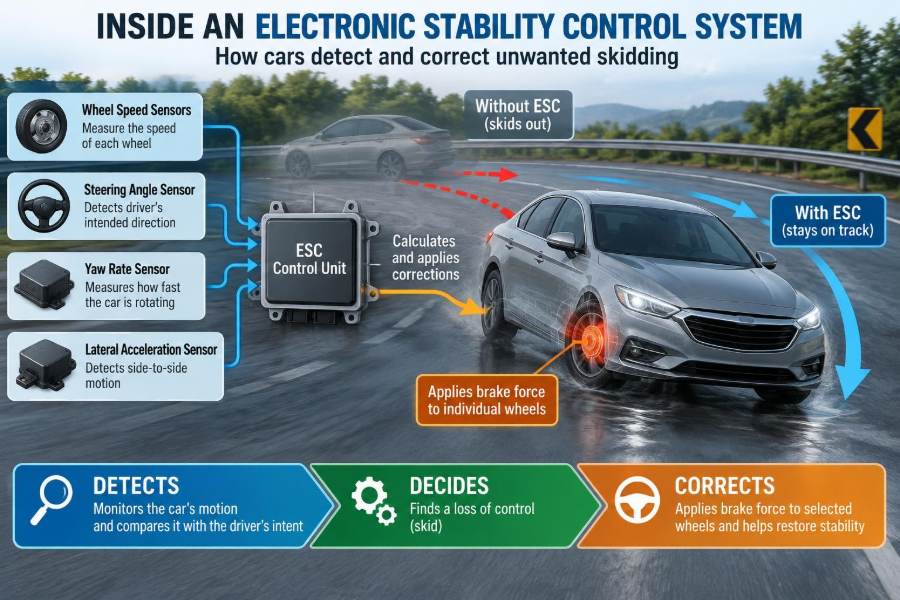
ESC depends on information from several sensors, many shared with the anti-lock braking system. Their signals are processed repeatedly while the vehicle is running.
- Wheel-speed sensors measure the rotation of each wheel.
- Steering-angle sensor reports the driver’s steering input.
- Yaw-rate sensor measures how quickly the vehicle rotates around its vertical axis.
- Lateral-acceleration sensor measures sideways acceleration.
- Brake-pressure and pedal signals indicate braking demand and hydraulic conditions.
- Powertrain data can show requested and available engine or motor torque.
Sensor plausibility checks are essential. A corrupted or implausible signal may cause the system to disable stability intervention and illuminate a warning lamp rather than act on bad information.
🛞 Why Wheel-Speed Sensors Matter So Much
Each wheel-speed sensor provides more than a speedometer input. Comparing individual wheel speeds helps the controller identify wheel slip during braking or acceleration and estimate overall vehicle speed.
Differences between wheel speeds can also reflect cornering, because the outside wheels travel farther than the inside wheels. The controller must distinguish normal cornering differences from abnormal slip, which is why ESC uses wheel-speed data together with yaw, steering, and acceleration signals.
🎛️ The Steering-Angle Sensor Sets the Reference
The steering-angle sensor tells the ESC controller which direction the driver has requested. Its zero position and calibration matter: if the vehicle is travelling straight but the sensor reports a significant steering angle, the controller’s reference calculation becomes unreliable.
After certain alignment work, steering-column repairs, battery-related service procedures, or sensor replacement, some vehicles require calibration. The exact procedure is vehicle-specific and should be performed with suitable diagnostic equipment and manufacturer information.
🧭 Yaw Rate and Lateral Acceleration Reveal Reality
The yaw-rate sensor reports actual rotation, while the lateral-acceleration sensor reports the sideways acceleration associated with cornering. Together, they show how the body of the vehicle is responding rather than merely what the wheels are being asked to do.
For instance, excessive yaw relative to the calculated target points toward oversteer. Too little yaw for the steering input can indicate understeer. Engineers use filtering and validation logic because road bumps, banking, vibration, and sensor noise can affect raw signals.
⚖️ Vehicle Dynamics Models Turn Signals into Meaning
The ESC electronic control unit runs a simplified mathematical representation of vehicle behaviour. It combines steering angle, estimated speed, wheelbase, and calibrated vehicle characteristics to calculate expected motion.
This is not a perfect digital copy of the car. Tyre-road friction cannot be measured directly with complete certainty in ordinary driving. Instead, the controller uses observed behaviour and conservative control strategies to decide whether corrective action is justified.
🚨 The Threshold for Intervention Is Deliberate
ESC should not activate every time a vehicle corners briskly. Frequent unnecessary intervention would feel intrusive and could disturb a driver who is still fully in control.
For that reason, controllers use thresholds, time windows, and confidence checks. They look for a meaningful mismatch between intended and actual motion, often alongside evidence that the vehicle is approaching tyre-force limits. Calibration differs by vehicle type, tyre specification, suspension layout, and intended use.
🧱 The Hydraulic Modulator Is ESC’s Muscle
The electronic controller needs a way to create brake force at an individual wheel, even when the driver has not pressed the brake pedal. That capability comes from the electrohydraulic brake modulator, closely related to the unit used for ABS.
Solenoid valves direct brake fluid pressure to selected wheel circuits, while a pump can restore or build pressure as required. During an intervention, drivers may hear buzzing or clicking and may feel pulsation through the brake pedal. These sensations can be normal signs of rapid hydraulic control.
🛑 Correcting Oversteer with an Outside Front Brake
When the rear of the vehicle rotates too far outward in a turn, ESC often applies brake force to the outside front wheel. In a left-hand bend, that is commonly the right-front wheel.
Braking that wheel creates a stabilising yaw moment opposing the unwanted rotation. Think of it as placing a controlled resisting force at a strategic corner of the vehicle. The goal is not simply to slow the car; it is to alter its rotational behaviour.
➡️ Correcting Understeer with Rear-Wheel Braking
When the vehicle is understeering, ESC may apply brake force to an inside rear wheel, depending on the control strategy and vehicle condition. This can help create a yaw moment that encourages the vehicle to rotate into the turn.
However, braking alone cannot create grip where the front tyres have none. If entry speed is far too high for the surface, the system may reduce engine torque and slow the vehicle, but the car still needs sufficient road space and tyre friction to recover.
⚡ Torque Reduction Works Alongside Braking
During acceleration, excess drive torque can overwhelm the driven tyres and destabilise the vehicle. ESC can request reduced engine torque by managing throttle opening, fuel delivery, ignition timing, boost control, or electric-motor torque, depending on the powertrain.
In electric vehicles, torque response can be especially fast. That offers useful control authority, but calibration remains complex because regenerative braking, friction braking, axle layout, and battery conditions all affect the available response.
🔗 How ESC, ABS, and Traction Control Differ
These systems share hardware and information, yet they solve different problems. Their functions overlap during real events, which is why drivers often experience them as one integrated safety system.
| System | Primary concern | Typical action |
|---|---|---|
| ABS | Wheel lock during braking | Modulates brake pressure to preserve steerability |
| Traction control | Driven-wheel spin under acceleration | Reduces torque and may brake a spinning wheel |
| ESC | Vehicle directional instability | Brakes selected wheels and manages torque to control yaw |
ABS helps retain steering ability under heavy braking; it does not by itself decide whether the car is following the intended cornering path. ESC adds that higher-level directional assessment.
🏁 A Typical Intervention Sequence
Imagine a hypothetical right-hand bend on a damp road. The driver lifts abruptly after entering too quickly, the rear axle becomes lightly loaded, and measured yaw rate begins to exceed the value expected from steering angle and speed.
- Sensors report steering input, wheel speeds, yaw rate, and lateral acceleration.
- The controller detects a growing oversteer tendency.
- It requests less drive torque if applicable.
- It applies a brief, controlled brake intervention to a selected wheel, often the outside front.
- It reassesses vehicle motion continuously and reduces intervention as stability returns.
The process occurs far faster than this description suggests. The driver may notice only a warning lamp flashing and a brief change in vehicle response.
💡 The Flashing ESC Lamp Has a Specific Meaning
A flashing stability-control symbol generally means the system is actively intervening or detecting wheel slip. It is a useful reminder that available traction is limited and that a gentler approach is wise.
A lamp that remains illuminated steadily may indicate that the system has been switched off, has detected a fault, or is unavailable for another reason. The owner’s manual and diagnostic fault information are needed to identify the exact cause; the symbol alone is not a complete diagnosis.
🌧️ Surfaces That Challenge Stability Control
ESC is most likely to be useful when grip changes suddenly or is lower than the driver expects. Wet painted markings, loose gravel, snow, ice, standing water, mud, and uneven road surfaces can all reduce or vary tyre friction.
Split-friction braking is another challenge: for example, when the left wheels are on wet grass and the right wheels are on asphalt. ABS and ESC can help preserve control, but the different forces across the vehicle still create strong yaw tendencies.
🛞 Tyres Remain the First Safety System
ESC can only work through the tyre contact patches. Worn tread, unsuitable seasonal tyres, incorrect inflation pressure, damaged tyres, or mixed tyre sizes can reduce the grip and predictability on which the system depends.
Replacing tyres with sizes or constructions not approved for the vehicle can also affect rolling-radius calculations and handling balance. The issue is not that ESC immediately becomes ineffective; rather, its calibrated assumptions and the vehicle’s available grip may no longer match the original design intent.
📦 Loading, Towing, and Centre of Gravity
A heavily loaded vehicle, roof cargo, or trailer changes mass distribution and can raise the centre of gravity. These changes influence braking distances, cornering response, body roll, and the rate at which instability develops.
Some vehicles include trailer-stability functions that use ESC-related sensors and braking control to counter trailer sway. Such functions can reduce certain oscillations, but proper hitch loading, appropriate speed, and correct tyre pressures remain essential.
🚙 ESC in SUVs, Pickups, and Commercial Vehicles
Taller vehicles may experience more body motion and different load transfer than low passenger cars. Pickups can also behave very differently when empty versus loaded because rear-axle loading changes substantially.
ESC calibration accounts for the basic vehicle configuration, but it cannot fully compensate for an extreme or poorly secured load. Drivers of vans and commercial vehicles should be particularly conscious of cargo placement because a high or rearward load can alter stability significantly.
🔌 Brake-by-Wire and Integrated Control
Many modern vehicles use electronically coordinated braking systems, especially hybrid and electric models. These systems may blend regenerative braking with friction braking while maintaining requested deceleration and stability control.
The engineering challenge is to make the transition feel consistent to the driver while preserving rapid wheel-by-wheel pressure control. ESC remains a supervisory stability function, but its commands may be delivered through more integrated brake and powertrain architecture.
🧰 Calibration, Repairs, and Diagnostic Discipline
Stability control faults are not always caused by the ESC module itself. A damaged wheel-speed sensor, corroded connector, incorrect wheel bearing installation, steering-angle calibration error, low system voltage, or hydraulic problem can all affect operation.
Good diagnosis starts with stored fault codes, live data, basic electrical checks, and verification of tyre condition and size. Replacing parts based only on a warning lamp is an expensive habit and can leave the underlying fault unresolved.
🚫 Why Switching ESC Off Is Usually a Poor Road Strategy
Some vehicles allow reduced intervention or partial deactivation. This can be useful in limited circumstances, such as trying to move through deep snow, loose sand, or mud where controlled wheel spin helps maintain momentum.
On public roads, leaving ESC enabled is generally the sensible choice. Disabling it does not increase the tyres’ grip; it removes or reduces an electronic safeguard against a developing yaw error. Track use and specialised off-road conditions require separate judgement, vehicle knowledge, and appropriate space.
🙅 Common Driver Mistakes During a Slide
When a vehicle feels unstable, panic inputs can compound the problem. Sudden steering reversals, stamping on the accelerator, or looking at the obstacle rather than the open path can make recovery harder.
- Look where you want the vehicle to go, not at the hazard.
- Keep steering inputs smooth and avoid adding unnecessary steering lock.
- Ease off acceleration when traction is limited.
- Allow the system room to work; do not fight rapid pedal feedback from ABS.
- Remember that reducing speed before the bend is safer than relying on correction within it.
Driver training can improve understanding, but no routine road situation is a safe place to deliberately test the limits of ESC.
🧊 The Limits Physics Still Sets
ESC cannot overcome excessive speed, bald tyres, severe ice, deep water, a mechanical failure, or a lack of space. If all four tyres have almost no lateral grip, selective braking has little force available to create a meaningful correcting moment.
It also cannot guarantee that every manoeuvre will remain controllable. The system is best viewed as a powerful assistance layer, not a substitute for attention, appropriate speed, restraint, and vehicle maintenance.
🧪 How Engineers Validate ESC Behaviour
Developers assess stability-control behaviour in simulations, test rigs, proving grounds, and controlled low-friction surfaces. They evaluate scenarios such as sudden lane changes, split-friction braking, cornering on variable surfaces, and acceleration with unequal grip.
Validation is not only about preventing a spin. Engineers also examine whether interventions are timely, smooth enough for the driver, compatible with other control systems, and robust against sensor variation. The desired balance is early support without needless intrusion.
🛡️ The Core Principle: Correct Yaw Before It Grows
The most valuable feature of ESC is not simply its ability to brake a wheel. Its strength is the control loop: sense the driver’s request, measure vehicle response, detect a meaningful mismatch, and apply a targeted correction.
A small yaw error may be manageable; a growing yaw error can become difficult to catch. By intervening early and selectively, ESC helps preserve the tyre forces and directional stability that a driver needs to continue steering the vehicle safely.
Electronic Stability Control is most effective when it works quietly alongside sound tyres, sensible speed, smooth driving inputs, and an alert driver—helping the car remain on the path the driver intended. 🚗🛞🛡️