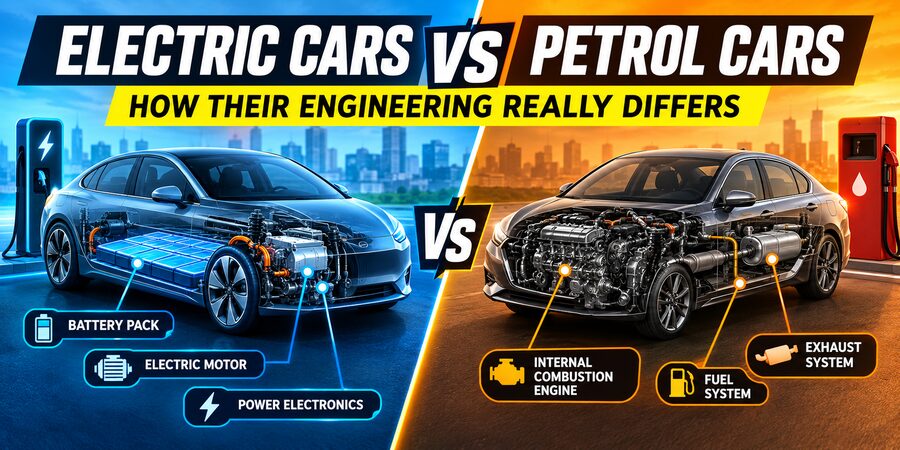

Electric cars and petrol-powered cars may look similar from the outside, but underneath their bodywork they are fundamentally different machines. One relies on electric motors, high-voltage batteries, and power electronics, while the other depends on internal combustion, fuel delivery, complex transmissions, and exhaust systems. 🔋⛽
These engineering differences affect almost everything: how the car accelerates, how efficiently it uses energy, how much maintenance it needs, how it is cooled, how its weight is distributed, and even how engineers design its structure.
Understanding these differences helps explain why electric vehicles, commonly called EVs, feel so different to drive compared with traditional petrol cars.
⚙️ The Biggest Difference: How Motion Is Produced
At the heart of every car is a system that converts stored energy into mechanical motion.
A petrol car stores energy chemically inside liquid fuel. The engine burns that fuel inside cylinders, creating expanding gases that push pistons. Those pistons turn a crankshaft, which eventually sends rotational power to the wheels.
An electric car works very differently. It stores electrical energy inside a battery pack and sends that energy to an electric motor. The motor converts electrical energy directly into rotational motion.
This fundamental difference explains many of the engineering advantages and disadvantages of each vehicle type.
⛽ How a Petrol Engine Works
A typical petrol engine is an internal combustion engine, or ICE.
Inside the engine, a mixture of air and petrol enters a cylinder. A piston compresses the mixture, and a spark plug ignites it. The resulting combustion rapidly increases pressure inside the cylinder, forcing the piston downward.
In a four-stroke engine, this process occurs through four main stages:
- Intake – air and fuel enter the cylinder.
- Compression – the piston compresses the mixture.
- Combustion or power stroke – the spark plug ignites the mixture.
- Exhaust – burned gases leave the cylinder.
This sequence repeats thousands of times every minute. 🔥
An engine therefore contains many moving components, including pistons, valves, camshafts, crankshafts, connecting rods, timing systems, fuel injectors, and pumps.
All these parts must operate with extremely precise timing.
⚡ How an Electric Motor Works
An electric vehicle replaces the combustion engine with one or more electric motors.
Electric motors operate using electromagnetism. When electric current flows through coils inside the motor, magnetic fields are created. These magnetic fields interact with permanent magnets or other electromagnetic components, producing rotational force.
That rotation can be sent almost directly to the wheels.
Unlike a petrol engine, an electric motor does not need thousands of controlled explosions every minute. It also does not require pistons, spark plugs, valves, or an exhaust system.
Electric motors can operate efficiently across a very wide range of rotational speeds, which makes the drivetrain much simpler. ⚙️⚡
🔋 Battery Pack vs. Fuel Tank
One of the largest engineering differences involves energy storage.
A petrol vehicle stores fuel inside a relatively lightweight tank. Petrol has an extremely high energy density by mass, meaning a surprisingly small quantity of fuel contains a large amount of chemical energy.
Electric vehicles instead use large battery packs, usually built from lithium-ion battery cells.
Thousands of individual cells may be combined into modules and then assembled into a battery pack. A sophisticated battery management system, or BMS, monitors factors such as:
- Cell voltage
- Temperature
- Current flow
- State of charge
- Battery health
Because batteries are heavy, the battery pack can weigh hundreds of kilograms.
However, engineers often position the battery underneath the passenger compartment. This creates a low center of gravity, which can improve handling and stability. 🚘
📦 Energy Density: Why Petrol Is Difficult to Replace
Petrol contains far more usable energy per kilogram than present-day automotive batteries.
This is one reason petrol cars can often travel long distances using a relatively small fuel tank.
Electric vehicles compensate in other ways. Electric motors are dramatically more efficient at converting stored energy into motion than combustion engines.
A petrol engine loses a large portion of its energy as heat through the cooling system and exhaust.
Electric drivetrains waste far less energy during normal operation.
This means an EV can travel surprisingly far despite carrying an energy storage system with lower energy density.
🔥 Efficiency: Where Electric Cars Have a Major Advantage
Internal combustion engines are heat engines. They rely on combustion and are limited by thermodynamic losses.
A large amount of the chemical energy in petrol ultimately becomes:
- Engine heat
- Exhaust heat
- Cooling-system heat
- Friction
- Pumping losses
Depending on operating conditions, only a fraction of the fuel’s energy reaches the wheels.
Electric motors, by comparison, can convert a much larger percentage of electrical energy into mechanical motion. ⚡
This is one of the main reasons electric vehicles can be substantially more energy efficient.
However, total environmental efficiency also depends on factors such as electricity generation, battery manufacturing, vehicle weight, climate, and charging losses.
🏎️ Why Electric Cars Accelerate So Quickly
Many people notice that electric vehicles respond almost instantly when the accelerator is pressed.
The reason is torque delivery.
Electric motors can produce strong torque from very low rotational speeds. In many designs, near-maximum torque is available almost immediately.
Petrol engines behave differently. They usually produce their strongest torque only within a particular range of engine speeds.
This is why petrol cars need transmissions with multiple gears.
An electric vehicle may require only a single-speed reduction gearbox because its motor can operate effectively across a wide speed range.
The result is smooth, immediate acceleration without conventional gear changes. 🚀
⚙️ Why Petrol Cars Need Multi-Speed Gearboxes
A petrol engine cannot efficiently operate at every rotational speed.
At very low RPM, it may not generate enough power. At extremely high RPM, it can become inefficient or mechanically overstressed.
A gearbox solves this problem by allowing the engine to operate within a useful speed range while the wheels turn at very different speeds.
Traditional petrol vehicles may use:
- Manual transmissions
- Torque-converter automatic transmissions
- Dual-clutch transmissions
- Continuously variable transmissions
These systems can contain many gears, shafts, clutches, hydraulic mechanisms, and control systems.
Electric vehicles often eliminate much of this mechanical complexity.
🌡️ Cooling Systems Are Different Too
Both electric and petrol cars require thermal management, but for different reasons.
Petrol engines generate enormous amounts of waste heat because combustion temperatures are extremely high. Coolant circulates through passages in the engine and transfers heat to a radiator.
Electric vehicles generate less waste heat, but they still need carefully controlled cooling systems.
EV engineers must regulate the temperature of:
- Battery cells 🔋
- Electric motors
- Inverters
- Charging electronics
- Power control modules
Battery temperature is especially important. Excessive heat can reduce battery life, while extremely cold temperatures can reduce charging performance and driving range.
Some modern EVs therefore use sophisticated liquid-cooling systems and heat pumps.
🔌 The Role of the Inverter
Electric vehicles contain a critical component that petrol cars do not need: the power inverter.
The battery stores electricity as direct current, or DC. Many electric motors operate using alternating current, or AC.
The inverter converts DC electricity from the battery into controlled AC electricity for the motor.
It can also reverse this process during regenerative braking, converting electricity produced by the motor back into DC electricity that can recharge the battery.
Modern inverters use high-speed semiconductor switches to precisely control motor speed and torque. ⚡🧠
♻️ Regenerative Braking: Turning Motion Back Into Electricity
One of the most interesting advantages of electric drivetrains is regenerative braking.
When a petrol car slows down, conventional friction brakes convert the vehicle’s kinetic energy into heat. That energy is released into the atmosphere and lost.
An EV can often use its electric motor as a generator while slowing down.
The moving wheels turn the motor, which generates electrical energy. The inverter sends this energy back into the battery.
As a result, the vehicle recovers some of the energy that would otherwise be wasted. 🔄🔋
This can also reduce wear on conventional brake pads and discs.
EVs still require friction brakes for emergency stops, low-speed operation, and situations where regeneration alone is insufficient.
🧰 Maintenance: Why EVs Have Fewer Mechanical Components
Petrol vehicles require regular maintenance because many systems are exposed to heat, friction, pressure, and combustion byproducts.
Common petrol-car maintenance items may include:
- Engine oil
- Oil filters
- Spark plugs
- Timing belts
- Fuel filters
- Engine air filters
- Exhaust components
- Transmission fluids
Electric vehicles eliminate many of these systems.
There is no engine oil to change, no spark plugs, no fuel injection system, and no conventional exhaust.
However, EVs are not maintenance-free. They still require attention to components such as:
- Tires
- Suspension
- Brake fluid
- Cabin filters
- Cooling systems
- Wheel bearings
- Battery systems
Because EVs can be heavier and produce strong instant torque, tire wear may also be significant depending on driving style.
🏗️ Vehicle Structure and Battery Protection
In a petrol car, engineers must create space for an engine at the front or sometimes the rear of the vehicle, along with a fuel tank and exhaust system.
EV architecture gives designers more freedom.
A common electric-vehicle platform places a large, flat battery pack beneath the floor with motors positioned near the front or rear axles.
This is sometimes called a skateboard platform.
The design can provide:
- More interior space
- A low center of gravity
- Better weight distribution
- Flexible cabin layouts
However, battery protection becomes a major engineering challenge.
The pack must be protected against impacts, punctures, water, vibration, and extreme temperatures. 🛡️🔋
⚖️ Weight Distribution and Handling
EV battery packs are heavy, but engineers can use that weight strategically.
Because batteries are usually mounted very low in the chassis, the vehicle’s center of gravity can be lower than that of many petrol vehicles.
A lower center of gravity can reduce body roll and improve cornering stability.
Petrol vehicles often have a heavy engine concentrated toward one end of the car.
Modern engineering can compensate for this, but EV platforms naturally allow designers to distribute major drivetrain components differently.
🔊 Noise and Vibration
Petrol engines generate sound and vibration from repeated combustion events, exhaust pulses, mechanical motion, and transmission operation.
Manufacturers spend considerable engineering effort reducing these effects using:
- Engine mounts
- Acoustic insulation
- Exhaust silencers
- Vibration dampers
Electric motors are much quieter and smoother.
At low speeds, some EVs are so quiet that artificial warning sounds are used to help pedestrians notice approaching vehicles. 🔈
Interestingly, the quieter drivetrain creates new engineering challenges because sounds that were previously hidden by engine noise—such as wind noise, tire noise, or suspension sounds—become more noticeable.
🧯 Safety Engineering
Both petrol and electric cars require extensive safety systems, but their risks differ.
Petrol vehicles carry flammable liquid fuel. Engineers must prevent fuel leaks and protect fuel lines and tanks during collisions.
Electric vehicles operate with high-voltage electrical systems, sometimes hundreds of volts.
EVs therefore require:
- High-voltage insulation
- Automatic electrical disconnect systems
- Battery crash protection
- Thermal monitoring
- Cell isolation systems
One engineering concern is thermal runaway, in which a damaged or defective battery cell may heat rapidly and affect neighboring cells.
Manufacturers use cooling, physical barriers, software monitoring, and battery enclosure design to reduce this risk.
🌍 Environmental Engineering Differences
Electric cars produce no tailpipe exhaust during operation because there is no onboard combustion.
Petrol cars release carbon dioxide along with other combustion-related pollutants through their exhaust systems.
However, comparing total environmental impact requires looking beyond the tailpipe.
EV battery manufacturing requires significant energy and raw materials such as lithium, graphite, nickel, manganese, and other materials depending on battery chemistry.
Meanwhile, petrol vehicles depend on the extraction, refining, transportation, and combustion of petroleum throughout their lifetime.
The total environmental impact therefore depends on the entire lifecycle, including how electricity is generated and how batteries are produced and recycled. 🌱
⏱️ Refueling vs. Recharging
Petrol vehicles have one major practical advantage: refueling is extremely fast.
A petrol tank can often be filled in only a few minutes.
EV charging usually takes longer because transferring large amounts of electrical energy into batteries must be carefully controlled.
Charging speed depends on:
- Charger power
- Battery size
- Battery temperature
- Battery chemistry
- State of charge
- Vehicle charging architecture
Fast chargers can add substantial range relatively quickly, while home charging may take several hours.
Engineers are continually improving battery chemistry and charging systems to shorten charging times. 🔌⚡
🚙 Which Engineering Approach Is Simpler?
Mechanically, electric drivetrains are generally simpler.
A petrol powertrain requires a complex interaction between combustion, lubrication, cooling, fuel delivery, exhaust treatment, and multi-speed transmission systems.
An EV removes many of those mechanical systems.
However, electric vehicles introduce new complexity in electronics, software, batteries, thermal management, and high-voltage control.
So EV engineering is not necessarily “simple” overall—it simply moves complexity from mechanical engineering toward electrical engineering, software, chemistry, and power electronics.
🧠 Electric vs. Petrol Engineering at a Glance
The core difference can be summarized simply:
Petrol car:
Chemical fuel → combustion → mechanical rotation → transmission → wheels
Electric car:
Battery electricity → inverter → electric motor → reduction gear → wheels
That shorter energy-conversion chain is one reason electric drivetrains can be so efficient.
Petrol technology has been refined for more than a century and offers excellent energy density, fast refueling, and enormous infrastructure support.
Electric vehicles offer high drivetrain efficiency, instant torque, regenerative braking, quieter operation, and fewer moving powertrain components.
🌟 Final Thoughts
Electric cars and petrol cars are not merely two versions of the same machine. They represent fundamentally different engineering philosophies.
Petrol vehicles rely on sophisticated mechanical systems designed to control combustion thousands of times per minute. Electric vehicles rely on electrochemistry, high-power electronics, advanced software, and electromagnetic motors. ⚡🚗
The shift from petrol to electric propulsion therefore changes far more than the source of energy. It changes how engineers design transmissions, cooling systems, chassis structures, brakes, safety systems, and even the interior layout of a car.
Whether future transportation becomes fully electric or includes several technologies, the engineering behind both systems remains fascinating.
One turns controlled explosions into motion. 🔥
The other turns moving electrons into rotation. ⚡
Both can move a car—but they accomplish that goal in remarkably different ways.